Download Games

Recent Posts

Showing posts with label Ann Sheridan. Show all posts

Olive Thomas and her perfect profile.


While researching this month's muse, I couldn't help but make connections between Ms. Olive Thomas and a plethora of other notable stars whose shot a fame was predicated on a random contest win. Just as Olive was given a leg up in the industry by winning Harold Chandler Christy's search for the "Most Beautiful Girl in New York" in 1914, so too would other fame-hungry hopefuls enter themselves into a hatful of names and faces for the chance of a lifetime. Winning these press gags would at the very least get them publicity, as well as assorted other prizes, but sometimes the victory too would buy them a straight ticket to Hollywood. Olive's path was less direct-- winning Christy's contest led to modeling for Harrison Fisher, which led to performing for Florenz Ziegfeld, which led to acting for Thomas Ince. For others, before the days of reality television and YouTube-- when any and everyone can become a star-- these press contests gave unknowns their time in the spotlight and also allowed already established stars the opportunity to keep their names shining. The following are those who had the gumption to take such opportunities to further their careers and eventually wind up as some of the biggest people in the biz. 


Ironically, another Hollywood beauty would have some help from HC Christy in obtaining stardom. Little, sixteen-year-old Clara Bow considered herself the least likely to succeed in anything. Growing up in Brooklyn, she somehow survived the shaky ground of an impoverished childhood, a mentally unstable mother, and an abusive father. Her release from this trauma was the movies. Her idol was Mary Pickford, and she constantly mimicked America's Sweetheart's every expression in the mirror when she came home from the latest flick. Imagine her excitement when her favorite movie magazine, Motion Picture Classic, announced Brewster Publications' "Fame and Fortune Contest" of 1921. On the hunt for the next great screen beauty, young female contestants were asked to send in two photographs of themselves, which would be judged by the artists Christy, Fisher, and Neysa McMein, along with Mary Pickford herself! Clara didn't have the money to get the photos taken, and her alcoholic father, Robert, performed perhaps the only kind act of his life in giving her the dough to get some taken. Clara wasn't happy with the results, but dropped them off at the contest manager's office anyway. He was immediately impressed, and left a note on her photos to the higher-ups that she had stopped by in person and was quite a looker. (The left publicity photo of Clara would appear in Motion Picture Classic to replace her cheaper entry pics).


Before Clara knew it, she was in the top dozen finalists and was called to Eugene Brewster's home for a screen test. Among the other girls, Clara was out of place. With her dismal wardrobe and third class upbringing, she immediately felt  like an outsider. The other gals confidently strutted before the camera and played out a scene in which they had to pretend to talk on the telephone; the shy Clara silently stood back and watched. Finally, her turn came. Instead of putting on airs, she decided to play the scene as herself-- not as an act, but as she would really do it. Her natural energy transferred, and she made it into the top two slots! She finally got up the nerve to tell her mother, Sarah-- who promptly fainted and then told her that she was going straight to Hell. Yet, in three days time, Clara received the call that she had won! Her picture appeared in Motion Picture Classic in Jan. 1922, and she was promptly summoned to Hollywood for her first film: Beyond the Rainbow. Her career should have ended there, but her innate charisma and gift at relaying honest emotion eventually made her Hollywood's "It" girl. (Clara rolls in "it," right).


1921 was clearly a busy year for talent scouts. At the same time Clara was answering the "Fame and Fortune" ad, Samuel Goldwyn was hosting his own "New Faces" hunt. (Ironically, almost as soon as the contest ended, Goldwyn was booted from his own company, but that's another story...). In the meantime, scout and former vaudeville star Bijou Fernandez was put in command of finding the newest male and female stars. The usual process followed, and a motley assortment of youths sent their photos for consideration. If attractive enough, they were called for a screen test, and eventually were signed to contracts at Goldwyn. It was a prime opportunity for any kid, especially someone like the wiseacre William Haines-- who had a zest for life but no specific ambitions. Legend has it that he was walking down Broadway when Bijou serendipitously spotted him and said, "I like your face" (see why, left). Billy responded in kind: "So do I, but it ain't mine." At her insistence, he entered the contest, having photos taken in probably the only nice suit he owned, and eventually wound up winning! His female counterpart was, unlike Billy, already an actress and a very driven one at that. Eleanor Boardman was a lovely, hard-working model when she saw this chance at a career boost. Naturally ambitious and talented, there are legends about her too, (such as the one involving her performing in the show The National Anthem, only to lose her voice half way through, and still pull off her performance completely in pantomime). After she and Billy made their screen tests, they were awarded contracts at the studio, and they rode out to Hollywood on a train together in March of 1922. They became fast friends and remained so for the rest of their lives. As two young hopefuls, they would both surpass and expand upon their own dreams. How could Eleanor have known that she would soon be Mrs. King Vidor, nor Billy that he would be soon be named Hollywood's Number One star?


Eleanor Boardman: gifted, glamorous, gorgeous.


The contests continued in 1922, but this time for different reasons. By now, Cecil B. DeMille (right) was one of the biggest directors in Hollywood-- big in professional stature, big in story, big in budget. Yet, after the success of The Squaw Man, Why Change Your Wife?, and Manslaughter, he was ready to top himself. In addition, he wanted to find out what the public was really in the mood for. So, on October 8, he ran an ad in the Los Angeles Times asking movie fans to write in ideas for his next film. The winner of the most creative story would receive $1000. In addition to keeping his name in the papers, Cecil used this cash reward press trick to both endear his audiences to him and keep his finger on the pulse of the nation. While reading through the multiple entries, he came across a letter from Mr. F.C. Nelson of Lansing, MI who wrote: "You cannot break the Ten Commandments-- they will break you." Finally, a worthy challenge! A religious man, Cecil was naturally drawn to the idea of exploring this Biblical moment, not just for the moral message, but because he already had dazzling images, set designs, and multiple taudry scenes dancing through his head. Mr. Nelson had hit the nail on the head; Cecil had his winner. However, he felt bad for the seven other people who, it turned out, had also sent in the Ten Commandments as a suggestion. To be fair, he sent all seven of them $1000 checks as well-- as always, a spendthrift. The Ten Commandments would be released the following year, and it remains just as startling and brilliant. For its time, and even today, the parting of the Red Sea is nothing to sniff at (thanks to the special effects of Roy Pomeroy, some gelatin, and gas jets).In effect, the contest spawned another contest-- one between Cecil and Cecil-- for he would decide to top even himself when he remade his own classic with Charlton Heston in 1956.


Jumping forward to the 1930s-- movie contests remained in full swing. This time, Clara Bow's home studio Paramount was about to feature another star-maker competition. Ironically, another Clara would win. Clara Lou Sheridan had absolutely no interest in acting. In fact, she was something of a tom boy who preferred working on cars to shopping. Nonetheless, her beautiful visage and curvaceous body made her a reluctant candidate for modeling-- despite the gap in her two front teeth, which she refused to fix. Her sister noticed that Paramount was featuring a "Search for Beauty Contest," the winner of which would receive a contract and a role in a major motion picture. Clara's picture was forthwith placed in the mail with the other contestants. Rumor has it that the deciding judge, flooded with so many photos, was having some trouble making up his mind on the winner, so he started throwing the pictures up into the air. Clara Lou's continued to appear face up when it hit the floor, and because she was a looker, she won the big prize. Signed to a one year contract, much to her chagrin, Clara Lou started making the rounds in B-pictures that showcased her beauty. After the year was up, she transferred over to Warner Bros, who made much better use of her earthiness by making her one of their many sexy-dames-with-an-edge. Cynical and direct, the newly named "Ann" Sheridan fit the Warner roster like a hand in a glove. Soon, she had gained enough popularity to earn the nickname she too would loathe: The "Oomph" Girl (see left). Maintaining her down-to-earth demeanor, the Texan girl always had a sense of humor about her random career change and the whole Hollywood biz. When asked later about the photo toss that won her her contract, Ann quipped, "Yeah, and I've been on my back ever since!"  


Lucille LeSueur would not achieve fame through a contest win; she got where she was going with a pinch of luck and a whole lot of grit and determination. However, a magazine contest too affected her life. Lucille had always had an inner drive and wanted nothing more than to distance herself from her turbulent relationship with her mother and her depressing childhood. Getting notice at a young age for her good looks, she got early work on the stage as a dancer, and she traveled around quite a bit in various shows. In time, she was discovered by a scout and subsequently landed a contract at the illustrious movie factory, MGM. It was here that she became pals with William Haines, who by now had taken to his new career path and was a huge screen star. Having mastered the art of film acting, Billy took Lucille under his wing and taught her how to play the part of the star on and off camera. After some minor roles and extra work, it was time for Lucille to renew her contract, but LB Mayer had a stipulation: he wanted her to change her name. He thought LeSueur sounded too much like Le-Sewer. At first, Lucille wanted to go by Billie Cassan, the name of the step-father who had shown her her only childhood warmth and whose vaudeville career had also introduced her to acting. In fact, all of Lucille's close friends already called her "Billie." However, Mayer didn't like it. Instead, to boost her public appeal and find an answer to the name question, he had the publicity department start a competition to find her a new one. On August 18, 1925, she received her new moniker: Joan Crawford (right). She was not happy. "It sounds just like Crawfish!" she complained to Billy. "Oh well," he quipped back. "They might have called you cranberry and served you every Thanksgiving with the turkey." (In the end, the contest got the new Joan Crawford two new names: thereafter, Billy always called her "cranberry"). Her first role as JC was with another JC, Jackie Coogan, in Old Clothes. Her new name soon became old hat, and twenty years later Joan Crawford would make the ultimate win, becoming an Academy Award winner for Mildred Pierce in 1946.

MENTAL MONTAGE: And the Winner Is...

Marilyn Monroe: The last movie star and the only performer
who could inspire a 52-foot replica of herself in Time Square.

I'm calm, okay? But... has the world gone mad?!?! Too often of late, I have gone to the movies, more out of habit than out of actual inclination, only to be disappointed. Dismally. Do I care about what I'm watching? No. Am I interested in what's happening? No. Do I relate to the actors on the screen? No, no, no. There is much flash, but little substance. Much "pretty," but no gritty. Recycled stories and themes and modus operandi have left me feeling like Malcolm MaDowell in A Clockwork Orange, with wires holding my eyes open while a series of the usual images plays on a loop: fire, tits, and spaceships. Riveting. It seems ironic that in the days since we liberated ourselves from the manufacturing mania of the Studio System, our films, stories, and celebrities seem to be more contrived, convoluted, and schmaltzy than ever. How did this happen, and why God why do we keep continuing the madness instead of nipping it in the bud? Pardon me while I ruminate:

The movies are based upon one thing: communication. As an early art form, the excitement of cinema was its availability. Unlike the Mona Lisa, a piece of legendary art that sits forlornly at the Louvre in Paris-- where sadly the majority of the world will never go-- the movies are not, nor have they ever been, elusive. Every class, every color, every creed, every language in every region of the world had access to a moving piece of the human discussion. For a nickel (Man, those were the days), even the most impoverished American could afford a seat in a world that offered limitless possibilities and continuous entertainment. As a nation, as a species, we were all invited to bask in our dreams, which the movies taught us that we all shared. Cinema thus became the great unifier--a small innovation of science that slowly grew into a medium through which art could recreate man in the flickering image of himself.

Man's first Trip to the Moon in 1902.

We chose early on those few reappearing faces that we would trust with such a responsibility-- those who did it better than anyone else and spoke to us and for us with an ease we could depend on and luxuriate in. And they were real people, just like us-- most of whom were inexperienced nobodies simply looking for a job and willing to make buffoons of themselves for the latest quack invention. So, out of nameless faces were born Mary Pickford, Douglas Fairbanks, Lillian and Dorothy Gish, William S. Hart, and Rin Tin Tin. For a decade or so, we tinkered with the camera until we developed ways to tell compelling and cohesive stories. D.W. Griffith, Tod Browning, and King Vidor were but a few of the pioneers guiding us to an authentic and emotional world. But always, there was an underlying truth. As the studios developed and moguls started building corporations out of the little art-form-that-could, things changed. The system was manipulated but still remained grand. With the talkie revolution, we latched onto newer stars, manufactured though they may be-- less real than those with whom we began. Hollywood's world became a little more glamorous. But, while we got to lavish in the splendor of the movie musical or the beauty of Ann Sheridan (right), still there was a gravity beneath the facade. While the publicity boys cranked out fake stories about the histories and present lives of a new breed of star, we were able to forgive the inaccurate polish of the film magazine covers, because we knew, once again, that the stars were just like us. Though, perhaps a little bit bigger and a little bit better. The performances we saw on the screen too echoed our own sentiments, apprehensions, and angers. Watching Clark Gable or James Cagney elbow their way through their film scripts as tough guys, bruisers, and sometimes overgrown children, permitted a mass of trampled on and confused people to exhale in a universal catharsis.

As WWII waged on, films, particularly those coming from MGM, started to become a little too predictable-- a little too sweet, a little too perfect. While, during the war years, these films served their purpose, a post-war return to normalcy required film personalities who better resembled the normal, average American. The pristine image of the nuclear family and the whistling down the apple blossomed streets of Andy Hardy weren't going to cut it anymore. Once again, we cried out for realism. Our prayers were answered by the Method actor: Marlon Brando, Montgomery Clift, Kim Hunter, Maureen Stapleton, Eli Wallach, Paul Newman and Joanne Woodward, (both left) etc, etc, etc. The rise of the "true" actor over the "movie star" came right at the collapse of the studio system and acted as a bridge to carry us over into a new generation of cinema; a new generation of human interpretation. Suddenly, a great divide between old-Hollywood and new-Hollywood took shape. The raw ferocity of the modern actor, devoted to telling the Truth, the whole Truth, and nothing but the Truth, had to contend with the much adored yet fading alumni of the nostalgic studio era. Those who were most beloved could make it over the hurdle, either because they were naturally ahead of their time in terms of characterization-- like Katharine Hepburn or Gary Cooper-- or because they were willing to unlearn their old tricks for the new game of authenticity, like Marilyn Monroe.

Marilyn Monroe is the last great movie star. The biggest movie star. She represents both the heights of studio produced star power and the transition to the actor star. She stands too as the greatest sacrifice of such an alteration, falling into the strange and indescribable black abyss between the "movie personality" and the "true artist." Though there were large names and memorable faces to follow hers, Marilyn alone stands as our great Christ symbol: she paid the price of stardom and sacrificed herself for our love and respect. What we responded to in Marilyn was not just her beauty but her genuineness. When people describe her as being likable for her vulnerability or her innocence, what they are truly referring to is her humanity. We loved her because she was larger than life and real-- a goddess you could reach out and touch. Marilyn's sadness was somehow always palpable, always present (as seen right). Whereas I am always in awe of the way Rita Hayworth could draw the shade and hide her inner sorrow from her screen performances, Marilyn could not do the same. Initially, she made a concerted effort to mask her complex nature behind her star-making doe-eyed stares, the sensuous movements of her mouth, or her infamous walk, but despite this, little Norma Jean was always there. Later, she used her personal torments and fears, the things that she had originally fought to disguise, to deepen her acting and her performances. She became the star who could act, and our love of her only increased when the little girl she had kept masked behind her caricatured performances was let loose into more complicated and interesting roles. The full-fledged, unadulterated, massively contrived, and absolutely magnificent movie star, thus, died when she did.

And where are we now? We never truly re-embraced the movie star. The Method actor film identity pretty well carried itself through the 60s, 70s, and 80s. The personified bridges of John Garfield and Marilyn led to Brando and Clift, to De Niro and Streep (in Sophie's Choice, left). Bold films, soul-searching work, and socially provocative filmmaking enjoyed a hey-day. There were always the little token candy films, but they were overshadowed by Baby Doll, The Graduate, Taxi Driver, One Flew Over the Cuckoos Nest, etc. In a society undergoing such turmoil as HUAC, the Vietnam War, the Korean War, and the Kent State shootings, there were plenty of questions to ask, plenty of statements to make, and plenty of Hell to raise. Our movies were reflections of our own rebellion, our own quest for truth, deliverance, and maybe even peace-- learning to love, or learning to fight. Then, under the overly optimistic period of the 80s and the 90s, we were at peace enough in ourselves to let go of this angst. Again, we shunned truth and started asking for, at long last, a respite: entertainment. Thus the birth of the action star-- Tom Cruise, Arnold Schwarzenegger, Harrison Ford-- the comedy star-- Tom Hanks, Meg Ryan, Julia Roberts-- and the provocative star-- William Hurt, Michael Douglas, Kathleen Turner, etc. There was a bonus, because not only were these names and faces huge, inspiring us and taking us on journeys of imagination and heart, but the majority of them could act. Win-Win, as they say.

Now, as these names and faces age and our stars become relics or shocking jokes-- ah, Mel, why'd ya do it?-- we are left in a kind of artistic limbo. Predicting the next societal trend on the tried and true taste cycle of authenticity-glamour-authenticity-glamour, it appears that we are due for another bout of authenticity. Our solution? Reality Television. Our fault as a creative society is that we have failed to find a new way to push the envelope. How much better can acting get than what it has become? Can you beat Marlon? No, but you can find him in Daniel Day-Lewis. Aesthetically we are at a stalemate as well. How many new ways can you find to blow something up? Not many. The car chase was doomed after Steve McQueen rocked our world in Bullitt. Our solution to our thumb-twiddling in conjunction with the corporate "more is more" mentality is to just make... more: more of the same things that make money and more of everything in general. More graphics, more special effects, more sex, bigger guns, thinner women, bigger boobs, etc. (I mean, don't even get me started on that topic. The mere fact that a woman's body has become little more than an apology, tits on sticks if you will, is enough to make me rant on in a blog marathon). More, more, more. Forgive me Avatar fans, but though the movie had its merits, it was in the end just a giant visual experiment. Like too many films today, art was the excuse and not the agenda. It was a mind-blowing aesthetic achievement with a green story tagged on. But what else could Cameron do? He literally had to create a new world because this one is tired. How else could he expand on old methods? We're stuck my friends. Stuck.

Avatar: box-office bonanza starring... technology.

Thus, we have no one to look up to. So many faces, so many names, and none of them stick. No one matters. There are too many venues! This isn't the silent era: one theater in town and one or two releases a week, presenting a minimal chance at seeing a familiar face on the screen. This is YouTube, and NetFlix, and reality TV, and every schmo with a camera making a movie and posting it online. "Movies" are everywhere and made by everyone. Some angst ridden teen can post a ranting monologue about their day and how much homework "sucks" and get 5 million hits. We live in a world where someone named Snookie, Snookie for Chrissakes, gets more press than rising stars like Olivia Wilde or Andrew Garfield. In effect, modern narcissism has killed the movie star. We don't want to worship anyone, because we want to be worshipped. And we can be. Got a camera on your Mac? Record yourself, upload, done. You can sit back and watch yourself all day. Lucky you. Lucky universe. And don't even get me started on Facebook. Geez. I mean, I'm as guilty as anyone, uploading pictures, updating my status, but does anyone really care where I am at this second? Am I that important? Maybe I should Twitter that I'm eating a muffin right now. That's sure to impact a lot of lives. How important can one person be? And if I see one more teenage girl holding her camera at arms length and taking a picture of herself in sexy face, I'm going to scream. Or punch her. (Again, win-win). Don't worry sweetie, you're profile pic is super hot. Now, can you put your vanity away long enough to read a book? We are sick. As a society, as an industry, we're sick. If The Social Network-- the only socially significant movie made this year-- doesn't win the Academy Award for Best Picture then, well, I don't know what. I will probably tear my eyes out like Oedipus and throw myself down the Santa Monica steps.

Of course, this modern self-absorption all stems from insecurity. In comparing ourselves with the stars we (used to) adore, we fall short. We're too short, in fact; too fat, too ordinary. We feel compelled to become the images we see; to make the two-dimensional image in the mirror reflect the two-dimensional images on the magazine rack. Newsflash: that makes you two-dimensional too. Pretty, but pretty lifeless. When did it became a crime to be a human being? Aging is criminal. Flaws are criminal. We want to be stars! And guess what, now we are. We've turned the cameras around on ourselves to capture the purest brand of realism, feeding our insatiable need for glamour by becoming our own glamour-pusses. But everyone can't be a star, for the very idea makes such a thing obsolete, which leaves us with one conclusion: there are none. Not even the ones on TV or in the movies. There is no idolatry. There are occassional adolescent crushes, (Twilight, right) but there is no life in the movies, only death-- the decay of a once proud frontier. We continue perpetuating the issue instead of diagnosing the disease and curing it. I don't even go to the movies anymore because I want to. I go out of habit. Me. The lover of all things celluloid. Things are bad, people. Bad. Movies aren't magic anymore; they're manic, because studios are too desperate to sell, and we're so desperate we'll buy anything.

I used to think that movies were things of beauty. Now they're just things. This isn't about wanting to return to the perfect illusion/delusion of the studio days, but moreso to reconnect with the integrity of the human race. Nothing is being said anymore, because we have nothing to rebel against, rally for, fight for. Perhaps we're too safe. Our economic "depression" is nothing in comparison to the depression of the '30s. The dark, tormented characters that once reflected our own paranoid and conflicted natures are not present in today's cinema. Our ongoing "war" overseas is not one that unifies the community nor is it one that anyone seems to comprehend. There is no finite goal-- stop Hitler and his madness!-- and a call to arms is likewise vacant in movie theaters. In essence, it seems that nothing is really going on, and what is going on no one understands. So the questions is, is there too much chaos to sift through and we've given up, or are we actually sitting pretty and have no need to communicate the same angst as our forefathers and mothers? The suffragist movement, segregation, and genocide are at least hypothetically problems of the past. We're more concerned with waistlines, cup sizes, and the accumulation of stuff. If cinema is a reflection of its current society, it is no wonder that today projects a mish mash of blah blah blah. We're brain dead. We're in serious need of a wake-up call. It's literally raining dead birds on us, but meh... whatevs. The result of this is our need to invent cataclysmic conflicts via ad nauseum zombie movies, alien invasion movies, or the invasive 3D movies of late (barf aka please make this gimmick stop). We are desperate to be shaken up before our intellects forever pay the forfeit. Why not take this confusing and deceptively unproblematic time to push ourselves artistically? Why read US Magazine when you can read poetry? Why write smut when you can write prose? Why rehash the usual visual stimuli when you can provide an accurate description of our current world? Have we truly run out of things to say?

All I can say is, I'm sad. And I must admit that I am scared too. This Hollywood is not the same one I signed up for nearly six years ago when I made the voyage from Cincinnati to Los Angeles. Something has changed. I don't think we should have to sacrifice beauty, nor controversy, nor conversation to make a buck, particularly when the, I'm sorry, but "crap" I see being made doesn't compel me in the slightest to throw down $12 for a movie ticket. And, oh boy, trying to be an actress in this industry right now is like trying to swim in the Sahara. We're worth more than this. So, what are we afraid of? If Hollywood knew what was good for it, it would take itself apart brick by brick and start over. Return to the simplicity of the human heart, the human soul, and human nature in general. I feel like the Hollywood Wendell Berry, and it says alot when someone like me would rather churn butter than go to the damn theater. We're trying too hard. You don't have to search for intrigue; you don't have to use a lot of flash to gain attention. Today's directors are making a mistake. They aren't so much filmmakers as they are master manipulators, working out their own fantasies and obsessions on the screen, thus committing the ultimate betrayal: instead of holding a mirror up to society, they hold one up to their own egos. Insightful directors with distinct visions and voice-- the Coen Brothers, Quentin Tarantino, and Danny Boyle-- are too few and far between. Self-absorption has killed unity. Has killed community. Not only are we cut off from our own humanity-- apologizing for ourselves with plastic surgery-- but we're cut off from each other-- texting and not speaking. How do we expect the movies to talk to us if we can't even talk to each other?

In Kill Bill, Quentin Tarantino shows his love of film by paying tribute to and 
expanding upon multiple genres, such as Japanese Samurai films, 
Westerns, and even Anime.  

I don't know how the future generation will evolve and grow, how the industry will change in the coming years, but I pray for a renaissance. I hope to one day go to the theater and find myself so moved by what I see that I start applauding as the credits roll. Maybe I can clap myself back to life like Tinker Bell. Maybe we all can. While celebrity is a killer, it also serves a purpose. Our film and our stars didn't just give us something to look up to or aspire to, but they taught us to relate-- to look outside ourselves and find the beauty in others. I was not alive when Marilyn was. But I still miss her. And I'm angry that she's gone because, in some ways, I feel that the things that killed her are the very things currently controlling us. Excess. Politics. Desperation. Corruption. Abuse. Bull sh*t. Instead of drowning in pity for our departed martyrs, we should recognize the things that ended them. We should find a way to make an old thing new. We will never run out of stories, so let's stop telling the same ones over and over again. Let's stop selling ourselves short. Or selling ourselves period. Is this a completely outlandish concept? Am I alone? Am I the only person at the parade who notices that the Emperor isn't wearing any clothes? And who the Hell do I text "STOP" to get out of here?

A rock and a hard place: Marilyn is bookended by history's King of the Studio
 era, Clark Gable, and the Prince of the new Method, Monty Clift, in The Misfits.

PERSONAL NOTE: YouTube Killed the Movie Star

The empire of Hollywood was built to meet public specifications. We've been spoon-fed love stories, crime capers, and whatever plot seems to suit our current appetite.  Keeping us happy can be quite a racket, and the best of the best like Louis B. Mayer and Adolph Zukor have made millions off predicting our next craving. However,  changing attitudes make the American mind difficult to read, and more than one box-office flop has been made when the big-wigs guessed incorrectly. Just as certain films become surprise hits, different stars also unpredictably climb to fame. Certain actors that were never supposed to make it still manage to capture our attention. When Meryl Streep auditioned for 1976's King Kong, she overheard Italian producer Dino de Laurentis say to a colleague: "She's ugly. Why did you bring me this thing?" Little did he know that this brainy lady could speak his language fluently and understood the jab. While Dino predicted that Meryl didn't have the looks to charm the infamous ape, she still managed to become the most beloved and respected American actress of her generation. Here are a few more cases of the Man in Charge being Wrong as Hell.


When Douglas Fairbanks (left in The Three Musketeers)came out to Hollywood in 1915, the established thespian was placed in very prestigious company. Now working with The Triangle Film Corporation, he was in the prime position of being directed by D.W. Griffith, Mack Sennett, and Thomas Ince. However, the first filmmaker, who was working out of his Fine Arts Studio at 4500 Sunset Blvd, was less than thrilled to be dealing with the overly energetic actor. Griffith would say of Doug: "He's got a head like a cantaloupe and can't act." Now, Doug was never referred to as classically handsome, but his manic charisma endeared fans to him nonetheless, and he went on to star in some of the most epic and technically accomplished films of the silent era. Griffith must have changed his mind about Mr. Pep, whom he later teamed up with to form the independent studio United Artists (along with Chaplin and Mary Pickford).


Fred Astaire received a similar response from a studio executive. When trying to pave his way in the film industry, Astaire struggled. Despite his extreme talent, he was slight of frame and did not possess those typical, leading man looks. No one saw his potential. After an early screen test, the jury was in: "Can't act. Slightly bald. Also dances." The money men were looking so hard for stars that they failed to see one in their midst! No matter, Freddy would do all right. What he lacked in stature, he made up for with indescribable, incalculable presence... And moves!


Some of the handsomest men of their day were also originally flooded with negative feedback. Clark Gable (barely recognizable in the left photo) is still referred to as the "King of Hollywood." Even today, women find themselves falling in love with him. During his hey-day, he could and did have nearly any woman that he wanted, but no one would have predicted that when he first started out. An awkward, Ohio boy, he was a bit of a physical anomaly. "Attractive" wasn't the first word used to describe him, especially with his two gold-plated front teeth, which he constantly had to paint white! When making a screen test for Little Caesar, Darryl F. Zanuck was underwhelmed: "His ears are too big. He looks like an ape." With a little help from the miracle workers at MGM, who fixed Clark's teeth, gave him polish, and cut his hair to hide his protruding ears, Clark would have the last laugh.


Even Rudolph Valentino was shunned when he first arrived on the scene, and today he is revered as one of the most powerful sex symbols of all time. Rudy's problem was a little more complex. Due to the bias against different immigrant groups, including the Irish, Chinese, and Italian, Rudy of Castellaneta was not the prototypical American dreamboat. Italians for the most part, with their darker skin and features, were seen as untrustworthy, even insidious. This made it hard for Rudy to break into the pictures, and he was originally cast in villainous, unsavory roles-- thieves, con artists, and charlatans. No one expected much from him, including (once agan) D.W. Griffith, who said: "He's too foreign looking. The girls will never like him." Seems like D.W. should have stuck to making stars of his women; his taste in men couldn't have been more off! It was exactly Rudy's "foreign-ness" that would make him a huge, dangerously sexual superstar.


The women had a lot to put up with in regard to their appearances, of course-- probably much more than men. In addition to being sized up by studio moguls, who were more concerned about going to bed with an ingenue than casting her in a movie, young women in Hollywood were pinched, powdered, bleached, stuffed, and pushed in front of the cameras with scanty wardrobe. Many were completely made over once the star system was in full effect, becoming unrecognizable transformations of their former selves. There were some sassy ladies that resisted it though, including the following:


Jean Arthur was never comfortable with her appearance. When sizing herself up with other leading ladies of the day like Rita Hayworth and Marlene Dietrich, she felt she didn't quite measure up. Perhaps this was one of the reasons she began dyeing her naturally brunette hair blonde. Studio magnate Harry Cohn was inclined to agree with her reservations, declaring: "D'ja see her face? Half of its angel, and the other half horse." Thankfully, the horse-side must have been invisible to the camera, because audiences never saw it, nor did David O. Selznick, who was madly in love with Jean for quite some time. Despite her insecurity, Jean dug in her heels and decided to prove that she was just as much of a woman as the next hot body. Not only did she refuse to go to bed with the notoriously lustful Cohn, but she made him eat his words. Jean's earthy, soft, and natural beauty became part of her eternal appeal.


Another feisty lady that refused to be bullied was the Irish spitfire, Maureen O'Hara. When first landing in Hollywood after having some success in London, there were a lot of grumblings from the higher-ups. It may come as a shock, since Maureen seems like such a classic beauty, but at the time a lot of argument circled around her nose, which was considered too big. It was delicately suggested that she get a nose-job to make her face more palatable to the movie camera, and thus the movie-going public. This time, it was Maureen who would have the last say: "My nose comes with me. I've got a big square face, and I need my big nose. If you don't like it, I'll go back where I came from." With that kind of passion and strength, it is no wonder that her hot-tempered Mary Kate Danaher of The Quiet Man was so believable. The nose stayed with Maureen, and Maureen stayed in Hollywood, thank Heaven!


The prey of the Hollywood racket seems to come in three categories: the Pawns, the Players, and the Rebels. The metamorphosis of Norma Jean Baker to Marilyn Monroe, both body and soul, still raises the question, "What Price Fame?" Marilyn was sadly a pawn. When Norma Shearer was refused the lead in The Divorcee by her own husband, because she wasn't "sexy" enough, she proved her sensuality by having sultry photos taken. Irving Thalberg readily recanted his refusal, and Norma got the role and the Academy Award as a result! Norma was a player, and she loved the game. As for the rebel category: one actress arrived in Hollywood with a gap between her two front teeth, which she refused to fix. It was part of her and who she was. Instead, she wore a cap in her mouth for all of her films and publicity photos. This was her way of showing that while the cameras rolled, she was Ann Sheridan of Hollywood, but on her own time, she was plain ol' Clara Lou from Texas. 


Ann Sheridan... Ain't nothin' wrong with that.


At the end of the day, it didn't matter how gorgeous a person was or how many categories they hit on the list of Movie Star Must-Haves. The "X-factor" wasn't found in a face, it was found buried within-- that uncanny quality that radiated from certain blessed individuals and reached out to their audiences. This is why, while people may have wanted to shun Valentino, Fairbanks, or O'Hara at first, they were forced to bow down in humility when the public showed them their error with box-office receipts. Jean Harlow was more than her luscious curves; Gary Cooper was more than a pretty face. Clara Bow may have risen to fame by winning a magazine beauty contest, but she wouldn't have maintained her status if not for having "It." It is only in believing in the long-shots and the unique individuals that true gold is found. People want to be shown something they've never seen before. I mean, you've seen one Barbie Doll, you've seen them all. But Clark Gables? They don't come around every day...


There's the Clark we know and love!!! Haha.


MENTAL MONTAGE: With a mug like that?!


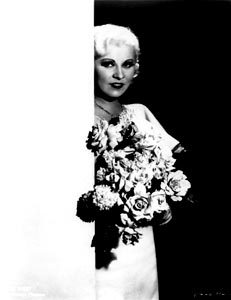
Casting the pivotal role of Norma Desmond in the noir masterpiece Sunset Boulevard was no easy task. What Billy Wilder and the rest of pre-production knew was that they needed a woman who could play, not only a former actress, but a symbol of all that Hollywood represented-- at its best and at its worst. Norma had to be over the top-- the classic diva who had fallen under the spell of her own delusions-- but she also had to carry within her a torrent of pain. The performer would likewise have to be brave enough to go before the camera, warts and all, and show the world the remaining carcass of a once proud beauty. Though far from decrepit, for the latter reason, Mae West (left) turned the role down. She had a rep to protect after all!


Mae may have seemed like a shoe-in, living in her own "Miss Havisham"-like palace at the Ravenswood Apartments where, in her land of pink and white satin, time indeed seemed to stand still. Mae had no qualms about showing her self-love and pride in her work, which could have transferred over well into a character who still sat around watching her old movies. But therein, the comparisons stopped. Mae's sole purpose in life was to bring joy and laughter to her audiences. Thus, playing a broken down, has-been turned  murderess was definitely out! Mae also would not have liked the idea of playing such a raw and emotionally dependent heroine; her ladies were tough as nails and knew there were plenty of Joe Gillises in the sea. So, the part more appropriately went to the incomparable Gloria Swanson (right), who threw herself so ferociously into the role of the silent film spider-woman that people would forever confuse her with the character. No shrinking violet, Gloria wasn't afraid to be dark and dangerous, and her unapologetic portrayal of the disturbed and love ridden femme fatale provided a remarkable bookend to a sterling career and, some say, the first era of film.


Mae's stamp still remained on the finished product, however, even if only in a small way. It turns out that she inspired the presence of Norma's pet chimp and thus the brilliant references in the film to Joe Gillis as Norma's monkey. Mae herself had a monkey, (as well as a house boy, if you refer to her companion Paul Novak as such), and Wilder found the inspiration too good to pass by. Who can imagine Sunset now without that fantastic monkey funeral???

Joan as the ultimate Mommie Dearest alongside Ann Blyth

Speaking of Noir... The classic Warner Bros. film Mildred Pierce rejuvenated an anxious Joan Crawford's dwindling career. After making the switch from MGM, Joan failed to impress at the box office, and the grand Madame feared that her days as a leading lady were numbered. When she heard of this vehicle, she lobbied hard for it, thinking it was a magnificent role and one that would put her back on top. Her stubborn elbowing and arm twisting eventually got her way, and her hard work and nuanced portrayal of a martyred mother won her the Academy Award. She was not always a shoe-in, however. When negotiations between her and the studio broke down before filming, the role was offered to another leading lady, Ann Sheridan (below), but she turned the role down. Had Ann said, "I do," it would have made for a very different film, for the laid-back, country girl was a far cry from the hell-bent and ambitious Joan. In the end, Ann didn't feel the part was right for her. Mostly, she was terrified of the daughter character, Veda, whom she deemed too horrible to be believed! No matter. She went on to make her own film noir, Nora Prentiss, two years later.


While Joan won the Mildred victory, she did lose a few here and there. She very nearly became the woman forever making love to Burt Lancaster on the beach in From Here to Eternity, but in the end those waves came crashing down on the refined, English actress, Deborah Kerr (left). Joan had caused too much of a ruckus by insisting that the film be shot with her preferred cameraman, and the studio heads finally put their foot down. Instead, they turned to Kerr, who would be playing against type in the role of Karen Holmes, the adulterous army wife. The casting gamble worked, for the fact that Kerr didn't quite fit in with her surroundings made her portrayal of the disgruntled and unhappy woman ill at ease with her place in life all the more compelling. The movie helped to crush her good-girl image and opened up more varied roles in her future.

The Eternal Beach Scene


 When Bette Davis (left)was first offered the role of Margo Channing in All About Eve, she thought it was a joke. Darryl F. Zanuck put in the call to Davis himself, but because the two had an ongoing feud and had not spoken in years, Bette thought the call was a prank from a friend. She played along, mhmm-ing and uh-huh-ing with an eye-roll, until it slowly dawned on her that she was indeed speaking to Zanuck! In shock, her tone changed completely. She agreed to read the script, which she adored, and said "Yes, yes, yes" to the role. 

By coming on board, Bette saved the picture, which had been put on hiatus because of the failure to secure the lead. Zanuck had at first wanted Marlene Dietrich, but director Joseph L. Mankiewicz didn't feel that she was right for the aging Margo. After all, Marlene did not age. Instead, he put his confidence behind the fabulous Claudette Colbert (right), who was thrilled to be offered the part. However, a back injury took her out of the running, although losing the part probably hurt more. In any case, every director under the sun warned Mankiewicz not to work with Bette, claiming that she was the most difficult of all film divas. Only William Wyler congratulated him on his coup, having worked with Bette on films like The Little Foxes. She was, he insisted, the ultimate pro. Wyler had it right, for Joe and Bette hit it off and had perfect chemistry on the set. Little ideas like giving Bette the container of chocolates to play with in the big party scene added even more layers to her incredible performance. Bette credited Joe with revamping her career. I guess it takes a genius to know one.

Ah, the magic of perfect casting...

CAST-AWAYS: Part Three