Download Games

Recent Posts

Showing posts with label Carole Lombard. Show all posts


Marlene, as an extreme personality- here in Blonde Venus-- 
was practically begging to be caricatured.


The struggle for fame and celebrity in Hollywood is a continual one. Even when someone has a few films under his belt and has a somewhat familiar face, the work that goes into maintaining his star status and position is more difficult than the public can ever imagine. Therefore, it naturally follows that no celeb is ever comfortable on his pedestal, which at any moment may topple. If he takes a break to blink, his moment may be over forever. From the outside, it looks easy, but to the one swimming upstream, it is impossible to ever utter the words, "I made it!" There is one tell-tale sign, however, to intimate that one has evolved past the cluster of "working actors" to the realm of bona fide "star," or perhaps even to the land of "legend." If you're popular enough to be mocked, heavily referenced, or flat-out imitated, you may have finally surmounted the curve. Today's stars can look forward to a lambast on "SNL" or "South Park," but before the days of television, there were only movies. Here are some stars who were big enough to be [mocked] in pictures.


The most obvious example is the hilarious haranguing of this month's muse, Marlene Dietrich, by one of the Queens of Comedy, Madeline Kahn, in Blazing Saddles (left). Mel Brooks's lampoon of the Western genre was derived from many classic films, including Dodge City, but the reference to Destry Rides Again never becomes more obvious than when Madeline takes the stage as Lili Von Schtupp. "Lili," one assumes, is a reference to one of Marlene's classic songs, "Lili Marleen" and "Schtupp" to... well, that's one Yiddish word everyone understands, I think. Madeline's every mannerism as Lili is clearly taken from the assertively sexual "Frenchy" that Marlene portrayed in Destry, and Madeline's impression of Marlene's accented speech is too humorously exaggerated and aped: "Oh, a wed wose..." Nothing is so spectacular as her rendition of the original song, "I'm So Tired." Her comedic expertise makes the performance more than a hammy imitation, it is genius. With Gene Wilder's so-quick-you'll-miss-it gun draw and Cleavon Little's confident and sly portrayal of the west's first black sheriff, there are few moments for one to draw breaths between laughs during the film, but it is Madeline's Marlene that takes the cake. As Marlene was still alive when the film was released, one wonders at her reaction, if she even saw it. Another screen beauty, Hedy Lamarr, gets a "shout out" as well, since Harvey Korman's character is named "Hedley Lamar." However, Hedy was not flattered, and sued Mel Brooks for what she considered to be the gross use of her name.


Another great parody comes via Carole Lombard in The Princess Comes Across. This screwball comedy is a mish-mash of mystery, murder, and maritime love. Carole portrays actress wannabe Wanda Nash who, in order to conceal her identity, pretends to be a Swedish princess (Olga) on her cruise to America, resulting in a lengthy, pitch-perfect send up of none other than Greta Garbo. From the moment Carole appears as Olga, beautiful, glamorous, and aloof, there is no question as to whom she is imitating. Her distant, irritated poise and uber-European accent-- "Dis is verry annoying..."-- draws an instant comparison to the eternal, gorgeous hermit who only wanted to "be alone." Of course, Carole is at her best when the mask comes off and her abrupt Brooklyn character has time to rant and fuss about the stress of maintaining her hidden identity and dealing with all those dead bodies that keep piling up on deck. A romance too ensues between Olga/Wanda and bandleader King Mantell, portrayed by a constant Carole co-star, (there's an alliteration for ya'), Fred MacMurray. Greta's very anti-social, dramatic, enigmatic, and slightly egotistical persona made her an easy person to duplicate, but through Carole's comedic expertise the likeness is exquisite (see right). With that special Carole stamp, we have a character who is part elegant and part kooky. For one great Hollywood screen goddess to portray another is superb, and the divide between the easy-going, deviant manner of Carole versus the otherworldy iciness of Garbo is both clear and divine.


In the film Monkey Business, Groucho, Chico, Zeppo, and Harpo Marx all used their singing skills and slight physical resemblance to Maurice Chevalier to comic effect. On yet another seafaring voyage, the four brothers are stow-aways (see left) who cause the usual amount of Marxian chaos and girl-chasing on their way to America. Groucho woos Thelma Todd, Zeppo befriends a pretty passenger, and Harpo and Chico step in as the vessel's very under-qualified barbers, all while evading capture and the anger of one very miffed gangster. After they make it across the Atlantic, they are left in a quandary: without passports, they will  be unable to disembark. Luckily, they swipe an ID from a passenger who coincidentally happens to be the Maurice Chevalier. One by one, they take turns offering the passport to the authorities, who of course doubt their identity. Forced to prove themselves as the French crooner and Lothario, they each sing the Chevalier classic, "You Brought a New Kind of Love to Me," only to be denied access to American soil for their very poor impersonations. Ironically, the deliberately mute Harpo comes closest to victory, as he lip syncs the verses to a recording strapped on his back, but a slight malfunction botches his liberation as well. However, as in all things Marx, all's well that ends crazily, and hats off to Maurice for the honorary mention.

A very direct homage was paid to everyone's favorite ghoul, Boris Karloff (right), as well. "Arsenic and Old Lace" was a play penned by Joseph Kesselring in the early '40s. The plot revolved around two lovable old ladies who perform the benevolent service of murdering old, lonely men past their prime-- somewhat akin to the way the Eskimos set their elder community members adrift, or so I've heard. Their plot is discovered by their nephew, Mortimer, who is in the midst of possible matrimony. As if the shock of blood on his sweet aunties' hands isn't enough, he too has to combat an uncle who thinks he's Teddy Roosevelt, and his brother Jonathan, another murdering criminal, who returns home with a new face to hide his identity. Unfortunately, the doctor who performed the plastic surgery was intoxicated during the operation, and Jonathan came out looking like... Boris Karloff. Of all the horrifying faces to be trapped with! Audiences totally responded to the joke, which obviously runs throughout the entire play. Of course, the real clincher was that Boris Karloff was playing the role of Jonathan himself! Sadly, for various contractual reasons, Boris was unable to participate in the film version of 1944, which starred Cary Grant as Mortimer and the capable Raymond Massey stepping in as the facially mutated Jonathan. Since the play and the film made Boris even more immortal than he already was, I suppose he had the last laugh.


Sometimes, in the quest for stardom, one starlet makes it over another by a hair. This was definitely the case with Veronica Lake, whose iconic 'do (left) made her a sensation in her own day and keeps her a legend in ours. Ronni's hair was her "thing," just like Marlene was known for her gams and Jimmy Durante was known for his schnoz. Articles were written about her mop's hygienic upkeep and daily grooming regimen, public service announcements for safety were made with her hair used as a prop, and countless jokes were made at her expense. Possessing a good sense of humor, Ronni took the jests in kind. After all, they only helped to boost her appeal. If it took her mane to keep her in the mainstream, then so be it. Yet another reference to her famous tresses was made in Billy Wilder's first directorial effort, The Major and the Minor. Ginger Rogers, in yet another case of hidden identity, runs into trouble when she cannot afford an adult train ticket, which causes her to pose as an adolescent for cheaper fare. Unfortunately, she gets mixed up with, and sexually attracted to, fellow traveler Ray Milland while in disguise and winds up at his military academy still portraying a precocious pre-teen. Forced to attend a junior dance, she encounters a room full of young women who "all think they're Veronica Lake": cue camera pan to a row of seated girls with their faces half-covered in hair. It is a priceless guffaw that is typical of Wilder's comedies. Not only was it a fantastic gag at the time, but this small, hilarious reference also places it firmly in its timeline when modern viewers watch it today.


Speaking of sexpots... Marilyn Monroe topped them all (right). Her star power would be exemplified ad nauseum during her life, as it continues to be in her death, but interestingly it too was brought to life via Jack Lemmon. The two had worked together in the film Some Like It Hot, and while the consummately professional Jack was a little put off by Marilyn's at times erratic behavior, he could not deny her inexplicable charisma and warmth, which in the end gave him a soft spot for her. A year later, now as one of Billy Wilder's favorite actors, Jack was given the leading role in The Apartment opposite Shirley MacLaine. Acclaimed for its comedy and sympathy, it in a way reunited Jack with his conflicted friend when one particular scene pays homage to Marilyn-- although, since Billy too worked with Marilyn, this was a way of professionally tipping his hat to her screen power despite their post-Hot feud. Early in the film, Jack's C.C. Baxter is called by work colleague Joe Dobisch (Ray Walston), who is in a frenzy, because he just picked up a girl and has nowhere to take her for a sexual rendezvous. Since Baxter's apartment has become the go-to for cheating spouses, Joe asks for the use of his digs. When Baxter begs off so he can rest, Joe becomes adamant. The girl, he insists, is exceptional: "She looks like Marilyn Monroe!" With that, how can Baxter refuse? He gives up his room so that his work superior can live out every man's fantasy-- or at least as close as a guy like him will ever get. "Marilyn" and "Monroe" were apparantly the secret passwords.


Marilyn co-operated in another public celeb kudos earlier in her career when she starred in How to Marry a Millionaire, however Lauren Bacall rightfully maintains the bulk of the credit. The movie, of course, is about three lovely but struggling young women (Lauren, Marilyn, and Betty Grable) who are Hell-bent and determined to marry well to rich men. In the film, Lauren befriends the elder but always gentlemanly William Powell, who resists her advances due to their May-December age gap, yet later decides to court her in earnest (see left). In doing so, the other two gals question Lauren's choice-- he is old after all. But, Lauren rebuffs their quips by making an example of all of the handsome older men in the world: "I've always liked older men. Look at Roosevelt, look at Churchill. Look at that old fellow what's-his-name in The African Queen. Absolutely crazy about him!" In this case, the crack wasn't just business, it was personal, for in real life Lauren was already married to Queen star Humphrey Bogart-- her senior by nearly 25 years. One imagines he found the cinematic joke hilarious and, of course, appreciated the extra publicity.


Lauren Bacall enjoys a day off with her "old man."

MENTAL MONTAGE: The Sincerest Form of Flattery

A "boo-tiful" Clara Bow gets in the mood for the Holidays.

This year's tasty greeting of chilly tidings from L.A. La Land comes in the form of the Hollywood Ghost. Just as silver screen souls continue to flicker on long after their deaths, so too do movie stars continue to haunt us in our own waking lives. Apparently, even though fate long ago called "cut," the following immortals choose to keep on living, mugging their way through the after-life, and maintaining their scene-stealing ways. Supernatural celebrity sightings have become almost as sought after as the living kind, and with accumulating stories of ghostly encounters piling up, avid fans often make it a point to visit the places their favorite, famous ghouls continue to haunt. Of course, it could all be tommyrot-- myths and legends built up over time in order to keep our idols close to us-- but then the similarities in various accounts are often a bit too startling to ignore. The locales that various celeb spirits continue to haunt is very curious and definitely indicative of who they were in life. Having never come face to face with a spirit, I can only imagine the exciting, frightening adrenaline rush a lucky (or unlucky) witness gets when encountering the eerie remnants of one they have grown to admire. Whether the fear outweighs the awe all depends on the person.


The Homes:


Errol Flynn (right) was referred to as the "Baron of Mulholland" because of his lush pleasure palace (situated at 7740 Mulholland Dr). The stories of his debaucherous parties and shenanigans are legendary. Though many stories of this Tasmanian's deviltry have been grossly over-exaggerated, the architecture of the building definitely suggested his notorious naughty side: from two way mirrors, to a front door that was really the back door, to wall murals with hidden sexual connotations, Errol always had a way of blending his keen aesthetic eye with his boyish sense of humor. But this home was more than a focal point for Hollywood parties-- it was a symbol of Errol's success, the struggles he had overcome, and the familial comforts he always sought but had trouble either finding or accepting as truth. He adored his home, which he filled with his carefully chosen, masculine decor and his beloved Paul Gauguin painting, "Famille Tahitienne." He surrounded himself with things that made him feel safe and secure; things that made him feel at home. Rumor has it that he did too good a job, for future tenants and guests would occasionally catch a glimpse of the mansion's former master.


The most interesting stories of Errol's continued residence ironically include another Hollywood heartthrob, Ricky Nelson, who moved to the address in 1977. Apparently, Ricky was a fan of the notorious lecher, and got a kick out of it when he had encounters with him. He and his family, including daughter Tracy, were constantly experiencing disturbances, such as loud banging sounds and lights turning on by themselves. One night, Tracy arrived home late. Looking toward the house, she happened to see a male figure staring out the dining room window. She thought it was her father, but when she went inside, she discovered that he was not home. When Ricky called not much later, Tracy asked him about the visitor, to which Ricky replied: "Oh, that's just Errol." After Ricky died in a plane crash in 1985, his surviving family drew the conclusion that Errol had been causing these disturbances to warn his roommate of the upcoming danger. Ricky didn't get the message. After Ricky's demise, the presence allegedly got more menacing. Thus far, there has been no word from Justin Timberlake-- who currently owns the property-- if any other odd occurrences have transpired. Since the original structure was demolished after Nelson's ownership and a new structure built, chances are slim that Errol has stuck around.


Ricky Nelson: soul brother of Errol Flynn.


Rudolph Valentino was equally proud of his Benedict Canyon home at 1436 Bella Drive, which he dubbed Falcon Lair (right) in honor of the unfulfilled film project The Hooded Falcon. The house was a grandiose expression of Rudy and wife Natacha Rambova's notorious passions and exotic tastes. The decor ranged from the oriental to the medieval, and the property housed plenty of room for Rudy's horses and dogs. Rudy became a homebody as he matured and preferred sitting at home by the fire to going out on the town. His home gave him the peace and quiet he needed. Of course, after Natacha left him, the house was also inhabited by bitter memories. Rudy's death in 1926 was a sudden, shocking event to fans and perhaps even moreso to himself. Merely thirty-one years-old at his expiration, Rudy still hasn't accepted the fact that he's dead, and there have been multiple accounts of his presence at his once beloved den. He appears most often in his bedroom and in the former stables. He too has given visitors a creep when they see him peering down from a second story window. Doors are also known to open and shut of their own accord. (George Reeves has also been known to saunter through the halls of his "suicide" house at 1579 Benedict Canyon Drive, ironically wearing his Superman costume, which he continues to bear as his own cross).


The Cemetery:

Some too have reported seeing the ghost of Rudolph Valentino at his gravesite at Hollywood Forever Memorial Park's Cathedral Mausoleum. Strangely, he is often reported as wearing his most famous costume: that of the Sheik. And he's not the only one roaming the stones at this cemetery. Some too claim to see the spirit of the infamous "Lady in Black" still visiting his grave site, as she did for several years until her own death. Also, on the edge of the lake, situated under a large tree, is the grave of Virginia Rappe (left)-- the woman notorious for crying "rape" against Fatty Arbuckle at the St. Francis Hotel in 1921, simultaneously ending his career and Hollywood's pristine image. Virginia actually died from what most scholars now agree was the effects of a botched abortion, which Fatty had nothing to do with. Nonetheless, her death was a tragic one, and the sound of her sobbing can often be heard near her gravestone, where she certainly cries for the film career she never had, the loss of her young life, and the baby she killed. Clifton Webb also has been spotted by his grave in the Abbey of the Psalms Mausoleum. Tucked down a claustrophobic corridor, the eternal man of etiquette, best remembered as Mr. Belvedere, lies in a simple plot indiscernible from his neighbors, identified only by his name. Having suffered through a complicated relationship with his mother as well as a lifetime of meticulously hiding his sexuality from the public, his restless spirit continues to hover about his final resting place. More than one visitor to the this section of the mausoleum has spotted a man in a finely tailored suit and a well-cultivated mustache walking toward them from the far wall, only to disappear as he comes too close for comfort. (Marilyn Monroe has also been reported to visit her own grave across town at Westwood Memorial).


Clifton Webb: still making a statement.


The Corner:


The famous intersection of Hollywood and Vine has also strangely been momentarily possessed by Ghosts of Hollywood's past. A bench that used to sit at the Northeast corner of the intersection was often occupied by a presence many identified as Lon Chaney. Chaney often sat at this very spot during his younger days, awaiting the bus to take him to the studios where he fought against the other hungry extras for work. As famous or as wealthy as he became, it was these lean years that always remained with him: painful years one can never fully shake off. In the future, after he had achieved success, he would pass this bench on his way to work and offer other struggling actors a ride. For years after his death, people would claim to spot him sitting at the stop, and in time the bench was even dedicated to him (see right, with son Lon Chaney Jr in top left). However, it was eventually (and unfortunately for fans) removed, and with nowhere to rest his weary bones, Lon has been seen no more. (At least not there... There are also accounts of him showing up in his Phantom garb at Stage 28 at Universal Studios where he filmed his most famous role in The Phantom of the Opera). Bela Lugosi also had an interesting moment at Hollywood and Vine... while on the way to his own funeral. Toward the end of his life, the actor was constantly taking long walks down Hollywood Boulevard, often stopping to chat with local merchants whom he'd come to know on the trek to purchase his beloved cigars. During his funeral procession,when the hearse passed through this intersection on its way to The Holy Cross Cemetery in Culver City, the driver temporarily lost control of the vehicle, and it swerved toward Hollywood-- though this route was not on the agenda. Many believe Bela was hoping to stop for one last stogie. 

Bela while appearing on Broadway as Dracula: both his
greatest friend and foe. He would be buried
in his cape.


The Restaurant:


Thelma Todd is known to prowl around her former Sidewalk Cafe (left), now home to Paulist Productions, at 17575 Pacific Coast Hwy. A cheerful, easy-going gal in life, the "Ice Cream Blonde's" appearances are never menacing, and her apparition is simply observed moving from room to room or perhaps descending the staircase. The garage where she was found dead, slumped behind the wheel of her car above the cafe at 17531 Posetano Road, also continues to experience disquieting quirks. When Thelma's body was discovered, the car's motor was still running, and the death was initially ruled a suicide by carbon monoxide poisoning-- despite the fact that her face had been clearly beaten in. The structure now appears much as it did when Thelma was alive. It was here that she always parked her car before coming down the long steps to her apartment, which was above the cafe. Today, the Posetano address belongs to another owner who-- as last reported-- uses the garage space for storage. Still, some nights, strange sounds emit from the belly of the house, including the faint sound of a motor running. Some have also recounted the scent of exhaust fumes.


The lovely Thelma in a tragic final photo.


The Hotel:


Clark Gable and Carole Lombard are still remembered as one of Hollywood's favorite golden couples (right). Carole's humor served to lighten the serious Gable's mood, and Gable's stubborn, little-boy-lost mentality induced Carole to mature (at least partly) into a loving housewife. They seemed to be made for each other, and enjoyed their blessed but simple life on their Encino ranch. After Carole's life was cut short on January 16, 1942 in a tragic plane crash, Gable was devastated. Many said that he was never the same; the light in his eyes had gone out. He would survive the love of his life by 18 years, which included two other marriages, until he was finally laid to rest beside her at Glendale Forest Lawn in 1960. However, it is not here that the two reside. Many people claim to see the duo continuing to enjoy dinner and cocktails in the lounge of one of their favorite "haunts": The Lady Windemere, now (The Georgian Hotel at 1415 Ocean Ave, Santa Monica). Various employs have entered the lower level restaurant, formerly a speakeasy-- and thus named "The Speakeasy"--after closing, to find it very much still occupied by a beautiful blond and her handsome partner. However, when they announce that serving hours are over, the figures simply disappear into thin air. (At least they know when to make an exit). In addition, the sounds of disembodied gasps, laughs, or voices saying "Good Morning," are often reported. Clark and Carole may not be completely responsible. This hotel was patronized by many, including Bugsy Siegel and Rose Kennedy, and was popular for its beauty parlor and barber shop as well. (The Roosevelt Hotel is also famous for its plethora of ghostly guests, including Monty Clift and his incessant trumpet playing, Marilyn Monroe's primping in her former mirror, and a mysterious presence and cold spot in the Blossom Room-- home to the first Academy Awards celebration).

"The Speakeasy Room" at The Georgian Hotel-- just imagine the happy
couple in the corner booth.


The Inexplicable:


Carole did a little more haunting on her own. While alive, she became close chums with upcoming comedic ingenue Lucille Ball (right). The two had much in common, including incredible beauty mixed with bawdy humor. Lucy, like many, was crushed by the news of Carole's death, and she missed her friend greatly. There were times she wished that she had Carole's ear to confide in. She particularly craved Carole's sage advice to guide her when things got rough and she felt her career slipping away. When the opportunity to do "I Love Lucy" came up, Lucy was skeptical. Television? Should she do it? What if it tanked? What would happen to her career!?!?! Anxious and full of nerves, she went to sleep, wherein she had a dream that Carole paid her a visit and said: "Honey, go for it!" Lucy listened, awoke, and went on to become the most famous television personality in history. Perhaps, in her sleep, her subconscious simply took the form of her beloved friend; but, perhaps Carole sensed a friend in need from the other side and decided to make a special trip and send a helpful message. Lucy too would go on to a future performance as a ghost. She would allegedly haunt her 1000 North Roxbury Drive home on its last day in existence. While the house was being destroyed, a passer-by happened to catch a glimpse of a flaming red-head wandering around the property. She shook her head, pacing, seeming deeply upset at what was being done to her former abode. She then disappeared around the South corner, never to be seen again... except on the boob tube. 


The Theatre:


To cap off her month as L.A. La Land's star, is Olive Thomas's preternatural tale. Olive (left) called The New Amsterdam Theatre in New York home during her years as a Ziegfeld Follies girl. These were very exciting, important years in her life, which is perhaps why-- after her death-- she chooses to return here rather than Hollywood for her occasional visits. Olive has been seen wandering the building, apparently soaking in memories of past times. Sometimes, she is in her typical, jolly mood; other times, she seems overcome with sadness. On rare occasions, she seems peeved and starts a ruckus. One employee recalled making his rounds on the stage when he surprisingly shined his light on a woman dressed in old-fashioned clothing. He thought she had merely gotten locked in, but when he called to her, she simply smiled, blew him a kiss, and disappeared. When he later compared his vision to a photo of Olive Thomas, he grew pale: it was the same girl! Mostly, Olive appears to men, continuing her worldly flirtations with impish grins and friendly greetings, often calling, "Hey, fella!" She once scared a worker away permanently when she appeared and said, "How are you doing, handsome?" His vanity was not flattered. Olive grew anxious when renovations began on the theater, allegedly becoming more vocal and wandering aimlessly in plain sight. She too has a jealous streak. When reunions involving the surviving Ziegfeld girls occur at the theater, Olive causes some serious shaking of the sets and even makes various light bulbs burn out-- simultaneously. She always appears gloriously bedecked, sometimes even wearing a sash that says "Olive," and at other mournful times, she can be spied carrying a champagne glass-- even the spirits indulge in spirits. She too walks in mid air at an area upstairs where the removed glass walkway used to be. To her, it is still there. It appears that the employees who have the courage to stay have grown accustomed to Ollie and her continued performances, often calling out "Good Morning, Olive" when they arrive in the morning and bidding her goodnight when they leave her alone in the dark with nothing but the stage's "ghost light" to keep her company.


The notoriously spooky Vincent Price lightens the mood with a bit of
dancing while filming The House on Haunted Hill.


In life, nothing is black and white. Does it not, therefore, make sense that there is not simply life and death? That there is a strange shade of gray that serves as a home for those who cannot choose a side? Our Gods and Goddesses of black and white movies seem to think so. Just as on the silver screen, they flicker on, continuing their intangible but effective presence in the world of us normal, living souls. Perhaps, to them, we are putting on the show as they exist behind the scenes, watching and observing, enjoying entertaining passion plays performed by those so unaware. Or maybe they simply continue on as if they never left, soaking in their happiest or most profound personal moments, unable to let go and unaware that they already have. Then, there are those who seem compelled to ham it up, to penetrate that thin screen between actor and passive audience, and jump out and say "Boo! I'm still here." Attention-hungry fame hounds are never satiated. Are our film players still playing with us? Putting on a show for their own amusement? Or are they simply lost and unable to make their final exit? Maybe it would be easier for them to bid farewell if we let go of them. As it is, we continue to be enamoured, hypnotized, and equally haunted by the stars who touch our lives, even after their own have ended. As we invoke their spirits every time we pop in a DVD, it should come as no surprise that they remain close to us. Until we ask them to go, they really have no reason to depart.

Halloween Spooktacular II

Everett Sloane, Joe Cotten, and Orson Welles cook up a plot in Citizen Kane.
Didja notice Orson's fake schoz? He wore them often, because he thought his
own nose was too small and demure.


Chapter Two of Random Factoids: enjoy!


The Real Rosebud


The great mystery of Orson Welles's Citizen Kane was the elusive "Rosebud." After all the ensuing drama, the character recollections, and the unwrapping of a complicated past, the last word of Charles Foster Kane is revealed as the name of his boyhood sled (left). When the bulk of Kane is whittled down, the audience is left to see that this small seed from a lost childhood is responsible for the maladjusted growth of the mammoth CFK. However, behind the scenes, there too was much controversy surrounding Rosebud. For years-- as the plot of the film was based at least in template on the life of William Randolph Hearst-- it has been gossiped that "Rosebud" was actually the nickname that Hearst prescribed to his mistress Marion Davies's nether regions. While this could quite possibly have been a fortunate (or rather unfortunate) coincidence, the truth is much simpler. Citizen Kane was the brainchild of Welles brought to life by the writing talents of friend Herman Mankiewicz. As such, pieces from both of these men's private lives found their way into the film, such as Orson naming one of the characters "Bernstein" after his mother's lover, Dr. Maurice Bernstein. The true Rosebud was similarly contrived: Orson received a sled from his beloved Todd School upon his graduation, marking the true end of his childhood-- not that he ever indulged in its innocence or naivete-- and Mank', as Orson called him, had a bicycle when he was a boy that he named... "Rosebud." By uniting these two youthful memories, one of cinema's most referenced plot devices was born. If Ms. Davies too shared the moniker, which cannot be confirmed or denied, it was thus by complete happenstance.


Obie, Camera, Action!


Every great actress knows that  the real man to make friends with on the set is the cinematographer. Carole Lombard and Marlene Dietrich were both staunch students when it came to lighting and angles, and they always knew how to hit their mark to look their best. Merle Oberon would too get a little education in this arena. She, like Lombard, was in a near fatal car crash in 1937, which left her face scarred. After painful surgery and recuperation, she returned to the screen, but covering up the new blemishes on her face was a daunting task. Luckily, while filming the 1944 remake of The Lodger, (right) she fell in with cinematographer Lucien Ballard. Ballard worked diligently to create a camera light which, when placed directly beside the camera, shined light directly onto her face and eliminated the appearance of her scars. Appropriately, he named his invention after her: The Obie. In gratitude, Oberon promptly married Ballard and enjoyed a fruitful career. (Coincidentally her first husband was Alexander Korda, the ambitious English producer who tried and failed to make many projects with Star of the Month Orson Welles over the years, including War and Peace).


Great Faces, Greater Minds


On the subject of inventions... It comes as no surprise that many screen performers are multi-talented. Especially in the early days, one had to be particularly well-rounded to make it, so that he or she could be thrown into any role-- drama, musical, or comedy-- and come out swinging... or singing. However, we also have a crew of film stars that should be acknowledged not just for their physical gifts but for their mental proclivities. It turns out that some stars aren't only lookers, they're thinkers, innovators, and even... inventors??? Did you know that: the first film star, Florence Lawrence, invented an early form of the automobile turn signal? It was comprised of two arms, which, when signalled, would drop to indicate which way the driver was turning. She sadly did not obtain a patent and thus missed out on the cash reward of such a novel idea. Zeppo Marx too was a very interesting man. Always tinkering with gadgets, the ex-actor/sometimes agent became an engineer. He started the Marman Products Company, Inc. in 1941 and helped the war effort by producing clamping devices and straps. He also developed the first heart-rate pulse monitor! Perhaps the most shocking-- to those who don't think that beauty and brains can come in the same package-- Hedy Lamarr (left), who had been previously married to an arms merchant, used what she had gleaned from him to make an invention of her own. She created a "frequency hopping" device to be used with WWII torpedoes in order to avoid signal "jamming" by the enemy. Sadly, although she did obtain a patent, the US Military never put her invention to work. Still, she must have been proud to do her part.


Don't Let the Heels Fool Ya'


Ann Miller was one tough cookie in her youth. In addition to her great dancing talent, she too possessed a fierce determination. This created quite the ambitious young lady, and her great work ethic would serve her well in the industry. It definitely helped her grab gigs opposite both Fred Astaire and Ginger Rogers. In 1937, Ann was already chomping at the bit to get to work, and when she had the opportunity to work opposite Ginger Rogers in the film Stage Door she was willing to do whatever it took to do so... Including lie. Only 14-years-old, Ann fudged four extra years and made herself eighteen! Whether or not the big-wigs believed her is unknown, but then they were probably too distracted by her lengthy stems to notice any discrepancies. Thus, the lanky youngster got her way and was cast as "Annie." She proved her mettle again when she was given the chance to dance opposite Fred Astaire. She was ecstatic about working on the project Easter Parade with him, and was devastated when she suffered a severe back injury-- aka her husband at the time pushed her down the stairs. (Real gentleman, that one). This should have taken her out of the running, but Ann wasn't about to give up the chance to waltz with her hero (see right). So, she worked overtime to get in shape and had the doctors strap up her back for the dancing sequences. The process hurt like hell and often left her in tears, but when the camera is on you never see it. What a pro.


Call of the Wild


Sound engineers rarely get their due. Ever since the talkies came screaming in with their sounds, squeaks, and squeals, a whole new arm of the filmmaking body had to be born to carry the weight. It's not always as easy as "Roll sound, record dialogue." Creating the proper atmosphere within a film requires a mind sophisticated or creative enough to combine a variety of noises into an underlying track. It's like writing a often barely audible symphony. Some of this sonic tinkering is more obvious, such as in explosions, sirens, gun shots... or jungle howls??? Believe it or not, coming up with the now iconic yowl of Johnny Weismuller's Tarzan for 1932's Tarzan the Ape Man was no easy feat. Audience imagination previously had to interpret his animalistic battle cry for the 1918 silent film version, but the addition of the mic made things more complicated. The point was to make his cry distinctive without making it laughable; make it palatable to the ears without making it either too passive or too threatening. There have been many theories over the years as to how the mammalian screech was made, including combining Weismuller's voice with the growl of a dog, a soprano trill, a violin, and a hyena. But the simplest version may perhaps be the most true: Johnny screamed, Douglas Shearer recorded his voice, the yell was enhanced, and then played backward. So, when you hear Tarzan howling for his Jane (with Maureen O'Sullivan left), he's actually screaming in reverse! Who knew Tarzan was fluent in palindrome?


(Another interesting note on this infamous yell was Johnny Weismuller's ability to use it as a "get out of jail free" card. He claimed that during the time Castro was preparing to take over Cuba in 1959, he was traveling with friends through Havana on his way to a celebrity golf tournament. His car was ambushed by rebel soldiers, and the only way he could prove that he was neither Cuban nor a threat was to tell them he was an American movie star. To prove it, he let out his Tarzan howl. They recognized it and gave him safe passage).

Didja Know: Part II

Bob Hope performs for the boys in Sicily, 1943.


For a brief period, film existed solely as a pure artistic venture blended with scientific innovation. Almost immediately, this sanctity was corrupted by business, which both heightened its possibilities and tangled its intentions. Cinema as a propaganda device was always forthcoming, but despite the expected birth of celebrity product endorsements, the most influential collision of stardom and salesmanship didn't occur until the Great War. The different ages of American War have revealed themselves in various ways through our movies, but perhaps the most interesting moments occurred not in the later rallying, reactionary cries of the Vietnam or Korean Wars, but in the earlier calls to arms of WWI and WWII. This equally paranoid and frightful time produced in Hollywood a profound moment of unity, patriotism, and brotherhood. On the screen or behind the cameras, an attitude of "One for all, and all for one" reigned supreme. The movies of the day were used to relay this message, as did its stars, who for once proudly took a back seat to the Stars (and Stripes) of the American Flag. Though contention and doubts did exist, an indestructible, unified front was always presented, which was perhaps simply due to the source of the battles being waged-- particularly the genocidal WWII. In a continuing celebration of Independence Day, here is a look back the impact of war on Hollywood, and the impact of Hollywood on the war.


While the Revolutionary War called upon a young and insecure landscape to defy its tormentors (and sometimes its own inhabitants) in order to proclaim itself a union, and the Civil War pitted brother against brother when incongruous versions of scruples and ethics threatened to tear the country apart, The Great War was entered into willingly by a freshly healed and newly thriving society. Its effect would render America not only unarguably the most powerful nation in the world, but-- as it was the lone combatant to emerge without war torn soil-- it too would rise victoriously as the film capital of the world. During a period of low economic peril that would lead to the euphoria of the roaring twenties, the strength and positivity of the nation was echoed loudly through its silent film players. Most memorably, Mary Pickford, Douglas Fairbanks, and Charlie Chaplin would embark on a tour selling war bonds (left), using their popularity and charisma to maintain and enhance the country's participation in the movement. The films of the time showcased their dedication, such as Mary Pickford's The Little American, which put America's Sweetheart right in the throes of German atrocities. The picture was passionately directed by Cecil B. DeMille-- a strong supporter of both the war movement and the armed forces-- who had in fact established the Home Guard, via Famous Players-Lasky, as its Captain when the war began in April of 1917. Yet, it is Douglas Fairbanks who was perhaps most indicative of American patriotism at the time. Healthy, virile, in incredible shape, and possessing both an optimistic spirit and a zest for life-- which, if canistered, could probably have provided enough energy to power a large city for 100 years-- "Mr. Pep" was the era's masculine ideal. He proudly made several short propaganda films to get his brethren in the spirit of battle, such as Swat the Kaiser and Sick 'em Sam.


Chaplin too did a great deal to express his feelings about the war, but as a more calculating aesthete and a true humanitarian, his efforts most often revealed themselves through his own compelling work. The strongest statement he ever made about war came about prior to WWII in his defiant, tragicomic masterpiece The Great Dictator (right). While many remained blind to or even embraced the shocking new stratagems of Adolf Hitler during his rise to power, Charlie always remained aghast, dismayed, and disgusted by the Fascist's lunacy. When Hitler's administration mutated into abject madness, Chaplin was not surprised, and The Great Dictator became his impassioned wake up call to America. The artistry of the film remains pure poetry, yet at the time its honesty was under-appreciated: Hitler banned it in Germany and all other Nazi-occupied countries. It was the presence of Hitler, recalled quite accurately as one of the most crazed and demonic beings to ever live, that propelled Hollywood more emphatically into its support of the war, making WWII even moreso than WWI an interesting period to look at cinematically. While it was a Japanese attack that pulled America directly into battle, it was Naziism that more accurately identified the threat of the times. Yet, after the tragedies and losses of the Great War, there was a still a hesitant skepticism about entering into another foreign battle. Not surprisingly, most early support was coming from British actors like Laurence Olivier and Vivien Leigh, whose homeland was already suffering graphic actualities that America was only theoretically pondering. Then, the eternal day of infamy arrived at Pearl Harbor and erased all doubts. America went to war with a vigor that has yet to be matched.


A very vocal spokesperson at the beginning of America's entrance into WWII was Carole Lombard (selling bonds, left). Everyone's favorite and most beautiful kook definitely had a serious side when it came to Life, Liberty, and the Pursuit of Happiness. She gave her staunch support to the cause and went on a nationwide war bond tour for which she was able to raise over $2 million in one day. Her shocking death while on her way home from this tour had a great impact on the American people in general but most specifically on her Hollywood friends. Jack Benny couldn't even bring himself to perform his radio show when he heard the news. Respectfully, Carole was awarded the Presidential Medal of Freedom by FDR and given the notoriety of being the first woman killed in the line of duty. Carole had been prodding husband Clark Gable to enlist since before the war even began, but he-- fearing that he was not cut out for it-- had demurred. After her death and in honor of it, he did indeed enlist and, as many in his regiment would attest, started volunteering for the most dangerous missions. While fighting, he wore a locket containing the last remnants of his beloved wife: a few sparse pieces of her jewelry collected from the crash site.


Clark was not the only member of the Hollywood community to serve heroically. A large portion of the male actors fought, including Douglas Fairbanks, Jr (who enlisted before war was even declared), Henry Fonda, Glenn Ford, Robert Montgomery, Tyrone Power (right), David Niven, Alan Hale, Mickey Rooney, William Holden, etc. Jimmy Stewart, who had to sweet-talk his way into the war (due to the fact that he was underweight), would become the most decorated actor to ever serve his country. Directors like John Huston, George Stevens, and Frank Capra too contributed by going overseas and filming raw footage, which was subsequently compiled for newsreels and war documentaries. This is not to imply that these fellas were blithely fearless. The old paranoia remained, which is perhaps why Jack Warner, fearful that his studio would be misconstrued from the sky as an army base, had "LOCKHEED" painted on the roofs in large, bold letters. However, the war department demanded that he have the label removed. This was an obvious overreaction on the mogul's part, but there was reason to worry. War is a very real thing, after all. Leslie Howard became another Saint of the cause, joining Lombard, when he and sixteen others were shot down by the Germans when flying over the Bay of Biscay.


The women also did what they could in terms of entertaining the troops, participating in war bond rallies, and making public service announcements and war propaganda advertisements. Veronica Lake (right) participated in a memorable campaign that persuaded women to wear their hair up at the factories, where so many females were seeking employment during the war effort. It turns out, too many of their copied, peek-a-boo hairstyles were getting caught in the machines! War was about social fusion not fashion! (However, it could be argued that this was a mere publicity ploy to publicize Paramount's latest, sexy star). Actresses too encouraged their sisters to ration supplies, including their precious silk stockings. Rarely recalled, as well, is the fact that a young Audrey Hepburn was a courier for resistance fighters in Holland at this time. 


However, there were some men who were unable to serve due to various injuries, ailments, or simply their age. If these reasons were explained thoroughly enough by the press, the public forgave the trespasses, but there was occasional, savage hostility directed at the men whose absence from the front identified them as cowardly or emasculate. Errol Flynn irritatingly received a 4F classification from the army-- a crushing blow to such a screen hero-- due to the ravages of past and recurring illnesses. His lung was marred by an unmistakable shadow-- an effect of TB-- and he too suffered recurring bouts of malaria. There also were alleged problems with his heart, though it was only after he was refused entree into the army that it was truly broken. (He does his part for the effort in The Dawn Patrol with David Niven, left). John Wayne was too left out of the loop due to an old knee injury, and Van Johnson's recent car crash and head injury extricated him from combat. Left at home, these boys carried on the tradition of screen heroism, and their careers boomed as Hollywood churned out more and more patriotically themed films.


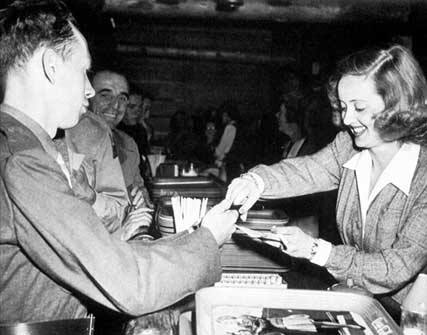
John Garfield was another macho guy, ironically left behind due to his weak heart. Frustrated by inactivity, he yearned for a way to do something special for the war effort. He decided to team up with friend Bette Davis (left, serving her autograph to a serviceman) to form the Hollywood Canteen, the dream oasis and dance hall for soldiers with a night off. Instead of cruising around to the nearest local bar, fighters lucky enough to have landed in Hollywood now had a chance to go to the infamous Canteen and talk to, be served by, and even dance with, some of the most famous stars of the silver screen. This memorable hot spot is but one of many examples of Hollywood's selflessness during the war. The way these different celebrities turned the spotlight away from themselves and onto the brave men serving their country added a great deal of gravity and character into an industry that had grown increasingly self-absorbed. The bugle sound of battle had awakened more than just a need to defend human rights; it had brought the city of angels down to earth. Movie stars making thousands upon thousands of dollars a picture were reminded of their good fortune. Thus, the immortals, the untouchables, made a conscious effort to repay a great debt to the viewers who basically allowed them their lavish privileges, and what's more, were fighting for them. Barbara Stanwyck, Ann Sheridan, Jennifer Jones, Marlene Dietrich, and Claudette Colbert were some of the many beautiful ladies who dedicated their time to the soldiers, sometimes dancing with them until their feet started to bleed! But, the men came too, and Gary Cooper, Cary Grant, and the Marx Brothers offered up jokes and laughs, chumming up to the brave men and doing their part. Before Tony Curtis became one of these elite, he came to the Canteen as a young navy officer to stare awestruck at such personalities. As such, John and Bette's landmark achievement became a Hollywood monument, (though it is rumored that Bette was a little overly patriotic in her attentions to some of the soldiers. Not that they complained).


The most dedicated and selfless offerings came from those stars who devoted their time to entertaining the troops. A majority of stars would make such a contribution, particularly to the local California army bases. Those who are truly noteworthy went overseas and into the heart of danger to bring a bit of home to the men abroad. Bob Hope's efforts are legendary as are Jack Benny's. But the army's number one girl during WWII was none other than Carole Landis (hitching a ride, right). The tom-boy knock-out was dedicated to the cause from the get-go, singing at bases, volunteering, and gamely donating both blood and money. She saw the war coming before it had reached American soil, and had even requested an acting job in England so that she could be closer to those who were already fighting. She earned her own pilot's license, hoping to enlist with the ATS, but she sadly withdrew when she learned that she would have to surrender her American citizenship, which was something the All-American-Girl was not apt to do. Her solution was to devote as much time as she could to "the boys." She remained as active as possible, and actually carried a trunk in her car filled with a variety of uniforms and wardrobe options for whichever random event should happen to claim her attention. She motored back and forth to countless benefits. By 1942, she was already made an honorary Colonel by Hollywood Post 43. She became a favorite of soldiers on leave, whom she honestly befriended. She offered up her beach house to them, and many a lucky gang found themselves taking a breather there and being served breakfast by Carole and her mother. (No funny business. She treated them as her own brothers, and they as their sister). Carole also always volunteered for the foxhole tours, which were considered the most dangerous. To her, the fellows here were the most in need.


Carole was aching to do more, and her most memorable gift to the servicemen came when she enlisted the help of actress Kay Francis, dancer Mitzi Mayfair, and comedienne Martha Raye to join her in a trip to entertain the troops stationed in Britain (all Four Jills in a Jeep, left). With her singing talents, the quadruple threat was a welcome relief to many young men whose first words to them often were, "I haven't seen an American girl in months!" Warm, fresh faces from home-sweet-home, and famous faces at that, were a dream come true in the hellish nightmare of war. Taking Cary Grant's advice to pack as many warm clothes as she possibly could, Carole and her talented retinue took on the dangerous task of spreading cheer with heart and courage. And it was dangerous. After a brief and unexpected stopover with the troops in Bermuda, the ladies traipsed on to England and later Africa. Carole documented her memories in a blue notebook that one friendly soldier gifted her early in her travels, which she would later turn into a book, and Fox would turn into a movie: Four Jills in a Jeep. However, this film, which does much to showcase the ladies' talents, does little to reveal the realities of the ordeals they went through. Carole would recall freezing nights, explosions that shook the girls to the bone and blew through their bedrooms, and life-threatening experiences-- such as a near-crash landing with the plane still ablaze! She and the ladies were once thrown into safety by some of their soldier friends, who protected their bodies from flying shrapnel. Though they donned their fancy duds on stage, where they performed a number of exhausting shows nearly every day, they wore army regulation clothing and boots on their off time, wherein they unglamorously clomped through the mud with the boys.


Carole's memories of the war and of the men she encountered would change her life and leave her with bittersweet feelings (with Mitzi at the Biskra Air Base, right). She committed herself fully, and at a cost (she would have recurring bouts of malaria and painful stomach ailments for the remainder of her short life). The height was meeting so many people, befriending them, and touching their lives; the downside was the pain of learning that they had been injured in battle or had lost their lives. Carole visited the hospitals devotedly, memorizing names, palling around with the nurses, and even refusing a private room when she herself became ill. When her tour was halted from proceeding further, Carole and Kay petitioned to Dwight Eisenhower himself for aid in allowing them to continue their mission to the frontline, come Hell or high water. He found it impossible to say no to them, and their persistence eventually got them to Africa. As tiring as the entire process was, doing eight shows a day over and over for thousands of men, traveling to strange and dangerous destinations, and getting little sleep, there was some time for fun. A few of her favorite soldiers took her and Mitzi especially around, showed them what remained of the wrecked local life, and indulged them in jitterbugging. Carole too found time for love, falling for soldier Thomas Wallace, and fulfilling what she must have believed was a patriotic duty in marrying him. The trials she had to get through merely to get this process done was arduous enough in wartime England, but with her usual persistence, a little luck, and the help of friends-- who offered up their wartime coupons, so she could buy a wedding dress-- she completed this ultimate fantasy on January 5, 1943. Another high point was being able to perform for the Queen of England. It was always Carole's singing finales that brought down the house. After four and a half months, Carole and her gal pals ended their unified journey. Carole would never forget it, nor the soldiers her.


Back at home, Carole motored on with radio work, filmmaking, writing her war memoirs, and continuing in her patriotic efforts-- even performing in the rain for an ecstatic public who came to see her. As the war ended-- and her storybook marriage to Tommy-- she found it hard to re-assimilate to the banal existence of a once again self serving Hollywood. It certainly contributed to the depression that would later claim her life. Perhaps she felt the impact of that brief moment of history a little too deeply. Perhaps her knowledge of it was simply more profound than so many others-- who had remained ignorantly comfortable on American shores-- to understand. Existing on war-torn terrain and returning to a land of glamour and phony prestige no longer seemed bearable. But then, this was not the total reason for her end. She had lived for the boys, and she would have continued to do so had it not been for other factors affecting her emotional life. Certainly, when she took her own life, she broke a million hearts. These hadn't been lads who had merely caught a glimpse of her, but those who shook her hand, knew her by her first name, had confided in her their fears, stories about their families, tragic tales about their battles, and the dreams that they had held for the future. (Carole sings in her favorite dress, in which she would also be buried, left). To say that she touched many lives would be the understatement of the century.


Ann Sheridan at the Hollywood Canteen.


Carole was one of the many who saw to it that, for once, this topsy-turvy world was inverted, and that honor was bestowed in the right place. During WWII especially, soldiers became the celebrities. They were the ones receiving admiration and unadulterated respect. That so many Hollywood personalities would step down from their ivory towers to make this known is still a mind-boggling and moving concept. This was an odd and unrepeatable moment of cohesion and certainty, which in our confused, modern world no longer makes sense. Normally our cinema reflects social turmoil, escapist fantasy, and the product of constant human questioning. Movies, thus, become the products of our disagreements. Rarely, as in these periods of war, it becomes instead of medium of complete agreement, when the living heart and the filmic heart beat in unison. When this moment ends, and our bickering continues-- our political debates and communal banter-- it only renders our artistic and actual freedom more perfect. Our ability to vocally, visually, and even vapidly express ourselves and the things that we always fight over, is the very thing we've always been fighting for. God Bless America and American Film!

HISTORY LESSON: Hollywood at War