Download Games

Recent Posts

Showing posts with label Clara Bow. Show all posts


Linda Darnell: the "Glory Girl."


Linda Darnell was just a regular girl from Texas, but most importantly, she was just a girl. Scooped up by Twentieth-Century Fox when she was just 15-years-old, her adolescent, romanticizing mind would become both awestruck at her good fortune and dumbfounded at the illusion it turned out to be. Her dream-come-true turned out to be a malfunctioning nightmare that clipped her young life short after robbing her of her youthful innocence. Linda Darnell was a beautiful, fresh creature forced into an environment that didn't suit her naivete nor cater to her vulnerabilities. Like a tortoise without a shell, she would come to seek refuge where she could find it: in her work, in her dreams, in alcohol, in denial... But nothing could protect her from her own violent fate-- when the living Hell of her life and torment came to claim her, suffocating forever the little girl hopes that had promised a castle in the sky and brought her instead face to face with the Big Bad Wolf. But shed no tears for this casualty: she was a tougher cookie than you think...


How is it that we all start out on the same end of this yellow brick road, but wind up in different places? A great many on their travels decide to turn around, for "there's no place like home." Others get lost in the seductive poppy fields; others' routes are cut short by their own personal wicked witch. Very few make it to the Emerald City. Linda was one of those who thought she had arrived only to realize that she had landed somewhere else. The "witch" of her life, as is too often the case, was her mother. Oh, mother... What a complicated relationship. The love and support of good parenting seems to be at the backbone of nearly every success story, while every Hollywood victim seems to be plagued by the lack of it. For every Ginger Rogers there are a dozen like Harlow, Lake, Flynn, Bow, and Gilbert. So it was that Linda by bad fortune was born to Maggie Pearl Brown. This is not to say that Pearl was a wholly bad parent, bereft of maternal instinct, nor that she did not truly love her children. Certainly, the woman had her good qualities. Her flaw, however, was a fatal one in that she projected all of her own dreams and desires onto her daughter Linda's back. What she failed to accomplish for herself, she vowed to vicariously triumph through her second born-- the most beautiful of her children, the most talented, and also the one most like herself. To understand the life of Linda, you have to understand Pearl.


Linda with her mother, Pearl.


Pearl was the daughter of Mary York and Thomas Gaugh Brown. Her father passed on his half-Cherokee blood to his tempestuous daughter, whose restless unruly spirit yearned for an exciting life outside Clifton, TN. A beautiful young woman, she enjoyed and craved attention, but was loathe to settle down in the conventional way and start a home and family like the other girls. Inside her beat the heart of a wild thing, and her "otherness" shirked convention and jumped into the arms of Lawrence Ketroe after her father's untimely passing. At 14, she was married, and soon she had birthed two children: Richard and Evelyn. Larry's ambitions were ill defined, and after the family ran out of cash, Larry ran out on them. Her dreams dashed, Pearl now found herself a lone mother of two living in Texas. But the grief that resulted from her youthful impetuosity was coupled with an iron will. For all her faults, she wanted to provide for her children-- she may be temporarily beaten, but broken she was not. Forced to put Richard and Evelyn in temporary care at an orphanage, Pearl went into a rage when she learned that they had been adopted by new parents and were forever out of her reach. Here, the last tether of tenderness in her heart seemed to snap. Completely alone, Pearl obsessively embraced religion to keep her sanity. Her luck changed when she made the acquaintance of a bashful and soft-spoken postman, Calvin Roy Darnell. Intoxicated by her energy, he married her. The two moved into a modest house in Oak Cliff and had four children together: Undeen, Monetta, Monte, and son Calvin, Jr. (In an ironic twist, Pearl also discovered her two eldest children, Richard and Evelyn, living mere blocks away). At first, Pearl put more focus into pretty, eldest daughter Undeen, hoping that through dancing and elocution classes the younger party could finish what her mother had started. Undeen was not an entertainer, however, and proved both un-gifted and unwilling in the realm of performance. But Monetta, who was born with her mother's same dark, intense features, too seemed to inherit her eager gift for the stage.


Linda at about 14, dressed to the gills for one of her talent shows.


The question remains, did Monetta truly want to become a star, or was she brainwashed from her earliest memories to think that was what she wanted? A natural talent, Monetta's soft beauty and amiable nature made her easy prey for Pearl's ambitions. While Linda would inherit a temper to match her mother's, it was not as intense nor as frequent in its eruption. Monetta was "sweet" and well-liked whereas her mother was erratic, or as son Calvin put it, a "fire-breathing dragon." Monetta did not argue Pearl's wishes, wanting to please her and hoping that in doing so she could earn the love and affection that she had always craved. Monetta was thus crafted into a sensitive soldier: obedient, focused, and constantly stressed. So adamant was she that she had to become a movie star that she never stopped to ask if that was what she truly wanted. She found little time to play with the kids at her school, where she was well-liked but a bit ostracized for her impeccable appearance, far too mature for her years. Most of her time was spent at home, studying, learning piano, performing skits, or cavorting with the multiple animals that were housed with her family: chickens, turtles, rabbits, etc. It was a wild life, indeed. Monetta proved a model student who balanced her good grades with daydreams of stardom. She began performing in talent shows, usually singing "Alice Blue Gown," modeling, dancing, and even performing in some minor theaterical productions. As she was only a young-un when she really started making the rounds, she was coached by Pearl to tell judges that she was older. Despite her self-effacing nature, Monetta could be determined, which is what caught the attention of scout Ivan Kahn. Charmed by Monetta, he was shocked to learn that she was only 14! A screen test was scheduled, and though Fox was interested, Monetta's age posed a problem: too young for an ingenue, too old for child roles.


Linda stars opposite her childhood crush Tyrone Power in The Mark of Zorro.


Undeterred, Monetta diligently kept in touch with Fox while concurrently landing a short-term contract at RKO for their "Gateway to Hollywood Contest." The competition intrigued Darryl F. Zanuck, who decided that he wanted Monetta at Fox after all, with a couple of stipulations-- she change her name to Linda, and she leave the finagling Pearl behind. By now convinced that this was her own dream and determined to escape Pearl's clutches, the new "Linda Darnell" made no objections and made her big debut in Hotel for Women. Life was good. Living with Undeen in her early Hollywood days, Linda quickly became accustomed to the long hours, publicity gamuts, and the art of film acting. Suddenly, the little Texan girl was being cast in films opposite her crush Tyrone Power: Daytime Wife, Brigham Young, The Mark of Zorro, and Blood and Sand. In most of her early roles, she portrayed the young, virginal figure-- American as apple pie and sweet as candy. Yet, the flash was not enough to alter her sensibilities. Linda did not become a party girl, but preferred to stay at home and read or prep for the next day's work. Still a teen, Linda may have been intoxicated by the freedom-- something that she had never experienced under Pearl's control-- but she was still impressionable and uncertain on her own. Since her parents' marriage was long since one in name only, and Calvin had preferred life outside the home, Linda too was longing for the paternal figure she'd never really had. For this reason, she quickly fell under the spell of the attentive cinematographer, Pev Marley. With a 22 year age difference, few in the community saw it coming when they eloped on April 18, 1943.


Linda shocked fans and critics with her sultry, stunning turn in Summer Storm.


Pev provided the shoulder Linda needed to cry on, the support system that bulked up her confidence, and the sounding board that advised her in her career. Despite this, the marriage was a rocky one. With Linda's insecurity and tender age, arguments and misunderstandings were imminent, and Linda's personal pain was only deepened when she discovered that she could not bear children. The result, adopting daughter Lola, brought some light into her life, but constant threats of divorce and reconciliations made her private life a hazard, especially after she moved her entire family out to California and had to contend with Pearl's jealousy and constant implications of ingratitude. Ironically, Linda's career was soaring. Growing sick of her sweet girl roles, she turned the tables by showing up as grown woman with an edge in films like Summer Storm and her greatest triumph A Letter to Three Wives-- which incidentally ignited a passionate affair between herself and director Joseph L. Manckiewicz. She hoped the hot and heavy film adaptation Forever Amber would be her true star-making turn, but it failed to draw in the expected business. A success it was; a legend of filmmaking it was not. The experience nearly killed her, as she was on a strenuous diet that induced multiple collapses on the set. Her unfortunate crutch during times of woe was the bottle, a habit taught her by her husband. Under the influence, the normally kind and sweet-natured Linda became angry, unmanageable, and filthy of tongue. As her marriage finally crumbled, Linda found herself on her own once again, especially after her contract with Fox was cancelled-- a result of the new-fangled invention known as television that was picking off stars one by one. Suddenly, the phone stopped ringing, parts were few and far between, and Linda was left to face herself for the first time.


Linda's role in A Letter to Three Wives was her favorite and her most 
remembered. Who can forget the line: "What I got don't need beads." 
(With Ann Sothern and Jeanne Crain).


Having grown up on dreams of film and then later on film sets, life outside the movies was unfathomable. Suffering too much too soon, Linda had developed into a lost child of sorts. She was raised as an adult and had matured into a disconcerted infant. Once a star, she was already out of work at 28. Linda took jobs in television and found herself to be a natural actress on the stage-- an experience she found more gratifying than any of her film work-- and she too sought comfort in love, marrying twice more to Phillip Liebmann and Merle Roy Robertson-- both unsuccessful. To cleanse her soul, she devoted herself to charity, opening up "The Girls Town of Italy" and working with "The Kidney Foundation," but it did not salve the pain of her own disintegrating relationship with her daughter Lola nor the pain of discovery that her long time lover's latest film-- The Barefoot Contessa, which Mankiewicz had penned for her-- had gone to Ava Gardner and not herself. Unsuccessfully freelancing, Linda landed roles here and there, but after Zero Hour! in 1957, she would be off the big screen for seven years. Stage roles and nightclub acts became the main sources of her income. After her third marriage collapsed, she tried to commit suicide multiple times via overdose, but was fortunately saved. Her home and belongings were auctioned off, and Linda was right back where she started: nowhere. Linda suffered through a bout of alopecia areata, the death of first husband Pev-- with whom she had remained friendly-- and unemployment, but still she would accept help from no one. She was determined to build herself back up on her own terms, as she had never done before. The process strangely brought her closer to Lola, and friends started seeing the sweet girl that they had always known re-emerging from a cocoon of bitterness and cynicism, which for years had become her only protection.


Fox had hoped the Forever Amber would be the equivalent of Gone with the Wind 
for their studio. While a financial success, it was not a windfall, and it was a 
bitter disappointment for Linda. (With Cornel Wilde).


Life seemed to be turning in the right direction again when Linda was cast in a cameo role in Black Spurs, and she was a hit with the cast and crew-- all who delighted in working with a legend who was as kind and down to earth as they had always imagined. Staying with longtime friend Jeanne Curtis in April of '65, Linda was determined to fix her finances and get back on track. Late on the night of the 8th, she saw that Star Dust, one of her earliest films, was playing on Television. As a lark, the group, including Jeanne's daughter Patty, sat watching the film, then everyone went off to bed-- except for Linda, who as always was suffering from insomnia. Some time in the night, the house caught fire. The three women were able to reach each other, and through the smoke and flames Jeanne managed to get Patty out an upstairs window, but when she turned behind her for Linda, her friend had disappeared. Jeanne made it outside and waited for the appearance of her friend, but Linda's charred body would not emerge until the fire department arrived and barely saved her life. With ninety percent of her body covered in burns, Linda held on for thirty-three hours as friends and well-wishers flooded her room with flowers. At 2:20pm on April 10, 1965, Linda Darnell made her final exit at the age of forty-one. The news was kept from Pearl, who passed on less than a year later.


Linda's beauty was always mixed with a wholesomeness that 
made her castable as the girl-next-door or
 man's most dangerous threat.


A shooting star is here and gone, seen only by a lucky few before it disappears into the dark recesses of space. So too was Linda's short life a "blink and you'll miss it" affair; her stardom a phenomenon so brief that attempting to catch it out of the corner of one's eye is certain to result in a sort of existential whiplash. Too much of Linda's life was built upon a fable-- a dream that stardom would bring her happiness and fulfilment. Hollywood became a religion to her, one she practiced devoutly, until her faith was pulled out from under her by time, circumstance, and perhaps simply the cruel hands of fate. In her later years, though still young years, Linda would for the first time discover herself as a human being, question her desires, and attempt to clean up the mess that a lifetime of delusions had made. Just as she started to embark on her second chance adventure, all hope was snuffed out. Luckily, Linda did not fade away with her last breaths. Her memory is still cherished by those who knew her-- friends like Ann Miller who recall the friendly, old-fashioned girl with a love of animals and a generous spirit. The innocent girl who was tread upon and manipulated by a corrupt business too remains gorgeous and unaltered in the films that gave her the only peace she ever knew. Whether one prefers the doe-eyed Linda or the femme fatale, her films are there to satisfy. With the best of her left on the silver screen, even the savage ending of her life cannot tarnish what we hold dear. As Keats said, "A thing of beauty is a joy forever./ Its loveliness increases; it will never/ Pass into nothingness." And so it is that Linda's "Star Dust" lingers, and we remain mesmerized.

STAR OF THE MONTH: Linda Darnell


Loretta Young, whom old pal John Wayne always called Gretchen, would help
 him in his early Hollywood career by getting him roles in  The Life 
of Jimmy Dolan and Three Girls Lost (above).


Football was a big part of John Wayne's life. Not only was it an important part of his close relationship with his father, but it also helped him get to college. Ironically, it would also bring him into the world of Hollywood. John was no stranger to the world of film, having grown up in Glendale and witnessed first hand actual location shoots. But, while focusing on his law degree, he had little time for the make-believe games that he had enjoyed in his youth-- when he had played "movies" with his friends. Nonetheless, the creme de la creme would seek him out, or more particularly his football team, when he began playing college ball for USC. John would later come to emulate the more authentic cowboys of William S. Hart and Harry Carey, but it was the flashy rhinestone cowboy and buckaroo Tom Mix (left) who had the most immediate affect on his life. Tom was a huge football fan, and he used to come to the games to cheer the Trojans on. In return for getting his own private box at the field to entertain guests, he made a promise to coach Howard Jones to "help out some of his boys" by giving them summer jobs. A man of his word, Tom soon had John and a handful of others working as prop boys on the Fox Studios lot. In addition, John worked up close and personal in the Tom Mix hit The K&A Train Robbery. It is possible that he even appeared in it as an extra, playing one of the thugs Tom shoots early in the film.


But, perhaps more interesting on another level was the USC connection John made with Clara Bow (above), who too loved coming to the local games. Of course, she was probably more interested in looking at the young fellas in their uniforms, but who could blame her? There is no doubt that the tall and handsome Duke caught her eye, but she didn't play favorites. In fact, she used to invite the whole team up to her house on Saturday nights after the home games for dinner. Later, such behavior would lead to scandalous rumors-- all complete BS-- that Clara was sexually working her way through the entire team. These allegations were published in salacious rag mags like GraphicC. As the prototypical "flapper" of the 1920s, Clara's free-wheeling and uninhibited ways onscreen and off ruffled feathers and caught her a lot of flack. Sadly, she was too often misconstrued and publicly ridiculed, as in this instance, where her kind intentions to share her wealth and hospitality with starstruck youths backfired on her in the press. There was never any "funny business" to speak of between her and the team, and Duke would never forge any kind of relationship with her other than one based on the memory of a beautiful actress who acted like a kind sister to a bunch of tongue-tied, starry-eyed bucks. By letting them hang out at her palace, she must have made them feel like kings!


Another team member that may have been present at these casual soirees is Ward Bond (above). Turns out that Ward also wore the Trojan jersey and played as a lineman on the team with Duke. Strangely enough, the duo did not originally get along. Outwardly, they were as different as two men could be. Duke was charismatic, yet somewhat bashful, well mannered, educated, and noted for his classic good looks. Ward, on the other hand, was gruff, abrasive, openly promiscuous, arrogant, and constantly getting into trouble. Ward's behavior would annoy Duke... at least at first. Later, after Duke had started working for John Ford, Ward would come back into the picture. Ford wanted to use the famed football team in his film Salute, and he assigned Duke the task of recruiting some of the players as well as his Sigma Chi brothers. Much to his chagrin, Ford gave Ward one of the prime spots, having taken a liking to his "ugly face." Knowing the two didn't get along, Ford took great pride in bunking Duke and Ward together on the train to Annapolis. Perhaps because he found his behavior so shocking and amusing, Ford latched onto to Ward. His brazenness and inability to be intimidated by the notorious director intrigued the senior party, who would both take him on as a friend and cast him in several of his films. Duke too softened after sharing a bunk with Ward. His caustic manners, at first irritating, surprisingly became endearing... and somewhat reassuring. The two became lifelong friends and got into several drunken shenanigans together, often with Ford too in attendance. Not everyone would cozy up to Ward as easily as Duke and Ford did, and he irritated them from time to time over the years. But, as Ford would say, "Ward is a son of a bitch, but he's our son of a bitch."


Loretta Young also knew Duke when he was a USC boy. It turns out that Duke and ol' Gretchen Belzer (as she was known then) went way back, again to his football days. While attending college his freshman year, Duke was set up in the conventional way on a slew of blind dates. He and his friends would pick up a girl or two and go out dancing and whatnot. It was never a serious thing; just a group of friends having fun. One of Duke's dates was with Loretta's sister, Polly Ann, which in turn must have initially introduced him to Loretta. He and Polly Ann never became more than chums, and she set him up with another friend, Carmen Saenz. Again, Duke kept things casual and wasn't too interested... until he dropped Carmen at home and was introduced to her younger sister, Josie. Here, Duke fell head over heels. Thus commenced a 7 year courtship-- the result of Josie's much opposed family. Not seeing anything bright in Duke's future, the Saenz's weren't an easy sell, being upper crust "Hispanic blue bloods." They were against the match-- particularly after Duke lost his scholarship when he injured his shoulder, and even moreso when they discovered that Duke was not exactly a steadfast Catholic. Nonetheless, he and Josie suffered through the ups and downs, and he finally received her parents' consent. In addition to helping Duke in his career-- helping him land a role opposite herself in films like Three Girls Lost-- Loretta stepped in and  offered up the gardens at her parents' Bel Air estate as a wedding place, since the duo's conflicting religions would not allow them to marry in the Catholic church. Loretta was present at the wedding (above with the happy couple), as were George O'Brien and Henry Fonda, but despite the fact that Duke was already working in Hollywood, he was not yet big enough of a star to demand more media attention. The nuptials were barely noted in the press, and when they were, Duke's fraternity brothers and USC teammates-- who served as groomsmen-- received more press than he. Six more years would change that. Still, he always honored his days at USC.

BITS OF COINCIDENCE: Part VIII


Olive Thomas and her perfect profile.


While researching this month's muse, I couldn't help but make connections between Ms. Olive Thomas and a plethora of other notable stars whose shot a fame was predicated on a random contest win. Just as Olive was given a leg up in the industry by winning Harold Chandler Christy's search for the "Most Beautiful Girl in New York" in 1914, so too would other fame-hungry hopefuls enter themselves into a hatful of names and faces for the chance of a lifetime. Winning these press gags would at the very least get them publicity, as well as assorted other prizes, but sometimes the victory too would buy them a straight ticket to Hollywood. Olive's path was less direct-- winning Christy's contest led to modeling for Harrison Fisher, which led to performing for Florenz Ziegfeld, which led to acting for Thomas Ince. For others, before the days of reality television and YouTube-- when any and everyone can become a star-- these press contests gave unknowns their time in the spotlight and also allowed already established stars the opportunity to keep their names shining. The following are those who had the gumption to take such opportunities to further their careers and eventually wind up as some of the biggest people in the biz. 


Ironically, another Hollywood beauty would have some help from HC Christy in obtaining stardom. Little, sixteen-year-old Clara Bow considered herself the least likely to succeed in anything. Growing up in Brooklyn, she somehow survived the shaky ground of an impoverished childhood, a mentally unstable mother, and an abusive father. Her release from this trauma was the movies. Her idol was Mary Pickford, and she constantly mimicked America's Sweetheart's every expression in the mirror when she came home from the latest flick. Imagine her excitement when her favorite movie magazine, Motion Picture Classic, announced Brewster Publications' "Fame and Fortune Contest" of 1921. On the hunt for the next great screen beauty, young female contestants were asked to send in two photographs of themselves, which would be judged by the artists Christy, Fisher, and Neysa McMein, along with Mary Pickford herself! Clara didn't have the money to get the photos taken, and her alcoholic father, Robert, performed perhaps the only kind act of his life in giving her the dough to get some taken. Clara wasn't happy with the results, but dropped them off at the contest manager's office anyway. He was immediately impressed, and left a note on her photos to the higher-ups that she had stopped by in person and was quite a looker. (The left publicity photo of Clara would appear in Motion Picture Classic to replace her cheaper entry pics).


Before Clara knew it, she was in the top dozen finalists and was called to Eugene Brewster's home for a screen test. Among the other girls, Clara was out of place. With her dismal wardrobe and third class upbringing, she immediately felt  like an outsider. The other gals confidently strutted before the camera and played out a scene in which they had to pretend to talk on the telephone; the shy Clara silently stood back and watched. Finally, her turn came. Instead of putting on airs, she decided to play the scene as herself-- not as an act, but as she would really do it. Her natural energy transferred, and she made it into the top two slots! She finally got up the nerve to tell her mother, Sarah-- who promptly fainted and then told her that she was going straight to Hell. Yet, in three days time, Clara received the call that she had won! Her picture appeared in Motion Picture Classic in Jan. 1922, and she was promptly summoned to Hollywood for her first film: Beyond the Rainbow. Her career should have ended there, but her innate charisma and gift at relaying honest emotion eventually made her Hollywood's "It" girl. (Clara rolls in "it," right).


1921 was clearly a busy year for talent scouts. At the same time Clara was answering the "Fame and Fortune" ad, Samuel Goldwyn was hosting his own "New Faces" hunt. (Ironically, almost as soon as the contest ended, Goldwyn was booted from his own company, but that's another story...). In the meantime, scout and former vaudeville star Bijou Fernandez was put in command of finding the newest male and female stars. The usual process followed, and a motley assortment of youths sent their photos for consideration. If attractive enough, they were called for a screen test, and eventually were signed to contracts at Goldwyn. It was a prime opportunity for any kid, especially someone like the wiseacre William Haines-- who had a zest for life but no specific ambitions. Legend has it that he was walking down Broadway when Bijou serendipitously spotted him and said, "I like your face" (see why, left). Billy responded in kind: "So do I, but it ain't mine." At her insistence, he entered the contest, having photos taken in probably the only nice suit he owned, and eventually wound up winning! His female counterpart was, unlike Billy, already an actress and a very driven one at that. Eleanor Boardman was a lovely, hard-working model when she saw this chance at a career boost. Naturally ambitious and talented, there are legends about her too, (such as the one involving her performing in the show The National Anthem, only to lose her voice half way through, and still pull off her performance completely in pantomime). After she and Billy made their screen tests, they were awarded contracts at the studio, and they rode out to Hollywood on a train together in March of 1922. They became fast friends and remained so for the rest of their lives. As two young hopefuls, they would both surpass and expand upon their own dreams. How could Eleanor have known that she would soon be Mrs. King Vidor, nor Billy that he would be soon be named Hollywood's Number One star?


Eleanor Boardman: gifted, glamorous, gorgeous.


The contests continued in 1922, but this time for different reasons. By now, Cecil B. DeMille (right) was one of the biggest directors in Hollywood-- big in professional stature, big in story, big in budget. Yet, after the success of The Squaw Man, Why Change Your Wife?, and Manslaughter, he was ready to top himself. In addition, he wanted to find out what the public was really in the mood for. So, on October 8, he ran an ad in the Los Angeles Times asking movie fans to write in ideas for his next film. The winner of the most creative story would receive $1000. In addition to keeping his name in the papers, Cecil used this cash reward press trick to both endear his audiences to him and keep his finger on the pulse of the nation. While reading through the multiple entries, he came across a letter from Mr. F.C. Nelson of Lansing, MI who wrote: "You cannot break the Ten Commandments-- they will break you." Finally, a worthy challenge! A religious man, Cecil was naturally drawn to the idea of exploring this Biblical moment, not just for the moral message, but because he already had dazzling images, set designs, and multiple taudry scenes dancing through his head. Mr. Nelson had hit the nail on the head; Cecil had his winner. However, he felt bad for the seven other people who, it turned out, had also sent in the Ten Commandments as a suggestion. To be fair, he sent all seven of them $1000 checks as well-- as always, a spendthrift. The Ten Commandments would be released the following year, and it remains just as startling and brilliant. For its time, and even today, the parting of the Red Sea is nothing to sniff at (thanks to the special effects of Roy Pomeroy, some gelatin, and gas jets).In effect, the contest spawned another contest-- one between Cecil and Cecil-- for he would decide to top even himself when he remade his own classic with Charlton Heston in 1956.


Jumping forward to the 1930s-- movie contests remained in full swing. This time, Clara Bow's home studio Paramount was about to feature another star-maker competition. Ironically, another Clara would win. Clara Lou Sheridan had absolutely no interest in acting. In fact, she was something of a tom boy who preferred working on cars to shopping. Nonetheless, her beautiful visage and curvaceous body made her a reluctant candidate for modeling-- despite the gap in her two front teeth, which she refused to fix. Her sister noticed that Paramount was featuring a "Search for Beauty Contest," the winner of which would receive a contract and a role in a major motion picture. Clara's picture was forthwith placed in the mail with the other contestants. Rumor has it that the deciding judge, flooded with so many photos, was having some trouble making up his mind on the winner, so he started throwing the pictures up into the air. Clara Lou's continued to appear face up when it hit the floor, and because she was a looker, she won the big prize. Signed to a one year contract, much to her chagrin, Clara Lou started making the rounds in B-pictures that showcased her beauty. After the year was up, she transferred over to Warner Bros, who made much better use of her earthiness by making her one of their many sexy-dames-with-an-edge. Cynical and direct, the newly named "Ann" Sheridan fit the Warner roster like a hand in a glove. Soon, she had gained enough popularity to earn the nickname she too would loathe: The "Oomph" Girl (see left). Maintaining her down-to-earth demeanor, the Texan girl always had a sense of humor about her random career change and the whole Hollywood biz. When asked later about the photo toss that won her her contract, Ann quipped, "Yeah, and I've been on my back ever since!"  


Lucille LeSueur would not achieve fame through a contest win; she got where she was going with a pinch of luck and a whole lot of grit and determination. However, a magazine contest too affected her life. Lucille had always had an inner drive and wanted nothing more than to distance herself from her turbulent relationship with her mother and her depressing childhood. Getting notice at a young age for her good looks, she got early work on the stage as a dancer, and she traveled around quite a bit in various shows. In time, she was discovered by a scout and subsequently landed a contract at the illustrious movie factory, MGM. It was here that she became pals with William Haines, who by now had taken to his new career path and was a huge screen star. Having mastered the art of film acting, Billy took Lucille under his wing and taught her how to play the part of the star on and off camera. After some minor roles and extra work, it was time for Lucille to renew her contract, but LB Mayer had a stipulation: he wanted her to change her name. He thought LeSueur sounded too much like Le-Sewer. At first, Lucille wanted to go by Billie Cassan, the name of the step-father who had shown her her only childhood warmth and whose vaudeville career had also introduced her to acting. In fact, all of Lucille's close friends already called her "Billie." However, Mayer didn't like it. Instead, to boost her public appeal and find an answer to the name question, he had the publicity department start a competition to find her a new one. On August 18, 1925, she received her new moniker: Joan Crawford (right). She was not happy. "It sounds just like Crawfish!" she complained to Billy. "Oh well," he quipped back. "They might have called you cranberry and served you every Thanksgiving with the turkey." (In the end, the contest got the new Joan Crawford two new names: thereafter, Billy always called her "cranberry"). Her first role as JC was with another JC, Jackie Coogan, in Old Clothes. Her new name soon became old hat, and twenty years later Joan Crawford would make the ultimate win, becoming an Academy Award winner for Mildred Pierce in 1946.

MENTAL MONTAGE: And the Winner Is...


William Haines in Are You Listening?

William Haines was no phony. While he may have enjoyed the privileges that a life of luxury could afford, he also never took any of it seriously. It was all a joke really, and while he liked nice clothes and a fancy home, he could just as easily have walked away from it all at any given moment... which he essentially proved when he left the movies. Perhaps this stems from his good, old-fashioned southern roots. Integrity was everything to Billy, and those who lacked it or shirked it for superficial reasons annoyed him. He found the dramatic mannerisms of Pola Negri hilarious. Some found Greta Garbo "mysterious;" he found her stuck up. Others fell for Louis B. Mayer's tearful rages, Billy just laughed. He wanted people to be real: if you had class, you didn't have to invent it, nor cram it down anyone's throat. Thus, it comes as no surprise that one of his greatest foes was the ever exaggerated Elinor Glyn, who sent his BS detector flying off the charts.

Billy wasn't the only one who found the authoress to be an over-the-top, full-of-baloney diva. Clara Bow would jokingly refer to her as "that sh*t head." Chaplin too openly laughed at her feigned, worldly knowledge. But, for the most part, people tolerated her condescending invasion into the Hollywood lifestyle as her erotic books were adapted into screenplays. Billy didn't give a hoot who a person was as long as he or she was honest about it, but he saw Elinor as a walking nightmare of garish concoctions, both physical and mental (see right). The two never got along. Indeed, he called her "Baby Peggy." When Elinor passed out her great stamp of "It" on various actors like Clara, Gary Cooper, and Wallace Beery, Billy did not make the list. In fact, she blatantly told the world that he did NOT have "it," which theater-goers obviously disagreed with in ticket sales. (Others not making the "it" list were: Ronald Colman and Ramon Novarro). This was a jab that Elinor took at Billy specifically because he was immune to her charms, refusing to fall for her ruse of grandeur and grace. Too, he refused to flirt with her, as many men did in the hopes that her public approval would enhance their careers. When Elinor came sniffing around Billy, he just raised an eyebrow, threw off a quip, and ignored her. The insecure Elinor was enraged.

Their battle was quite public, and Billy showed his open irritation, if not contempt, refusing to support the image of Elinor's supreme intellectual and sexual perfection. He made fun of it-- and her snubbing of him-- by saying: "Elinor... said I was a big ham. I replied that the best hams in the world came from Virginia." However, the most memorable confrontation Billy and Elinor had was at the illustrious San Simeon, home of William Randolph Hearst and Billy's good friend, Marion Davies. A frequent guest, Billy was not too jazzed to see Elinor in attendance at one particular party. He happened to overhear her rattling on and on about "It." Who had "it," who didn't, and finally he got fed up. After hearing her list off all the reasons that he himself did not have "it," Billy marched right up to her and said, "Madame Glyn, you, of course, certainly do have 'it,' but you left the 'sh' of it." Elinor's face turned bright red. Billy, undoubtedly, turned on his heels and sauntered off with a smirk and a whistle. Final score: Billy- 1, Elinor- 0.

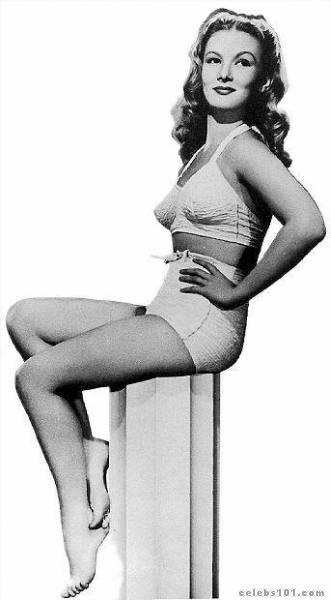
Another minor rivalry existed between Louella Parsons and Veronica Lake. Ronni (right) could really care less what Louella Parsons thought about her, and she didn't ever get involved in any of the petty gossip that seemed to keep Hollywood spinning, but for some reason Louella took a particular interest in her. Perhaps out of jealousy, Louella often made Ronni the subject of her articles, spreading the slanderous rumors that Ronni was both hard to work with and a temperamental diva. These allegations are strange, as in looking back I find it difficult to find any accounts of unprofessional behavior or rage-fueled tantrums displayed by Ronni on the set. Most of the rumors harken back to her first big movie, I Wanted Wings, when Constance Moore started spreading it around set that Ronni kept late hours and was always up partying. Ronni was actually always home in bed while Connie was engaging in this behavior. However, director Mitchell Leisen believed the tales and gave Ronni quite a roasting. Stories were spread, and soon every one believed that Veronica was causing trouble on this and every set she ever stepped on. Louella caught wind and chose to believe that Ronni truly was the troublemaking brat Hollywood had labeled her as. In her columns, she often reference Ronni was "overrated," either in acting ability or in the looks department. Ronni tried to ignore the negative press, but it did at times get her down. One day, she got a little bit of revenge. She happened to bump into Louella at a beauty parlor. Louella didn't recognize her, which was common since in her off time Ronni dressed down and without makeup. Looking simple and soft, like the girl next door, she overheard Louella comment to her attendant, "What a pretty girl." Not letting the opportunity pass her by, Ronni piped in: "Why don't you write that in your column!" Whoops, Lolly.

 Louella takes aim...

Of course, some of the slanderous portrayals of celebrity naughtiness are true, or at least based on some kernal of the truth. For example, William Haines was rightly referenced as a bit of a party-boy, enjoying nights on the town, get-togethers with friends, and good-natured shenanigans. One of his partners in crime was BFF Joan Crawford, his number one fan and lifelong ally. Joan had a rep of her own, mixing together her own ferocious ambition and unstoppable diligence with her raw and uninhibited sexuality. Joan always got what she wanted, whether it be a role or a man, but her career always came first. For this reason, she rarely got into trouble. She did get others into trouble, however. Case in point: West Point, in which she starred with Billy (left). The story takes place at the legendary military academy, and indeed this is where the cast and crew shot many of their scenes. Joan was already causing a stir on the set by NOT wearing stockings and baring her legs to the world, but she would take her rebelliousness further when flirting with the entire student body. In fact, the erotically charged Joan had no qualms about enjoying her time on campus, so she accepted (or perhaps even made) a date with one of its students. When it was discovered that the cadet skipped his classes to go out with Joan Crawford, he was immediately expelled. However, I doubt he regreted it, and Joan certainly had a good laugh.


Another naughty boy was Montgomery Clift, whose chosen salve for his personal demons was the age old trick of inebriation. Marring his classic good looks in his notorious car wreck of 1956 only propelled him deeper into his personal misery and an addiction to pain pills. Meanwhile, Monty had an ongoing rivalry with Marlon Brando, though they both truly respected each other. They would never be close friends, as competing egos rarely are, but they spent their lives privately inspired by each other, openly criticizing each other, and always trying to out-do each other. In truth, they were very different talents, with Marlon bursting forth on the screen like a lightning bolt and Monty insinuating himself more like an ominous storm cloud. In life, they came off the same way, with Monty being more elegant and Marlon more brash. Not surprisingly, Marlon found Monty stuck up and serious; Monty found Marlon just plain sloppy. Both were fairly quirky characters, though Monty often appeared much more "normal" than the exaggerated Marlon. This made it all the more shocking to learn that Monty was the one in greater personal danger, as Marlon himself would witness. 


Marlon showed his respect for Monty shortly after the latter completed Raintree County, the film which notoriously shows the "before" and "after" of Monty's car crash face. Monty went into a deep depression after the film bombed and he was snickered by audiences aghast at his lost beauty. Marlon surprised him when he drove to his house and begged him to get off the drugs and alcohol. Monty was touched (and surprised) by the concern, but insisted that he was fine... as he downed another vodka. The two buried the hatchet, admitting how impressed they were by their respective performances in A Place in the Sun and A Streetcar Named Desire. It was quite a moment. Marlon explained that he didn't want Monty to kill himself-- it was a waste of talent. Sacrilege! He also couldn't lose his top competitor, his "challenger," who kept pushing him to better his own performances. "You have to stop this nonsense, if not for your sake, then for mine!" he pleaded. Still, Monty was unmoved. But he was inspired enough to get to work on his next picture, ironically with Marlon. The two made The Young Lions, their only mutual movie, though they didn't even have any scenes together. Occasionally Monty would see Marlon lurking around the set, watching him work. Even in this, his darkest moment, he saw that he hadn't lost his touch. If he could impress Brando... Well, 'nuff said.


 A true actor, Monty insisted on creating truthful 
characters from the inside out, such as for 
his role as Noah in The Young Lions,
for which he distended his ears
and put putty on his nose.


NOW, THAT'S FUNNY: Part III

Olivia de Havilland eyes the baby she was forced to give up in
To Each His Own.

Back in the days when the "unwed mother' was ostracized for her immoral life choices, her options were few. She could either A) Keep her baby and deal with the hostile prejudices of an unsympathetic society and brave the world alone, B) Find a discreet doctor to help erase her... situation, or C) Leave the little bugger on a doorstep, and hope that the inhabitants would give it at better life. This seems outrageous in these modern times when pregnancy without a wedding ring is more readily accepted and single mothers are favorites of the magazine rack: from the latest mommy to be, Natalie Portman, to all those "Sixteen-and-Pregnant" girls I seem to be hearing about everywhere. Back in the days when there were more concrete rules for acceptable behavior and more vocal contempt against those who dared to stray outside the norm, one's reputation was everything. Thus, one would rather be caught dead than unwed with a bun in the oven. This spawned a plethora of films possessing a very similar plot: "good girl" finds baby and claims it as her own and is thenceforward labeled as a "bad girl." Comedy ensues. This time, I have not three movies to compare for you, but four: Tess of the Storm Country, It, Bachelor Mother, and Bundle of Joy. Let's move forward chronologically.


Tess of the Storm Country:


(I saw the 1922 version of this film, starring the incomparable Mary Pickford, thinking it was the only one. However, upon further investigation, it appears that this film alone has been made and re-made several times, the first of which was in 1914, also starring Ms. Pickford. Future versions were made in 1932 with Janet Gaynor and in 1960 with Diane Baker. As it is based upon a novel by Grace Miller White, I suppose the continued use of the story makes sense. However, I will refer to the 1922 version, as this is the only one I have viewed).


The plot of this movie involves a backwoods girl, Tess, who is squatting with family on the wealthy Elias Graves's land. Needless to say, Elias tries to remove the impoverished nuisances from his property. The usual battle of rich versus poor ensues, and in the meantime, Frederick Graves, son of Elias, becomes fond of Tess and takes her side in the argument. Meanwhile, Fred's sister Teola becomes pregnant out of wedlock by a law student who is quickly murdered, and thus unable to marry her and make the baby legitimate. Humiliated and suicidal, Teola is desperate. Enter Tess, who out of her good heart pretends that the newborn baby is her own to save Teola's face. The only problem is that now Frederick thinks that the girl he was falling for is really a no good scamp. Fred turns his back on Tess, and so Tess is left alone to raise the baby. The truth is eventually discovered when Tess brazenly tries to baptize the child herself after being initially denied the privilege by the church-- it's  a bastard child, after all-- and Teola and Elias witness the event. Teola is so moved that she spills the beans and confesses that the baby is hers. Fred feels like a cad and apologizes to Tess, whom despite her low class has more courage and goodness in her than anyone in his elite circle. After declaring his undying love, the two embrace, the two feuding families call a truce, and everyone lives happily ever after.


Tess and Fred, played by Lloyd Hughes, fall in love.


The plot of the film is quite bold in that it makes the unwed mother a sympathetic character, however it is still the innocent Tess that is lauded as the true hero. Yet, what she symbolizes also speaks volumes: the hypocrisy of prejudice. Tess is labeled as something she is not, and is shunned by the man she loves. The world looks down on her, but considers her behavior typical of a woman of "her kind," meaning poor, uneducated, and uncouth. By the end, we learn the age old lesson, "don't judge a book by its cover." Tess not only possesses more grace than the upper classes that are judging her, but it is also one of their own that is the true culprit of immoral behavior, Teola. The guilt of blaming one woman for another's crimes, and the imminent death of Teola, who dies shortly after her revelation of motherhood, causes people in the community to open their eyes and rethink the harshness of their own criticisms. If you live in a glass house, don't throw stones. So, the movie preaches open-mindedness, while at the same time being church-friendly in suggesting that we all try to be "good"-- it is much better to be a Tess than a Teola. The movie itself is an entertaining silent, and one of The best of Mary Pickford's remaining gems.


"It":


Lord love Clara Bow (right). This 1927 movie will forever be the one most associated with one of the hottest flappers to ever va-va-voom onto the silver screen. Clara wasn't known for her dancing, of course, but for her electric presence, which sizzled in the camera's adoring eye. This film was fashioned for her with the help of Elinor Glyn as a publicity campaign to boost the already rising star. Clara was labeled as the "It" girl: one completely possessing of that mysterious X-factor that separates the superstars from the rest of us civilians. Many are familiar with the concoction of Clara's title as "the It girl," but few are familiar with the film that awarded her this stamp. Upon comparison, it is quite clear that it is, or rather was, a more modernized version of Tess of the Storm Country but in the raw and bustling environment of the roaring twenties.


This time around, Clara stars as Betty Lou, a single working girl trying to get by, who has a job behind the counter of a posh store. Brimming with energy despite her financial woes, Betty is Miss Congeniality as far as her friends are concerned, but her low class keeps her from her recent crush-- the store Manager, Cyrus Waltham, Jr (Antonio Moreno). Cyrus is already involved with another woman, but when he finally notices the lovely Betty Lou, he can't help but be taken in. She takes him out for a night of fun at Coney Island, where for once he gets to let his hair down. However, things turn sour when he leans in for a kiss only to receive a slap-- Betty Lou isn't that kind of girl! Cyrus is a bit shocked, but still intrigued. However, any of Betty Lou's plans are foiled when her roommate gives birth to an illegetimate child, only to have welfare workers threaten to take it away. Betty Lou steps in, claims the child as her own, and insists that she is able enough to take care of it. Now, Betty has to walk around with a scarlet T on her face (T for Tramp), and any chances of love between her and Cyrus are ruined-- the heir to a fortune can't be swindled by some hussy who's clearly only out for a good time, particularly when she teased him with that left hook!


Clara shows her sales skills (to William Austin).


Instead, Cyrus offers a compromise: since she's obviously a loose woman, Betty can settle for being his mistress. She does not take well to this suggestion, believing that his love for her should be enough to see through any alleged past mistakes she's made, and at the very least he should not insult her with such an offer! Cyrus chooses appearances over love and kicks Betty to the curb, but she's not to be outdone. She shows up at a party on his yacht, seducing him with her innocent wiles once again, and she gets her sweet revenge when he finally proposes marriage. She tosses it back in his face with a defiant "Thanks, but no thanks" and  secures her pride once more. Afterward, she and Cyrus are thrown overboard, and they find themselves in each other's arms. Now that Betty Lou has taught Cyrus a lesson, and he knows the truth about the baby, they reconcile and live happily ever after. Again, the same themes of upper class hypocrisy and lower class... class. We see that Betty is more moral than those financially and socially superior to her in that she refuses Cyrus's attempts to make a whore of her, consequently making him the true embarrassment. Compassion for the unwed mother is too explored, but just as Tess, Betty Lou is put on a pedestal for her ability to be both decent and demure. Her raw sexual magnetism too makes a statement that a woman can be sexy without being a mere sex object. In both this and the aforementioned film, the baby and its destiny is less important than how it effects others' lives or at least the images of them. A silent classic, this too is one of the leading lady's best.


Bachelor Mother:


Baby makes three in 1939 with Ginger Rogers, David Niven, and everyone's favorite character actor, Charles Coburn. Hereafter, the plots remain quite similar to It in that the main character is a shopgirl trying to make a living who gets caught up in a case of mistaken motherhood instead. Love, of course, is always found in the process. Thus, Ginger stars as Polly Parrish, working at J.B. Merlin's department store (left). Polly is fired over the Christmas holiday, and soonafter sees a baby that has been left on the stairs of an orphanage. Fearing that it is going to roll right off and be injured, she hurries to pick it up. The baby is mistaken as her own, and she is left to care for it and defend the fact that the little thing isn't even hers. JB (Coburn) gives Polly her job back, feeling guilty about firing an unwed mother, especially during the holiday, and his son, play-boy David (Niven), becomes equally involved in the welfare of the baby and its mother. As a relationship between Polly and David grows, she no longer tries to deny that the baby is hers, if only because it is the one thing that keeps David in her life. He equally falls for her, but is too snobbish to admit that he has fallen for a lowly shop girl, let alone one with an illegetimate kid-- nevermind the fact that the Lothario probably has had his own fun around town. More hurdles are thrown into the mix when a search for the true father is begun, which includes JB's belief that his son is the true father. David is surprised to find this out, but is delighted to discover that his dad is fairly happy at the prospect of having a grandson and eager to have him settle down and make the family legit. David, after initially insulting Polly, finally admits his true feelings to himself and thus to Polly and Baby John. Soon enough, the fictional family becomes a real one. With this description, I can immediately jump to the next film, for it is a direct re-make.


Bundle of Joy:


In 1956, Bachelor Mother was remade as a musical to showcase the talents of married sweethearts Eddie Fisher and Debbie Reynolds, as well as to capitalize on the fact that the two had had their first child (Carrie Fisher). This film, therefore, has the exact same plot as the one mentioned above, but with more musical numbers. This time, Debbie is Polly and Eddie is Dan Merlin. Adolphe Menjou steps in as wealthy store manager, and proud grandpapa, JB Merlin. Both Bachelor and Bundle have their merits, but Bundle is more obviously cheesy. Debbie is her usual sunshine self, and her gift at comedy and charm is the saving grace of the film. Eddie does well enough, but doesn't possess the same charm as David Niven. Ginger, of course, is superb as ever in the earlier film, and it is her performance-- with a keen sense of timing and strong delivery-- that makes Bachelor a more graceful interpretation.

Modern family: David and Ginger play house.


The alterations in the script in these latter films make the male character a bit more likable in that he tries to become a part of the child's life from the beginning, even if just as a make-shift uncle, rather than turning up his nose in disgust and running away. The relationship between the leading actor and actress comes about because of and not in spite of the baby, as opposed to the first two films, and a sense of family is professed over that of romance, (though in Bachelor and Bundle the writers would have us believe that the two go hand in hand). In the enforced production code era, it should come as no surprise that the ideal set-up of husband, wife, and baby be extolled, and in both movies the sad mother who abandoned her child is never even seen by the audience. It is much nicer to just pretend that she doesn't even exist, and that no out-of-wedlock sex was ever engaged in. The child, therefore, just dropped from the sky. Indeed, sex is not an issue, especially in Bundle, where innocent kisses between Eddie and Debbie take the place of the sexual propositions of It. Thus, with the first two films, we are taught more of a lesson about social hypocrisy and moral prejudice and with Bundle we are taught "family first." Bachelor is somewhere in between. Also, the theme of mistaken identity plays a much bigger part to the central plot of the movie in the last two features than in the first two, wherein it was just another log on the fire to much bigger shenanigans.


It is difficult to recommend just one of these films, for they all have good points and are equally entertaining. However, as I am an obvious Clara Bow fan, It remains my favorite. If I were to suggest one of the latter two, I would offer up Bachelor Mother, if only for performance's sake. It is interesting to investigate these films, to watch them chronilogically, and to witness how clearly social attitudes changed with the times. The silent duo are more free and uninhibited, if only because they arrived before 1934's production code and the disarming alterations of the great depression. They too are a bit more ballsy, with Mary being brazen and almost naively heroic, and Clara pushing the envelope further by adding a dash of sex appeal into the mix. Their heroics were done not necessarily for any great moral stance, but simply because it was the right thing to do. The latter two films come after the end of the hooplah twenties, but Bachelor maintains a little more naughtiness than Bundle, which is pretty much family fun from concentrate. In Tess we were taught to stand for something, in It we were taught to stand up for ourselves, in Bachelor Mother we're encouraged to simply try to stand still while the chaos ensues around us, and in Bundle of Joy we're lectured to stand as a family unit. I guess the film you relate to the most, will equally tell you where you stand.


Have a Happy New Year!!!

TAKE ONE, TWO, THREE...: Oh, Baby!