Download Games

Recent Posts

Showing posts with label Florence Lawrence. Show all posts
Everett Sloane, Joe Cotten, and Orson Welles cook up a plot in Citizen Kane.
Didja notice Orson's fake schoz? He wore them often, because he thought his
own nose was too small and demure.


Chapter Two of Random Factoids: enjoy!


The Real Rosebud


The great mystery of Orson Welles's Citizen Kane was the elusive "Rosebud." After all the ensuing drama, the character recollections, and the unwrapping of a complicated past, the last word of Charles Foster Kane is revealed as the name of his boyhood sled (left). When the bulk of Kane is whittled down, the audience is left to see that this small seed from a lost childhood is responsible for the maladjusted growth of the mammoth CFK. However, behind the scenes, there too was much controversy surrounding Rosebud. For years-- as the plot of the film was based at least in template on the life of William Randolph Hearst-- it has been gossiped that "Rosebud" was actually the nickname that Hearst prescribed to his mistress Marion Davies's nether regions. While this could quite possibly have been a fortunate (or rather unfortunate) coincidence, the truth is much simpler. Citizen Kane was the brainchild of Welles brought to life by the writing talents of friend Herman Mankiewicz. As such, pieces from both of these men's private lives found their way into the film, such as Orson naming one of the characters "Bernstein" after his mother's lover, Dr. Maurice Bernstein. The true Rosebud was similarly contrived: Orson received a sled from his beloved Todd School upon his graduation, marking the true end of his childhood-- not that he ever indulged in its innocence or naivete-- and Mank', as Orson called him, had a bicycle when he was a boy that he named... "Rosebud." By uniting these two youthful memories, one of cinema's most referenced plot devices was born. If Ms. Davies too shared the moniker, which cannot be confirmed or denied, it was thus by complete happenstance.


Obie, Camera, Action!


Every great actress knows that  the real man to make friends with on the set is the cinematographer. Carole Lombard and Marlene Dietrich were both staunch students when it came to lighting and angles, and they always knew how to hit their mark to look their best. Merle Oberon would too get a little education in this arena. She, like Lombard, was in a near fatal car crash in 1937, which left her face scarred. After painful surgery and recuperation, she returned to the screen, but covering up the new blemishes on her face was a daunting task. Luckily, while filming the 1944 remake of The Lodger, (right) she fell in with cinematographer Lucien Ballard. Ballard worked diligently to create a camera light which, when placed directly beside the camera, shined light directly onto her face and eliminated the appearance of her scars. Appropriately, he named his invention after her: The Obie. In gratitude, Oberon promptly married Ballard and enjoyed a fruitful career. (Coincidentally her first husband was Alexander Korda, the ambitious English producer who tried and failed to make many projects with Star of the Month Orson Welles over the years, including War and Peace).


Great Faces, Greater Minds


On the subject of inventions... It comes as no surprise that many screen performers are multi-talented. Especially in the early days, one had to be particularly well-rounded to make it, so that he or she could be thrown into any role-- drama, musical, or comedy-- and come out swinging... or singing. However, we also have a crew of film stars that should be acknowledged not just for their physical gifts but for their mental proclivities. It turns out that some stars aren't only lookers, they're thinkers, innovators, and even... inventors??? Did you know that: the first film star, Florence Lawrence, invented an early form of the automobile turn signal? It was comprised of two arms, which, when signalled, would drop to indicate which way the driver was turning. She sadly did not obtain a patent and thus missed out on the cash reward of such a novel idea. Zeppo Marx too was a very interesting man. Always tinkering with gadgets, the ex-actor/sometimes agent became an engineer. He started the Marman Products Company, Inc. in 1941 and helped the war effort by producing clamping devices and straps. He also developed the first heart-rate pulse monitor! Perhaps the most shocking-- to those who don't think that beauty and brains can come in the same package-- Hedy Lamarr (left), who had been previously married to an arms merchant, used what she had gleaned from him to make an invention of her own. She created a "frequency hopping" device to be used with WWII torpedoes in order to avoid signal "jamming" by the enemy. Sadly, although she did obtain a patent, the US Military never put her invention to work. Still, she must have been proud to do her part.


Don't Let the Heels Fool Ya'


Ann Miller was one tough cookie in her youth. In addition to her great dancing talent, she too possessed a fierce determination. This created quite the ambitious young lady, and her great work ethic would serve her well in the industry. It definitely helped her grab gigs opposite both Fred Astaire and Ginger Rogers. In 1937, Ann was already chomping at the bit to get to work, and when she had the opportunity to work opposite Ginger Rogers in the film Stage Door she was willing to do whatever it took to do so... Including lie. Only 14-years-old, Ann fudged four extra years and made herself eighteen! Whether or not the big-wigs believed her is unknown, but then they were probably too distracted by her lengthy stems to notice any discrepancies. Thus, the lanky youngster got her way and was cast as "Annie." She proved her mettle again when she was given the chance to dance opposite Fred Astaire. She was ecstatic about working on the project Easter Parade with him, and was devastated when she suffered a severe back injury-- aka her husband at the time pushed her down the stairs. (Real gentleman, that one). This should have taken her out of the running, but Ann wasn't about to give up the chance to waltz with her hero (see right). So, she worked overtime to get in shape and had the doctors strap up her back for the dancing sequences. The process hurt like hell and often left her in tears, but when the camera is on you never see it. What a pro.


Call of the Wild


Sound engineers rarely get their due. Ever since the talkies came screaming in with their sounds, squeaks, and squeals, a whole new arm of the filmmaking body had to be born to carry the weight. It's not always as easy as "Roll sound, record dialogue." Creating the proper atmosphere within a film requires a mind sophisticated or creative enough to combine a variety of noises into an underlying track. It's like writing a often barely audible symphony. Some of this sonic tinkering is more obvious, such as in explosions, sirens, gun shots... or jungle howls??? Believe it or not, coming up with the now iconic yowl of Johnny Weismuller's Tarzan for 1932's Tarzan the Ape Man was no easy feat. Audience imagination previously had to interpret his animalistic battle cry for the 1918 silent film version, but the addition of the mic made things more complicated. The point was to make his cry distinctive without making it laughable; make it palatable to the ears without making it either too passive or too threatening. There have been many theories over the years as to how the mammalian screech was made, including combining Weismuller's voice with the growl of a dog, a soprano trill, a violin, and a hyena. But the simplest version may perhaps be the most true: Johnny screamed, Douglas Shearer recorded his voice, the yell was enhanced, and then played backward. So, when you hear Tarzan howling for his Jane (with Maureen O'Sullivan left), he's actually screaming in reverse! Who knew Tarzan was fluent in palindrome?


(Another interesting note on this infamous yell was Johnny Weismuller's ability to use it as a "get out of jail free" card. He claimed that during the time Castro was preparing to take over Cuba in 1959, he was traveling with friends through Havana on his way to a celebrity golf tournament. His car was ambushed by rebel soldiers, and the only way he could prove that he was neither Cuban nor a threat was to tell them he was an American movie star. To prove it, he let out his Tarzan howl. They recognized it and gave him safe passage).

Didja Know: Part II

Theda Bara, the original "Vamp."

Our relationships with our celebrities has changed over the past century and a quarter. Perhaps due to the fact that celebrities are so accessible today, we don't have the awe and wonder of them that we used to. There is no need to humanize them, because the jig is up: we know that they're human. The rag mags tell us alllllll about it. At best, we respect, but we don't admire. But it wasn't always so. Before, movie stars were mythic creatures that lived in the mystical world called La La Land, where they literally cavorted on Mt. Olympus. They were impenetrable beauties, trickster figures, and heroes-- real life cowboys, passionate vixens, and knights in shining armor. We looked upon them just like children, engaging in make believe, pasting their pictures to our walls, and dreaming the dreams that the movies taught us were safe. So deep was our love for them that we crafted nicknames (with studio help) after they'd worked their way into our hearts. This represented, if nothing else, how they had endeared themselves to the American public. As we celebrate our final week with Mr. Haines, I thought it would be a little fun to play the nick-name flick-game. Enjoy!

WILLIAM HAINES: THE WISECRACKER

Billy won his moniker for two reasons, the first of which should be obvious: he was a smart-ass. For every lame statement, he had a quick-as-a-whip retort, often running mental circles around those who dared to engage in conversation with him. His onscreen persona reflected this perfectly, for when his characters were faced with challenges, he merely laughed them off-- his wit used as a protective armor against responsibility. The youth of the roaring twenties responded to this rebellion with relish, especially when it seemed that Billy's personality off screen was not very different. In interviews with fan magazine reporters, Billy always deflected personal questions by making a joke of it, often turning the tables on the interviewer who suddenly found himself the interviewee. But too, his "wisecracker" status symbolized something else, for this was a code word often used to label men as homosexual. Thus, when people would say, "Billy Haines? Oh yeah... He's a real wisecracker," they were telling a double truth. As it stands in history, however, it seems that up until the emergence of the smart aleck Groucho Marx, Billy remained the king of zingers, taking the self-important divas he often found himself surrounded by down a peg or two. Or three.

BARBARA LA MARR: THE TOO-BEAUTIFUL GIRL

One of Billy's best friends (with supposed occasional benefits) in his early Hollywood days was Barbara La Marr. With dark hair and large hypnotic eyes that often appeared almost violet (a la Liz Taylor), she remains remembered most for her stunning physical presence and the looks that seemed to almost coin the phrase "knock-out." But, as many Hollywood ladies could certainly attest, beauty can be a burden, and since in the silent era Barbara held her position at the top post of "lookers," it comes as no surprise that the attention she received often worked against her. Perhaps there is such a thing as being too beautiful-- both too beautiful for words, and too beautiful for life. She earned her nickname in juvenile court, of all places, when she was spotted by writer Adela Rogers St. Johns, who gasped at the sight of her-- who is that gorgeous girl?! Barbara, then Reatha Watson, was allegedly brought in when found in the company of an older man. As a single young woman living in the city,  Reatha often fell prey to "friendly" gentlemen who wanted to help her out. Of course, the unspoken rule of quid pro quo often came into play. Standing before the judge, the youthful and tender La Marr was too lovely to punish. Indeed, Judge Monroe offered only the statement: "You are too beautiful to be allowed alone in a big city." Poor, poor pretty little thing. She made the papers the next morning, already named the "too-beautiful girl."

ROSCOE "FATTY" ARBUCKLE: THE PRINCE OF WHALES

This one needs no explanation. Not only was Roscoe's birth name quickly replaced with an insulting adjective, making him "Fatty"-- a nickname he hated-- but his size was furthermore emphasized when, as the reigning silent film comedian, he was dubbed the Prince of blubbery mammals with a wicked pun. He took it in stride, despite the fact that he had been sensitive about his size his whole life. Ironically, he ate relatively little. Even in his youth, when his family fed on a meager to invisible food supply, he was always a "big boy." Much larger than his waistline, however, was his personality. Possessing a huge heart and an energy that could light up a room, Fatty was surprisingly light on his feet and inescapable in his optimism. Audiences adored him for his at times smiling/at time befuddled mug that got into and escaped trouble to the soundtrack of uncontrollable laughter. Remembered today only for the crime of which he was innocently accused and rightly exonerated, Fatty deserves his throne back.

DOUGLAS FAIRBANKS: MR. PEP/MR. SMILE

Another man known for his enthusiasm was the seemingly irrepressible "Doug." Not only did he burst off the screen with his intoxicating positivity, exciting viewers with his heroic acrobatics and daring-do, but behind the scenes he worked with the same impassioned vim and vigor. Committed to creating and performing his own stunts, Doug was diligent about pushing the envelope and giving audiences the enthralling and inspirational stories they deserved. This demanded that he push himself to the physical limit, and today when one watches him in films like The Thief of Baghdad, his body remains something to behold. Yowzah! He was simply unstoppable, a manic maniac, who would rather run a hundred-yard dash than sit down to discuss politics or the recent findings of Freud. He was a force to be reckoned with. He even penned inspirational pieces of literature that his fans gobbled up: "Keep your chin up!" "Keep fighting the good fight!" "Reach for the stars," etc. He made anything seem possible, and when he spoke, people listened. Starring in war propaganda shorts during WWI and traveling around the country selling bonds, he united a country both in and out of the theater. We have yet to see another like him.

JOHN BARRYMORE: THE GREAT PROFILE

Oh, the illustrious Barrymore clan... So much talent, so much tragedy. The leader of the pack was always John, who ironically was the baby of the infamous acting trio, which too included Lionel and Ethel. John earned a commendable reputation as an actor with guts and gusto for his chilling and powerful performances on the stage, where he brought new depths to some of the most classic characters in literary history. His Hamlet was said to be profound, gut-wrenching, and provocative. When he entered the movies, his cinematic career followed suit. But despite his reputation for his acting gifts, it was his face that earned him his title. The startling beauty of his features, particularly as seen from the side, sent more than one woman's heart aflutter. Though his machismo was probably offended at his objectification-- which for once put a man on a woman's side of the fence-- he also embraced it. Being the sexual creature that he was, he certainly put his good looks and charismatic personality to use and wooed many an unsuspecting but willing lady into his bed. If ya' got it, flaunt it.

LANA TURNER: THE SWEATER GIRL

Lana was pegged with her nickname from almost the moment she set foot in front of the camera. She was noticed not for her gorgeous face or dripping sensuality, but for the way her sweater fit over her... parts. One of the many successful makeovers concocted by MGM, Lana went from being a brunette to a blond, from an average girl to a sex-kitten. Studios often had a way of shopping their latest ingenues around in bit parts, seeing if the public would latch onto them. When Lana strutted down the street in They Won't Forget, they didn't, and she caught more than one drooling male fan in her trap. People began writing into the studio asking for more of "the sweater girl." This was a specific ploy of the studio, who completely altered Lana's more modest costume to reveal her best assets. Thus, her original bonnet and polka-dot dress were exchanged for a sweater and that infamous walk to fame. While it was Lana's bosom that garnered her initial attention, the feisty minx's natural gifts before the camera were more than physical. Thus, she was able to stake her claim in Hollywood as a bona fide movie star and a lasting leading lady. But that damn sweater always haunted her, no matter how legitimately she strove to prove herself.

MABEL NORMAND: THE "I DON'T CARE" GIRL

Try as you may have to stop her, Mabel Normand was pretty much going to do whatever the Hell she wanted. Her rebellious and fearless nature was reflected in some of her earliest films, wherein she was known as "The Diving Girl", the bathing beauty who nonchalantly dove into the water-- backwards, forwards, you name it-- from daunting heights. Rising to fame with the aid of boyfriend Mack Sennett, Mabel attacked her comedic film roles with the same naive courage, hurtling in head first, never caring if she came off looking like a damned fool. She ignored her god-given beauty and mugged it up, enjoying a free-spirited nature completely devoid of vanity. She willingly took a pie in the face, fell on her bottom, rolled in the mud, whatever the situation called for. Unfortunately, this same lack of caution got her into trouble in her private life. She indulged in a love affair with drugs and alcohol in a foolish attempt to live in the moment. She just never considered the consequences, which would eventually destroy her. All the while, despite the rumor and folly that was to come, during her day in the sun, she reigned supreme as the first screwball queen, whose fun-loving, no-holds-barred persona won the respect of heavyweights like Charlie Chaplin, whom she could more than hold her own with. It was perhaps her joke of a husband, Lew Cody, who described her best: "She was just a little girl who neglected to look before crossing the street." But that's why they loved her.

 JEAN HARLOW: THE BLONDE BOMBSHELL


"Baby" is a name used far too often. Lovers use it to refer to each other, certain men (who seemingly hid in a cave during the feminist movement) may still use it to refer to any and all members of the opposite sex... But there is one lady whom everyone referred to as "Baby," and she didn't mind at all: Jean Harlow. For several years, Harlean Carpenter didn't even know her true name, because everyone in her family called her "baby." Warm and loving as she was, and adorable to boot, the name suited her and she carried it with her wherever she went. When she hit Hollywood, friends still referred to her as Baby, which she preferred to her stage name, Jean Harlow. Indeed, when she passed away suddenly at the age of 26, it was "Our Baby" that graced the face of her tomb. However, during her life, her fans more commonly knew her as "The Blonde Bombshell," the first of her kind, whose atomic arrival on the silver screen sent shock waves throughout the nation and changed the image of the sex symbol for all time. 

SHARED NAMES

Surprisingly, there are times that certain names have proven themselves to be recycled. Here are some examples of this equally fascinating phenomenon:


Most people are certainly familiar with the reference to Lon Chaney (right) as "The Man of a Thousand Faces." Never was there a more accurate description, for not only was this renegade actor able to flesh out countless and varied interpretations of characters in his stellar cinematic resume, but he also devised intriguing, shocking, and sometimes frightening makeups to further distinguish one creation from the other. His martyred stance for his craft communicated that his performances were not about him, but about the people he was playing, and thus people in general. But before Lon, the first movie star-- Florence Lawrence-- had already been pegged as "The Girl of a Thousand Faces." While Flo probably applied her own makeup, as many did in those early days, she never went quite as extreme as Mr. Chaney. However, her gift at relaying every shade of every emotion still won her the same title. She was given this lengthy handle due to the fact that her audiences did not know her true name, as at the time studios kept this under wraps. Afraid of resulting bloated egos and power struggles within the system, moguls tried to keep their guinea pig actors anonymous and spinning on the reels that kept the money coming in. In addition, Flo was referred to as "The Biograph Girl" and later "The IMP Girl" as she transitioned to different studios. Ironically, one of these names would also be usurped. After she left Biograph for IMP, a new ingenue stepped in and became the latest mystery face people were falling in love with. Thus, Mary Pickford became the new "Biograph Girl," though after she too became a phenomenon, she was also referred to as "The Girl with the Golden Curls."


Florence, with her happy face on.


Mary and her token curls.


There was also a steady competition going for various translations of "The Great Lover," "The Screen's Most Perfect Lover," etc. At various times in their careers, Wallace Reid, Rudolph Valentino, and John Gilbert all had titles of this sort bestowed upon them, which is interesting since they were all such different men. Wally (right) was the baby-faced, lovable cad of Carmen and The Roaring Road fame. In addition to finding him handsome, older women were often infatuated with him, taking a maternal stance. He was the all-American son they adored, who-- when he was naughty-- they couldn't help but forgive. He just had one of those faces. Valentino was distinctly different. He represented the opposite of Americana: a tantalizing and seductive foreigner, who was just as enticing as he was dangerous. Women veered from the more wholesome appeal of Wally to the powerful allure of the man who wouldn't take "no" for an answer. The desire to be dominated thus overruled the desire to be loved, though when Valentino got romantic he also sang to the emotional nature of the female heart. To see such a masculine powerhouse in a vulnerable moment again awoke feminine sympathy, and the duality of Valentino's complex nature made him irresistible. Unlike Wally, however, Rudy caught a lot of flack from members of his own sex, who despite his he-man roles in films like The Sheik and more particularly Son of the Sheik labeled him as a "sissy." Jealousy, anyone?


Rudy, alert and on the prowl.

Falling in between these two heartthrobs was John Gilbert, whose star had started soaring right when Rudy sadly passed away. John was left carrying the torch, providing a mixture of the heroic lover and the sensitive romantic. More concerned with being a true actor, John took on vastly different roles in vastly different films, sometimes playing the war hero (The Big Parade), sometimes the vengeful lover (Monte Cristo), and sometimes a downright villain (Downstairs), but always he carried off his performances with class and sophistication. And his movies with Greta (left in A Woman of Affairs)... oh my! The way he looked at her was the way every woman dreamed of being looked upon. John had a way of portraying both uncontrollable desire and undying love-- both animal and emotional-- presenting the perfect package. He could be boyish and lovable, but his dark features also relayed a warning to ladies, who were powerless to his charms. With John, the art of love was an art-- not the bashful, "ah shucks" of Wally or the domineering and savage embraces of Valentino. John offered poetry. In the end, a woman's favorite said a lot more about her than it did about the man. Choices, choices... How awful our plight.


Kim Novak: The Lavender Girl


The list could go on and on, but since you all have lives, I'll stop here, and let you ruminate about the others I've unfortunately left out-- The Great Stone Face, Old Blue Eyes, The It Girl... Though there are occasional nicknames given to our celebs today, usually referring to action heroes (The Muscles from Brussels or The Italian Stallion), for the most part, our camaraderie with our celebs is at a stalemate. And I'm sorry, but giving yourself a nickname doesn't count-- I'm looking at you "JLo"/"Jenny from the block," whatever. I think it is indicative of a disease in our culture when we remain more enamored of the stars of the past than the present. Perhaps it's just nostalgia, but I think it's a little bit more. Maybe even that lil' sum sum we all refer to as Magic.


MENTAL MONTAGE: A Star by Any Other Name...


Judy Garland writes to her favorite movie star while singing
the classic, "Dear Mr. Gable."

In Tinsel Town, it could be said that a star is worth his weight in fan mail. Studios were able to gauge the popularity of their contracted players based not only upon their box office receipts but also upon the amount of gushing fan letters they received every week. This method also helped to predict soon-to-be stars, for when admirers sent letters requesting more of "that blonde" or asking "Who was that handsome chap...?" in such-and-such scene, studios would know who to beef up in the publicity department. In fact, before there even were "movie stars," film-goers were pestering Biograph and later IMP trying to find out the name of their favorite leading lady. Carl Laemmle would give them what they wanted, staging a huge publicity gag to introduce Florence Lawrence to the world, and thus dub her the first official Movie Star.


The biggest stars got bags, truckloads, thousands of fan letters a week. People wrote in to RKO, MGM, or Warner Bros. begging for a picture, an autograph, or-- God help us all-- a written response. Some celebs like Mae West and Joan Crawford, the true diva pros, would insist on answering all of their mail, however not every one was that ambitious. It was impossible to keep up, to respond to everyone, to sign that many photos without getting chronic carpal tunnel. Most leading ladies and gents would have had no time left over to make movies! For example, at one point, Veronica Lake (left) was receiving somewhere around 1,000 letters a week. Though she tried to answer at least 1/5 of them, she fully admitted that she couldn't answer them all. The majority of her mail was answered by an expert forger who would respond to hopefuls with a signed Ronni photo. (This is why you can't trust all of the "autographs" out there-- most are scams. Caveat emptor)!


However, the most touching of all Ronni's fan letters would reach her long after her hey-day in Hollywood. You see, Veronica Lake had a brief love affair with Marlon Brando (right). I'm a little uncertain when their relationship took place, though it is safe to assume that they crossed paths when Marlon arrived in Hollywood in the early '50s, coincidentally at the same time that Ronni's film career was taking a nosedive. (Though, it is possible that they rubbed elbows in New York as well, which is where Ronni moved after her immediate exit from California). In any case, their affair was heated, brief, and mutually and amicably ended. Reflecting on Marlon, the ever humble Ronni would say: "Our romance was short but sweet. He was on the dawn of a brilliant film career, and I was in the twilight of one. Of course, my career could never compare with his." However, despite his eccentricities, Marlon could be oddly loyal and was in truth a very compassionate person. When he read in the paper that his former flame, the Veronica Lake, was working as a cocktail waitress at "The Martha Washington Hotel" in NYC, he sent her a $1000 check. Ronni was floored! However, proud woman that she was, she never cashed it. Instead, she had it framed, and it adorned the wall of her later Miami home.


Marlon's respect for disappearing Movie Queens is equally reflected in his treatment of the eternal flapper and "It girl," Clara Bow. Long after her day as the #1 box office star at Paramount Studios, Clara (left) had succumbed to the increasing deteriorations of schizophrenia-- something she had in common with Ms. Lake. After her fear of the mic and the brutal treatment by the salacious tabloids all but chased her from Hollywood, Clara had spent the remainder of her life trying to make a go of it on her ranch with husband Rex Bell. Her increasingly erratic behavior led to her psychotherapy at "The Institute of Living," where-- after unearthing the shattering sexual abuse she had experienced as a child at the hands of her own father-- her mental disease was also diagnosed. Later, separated from her husband and two sons and living alone at the Los Altos Apartments, Clara's health continued to decline, and except for the occassional emergence of her old, spunky spirit, she faded easily from the public consciousness. She would get a little boost in her later days when she heard that Marlon admired her, for she was equally enthralled by his raw, new performances. She even made a visit to  meet him at his home, which the (by then) sheltered lady never did. Marlon must have been equally effected by the meeting for, a few days later, Clara received a signed photo of Marlon in the mail. It said: "To Clara Bow Bell, A Memorable Personality Who Has Given So Much To So Many, With Sincere Respects, Marlon Brando." It warmed her heart to no end and reassured her that what is temporarily forgotten is not always completely gone.


Interestingly, there was always one fan letter that Clara wished she had written-- to her favorite actress, Marilyn Monroe (right). When witnessing Marilyn's cataclysmic and whirlwind career, Clara couldn't help but draw comparisons between her own pressure-filled rise and fall and the latest blonde ingenue's journey. In fact, Clara would not be the first nor the last to note the similarities between the two ladies: sexual dynamos with a hovering shadow of mental illness (both of them had mentally ill mothers) who were constantly mistreated and abused by the press. For this reason, Clara always wanted to reach out to the little girl who reflected so much of her own torments and pains. She never did, and both ladies were too shy to ever meet. It was probably shocking to Clara when Marilyn suddenly died in 1962. Clara would outlive her by three years, finally passing away in 1965. So much was left unspoken.

Another unsent fan letter was penned by Olivia De Havilland. Still alive and kickin' today, this tough movie diva remains one of the final touchstones to the studio era, which she almost single-handedly brought to an end thanks to her daring court case ending in the "De Havilland Decision." Though she correctly fought against her mistreatment and abuse by the studios-- Warner Brothers more specifically-- she could still look with fondness on her glory days as a star and her countless cinematic works, most of which remain classics. Her fondest memories, of course, always went out to her constant collaborator, Errol Flynn. Errol would not fare so well as the resilient Olivia in his later days. After a lifetime of alcohol (et al) abuse, the once handsome swashbuckler had become a sad wreckage of his former self. Sometimes, friends could see the mischievous bad boy peeking out from his sad eyes, but a life of living hard and fast was driving him to an early death. For this reason, after watching a later screening of Robin Hood, Olivia decided to write to her old friend, extolling his talents and remarking on how their chemistry and partnership had truly stood the test of time. Then, before the ink was dry, she had a change of heart. Fearing that the wisecracker would find her a sentimental old fool, she tore the letter up. She regretted her decision, for Errol passed away not much later at the ripe young age of fifty. (The famous duo sit together between takes, left).


Jean Arthur ponders her opening words of praise... 
(Still is from Mr. Deeds Goes to Town).

Luckily, these misfires are the exception and not the rule. While some may feel a bit silly before licking the envelope and sending their love to a comrade of celluloid, most simply see it as a way to pay their respects to those they continue to admire in the industry or new faces that they believe continue the legacy of integrity in film acting. Such was the case with Jean Arthur. Jean became enamored of Christopher Reeve (right) when she was introduced to his film work in the '70s. As a result, she made an out-of-character move when she wrote him a letter, gushing like a school girl in love. Jean was a woman not easily impressed, so Reeve must have been extremely flattered when he received her note. To be honored for his performances by one of the Queens of Silver Screen Comedy was a testament indeed! To show his gratitude and equally pay his respects, he sent her an autographed photo with a personal note.


A rare, legitimate Chaney autograph for Lt. Jay Roy Harlacher,
a Los Angeles fingerprints expert whom he conferred
with for his role in While the City Sleeps.

Lon Chaney was not a man apt to answer fan mail. Embarrassed by the attention, the notorious King of Mystery didn't get personal with his fans. Gracious, yes, but he preferred to allow the public to believe in the illusion of him over the truth. This is why a genuine signature from Lon is a rarity. They do exist, on his friend Jack Feinberg's violin for instance or in personal cards to friends, but the bulk of the pictures sent out to his multitudinous fans were signed by the studio itself. Lon always saw himself as just some guy, nothing special, so why all the hooplah? However, he too made an exception when he received an unlikely letter from stage actress May Robson. Acclaimed on the stage, May (left) was fairly unknown at the time, but would later gain further fame for her onscreen performances in films such as the original A Star is Born and Bringing Up Baby. May was deeply moved by Lon's performance as Quasimodo in The Hunchback of Notre Dame and penned him a letter telling him so. The genuine regard of an equal talent for his own moved Lon, and to be given validation by someone he truly respected caused him to do the unthinkable: answer her. He sat in front of his typewriter and wrote his penpal back with "humble thanks and appreciation," stating also that he hoped to live up to the great honor she had bestowed upon him. 


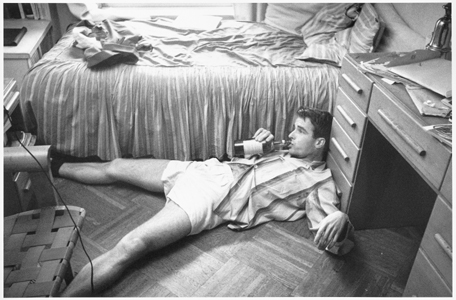
A photo of a very relaxed Montgomery Clift, taken by
Stanley Kubrick.


Sometimes these communications between fan and star aren't always by note. After the telephone entered every home in America, it was, of course, common for fellow stars to call and congratulate each other on a supreme piece of work or perhaps set up a future collaboration. Both Marlon Brando and Montgomery Clift would get frequent calls from a devoted fan who was eager to express his admiration for them. However, his attentions at times got a bit annoying too. It was only later that Marlon and Monty would compare notes and realize that they were both being phone-stalked by James Dean. The two thespians were initially flattered, but the equal sides of their nature that embraced acting, shunned celebrity and were irked and embarassed by the attention. Monty, whose talent Jimmy favored, entertained the young Dean's frequent buzzes as much as he could, sensing in the youth a familiar thirst for artistry (as well as perhaps the pressures of internal sexual conflict). In the end there was only so much he or Marlon could do for someone who was, in reality, a stranger. Dean's desperation to reach out to them is indicative of his search for both a father figure and a support system, and the fact that he aimed so high too communicates his desire to attain the greatness these men had already accomplished. Sadly, Dean would pass away before he could fully emulate Monty or Marlon's bodies of work but not before he became a legend. When Monty heard the news, he was so disturbed, he vomited. The loss of a like soul hit far too close to home. 


Jimmy Dean, equally relaxed but less at ease...


What is most interesting about these varied correspondensces between celebs, is that it brings them down to earth. In seeing their respect for their own individual idols, we too get to see the children in them-- the dreamers who wanted to be something more than and something better than themselves. They too looked up to their predecessors and sometimes contemporaries for guidance and inspiration. Thus, we get to see a wider spectrum of the close-knit community of Hollywood, which seems so big on the movie screen but is in truth a small family of co-workers, co-stars, and collaborators, who need just as much validation for their diligent work and efforts as the rest of us. As they say, one kind word goes a long way, and sometimes a pat on the back from a friend makes all the difference.

MENTAL MONTAGE: Fan Mail


Doug Fairbanks and Julanne Johnston: 
fearless and fancy free in The Thief of Baghdad

It only makes sense that a few accidents occur in the ramshackle process of turning a script into a film. As in any workplace, there are mishaps and mistakes, but there are also some outright dangers. The early silent days were the most fatal. Renegade filmmakers at the very advent of cinema knew nothing about stunt doubles, safety harnesses, or trick photography. They would simply point and shoot. For this reason, it was not an uncommon phenomenon for neighborhood people in New York or Los Angeles to see a cameraman treacherously dangling from a truck as it rushed past. Actors too were put in constant peril. Back in the days prior to special effects, in order for a thing to look real, it had to be real. People dove off cliffs, ran through fire, fell off horses...Mary Pickford recalled performing a scene in the water where she nearly lost her life when a boat came speeding at her head. Douglas Fairbanks also had his share of troubles, of course he looked forward to all of the death-defying feats he would become famous for.


Though these incidents often produced entertaining and wild stories to recall after time had replaced fear with laughter, there have been numerous tragedies involved with film. Florence Lawrence, the "First Movie Star, "Biograph Girl," and "IMP Girl," knew this better than anyone (right). During one of her first major films, The Despatch Bearer of 1907, Flo had to ride rapidly on horseback through a forest. She nearly ran straight into a thick tree trunk, missing it by mere inches! It left her shaken up, but the sassy Flo was an experienced horseback rider and actually enjoyed the thrill somewhat. Another incidence would not be as gratifying. When she was filming The Pawns of Destiny in 1914, there was a scene in which she was forced to carry her incapacitated lover, Matt Moore, down the stairs and out of a fire. No big deal for a dainty woman scaling in at about 5'. During this scene, which she had to perform three times, Flo actually did catch on fire and suffered minor burns that left her hospitalized for a brief period. Because her career faltered after this setback, many rumors were started suggesting that she had received horrible scarring that marred her appearance and left her unable to perform as before. This is false. Flo's beauty remained and the burns, once healed, did not hamper her acting chances. Her back, however, had been injured when suffering a fall while trying to lift Moore, and she would suffer painful aches and spasms for the remainder of her too short life, which did affect her ability to work.


Another person who had issues with her back was Linda Blair. The set of The Exorcist was said to be cursed, and several accidents occurred either while filming or off set to others somehow related to the film. Coincidence or demonic intervention? Who knows. Linda (left) was put through the ringer in this movie in more ways than one, but it was the scene where she is being flung up and down on the bed that still haunts her to this day. The special effects wizards devised a contraption that would send Linda flying forward, so that it seemed her body was uncontrollably bending up and down over her supine legs. The only problem was that to do so, Linda was constantly hit on the back with the apparatus, which repeatedly smacked her violently forward. As a young child, she didn't complain and thought nothing of it, but she still has severe back pain to this day.


There too have been outright deaths in cinema. John Gilbert (right) was quickly made accustomed to the rigors of filmmaking when he reported for his first projects as an extra at Inceville. He was doused with water for "rain scenes," which chilled him to the bone, he was physically beaten in action sequences where he would have to fall, battered and bruised, over and over again, and of course he endured the too-close-for-comfort contact with fire. His hunger for his work made him get through this, but not everyone was so lucky. A girl that John had been in love with, Effie Stewart, was killed on the set of Civilization when the set piece she was standing on collapsed right out from under her. She was not the only casualty. John was devastated, even more so because he had decided to end their relationship on the bus ride to the set that day! It's one thing to break a girl's heart, but to have to live with the knowledge that you did so right before she lost her life??? He never really got over it.

These accidents became such common occurrences during the silent days, that actors began suing their studios for their constant injuries. So frequent were such mishaps that newspapers and magazines would report on them under casual headlines such as "This Week's Crop of Accidents." In the early 1910s, silent players such as Charles Murray, Herbert Brenon, Ruth Hoyt, and Eugenia Besserer were all hurt during filming. Certain performers enjoyed the thrill of the physical work, women included, such as Helen Holmes, Cleo Madison, and Helen Gibson, however the adrenaline wasn't always worth the aftermath. Go-getter Gibson, for example, was nearly killed when she fell from a speeding train during filming and was hospitalized for a month! So too were there deaths. In 1914, both Grace McHugh and Owen Carter drowned during the filming of Across the Border in Colorado. Talk about sacrificing for your art...


Later, these accidents seemed to occur much less often as we became more knowledgeable about the dangers and how to protect ourselves. But sometimes, the unexpected still happened. On the set of Mogambo, three men were killed when their land rover went over a mountain cliff. One of the deceased was a 26-year old production assistant and the others were local African guides. Star of the Month Ava Gardner seemed to get out of this movie unharmed, despite the fact that she was interacting with wild animals (see left). She was nearly overturned in her canoe by a hippo one day, and she and Clark Gable were rammed in their jeep by a rhino on another! The worst she got was being pushed over by an elephant-- an unplanned moment that John Ford captured on film and used in the final cut. But the aforementioned debacles and some future disturbances surrounding Ava's movies make it seem like those who worked with her were cursed!

When making The Snows of Kilimanjaro, there was a scene where Ava's truck turned over in the midst of battle. Her long lost lover, (and real life pal), Gregory Peck swooped in to save her and drag her from the twisted metal (right). Ava wasn't a heavy woman, but when Greg tried to lift her, he somehow twisted his leg and tore a ligament. He struggled through the rest of the take like a pro before letting anyone know that he was in intense pain. He had to recuperate for awhile, which put a hitch in filming. Perhaps it helped his character, who was ironically chair-bound due to a leg injury for the majority of the film, which is told in flash back.


Ava's bad luck also wore off on co-star and drinking buddy Richard Burton during The Night of the Iguana (together, left). At one point during the shoot, Richard was electrocuted! His character was symbolically supposed to set an iguana free into the Mexican wilderness. All went well, except that when the lizard was untied, it didn't run away. John Huston decided to add a little juice, shocking the iguana with a 110-volt charge to send it scurrying away. It worked, but unfortunately, Dick was touching the iguana when it was electrocuted! He was sent into the air and landed on his back on the hard ground. He eventually shrugged it off like the tough Welshman he was, but he was... well, shocked! Not only this, but assistant directors Tom Shaw and Terry Morse were both hurt when they fell from a crumbling balcony and landed on their heads on the earth below! Morse awoke with his head in Deborah Kerr's lap, and Shaw was at first assumed dead! Luckily they both recovered. The shoot was so arduous, drunken, and chaotic, that the entire cast and crew was going crazy. At one point, Dick passed out for a nap. When an assistant came to wake him, he asked, "Where am I?" When the assistant told him he was still in Mismaloya, Dick replied, "God, no!"

These days, directors don't ask their performers to do anything too risky. After all, if they lose one of their leads, they would have to start the film all over again with another actor! Sometimes they do take chances, and there are certain actors that like to do their own stunts. During the filming of True Romance, Dennis Hopper was not one of these people. During the scene where Christopher Walken is supposed to shoot Dennis, dir. Tony Scott asked that the prop gun be held right up to Dennis's head when fired. Dennis was not having it. He didn't like the feeling of a gun being held to his head, let alone a dummy gun that would literally be fired. Tony, to calm his nerves, told him not to worry, that it was harmless, and even volunteered to do the stunt first himself for assurance. So, he sat, the gun was fired into his temple, and out trickled a line of blood from a new dent in his forehead. Dennis's response, "See, I told you."


Perhaps the most recent tragedy has been the death of Brandon Lee, son of Bruce Lee and star of the cult phenomenon The Crow. There was a lot of buzz surrounding the film and its leading man, who many agreed was on his way to super-stardom. Unfortunately, the "Lee family curse" would follow him to work one day. While filming his murder scene, a piece of a dislodged bullet became wedged in one of the prop guns. When the blanks were fired, it propelled the actual bullet forward, striking Brandon in his right side and killing him. Everyone thought he was just acting when he fell, and they didn't realize that he was truly injured until he remained lying on the floor after "cut." Fortunately, enough of the film had been made so that it could be released, for a double was used to finish shooting the remaining scenes. The Crow was sadly Brandon's swan song, but it remains a macabre masterpiece.

The stories go on and on: stunt man (and Errol Flynn buddy) Buster Wiles nearly drowning when he got stuck upside down in a lake after a faulty dive, Jennifer Aniston allegedly being saved by Jim Carrey on the set of Bruce Almighty when she was nearly crushed by a toppling crane, Josh Hartnett and Harrison Ford getting into a car crash on the set of Hollywood Homicide... Buster Keaton, the unbreakable clown, would literally break his neck during the filming of Sherlock Jr, though he wouldn't discover it until years later.The things people did and do to keep us entertained is mind-boggling! No wonder they make the big bucks. At least the most fatal cases are less frequent these days. But as this ghoulish month comes to a close, let's tip our hats to our fallen soldiers, who literally forfeited their lives to get one "in the can." May they rest in peace, may their films flicker on, and may we always remember them and their brilliant work.


Buster Keaton in Sherlock Jr:
His middle name is Danger!

MENTAL MONTAGE: Life and Death in the Movies