Download Games

Recent Posts

Showing posts with label John Barrymore. Show all posts
Linda Darnell felt like a star-struck fawn when she began working
with her acting heroes. Little did she know that she would
 in due time become one of the inspirational elite.


Just as the integration of sound in film created an uncomfortable tension between the silent generation and the studio era, so too would the invention of Television topple Golden Era Hollywood's ivory tower. Changing fads, younger audiences, and this new feat of technological competition would-- along with age-- humble many of cinema's greats. The more business savvy Gods and Goddesses immediately hopped on the gravy train, such as Loretta Young who starred in her own TV show. Other, older curmudgeons found it difficult to acclimate, like Clark Gable, who let his MGM contract run out and then sought semi-retirement. Linda Darnell became one of the many who was left to walk a crooked line between sudden, grateful independence from studio control and complete and utter bafflement at what to do next. Like many of her generation, too young to retire and too old to appeal to the new method-acting trend, Linda did a little of everything: the occasional, poorly made film, some television, and most importantly the stage. It was on the stage that Linda believed she truly learned to act and to carve out characterizations that went beyond simply hitting marks and giving good face to the camera. The various plays she did-- A Roomful of Roses, The Children's Hour, Critic's Choice, etc-- were sometimes successful and sometimes flops, but the experience was still an enriching one for her. With mostly positive reviews, her confidence was bolstered, and with younger cast members looking up to her, she gained a self-respect that had been absent from her film work. Many upcoming thespians and later film actors would get a chance to perform opposite the fading but still radiant icon, whom they came to respect and admire for her kindness, generosity, and under-appreciated talent. And so, it was on the stage performing Tea and Sympathy in 1956 that one of the gentle guiding hands of Old Hollywood would help usher in New Hollywood when Linda performed opposite a future leading man... Burt Reynolds.


After years doing stage and television work, Burt Reynolds takes his place
 in film history in Deliverance.


Another, earlier transition in the entertainment world came with cinema's first appearance. Suddenly, the world of the stage was broadened and audiences were introduced to another form of passion plays in flickering lights. Of course, as with all new "fads," many stuck their noses up at film and film actors, thinking it a cheap imitation of true performance. While half the population held tightly to the boards of the stage, another half embraced the possibilities of stories in pictures, resulting in an exciting and contentious era in our nation's past. While film actors endured the shame of ostracization and prejudice from a society that deemed them not only artistically by morally inferior, the actors of the stage dealt with an impending paranoia that the burgeoning new medium of movies was going to shake them out of the business. In time, movies did come to override the theatre as the mass favorite, but the prestige of the stage remained. Yet, with film's new success, attributed in part to the actors and actresses who helped elevate it above the mundane and superficial, respect between the two groups followed. One such example of this can be seen in the tribute one of the stage's greatest actors paid to one of cinema's. Turns out John Barrymore (left) had a bit of a crush on Lillian Gish. Not only did the notorious lecher certainly find her beautiful, but he was apparently in awe of her emotive talents, which he deemed "superlatively exquisite." He was moved to such a degree that he was uncharacteristically too embarrassed to approach her with his compliments. Instead, he used notorious director D.W. Griffith as a go-between. He wrote Griffith a letter full of plaudits, and asked him to pass on his ardent respect to Lillian after seeing her performance in Way Down East: "I wonder if you will thank Miss Gish from all of us who are trying to do our best in the theater." Of course, Jack would later arrive in Hollywood himself and start making his own impression on the cinematic world, but had it not been for his respect for actors like Lillian and their work in the medium, he may well have simply continued treading the boards on Broadway.


D.W. Griffith's "soul," Lillian Gish, apparently reached
John Barrymore's as well.


Another olive branch was extended by none other than Olive Thomas (right). She was at the height of her career when she started filming The Flapper. Life was good, work was steady, and she was quickly solidifying her place as a qualified leading lady. This certainly only served to heighten Olive's perpetually high spirits. Always a generous, free-spirited person, her charm was infectious and endeared many of her colleagues and collaborators to her. One such person was Norma Shearer, an up and coming ingenue who was breaking her way into the tough world of Hollywood through bit parts and extra roles. A fiercely determined girl herself,  Norma-- who landed her first, uncredited role in The Flapper alongside sister Athole-- most assuredly watched every move Olive made with great acuity. Here was a woman she wanted to emulate: charismatic, sensual, talented, and powerful. Never the haughty type, Olive and Norma must have struck up some sort of casual, working relationship while filming, for when Olive learned that the struggling actress had fallen ill, she was deeply concerned. As was her nature, she offered assistance without giving it a thought and wound up forking the dough for Norma's medical bills. It was a debt for which Norma remained eternally grateful and sadly never got to repay, due to Olive's untimely death. But, having indeed learned from a pro, she put this bit of kindness in her pocket and "paid it forward" in her later career, where-- after she became one of MGM's top attractions-- she often lent a hand to other up-in-comers in need, (such as Janet Leigh and Tyrone Power).


Norma Shearer grew to wield her hard-won fame
 energetically and gratefully.


Another type of world that consistently seemed to collide with Hollywood was that of the gangster. The stories of underworld debauchery made their way into cinematic stories as soon as prohibition put a bitter thorn in America's side. While we did not enjoy the truth behind the myth of the booze-pushing mobster-- the man-handling, threatening, and murdering-- we could not help but idolize him in some respect, because at least he was giving us something good to drink! Gangsters too were drawn to the glamorous allure of Hollywood for business and pleasure, and thus our nastiest ne're-do-wells started rubbing elbows with our creme-de la-creme, (see more in a past article here). Linda Darnell's mother, Pearl, would in time come into close, friendly contact with none other than Mickey Cohen (left). After Linda had moved her entire family to Los Angeles and bought them a home, Cohen happened to move in right around the corner. Due to his menacing reputation, many of the neighbors were understandably unhappy. Pearl, a tough cookie, hardly paid his presence any mind. After all, she had been causing a ruckus of her own. More than one neighbor raised an eyebrow at the unconventional Darnell home, where chickens ran amok, snakes were treated like fuzzy bunny rabbits, and Pearl fed her horse through the kitchen window. For classy Los Angelenos, this was the epitome of redneck malfeasance. For a time, Mickey distracted the neighborhood's attention from Pearl-- particularly after a bomb was thrown into his home! Now reasonably frightened, the block started a petition to have the hood ousted, but Pearl refused to sign. She believed him to be the "perfect" resident: he was quiet, had no parties, and kept up his home. When Mickey learned that Pearl had stood up for him, he called personally to thank her. I guess the only person more terrifying than Mickey Cohen was Pearl Darnell. 

Desi Arnaz (right) had his own relationship with the mob, and not just through his television production "The Untouchables." Desi's family escaped the violence and upheaval of Cuba during the revolution of 1933 and settled in Florida. His father, an ex-politician who had been incarcerated for his loyalties, wanted to start fresh in American and went about establishing himself as a businessman. Living in Miami as a teen, the charming and mentally ambidextrous Desi was also interested in business and thus had no penchant for education. Yet, at his parents' insistence, he attended St. Patrick's Catholic High School part time. The one spot of good luck was meeting the boy who was to become his closest friend at the time: Sonny Capone. Desi was aware of who Sonny's father was, but out of courtesy never brought up the fact that ol' Al was doing time in Alcatraz. He would never meet the notorious thug in the flesh, but he did have a bit of a shock one day. As per usual, Desi called the Capone household to chat with Sonny and make plans to meet up and get into the usual boyish hijinks. However, a strange, male voice answered the phone. Desi was thrown at first... and then became even more thrown as he put two and two together: Al was out on parole at the time, and must have traveled to meet with his family. Holy Moly! He was talking to Al Capone! Desi would play it cool at the time, but years later he would have a good chuckle over it. However, after he had found success in Hollywood with wife Lucille Ball, he was surprised to hear from his old friend Sonny, who was deeply insulted by "The Untouchables" due to its subject matter-- an insult to his father. "How could you do it?" Sonny asked. "Why not?" Desi retorted. "Somebody else would have anyway." Sonny's ego was not soothed-- he served Desi with a million dollar law suit. Sometimes, old friendships die hard.

Al Capone: one character not even Hollywood could make up.

BITS OF COINCIDENCE: Part IX

Here are the latest facts that were "news to me." Didja know that...


Cagney gets a little rough with Bogie in Angels with Dirty Faces.


... James Cagney almost slept with the fishes???


In 1939, James Cagney and George Raft went to work on the intense prison film Each Dawn I Die (left). The two leading men knew each other and got along well. Both had grown up "in the hood" as it were, and had rubbed elbows with some of the nastiest ne'er do wells-- some of whom would go on to become leading gangsters and Mafiosos. However, both managed to keep themselves from becoming too deeply involved in the mobster lifestyle. For his part, Jim stayed completely away from the men he considered morally reprehensible. George, on the other hand, forged certain alliances when acting as a chauffeur for certain goons in his Hell's Kitchen days, yet he never got into the deep stuff. A suave guy, he knew how to play the game, kept things social, and stayed out of the business, while giving the bad guys just enough allegiance to maintain their respect and his own separate life. These connections would come in handy. James and George met again in Hollywood, and Jim got George one of his first big breaks dancing the "Peabody" in Taxi. Later, George would return the favor.

During the big Hollywood shakedown, when gang warfare had resulted in physical and financial intimidation of the studios-- who were forced to use mob managed union workers-- the notoriously stubborn Jack Warner must have been causing the big guns a little bit of irritation. While on the set of Each Dawn I Die, George happened to see his old pal Willie Bioff wandering around the set. Bioff's eyes landed menacingly on Cagney, no friend to the mob, then moved up to a large klieg light hanging above. George then witnessed Bioff give a signal to a worker standing in the rafters. What George didn't know, was that Bioff was planning a celebrity assassination: he wanted to take Cagney out by dropping a light on his head! Offing one of Warner's biggest stars was a definite way of sending the big-wig a message. It has been popularly recalled that George stepped in to save Jim's life, but this is only partially true. George clearly knew that something was afoot, but he didn't know what, and he also knew better than to get in the middle of it. Later, after the film wrapped, Bioff told George that he was indeed going to bump Cagney off, but had been halted because they didn't want to screw up filming for George. So, in effect, George did save Jim's life, even if indirectly. One wonders if Jim ever knew how close he came to curtains???


Of course, Jim always knew that life on a film set was dangerous. Not only is a film celebrity's career constantly in jeopardy due to changing public tastes, competitive talent, or demanding moguls, but before the advent of the Screen Actors Guild-- of which Jim was a proud member and instigator-- performers were often put through the mill emotionally and physically. Overworked, underpaid, and unprotected, the company brass had little concern for the pawns in their money game. After all, if you lose one actor, you can just hire another. This mentality led to the lackadaisical way actors were put in danger. Ever notice how in those old Cagney pictures and likewise gangster films, the shooters are always pointing their guns at a downward angle? This was because they were often shooting with live rounds. For those big productions, when Jim had to outrun or dodge an array of bullets, he wasn't acting. When working on The Public Enemy, for example, a man named "Bailey" was hired as a professional sharpshooter. Having served in the Great War, Bailey was an ace shot. The director would set up the scene and direct the movement, then Jim's character would be instructed to run this way or that away from the spray of bullets, which Bailey, from his gunner platform, calculatingly fired behind him, leaving authentic bullet holes along the walls of the set. Filming these scenes took a lot of guts-- or stupidity. As good a shot as Bailey was, it took a lot of trust for Jim to perform knowing that if he moved a hair out of place, he might lose his whole head! Luckily, the miracle of special effects has made this method of gun play obsolete on the sound stage.


... John Barrymore had one up on Al Jolson?


Everyone recalls The Jazz Singer as being the miracle film that moved cinema from a land of silence to a world of sound. However, this transition did not occur overnight. Even The Jazz Singer itself was not an in toto sound film from start to finish. Instead, it is a silent piece with synced music in various places, into which Al Jolson stealthily added a line of dialogue or two. Before continuous music and dialogue became the norm, there were films produced with random sound effects, profiting off the gimmick of the new innovation. Inserted into the fray were a whistle here, a car horn there, and occasionally entire songs. But, before The Jazz Singer was released in 1927, John Barrymore's romantic epic Don Juan was produced in 1926 (left). It represented another step toward sound film in that it was actually the first film Warner Brothers released with the use of the novel "Vitaphone." Warners really spearheaded the sound film movement by investing in and acquiring this new apparatus, while the rest of the industry remained hesitant both about the change and the huge costs it would incur-- not only in production but in restructuring theaters to suit the new technology. The first Vitaphone feature film, Don Juan was synced from start to finish with sound effects and music, though dialogue was still noticeably absent. When played to packed houses, it was often accompanied by more talkie shorts and even an intro by the fearful censor boss, Will Hays.The film was a huge success as a result, but despite big box office, it failed to recoup its financial losses. This put Harry Warner off a bit, but Sam Warner-- the most forward thinking of the brothers-- really pushed for continued use of the device. His pegged the next Vitaphone feature as The Jazz Singer. Though not the first film produced with the Vitaphone, it would in time prove to be the most vital. Ironically, Sam would pass away one day before the premiere of his greatest success.


... the Egyptian was the first Hollywood movie theater?


Back in the early Hollywood days, the awkward transition from live performance to recorded film was evidenced in the film premiere. These days, one merely sits back as the opening credits start to roll, but in the 1920s especially, the film premiere was made to be almost as big a production as the film itself. Sid Grauman personified the extremities of cinematic extravagance with his plush movie palaces, complete with vast stages for elaborate pre-show performances, skits, dance numbers, and songs. The theater-going experience was just that-- an "experience," and one ripe for the senses. In addition to transporting his paying customers and clientele to various different places as they watched the screen, Sid too constructed his theaters to resemble far off, exotic locales. Grandeur, splendor, pleasure-- there was no holding back, and customers paid to be awed. While his Chinese Theatre is best remembered, he too had great success with a previous venture, The Egyptian Theatre, which opened 5 years earlier in 1922, mere blocks away on Hollywood Boulevard (right). This was the first official Hollywood movie theater because it was built specifically for cinema and was not a transformed storefront or vaudeville theater like the others, including The Iris.

Modeled after the infamous African country, and cashing in on the invigorated interest in the recent King Tut phenomenon, Sid covered the Egyptian's walls with ancient artwork and hieroglyphics, convincing audiences that they were sitting in the midst of a desert mirage. Lining the red carpet entrance, where fans stood to watch their favorite stars attend premieres, there too were rows of vendors offering souvenir items and showcasing costumes and props from the latest flick. Needless to say, the largess made it a huge success. To Sid, it was all in the details. He even had a sentinel fully costumed, standing on the roof of the theater to announce when showtime was about to commence. After the pre-show hooplah, the fan mayhem, and the dancing girls, it's a wonder anyone had any energy left to even watch the scheduled movie. Because Sid created this first massive theater, he literally brought film to Hollywood, which until then wasn't considered the hub of the industry it is today. With studios scattered all around Los Angeles, Hollywood and cinema had little connection until Sid came along, which is why he was given the name "Mr. Hollywood." After nearly 90 years of operation, the Egyptian is still going, though it's interior has changed a great deal. Nonetheless, it remains the oldest running 100%-movie-theater in Hollywood.

 
... "virgin" is a dirty word?


In 1953, Otto Preminger decided to tackle Hugh Herbert's smash play and turn it into a film. The Moon is Blue, a comedy of wit and manners, may have read like a modern Oscar Wilde play, but it translated like a bombshell. Opposing forces took offense to the very open and lighthearted dialogue with regard to sex. The film's heroine is a young, outspoken, and charming girl played by newcomer Maggie McNamara, who just happens to be a virgin and makes no apology about it. After she meets architect William Holden on the Empire State Building observation deck (where else?), he becomes completely smitten, but is mostly consumed with the idea of-- politely-- ridding her of the tedious "virgin" label. What results is a inept seduction with fellow suitor David Niven thrown into the mix and both boys realizing that they're no match for Maggie's smarts. Despite the fact that all ends well, in matrimony, MPPDA head Joseph Breen was hot under the collar due to the casual way with which sex was discussed, not to mention the open way in which the characters of Holden and Niven went about hatching plans to seduce their innocent prey. Breen refused to give the film the censorship's seal of approval, but Preminger released the film anyway with the help of United Artists. Such a thing was unprecedented. Due to the film's themes and the use of words like "seduction," "mistress," "pregnant," and "virgin"-- the latter of which had never been used in such context in a film before-- several theaters refused to show it. It started at small venues, slowly drumming up a fan following, and eventually earned a hefty $3.5m dollar profit. "Virgin" thus became the word that started the toppling of the production code administration. The film was additionally successful in earning McNamara an Academy Award nomination and winning Niven a Golden Globe, (which was doubly eventful for him, since originally the studio didn't want to cast him, thinking he was old news). 


... porn is nearly as old as film itself?

That's right. We've all been dirty perverts a long, long time. It's nothing new. While some pinpoint early German sexual education/health films as the earliest source of pornography, the movie labeled as the first official stag film is 1915's A Free Ride (right). There is some debate as to the year of its release, which may actually have been later, around 1923, but thus far it is the oldest surviving product of our cinematic debauchery. The plot is about as intricate as those today: some random guy picks up some random girls on the side of the road. After he pulls to the side to relieve himself in the desert, one of the two females follows him to do the same. The sight of her panties dropping apparently is more than he can handle, and before you know it... Yadda yadda yowza! Because such levels of sexuality and outright raunchiness were illegal, the film was not released publicly but was instead shown in all-male clubs, so as not to offend delicate, female sensibilities-- excluding of course the two female leads. What can be said about this now hilarious attempt at celluloid erotica, is that the filmmakers apparently embraced its comedy. The director is credited as A. Wise Guy, the DP as Will B. Hard, and the title writer as Will She.

Didja Know: Part III

The latest addition to the L.A. La Land blog is the article category "Didja Know?" This quick-takes column of cinema trivia will hopefully introduce little known facts and miscellaneous brain food for the ever-hungry, movie-savvy devotee. Dig in!


Didja know, on this famous "I Love Lucy" episode, the co-worker Lucy is left 
alone to work with was an actual candy maker, cast by Desi. In the scene, the
 focused, yet inexperienced, bit player was not acting when she slapped Lucy. 
She really let her have it, and left Lucy seeing stars 
(with chocolate running down her face).

TV Loves Desi:
Though the success of "I Love Lucy" is accurately credited to the zany performance of Lucille Ball, her paramour and partner Desi Arnaz had a great deal to do with the show's popularity, as well as some new innovations that he introduced, not only to "I Love Lucy," but to television in general. Firstly, CBS insisted that the show be filmed before a live audience-- which in itself was a first for a sitcom. Consequently, the now familiar cue cards were invented for the audience: "APPLAUSE," CHEERS", and "LAUGHTER." However, it was quickly noted that the 'LAUGHTER' card was unnecessary. The audience guffawed ably enough on their own thanks to the comedic sensibilities of the entire cast: Lucy, Desi, William Frawley, and Vivian Vance. Desi added his two cents to this novel idea by stipulating that each episode be filmed with three cameras filming simultaneously, thus cutting down on shooting time. It was not an easy sell, but with Karl Freund's photography, it worked so efficiently that the three camera setup became a staple of the televised situation comedy. Another added piece that Desi contributed related to the commercials. After watching the first season's episodes, he concluded that the transition between the show and the advertisements was too awkward. Thus, he contrived to have an animated segue added before each commercial break to inform the viewer of the brief intermissions. So, one now sees in re-runs the cartoon versions of Lucy and Desi smooching at the drive-in or playing with the camera before the interruption of the latest miracle toothpaste, cleaning fluid, or (at the time) cigarette brand.


Rasputin and the Jury:
Ever wonder where those annoying disclaimers in the opening credits come from? You know, the ones that say, "Any resemblence to persons alive or dead is complete coincidence..." yadda yadda yadda? Well, we have director Richard Boleslawski's Rasputin and the Empress to thank for that. When the film-- which dramatizes the notorious Grigori Rasputin's relationship with the last Czar (et familia)-- was released in 1934, MGM was sued by Princess Irina Alexandrovna Youssoupoff for libel when she claimed to recognize herself  in the character Princess Natasha. In the film, John Barrymore's character too represents Prince Chegodiefl, who had a direct part in Rasputin's (played by Lionel Barrymore, with John right) murder. It was not this macabre revelation that bothered Chegodiefl and his wife-- he in fact took pride in his part of the assassination; it was the idea that the Princess, or rather her character, was presented in the film as having been seduced by Rasputin, like the many other Russian women of the time. Because of this, the disclaimer was added, and to protect their backsides from future financial attacks, MGM and other studios started adding these shields of dissociation to all films based upon biographical material. Another interesting tidbit about the film is that it is the only time all three Barrymores appeared together onscreen. Though Lionel and John would work together in films like Dinner at Eight and Grand Hotel, Ethel (portraying the Empress in this film) was too attached to the stage to be wooed into too many Hollywood pictures, with her brothers or not.


The "Dirty" Lie:
Since I have been on a bit of a gangster kick lately, I thought I would introduce the following tidbit. Many of us have heard the phrase, "You dirty rat..." which we associate with mobster flicks. Commonly, this derogatory exclamation is attributed to the eternal Movieland hood, James Cagney. However, this credit is undeservedly bestowed, as Cagney himself would attest. The true source of the now iconic utterance is none other than Lon Chaney, whose Black Mike Silva said it, albeit silently, in the 1920 Tod Browning picture Outside the Law (left with Priscilla Dean and Wheeler Oakman). Before Lon became associated with his outlandish makeup concoctions and the macabre and sometimes monstrous performances that would become his token, he popularly played the character heavy and bad guy in a slew of early silent films that explored the dark underbelly of city life. His contribution to the slowly evolving genre of the gangster pic set the groundwork for later cinematic derelicts like Cagney, Robinson, and Raft to tread upon. Other films depicting Lon in a similar vein are The Blackbird, The Wicked Darling, and The Penalty.


Miss Quoted:
Another incorrect quote credit involves Ginger Rogers (right), that saucy lady of steps. Beautiful, graceful, and possessing both acting chops and a biting humor, Ginge' made everything she did look seamless and easy. Obviously, this was not the case. Behind all of her street smart characters and effortless dance moves, opposite Fred Astaire, went a hefty bit of diligence, rehearsal, and training. For this reason, because of the woman she was and the success she was able to accomplish, she was in her time, and still today, a popular feminist icon. It is often recalled that she said: "I did everything Fred Astaire did, but backwards and in high heels!" However, she never made this statement herself. The true source was the popular comic strip created by Bob Thaves, "Frank and Ernest," and in particular the cartoon printed in 1982. Yet, because it bore the ring of truth, the famous quote became one of the continuing slogans for girl power. Whether Ginger said the actual words or not, she did indeed live the example, for which women everywhere remain eternally grateful.


The famous Ginger comic strip.  


City Noise:
In the early days of the talkies, directors were trying to find new and innovative ways to not only record and synchronize sound appropriately, but also use it to a film's best advantage artistically speaking. All of a sudden, in addition to awkward staging to allow recorded dialogue, filmmakers began toying with sound effects, atmospheric sound, audio transitions, etc. It was all a little rocky, which explains why so many silent film players were certain that the latest invention was just another fad. Yet, the transition carried over, and slowly the kinks were ironed out and new ideas perfected. One such example comes via Rouben Mamoulian's City Streets (1931) starring Gary Cooper and Sylvia Sidney (left). Mamoulian is credited through the film of introducing the wonder of the "inner monologue." For the first time, a character's thoughts are heard by the viewer while the character herself remains silent. In this case, Sylvia Sidney ponders worriedly about her lover, Gary Cooper, and she hears his voice in her mind, as does the viewer. This technique was poo-pooed by many at the studio, who thought it came off as ridiculous and would never work, but it became a landmark moment. In the same year, Fritz Lang employed the same practice in his first sound film M, starring Peter Lorre as a twisted, child murderer. At one point in the film, Lorre covers his ears and rocks himself back and forth. The audience hears the whistling of "In the Hall of the Mountain King," which is occuring only inside the psycopath's head, both calming him and firing him up for the kill at the same time. This method was soon copied by others until it became a commonplace staple of cinema narrative. No longer does an audience have to guess what a character is thinking. We can hear it too! (Another interesting bit of info from City Streets is that originally, Gary's former lover Clara Bow was to appear in the picture, but she was replaced by Sylvia after she suffered one of the tragic nervous breaksdowns that would send her career on a downward spiral).

DIDJA KNOW: Part I

Theda Bara, the original "Vamp."

Our relationships with our celebrities has changed over the past century and a quarter. Perhaps due to the fact that celebrities are so accessible today, we don't have the awe and wonder of them that we used to. There is no need to humanize them, because the jig is up: we know that they're human. The rag mags tell us alllllll about it. At best, we respect, but we don't admire. But it wasn't always so. Before, movie stars were mythic creatures that lived in the mystical world called La La Land, where they literally cavorted on Mt. Olympus. They were impenetrable beauties, trickster figures, and heroes-- real life cowboys, passionate vixens, and knights in shining armor. We looked upon them just like children, engaging in make believe, pasting their pictures to our walls, and dreaming the dreams that the movies taught us were safe. So deep was our love for them that we crafted nicknames (with studio help) after they'd worked their way into our hearts. This represented, if nothing else, how they had endeared themselves to the American public. As we celebrate our final week with Mr. Haines, I thought it would be a little fun to play the nick-name flick-game. Enjoy!

WILLIAM HAINES: THE WISECRACKER

Billy won his moniker for two reasons, the first of which should be obvious: he was a smart-ass. For every lame statement, he had a quick-as-a-whip retort, often running mental circles around those who dared to engage in conversation with him. His onscreen persona reflected this perfectly, for when his characters were faced with challenges, he merely laughed them off-- his wit used as a protective armor against responsibility. The youth of the roaring twenties responded to this rebellion with relish, especially when it seemed that Billy's personality off screen was not very different. In interviews with fan magazine reporters, Billy always deflected personal questions by making a joke of it, often turning the tables on the interviewer who suddenly found himself the interviewee. But too, his "wisecracker" status symbolized something else, for this was a code word often used to label men as homosexual. Thus, when people would say, "Billy Haines? Oh yeah... He's a real wisecracker," they were telling a double truth. As it stands in history, however, it seems that up until the emergence of the smart aleck Groucho Marx, Billy remained the king of zingers, taking the self-important divas he often found himself surrounded by down a peg or two. Or three.

BARBARA LA MARR: THE TOO-BEAUTIFUL GIRL

One of Billy's best friends (with supposed occasional benefits) in his early Hollywood days was Barbara La Marr. With dark hair and large hypnotic eyes that often appeared almost violet (a la Liz Taylor), she remains remembered most for her stunning physical presence and the looks that seemed to almost coin the phrase "knock-out." But, as many Hollywood ladies could certainly attest, beauty can be a burden, and since in the silent era Barbara held her position at the top post of "lookers," it comes as no surprise that the attention she received often worked against her. Perhaps there is such a thing as being too beautiful-- both too beautiful for words, and too beautiful for life. She earned her nickname in juvenile court, of all places, when she was spotted by writer Adela Rogers St. Johns, who gasped at the sight of her-- who is that gorgeous girl?! Barbara, then Reatha Watson, was allegedly brought in when found in the company of an older man. As a single young woman living in the city,  Reatha often fell prey to "friendly" gentlemen who wanted to help her out. Of course, the unspoken rule of quid pro quo often came into play. Standing before the judge, the youthful and tender La Marr was too lovely to punish. Indeed, Judge Monroe offered only the statement: "You are too beautiful to be allowed alone in a big city." Poor, poor pretty little thing. She made the papers the next morning, already named the "too-beautiful girl."

ROSCOE "FATTY" ARBUCKLE: THE PRINCE OF WHALES

This one needs no explanation. Not only was Roscoe's birth name quickly replaced with an insulting adjective, making him "Fatty"-- a nickname he hated-- but his size was furthermore emphasized when, as the reigning silent film comedian, he was dubbed the Prince of blubbery mammals with a wicked pun. He took it in stride, despite the fact that he had been sensitive about his size his whole life. Ironically, he ate relatively little. Even in his youth, when his family fed on a meager to invisible food supply, he was always a "big boy." Much larger than his waistline, however, was his personality. Possessing a huge heart and an energy that could light up a room, Fatty was surprisingly light on his feet and inescapable in his optimism. Audiences adored him for his at times smiling/at time befuddled mug that got into and escaped trouble to the soundtrack of uncontrollable laughter. Remembered today only for the crime of which he was innocently accused and rightly exonerated, Fatty deserves his throne back.

DOUGLAS FAIRBANKS: MR. PEP/MR. SMILE

Another man known for his enthusiasm was the seemingly irrepressible "Doug." Not only did he burst off the screen with his intoxicating positivity, exciting viewers with his heroic acrobatics and daring-do, but behind the scenes he worked with the same impassioned vim and vigor. Committed to creating and performing his own stunts, Doug was diligent about pushing the envelope and giving audiences the enthralling and inspirational stories they deserved. This demanded that he push himself to the physical limit, and today when one watches him in films like The Thief of Baghdad, his body remains something to behold. Yowzah! He was simply unstoppable, a manic maniac, who would rather run a hundred-yard dash than sit down to discuss politics or the recent findings of Freud. He was a force to be reckoned with. He even penned inspirational pieces of literature that his fans gobbled up: "Keep your chin up!" "Keep fighting the good fight!" "Reach for the stars," etc. He made anything seem possible, and when he spoke, people listened. Starring in war propaganda shorts during WWI and traveling around the country selling bonds, he united a country both in and out of the theater. We have yet to see another like him.

JOHN BARRYMORE: THE GREAT PROFILE

Oh, the illustrious Barrymore clan... So much talent, so much tragedy. The leader of the pack was always John, who ironically was the baby of the infamous acting trio, which too included Lionel and Ethel. John earned a commendable reputation as an actor with guts and gusto for his chilling and powerful performances on the stage, where he brought new depths to some of the most classic characters in literary history. His Hamlet was said to be profound, gut-wrenching, and provocative. When he entered the movies, his cinematic career followed suit. But despite his reputation for his acting gifts, it was his face that earned him his title. The startling beauty of his features, particularly as seen from the side, sent more than one woman's heart aflutter. Though his machismo was probably offended at his objectification-- which for once put a man on a woman's side of the fence-- he also embraced it. Being the sexual creature that he was, he certainly put his good looks and charismatic personality to use and wooed many an unsuspecting but willing lady into his bed. If ya' got it, flaunt it.

LANA TURNER: THE SWEATER GIRL

Lana was pegged with her nickname from almost the moment she set foot in front of the camera. She was noticed not for her gorgeous face or dripping sensuality, but for the way her sweater fit over her... parts. One of the many successful makeovers concocted by MGM, Lana went from being a brunette to a blond, from an average girl to a sex-kitten. Studios often had a way of shopping their latest ingenues around in bit parts, seeing if the public would latch onto them. When Lana strutted down the street in They Won't Forget, they didn't, and she caught more than one drooling male fan in her trap. People began writing into the studio asking for more of "the sweater girl." This was a specific ploy of the studio, who completely altered Lana's more modest costume to reveal her best assets. Thus, her original bonnet and polka-dot dress were exchanged for a sweater and that infamous walk to fame. While it was Lana's bosom that garnered her initial attention, the feisty minx's natural gifts before the camera were more than physical. Thus, she was able to stake her claim in Hollywood as a bona fide movie star and a lasting leading lady. But that damn sweater always haunted her, no matter how legitimately she strove to prove herself.

MABEL NORMAND: THE "I DON'T CARE" GIRL

Try as you may have to stop her, Mabel Normand was pretty much going to do whatever the Hell she wanted. Her rebellious and fearless nature was reflected in some of her earliest films, wherein she was known as "The Diving Girl", the bathing beauty who nonchalantly dove into the water-- backwards, forwards, you name it-- from daunting heights. Rising to fame with the aid of boyfriend Mack Sennett, Mabel attacked her comedic film roles with the same naive courage, hurtling in head first, never caring if she came off looking like a damned fool. She ignored her god-given beauty and mugged it up, enjoying a free-spirited nature completely devoid of vanity. She willingly took a pie in the face, fell on her bottom, rolled in the mud, whatever the situation called for. Unfortunately, this same lack of caution got her into trouble in her private life. She indulged in a love affair with drugs and alcohol in a foolish attempt to live in the moment. She just never considered the consequences, which would eventually destroy her. All the while, despite the rumor and folly that was to come, during her day in the sun, she reigned supreme as the first screwball queen, whose fun-loving, no-holds-barred persona won the respect of heavyweights like Charlie Chaplin, whom she could more than hold her own with. It was perhaps her joke of a husband, Lew Cody, who described her best: "She was just a little girl who neglected to look before crossing the street." But that's why they loved her.

 JEAN HARLOW: THE BLONDE BOMBSHELL


"Baby" is a name used far too often. Lovers use it to refer to each other, certain men (who seemingly hid in a cave during the feminist movement) may still use it to refer to any and all members of the opposite sex... But there is one lady whom everyone referred to as "Baby," and she didn't mind at all: Jean Harlow. For several years, Harlean Carpenter didn't even know her true name, because everyone in her family called her "baby." Warm and loving as she was, and adorable to boot, the name suited her and she carried it with her wherever she went. When she hit Hollywood, friends still referred to her as Baby, which she preferred to her stage name, Jean Harlow. Indeed, when she passed away suddenly at the age of 26, it was "Our Baby" that graced the face of her tomb. However, during her life, her fans more commonly knew her as "The Blonde Bombshell," the first of her kind, whose atomic arrival on the silver screen sent shock waves throughout the nation and changed the image of the sex symbol for all time. 

SHARED NAMES

Surprisingly, there are times that certain names have proven themselves to be recycled. Here are some examples of this equally fascinating phenomenon:


Most people are certainly familiar with the reference to Lon Chaney (right) as "The Man of a Thousand Faces." Never was there a more accurate description, for not only was this renegade actor able to flesh out countless and varied interpretations of characters in his stellar cinematic resume, but he also devised intriguing, shocking, and sometimes frightening makeups to further distinguish one creation from the other. His martyred stance for his craft communicated that his performances were not about him, but about the people he was playing, and thus people in general. But before Lon, the first movie star-- Florence Lawrence-- had already been pegged as "The Girl of a Thousand Faces." While Flo probably applied her own makeup, as many did in those early days, she never went quite as extreme as Mr. Chaney. However, her gift at relaying every shade of every emotion still won her the same title. She was given this lengthy handle due to the fact that her audiences did not know her true name, as at the time studios kept this under wraps. Afraid of resulting bloated egos and power struggles within the system, moguls tried to keep their guinea pig actors anonymous and spinning on the reels that kept the money coming in. In addition, Flo was referred to as "The Biograph Girl" and later "The IMP Girl" as she transitioned to different studios. Ironically, one of these names would also be usurped. After she left Biograph for IMP, a new ingenue stepped in and became the latest mystery face people were falling in love with. Thus, Mary Pickford became the new "Biograph Girl," though after she too became a phenomenon, she was also referred to as "The Girl with the Golden Curls."


Florence, with her happy face on.


Mary and her token curls.


There was also a steady competition going for various translations of "The Great Lover," "The Screen's Most Perfect Lover," etc. At various times in their careers, Wallace Reid, Rudolph Valentino, and John Gilbert all had titles of this sort bestowed upon them, which is interesting since they were all such different men. Wally (right) was the baby-faced, lovable cad of Carmen and The Roaring Road fame. In addition to finding him handsome, older women were often infatuated with him, taking a maternal stance. He was the all-American son they adored, who-- when he was naughty-- they couldn't help but forgive. He just had one of those faces. Valentino was distinctly different. He represented the opposite of Americana: a tantalizing and seductive foreigner, who was just as enticing as he was dangerous. Women veered from the more wholesome appeal of Wally to the powerful allure of the man who wouldn't take "no" for an answer. The desire to be dominated thus overruled the desire to be loved, though when Valentino got romantic he also sang to the emotional nature of the female heart. To see such a masculine powerhouse in a vulnerable moment again awoke feminine sympathy, and the duality of Valentino's complex nature made him irresistible. Unlike Wally, however, Rudy caught a lot of flack from members of his own sex, who despite his he-man roles in films like The Sheik and more particularly Son of the Sheik labeled him as a "sissy." Jealousy, anyone?


Rudy, alert and on the prowl.

Falling in between these two heartthrobs was John Gilbert, whose star had started soaring right when Rudy sadly passed away. John was left carrying the torch, providing a mixture of the heroic lover and the sensitive romantic. More concerned with being a true actor, John took on vastly different roles in vastly different films, sometimes playing the war hero (The Big Parade), sometimes the vengeful lover (Monte Cristo), and sometimes a downright villain (Downstairs), but always he carried off his performances with class and sophistication. And his movies with Greta (left in A Woman of Affairs)... oh my! The way he looked at her was the way every woman dreamed of being looked upon. John had a way of portraying both uncontrollable desire and undying love-- both animal and emotional-- presenting the perfect package. He could be boyish and lovable, but his dark features also relayed a warning to ladies, who were powerless to his charms. With John, the art of love was an art-- not the bashful, "ah shucks" of Wally or the domineering and savage embraces of Valentino. John offered poetry. In the end, a woman's favorite said a lot more about her than it did about the man. Choices, choices... How awful our plight.


Kim Novak: The Lavender Girl


The list could go on and on, but since you all have lives, I'll stop here, and let you ruminate about the others I've unfortunately left out-- The Great Stone Face, Old Blue Eyes, The It Girl... Though there are occasional nicknames given to our celebs today, usually referring to action heroes (The Muscles from Brussels or The Italian Stallion), for the most part, our camaraderie with our celebs is at a stalemate. And I'm sorry, but giving yourself a nickname doesn't count-- I'm looking at you "JLo"/"Jenny from the block," whatever. I think it is indicative of a disease in our culture when we remain more enamored of the stars of the past than the present. Perhaps it's just nostalgia, but I think it's a little bit more. Maybe even that lil' sum sum we all refer to as Magic.


MENTAL MONTAGE: A Star by Any Other Name...

I've got a new category of interest for you all. Sometimes I come across a funny or strange story that I find entertaining, but which I find difficult to tie in with the other topics I present on this site. Thus, I have developed a new article formula for the misnomers, miscellaneous, and mystifying occurrences in celeb culture. Sometimes, these blurbs will reveal humorous moments, other times they will reference complete head-scratchers. In either case, they are movie star quips, flips, and conundrums that will make you go, "What? Really? Hahahaha!" At least, I hope so...

~ ~ ~
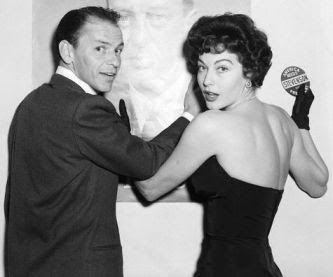

Let's kick things off with October's vixen, Ava Gardner. Ava is remembered among friends as having a vibrant energy and a wicked sense of humor. Her laughter was quite infectious, and her self-deprecation often left those around her in an uproar. For example, she frequently made herself the butt of the joke (literally) around paramour and husband #3, Frank Sinatra (together above). When Ava and Frank first got together, they went through a rough patch of public hatred. Frank was married to wife Nancy at the time, so he was labeled a philanderer and Ava a home-wrecker. In addition, Frank's career was in a steep decline, which would not pick up until he shot back to fame and appreciation for his performance in From Here to Eternity. For this reason, he was often down in the dumps. Ava's derriere was her most notable asset (pun intended), and she knew how much Frank liked it. So, when he was upset about his lack of movie roles or declining singing career, she would say, "Here, rub my ass for luck!" He always obliged. After their divorce, they would remain lifelong albeit tumultuous friends, and Frank would often tell her how much he missed her lucky rump.

Ava knew the bounty of her booty long before Frank came along, however, which brings me to the real point. When she was filming One Touch of Venus, her likeness was sculpted for the actual statue used in the film (left). Her luscious, nude form was so provocative that the studio had artist Joseph Nicolosi start over from scratch to make a less sexy, more clothed representation. Since the final product is pretty smokin', it makes you wonder what the original looked like! So too did the studio create a promotional scam to gain the audience's attention, making miniature Ava/Venus statues. Publicist Bob Rains brought the initial prototype into Ava's dressing room for her to look at. Ava held the little Venus in her hands and said, "That's not my figure." She then removed a chunk of clay from the chest and placed it on the statue's rear. "That's more like my ass!" she said.

~  ~  ~


When Anthony Hopkins was given the opportunity to work opposite Katharine Hepburn in one of his first major film roles, he was both ecstatic and nervous. To come toe-to-toe with a reigning movie queen-- who was indeed playing Queen Eleanor of Aquitaine in The Lion in Winter (above) opposite himself as Richard the Lionheart-- was a dream he found almost impossible to believe. However, he found Kate to be completely down to earth, spunky, and generous. She gave him some of the best advice of his career, which was "Don't act, just say the lines." He was also quite taken with her voice, which was so powerful and unique. Her familiar New England drawl had become by that time as infamous as the lady herself. Attracted to the caricatured way she spoke, Anthony kept the memory of her natural yet calculated undulations in his pocket for future use. In his later career, he returned to good ol' Kate and her staccato accent for inspiration, adapting her way of speaking for one of his own characters: Hannibal Lecter in Silence of the Lambs (below). You may not have noticed the resemblance before, but you definitely will now. Just imagine Kate asking for fava beans and Chianti. Uncanny.


~ ~ ~

Speaking of Anthonies, Anthony Quinn (left) had a run in the with Grande Dame Mae West when he was a young, struggling actor. A friend got him a meeting with Mae when he heard that she was backing a play about John Barrymore. Anthony could do a heck of a Barrymore impression, so he thought maybe he could score a role. However, having heard the rumors about her, he assumed that she was a compulsive sex-goddess, who would certainly make a play for him. In his youth, he was known for his exotic masculinity and unconventional good looks, thus the he-man was a bit afraid of her! What if she made a move? Should he, could he, refuse? In his mind, he found the gender roles switched, with him the coy and nervous young thing and Mae the sexual predator with a lustful appetite. 

He was, therefore, surprised, when he entered Mae's abode and found her to be nothing but nice and surprisingly petite, (as seen right). She was sweet, accommodating, and listened appreciatively to his audition. Quinn got a bit uncomfortable when she gave him a tour of her home, which included her bedroom complete with mirrored ceiling. No moves were made, but when she showed him to the door, she asked to feel his bicep. Quinn blushed but obliged. "Very nice," she said. At that, they said goodbye. Years later, Quinn relayed this story to John Barrymore himself, whom he had befriended. John's response: "You mean with a come-on like that, you didn't do anything! That's not a very good impersonation of me." 


 But then, John (above) wasn't exactly a shrinking violet. In a separate bit of information, the notorious lecher once drunkenly entered the Ladies Room at a restaurant by mistake. When a matronly woman entered, she was quite shocked to see him standing in one of the stalls. "Sir, this is for ladies!" she said. John turned around, swung his "appendage" at her and said, "So is this."

~ ~ ~


Greta Garbo (above) is notorious for being enigmatic and eccentric. Because she took Lon Chaney's advice to maintain an aura mystery with regard to the public, Garbo has remained as fascinating and alluring all these decades after her heyday. Our curiosity continues to draws us to her. She belongs in that small cluster of celebs that you can't quite figure out, such as Marilyn Monroe or Marlon Brando. What was it that made these odd ducks tick? I can't answer that one for you, so instead I'm going to throw another log on the fire.

Greta had a very small group of friends that she collected over the years. Every once in awhile, her shyness and aloofness would disappear at parties, particularly in her early Hollywood years when she was on the arm of her beloved John Gilbert. But in her later days, she kept a few friends close and everyone else a few thousand leagues away. One of her pals was Sam Green, an art dealer whom she respected and admired. Sam was used to Greta's "come here, go away, come here, go away" mentality-- keeping people at a distance and then calling them back when she was lonely. He would get frustrated with the game, but he had a soft spot for the strange, sad girl underneath the confusing facade. He too would spend a big chunk of his life trying to get to know Greta and coming up empty handed. The woman was... indescribable, as this next tidbit will exemplify:

The Aging Movie Queen

One day Green was visiting with Greta at her New York home, long after her days in the movies. The now elderly Greta left the room to mix some drinks in the kitchen. Sam grabbed a handful of peanuts off the coffee table, and he accidentally dropped a few on the ground. When he bent to pick them up, he saw a strange shock of color underneath the couch. Bending down farther, he saw a cluster of troll dolls, all standing in a row. He couldn't believe his eyes! What in the world would the Queen of Cinema want with all of these ugly little things? He shook his head, sat back up, and didn't say a word when Greta returned to the room. He never mentioned the dolls to her, but on every future visit, he would peek under the couch when he got a chance. Each time, he would see the dozen or so dolls, always in different positions. He never knew what exactly Greta did with them, but he always imagined that the aging madame brought them out when she was lonely and had them enact little plays for her. Who knows... Greta, you're a quandary.


NOW, THAT'S FUNNY: Part I