Download Games

Recent Posts

Showing posts with label W.C. Fields. Show all posts
Paulette Goddard in a very elaborate get-up when she was
part of the Follies.


Hollywood and Beauty are nearly synonymous terms; Hollywood and sex are perhaps even more interchangeable. Aside from invigorating storylines and their emotional relevance, the movies have always offered us perhaps even more profoundly another source of satiation for our very ravenous eyes. Hitchcock wasn't barking up the wrong tree when he made Rear Window, starting a discussion on the obsessive and at times creepy voyeuristic tendencies of mankind. Watching gorgeous bodies in motion, observing creative and aesthetically appealing mise en scene compositions and camera angles, has made us all rabid devotees of theaters, televisions, and now iPads. But we didn't always have the movies. Before that, there was theater, vaudeville, travelling acting troupes... But nothing would produce the glorious collaboration of beauty and sex appeal, nor unleash it upon a grateful public on such a grand scale, as the brainchild of Florenz Ziegfeld: The Ziegfeld Follies. Using the knowledge that men enjoy few things more than looking at beautiful things, and enlisting the aid of a myriad of women who enjoyed the power of being the objects of male desire and adoration, Ziegfeld started the Paris-inspired Follies in New York in 1907, renaming it the Ziegfeld Follies in 1911. By 1913, The New Amsterdam Theater had become its home, with 1800 seats and shows going all the way up to the rooftop, where The Danse de Follies took place. While some regarded these extravaganzas as rude, offensive, and exploitative, you couldn't argue with box-office revenue. The public had spoken; they liked what they saw.


Chorus girls light up the stage.


The shows weren't as simple as strip-teases: there was elegance, detailed costuming, fantastical imagery, and romanticized story-telling. Sure, every once in awhile girls showed up buck naked, but in these cases, they were always forced to remain stationary so that the show did not become graphic or "lewd." It was only the glamorously bedecked females that were able to move and shake. And these women weren't frowned upon; they were adored. Wealthy businessmen, most of them older, near to retirement and enjoying their years of hard work, spent the late night hours paying it off on the numerous lovelies who danced and sang for them on stage. Of course, performances by comedians like Eddie Cantor were also intermittently featured, but that's not what the public came for. Tickets to get in were expensive, so only the elite could afford them, which also added to the acceptance of the shows as "classy." Because of the glamour and fashion, women came too, and the shows became hailed as legitimate and invigorating entertainment... with a side of naughty. The same reception would not have resulted in poorer districts that lacked the cash for flash. Working girls fought their way into the Follies, both to have a job that often paid more than their fathers were making, but also to hopefully land a "sugar-daddy." For some, a little gold-digging went a long way. For others, their brief moments on the stage only served as a stepping stone to higher aspirations. Many Hollywood leading ladies got their start spanking the planks at the scandalous Follies. It proved to be a wealthy source of education in terms of how to use sex appeal and feminine charm to demand attention. While some may have been embarrassed at their humble, fleshy beginnings, they often had to admit that the experience helped them establish their later film careers. In this respect, the days with Zeigfeld were not merely moments of youthful folly.


Olive Thomas:
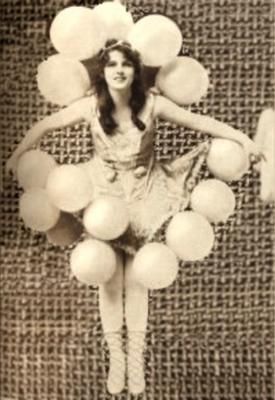
Olive arrived at the Follies in 1915. A great beauty, it wasn't long before she became a main attraction, of course her ongoing affair with Florenz also helped her rise in the ranks. She was assigned to more and more scenes, got to wear the most elaborate and elegant costumes, sang solos, and accrued scores of admirers-- including a German ambassador who once gave her a $10,000 string of pearls, (that's $100 grand today). The era when Ollie was a part of the Follies is often remembered as the best, due to the epic stage designs by Joseph Urban, but the shows would continue into the early thirties. In the 1910s, girls would sometimes stroll through the crowds of appreciative spectators wearing negligees covered by several helium balloons (see Olive left). The men in the crowd would use their cigars to pop the balloons, slowly revealing more girl and less latex. The girls also played games to entertain themselves while onstage, such as competing to see who could hit the most bald heads with their tossed garters. While performing in the Midnight Frolic, which was slightly more risque, Olive was also one of the many girls who danced on the infamous glass walkway, which Florenz had built so the men could sit beneath the high-kicking ladies with a... better view. Like most of the girls working at the Follies during these early, rebellious years, Olive didn't take the whole thing too seriously. She felt no guilt or embarrassment with regard to her employment; she was laughing all the way to the bank, and in an era when women still had little authority-- indeed, not even the right to vote-- a position in the Follies was one of the most powerful positions a girl could hold. Olive tarried at the Follies for 2 years, and then left the stage for the screen. But, during her time with Ziegfled, she was numero uno. As the "Most Beautiful Girl in the World," she was featured in a routine that showcased various women of different nationalities walking down into a large cauldron of sorts. Then, emerging from the melting pot came the sum whole of their parts: God's perfect creation, Olive Thomas. She was the ultimate, male dream.


Barbara Stanwyck:
Back when Barbara was still known as Ruby Stevens, she was a feisty and ambitious youth determined to overcome her impoverished lifestyle. Toughened up after her mother's death and her father's abandonment, Ruby spent most of her tender years escaping from foster families until she completely dropped out of school and started looking for work on her own. By the age of 14, she was already pounding the pavement, and having been inspired by her elder showgirl sister Mildred and the acting of silent film star Pearl White, she decided to become a performer on her own. Driven by an unrockable focus, there was little that was going to get in her way, which, despite her unconventional looks, allowed her to force her way into the mainstream. Allegedly, an audition landed her a gig in the chorus of the Follies for both 1922 and 1923, when she about 15 or 16-years-old. She also participated in various other chorus girl acts after leaving the Follies, but the hardened youngster wasn't satisfied with merely smiling and looking pretty, and her great strength and passion for honest and deeply felt work would soon take her from the stage to the screen, where even after her death she maintains a reputation as one of cinema's greatest, most professional actresses.


Louise Brooks:
Louise started out her performance career as a dancer with absolutely no ambitions to go into acting. As such, she was much more comfortable performing on stage under the tutelage of the illustrious dance instructors Ted Shawn and Ruth St. Denis than she would ever be before the camera. After learning from the masters, she performed with Ted and Martha Graham in the Denishawn company, but was later fired by Ruth for her inability to "co-operate." Louise then found herself a part of George White's Scandals, a contemporary of the Follies, but quit to follow her friend Barbara Bennett to Europe. When she returned, Florenz Ziegfeld scooped her up, and she began dancing at the Follies of 1925. Florenz was impressed with Louise, and soon she was climbing the ranks (literally) and was placed at the top of those notorious Follies girl-pyramids. During her time there, she also befriended fellow performer W.C. Fields, though his routines in the show were far different from her own. Will Rogers was also a member of the company at that time, as was Paulette Goddard. Louise was finally wooed by Walter Wanger to Astoria's Paramount Studios, where she begrudgingly started taking on film work. She considered it a mere experiment when she made her debut in Streets of Forgotten Men, however, she would soon become one of Hollywood's brightest stars. The city girl was about to move West.


Marion Davies:
Marion Douras too came to the Follies in her youth, but she may have had a little help securing a spot in the chorus. She was already working as a chorus girl in various shows, along with her sisters, by the time she met William Randolph Hearst in 1915. She was appearing in the Irving Berlin musical Stop! Look! Listen! at the time, in which she appeared in the number "The Girl on the Magazine Cover." Hearst definitely noticed her, despite the fact that she was an awkward beauty with a stammer. Her light personality and large eyes won him over, and he started flattering her with flowers and gifts. She wasn't the only lovely he was courting, indeed he had a reputation with show girls (he had even married one, Millicent Wilson), but soon Marion would become the only real woman of interest in his life. He arranged to have some special photos done of Marion at Campbell's Studio to test her star power and promote her. Marion was fairly clueless as to what was going on, and was uncomfortable when she spotted Hearst sitting by the camera watching her. Noticing her discomfort, he in turn got embarrassed and left. He would begin courting her in earnest and started heavily publicizing her career in his many papers, which eventually helped to land her a spot in the Follies in 1916. Marion, who had by now changed her name to Davies, didn't shy away from the attention; it was a way to support herself and her family. She later admitted that she had started out a gold-digger only to surprisingly find herself in love. She didn't tarry long in the Follies, for Hearst was determined to make her a star in the movies. As was Marion's character, she just kinda went with it, and it paid off in full.


Many other girls paid their way to fame in the Follies, including Joan Blondell, Mae Murray, Josephine Baker, Gyspy Rose Lee, Dolores Costello, Eve Arden, Irene Dunne, Mary Nolan, and Billie Dove (left). However, there too were a few who were turned down as being "not pretty enough," including Norma Shearer and Alice Faye-- of course, those ladies certainly proved their worth when the world fell in love with them on the silver screen. While the Follies shows at first appear to be nothing more than early strip-joints-- and perhaps when it all comes down to it, that's what they were-- somehow they remain something better. Before the great depression, they were an example of the grandeur, the wealth, and the glory of the almighty American dollar. Florenz Ziegfeld spared no expense when it came to his sexual extravaganzas, a flaw that would later send him into bankruptcy, but his big dreams echoed those of his thriving country. As America continued to play with the very thin line between artistry and deviance, between innocent sexuality and flat-out sin, the Follies reflected the most we could get away with. While some of the participating women may be mocked or criticized for their bartering of flesh for cash, the times they lived in did not promote the same sense of "wrongness" that today's feminists cringe at in retrospect. The female had not yet escaped her place in life as an object/wife/mother. The Follies were thus surprisingly a step in the right direction; a step toward female independence. For the first time, and on a grand scale on that large, vibrant stage, women were finally able to feel powerful. With men wrapped around their fingers and drooling at their feet, the Follies stage must have been one of the only places on earth that these ladies felt completely safe, completely in control, completely in command... even while scantily clad. After all, they couldn't very well have sold seats to a crude show if there weren't people willing to buy tickets.


An example of the mixture of sex and sophistication that
Ziegfeld brought to his shows.

HISTORY LESSON: Follies Girls to Leading Ladies

Gary Cooper on the set of Farewell to Arms


I spend a great deal of my time reading. A very, VERY great deal. Most weeks when I come to the computer, the topics I discuss are a result of deductions I have made from different source materials. The more I read, and the more films I watch, the more I am able to pull together a thorough analysis of a given individual or situation. When I see a person surrounded by the layers of context they survived within, it makes him or her much easier to understand and flesh out. 

I have been impressed by many biographies or novels of historical analysis, and nonplussed by a handful as well, but there are a few that stand out in my mind as particular favorites. This week, instead of drawing personal conclusions based on what I've read, I shall introduce the materials themselves! Here are the books that currently fill my "Top Three Faves" slots:

1) A Cast of Killers by Sidney D. Kirkpatrick: This book is amazing!!! I stumbled upon it at the Los Angeles Library when looking into the William Desmond Taylor murder. Curious about the unsolved case, I decided to investigate and was thrilled to find that a book existed told from the perspective of acclaimed Director, King Vidor. This book reads like a crime novel, with Vidor standing in as Sherlock Holmes. It passes like fiction, but is non-fiction, based totally upon the diaries and findings of the director himself as he plunged headfirst into the life and death of his dearly departed friend. Kirkpatrick weaves together the facts of the Desmond case along with Vidor's personal investigation of it. Along the way, you get to know Vidor himself, including the romantic and enduring friendship he shared with business partner and former flapper, Colleen Moore. Light is shed on the effect the case had on Mabel Normand, Mary Miles Minter, and all of Hollywood, and recorded interviews with the people who were there give you a first-hand look at the death that knocked the film world off its Olympian pedestal. I won't give away the ending to those who wish to experience it for themselves, but for a spoiler and a recounting of the case as exposed by Kirkpatrick, go to my past blog on Taylor. I can't say enough about the pacing, the suspense, nor the fascinating approach to history that Kirkpatrick presents. I think I set a record for how quickly I read this one! For murder, mystery, scandal, and heart, this one is a must.

2) Hollywood's Hellfire Club: The Misadventures of John Barrymore, W.C. Fields, Errol Flynn, and the Bundy Drive Boys by Gregory William Mank: I bought this book on a whim when killing time in a Joseph-Beth Booksellers. I already had a stack of books at home and had no reason to make a purchase, but this one was pulling me to it like a moth to a flame! The jubilant, horrendous, mischievous, and down-right dirty lives and shenanigans of the group of friends who used to meet and mingle at the former residence of John Decker is brilliantly recounted in this novel. The 'Boys' include: Barrymore, Fields, Flynn, Decker, John Carradine, Sadakichi Hartmann, Thomas Mitchell, Anthony Quinn, William Fowler, and a few more. Since misery loves company, it only makes sense that these fun-loving, drunken fools find each other, and the trouble they get into is legendary. There are stories of Decker and Flynn hi-jacking a mannequin, Barrymore flashing a matronly woman in the ladies room, and the eccentric Hartmann wetting his pants because he's too lazy to get up from his seat. But with the laughs comes the tragedy, and while you chuckle at the general merriment of these troublesome fellas, you also find yourself weeping at their tales of self-destruction. Most die too young, mere fragments of the men they once were. Though their flaws are displayed openly and without apology, you cannot help but wish you had been a fly on the wall to witness even one night of their debaucheries! For all the mud slung at these men over the years, something has to be said for each of them-- if you want to know a measure of a man, count his friends. The love they denied themselves, they gave to each other... with a shot of brandy, of course.

3) Silent Stars and The Star Machine by Jeanine Basinger: I grouped these two phenomenal books together, because they are written by the same author, whom I adore, and I couldn't decide between the two!!! I have my mama to thank for these, who is always on the lookout for me when it comes to literature. Silent Stars is a great jumping off point for anyone looking for an introduction to silent cinema and its celebrities. The enormous impact that the artists Basinger features is so profound, that even witnessing it years later in the pages of the book is enthralling. The decadence of the silent stars is unparalleled. Back then, passers-by could see Pola Negri walking her white tigers down the street, or see tracks on the dirt road from Tom Mix's initialed tires. In The Star Machine, she equally investigates the impact of movie stars in the golden age, but more interestingly deconstructs their calculating and laborious creation. How stars were built, physically as well as career-wise, is fascinating. The complete and utter metamorphosis many went through created a great divide between their true and their manufactured identities, and more than one celebrity fell prey to a fractured and unnerved psyche as a result. Some played along, others fought against the system. Some are remembered today, some are forgotten. Some found a place at the crest of super-stardom, and some never quite made it because the public never responded. With features on Jean Arthur, Tyrone Power, and Eleanor Powell, you get more than a taste of true Hollywood, where all the glitz and glamour is shamelessly chipped away.


I recommend all of the aforementioned books very highly, as I refer to them frequently in my studies. For those not so interested in film and its historical and social implications, they may not seem worthwhile or could be quite laborious. But for those true Hollywoodland connoisseurs out there, there will be no tastier meat upon which to feed your starving minds! If you do take a gander, tell me what you think, and if you have any recommendations for me as well, I would love to hear them. And remember, "Beware of the man of one book!"

IF I DO SAY SO MYSELF: Book Review