Download Games

Recent Posts

Showing posts with label Betty Grable. Show all posts


Rita Hayworth throws herself into the bullring and takes
down Tyrone Power in Blood and Sand.


Blood and Quicksand


In the Golden Era, the battle of Stars vs. the Studios was a constantly waged and painstakingly contained one. A star could use his or her box-office power to get away with a lot of things that the top dogs would otherwise refer to as "deviant behavior," but the moguls too had ways of getting their performers to toe the line. One method was "career threat." When a celebrity got too pushy or started to go too far, another, younger actor would be presented-- one who was almost a double of the alleged offender. This was the studio's way of saying: "Go ahead. Misbehave. There are plenty of people waiting to take your place." This ominous warning would often cause whatever diva was having a tantrum to back down. It was but one of many games in the dog-eat-dog world of Hollywood, where biting the hand that feeds was the appetizer de rigueur. Victims and villains were hard to tell apart: moguls thought that they were betrayed by the childish, narcissistic stars they had helped to create, and stars thought that they were abused, overworked, and under-appreciated by the greedy men behind the metaphorical curtain. In such an environment, if you weren't a business mastermind, it was often hard to keep your head above water. Suffice it to say, there were rarely winners, and mostly losers.


Carole Landis (left) was one of the many who played the game and lost, though her complete victimization by the system is not up for debate. An actress who was very far from the accepted cinematic Drama Queen, Carole was selfless, friendly, and hard-working. This did not, however, leave her free from punishment. Just being a woman in Hollywood was burden enough on its own. When Carole was signed at Twentieth-Century Fox, she quickly became accustomed to this fact. Early in her career, her beauty, singing talent, and natural charisma in front of the camera made her a prime pawn of actress intimidation. Low on the totem pole, Carole wasn't immediately given leading roles, for her box-office power hadn't been tested. Thus, her presence was used to intimidate other actresses-- whom she resembled in some respect-- and keep them in line. Alice Faye and Betty Grable were two unenthusiastic recipients of this maneuver. Her presence reminded them of their own career vulnerability. Carole, of course, was innocent of these studio machinations, and merely used whatever opportunity she had to better her standing and hone her acting skills. Slowly, with the help of the publicity machine and the public's growing attentions, Carole found her popularity rising. She gained a little position and started using it. Thus, she in turn found herself being equally intimidated by other actresses, some of whom snagged plum roles right out from under her.


A favorite beauty that Zanuck loved to use against Carole was Rita Hayworth (right), who was signed at rival studio Columbia Pictures. Zanuck's disdain for Carole had nothing to do with her professionalism and everything to do with her refusal to go to bed with him. After an initial affair, Carole put her foot down and claimed her independence, refusing to be further manipulated or taken advantage of. Zanuck thereafter went about trying to destroy her career, finding that nursing a bruised ego was more important than cashing in on a viable, talented asset. When a remake of Blood and Sand was presented to Fox for production, Carole was a front-runner for the role of Dona Sol, and she wanted it badly. But, instead of giving Carole a rich part that she could really sink her teeth into, not to mention one that could help to further her career, Zanuck paid Harry Cohn five times Rita Hayworth's salary to borrow her on loan-out for the role. He would commit the exact same crime when My Gal Sal was filmed, though Carole was allowed to remain in this picture. However, that time around she was forced to play a minor role beneath her stature, still under the starring Rita Hayworth. Rita, like Carole, was not guilty of any malevolence. In fact, the two had a lot in common, and were simply sweet women stuck in a rotten game. Today, it is hard to imagine anyone else beside Rita playing the seductive and heartless Dona Sol opposite Tyrone Power's toreador, but with Carole's equal talent and sex appeal, it makes one yearn for what could have been had she landed the part. The reason for the final outcome had less to do with perfect casting, and more to do with the fact that-- between the two of them-- the sensitive Rita was more apt to do as she was told. Carole??? She had less of a problem speaking her mind.


Love Me or Leave Me? Given the option...


Speaking of feisty women and toreadors, Hollywood's favorite She-Wolf, Ava Gardner, didn't take too kindly to orders. She too had had her fill of harsh studio treatment, and after playing nice for many years, she was no longer in the mood to sit back and do as she was told. After an arduous shoot on The Barefoot Contessa and an enduring, tumultuous marriage to Frank Sinatra, Ava now found herself in the hospital suffering severe pangs from kidney stones. MGM ordered her back to work starting on Love Me or Leave Me, but Ava was having none of it. For starters, they were ignoring her illness, claiming that she was "faking it," which ticked her off. Then, they offered her a part in a biopic musical (about the life of Ruth Etting) in which her voice would certainly be dubbed, which ticked her off more. After the humiliation of singing her heart out in Show Boat (left) only to have her voice replaced by Annette Warren, Ava was not about to go through an embarrassing repetition. She refused, mostly because she didn't like lip-syncing and looking like "a goddamn goldfish." At her wit's end emotionally and physically, she said "hell no" and headed for Europe, leaving the way free and clear for Doris Day, for whom co-star James Cagney had been enthusiastically rallying. Doris was known up to now as a pretty, ever-smiling songstress, but this role allowed her to indulge in her underutilized talents. The depth and pain she gave to her interpretation opened a lot of eyes, though she would rarely get this serious again. She soon after hit her stride in romantic comedies opposite the likes of Rock Hudson. As for Ava, she preferred Spain... and its bullfighters.


James Cagney fought to have Doris Day star opposite him in 
Love Me or Leave Me. He chose a perfect sparring partner, and the duo
 produced some poignant and painful scenes together.


Opportunity Always Rings Twice


The hot and heavy film noir masterpiece The Postman Always Rings Twice, whose success depended very much upon the chemistry of its leading characters, could have been a very different film. Originally, Joel McCrea was offered the role of Frank Chambers. However, Joel was always very astute about his career and his star persona, and he turned the role down, not thinking himself right for it. So, the offer was given to the darker, more rugged John Garfield, who was ecstatic at the opportunity. Unfortunately, just as filming was about to begin, WWII came roaring onto the scene, and John backed out of the film to fight overseas. Then, John was refused entree into the service because of his heart condition. Deeply upset, he felt that he had missed out on two golden opportunities: the role of a lifetime and the chance of a lifetime to serve his country. Luckily, MGM offered him the role again, and this time Chambers was his. This was a fortunate result. The steamy connection between John and Lana Turner (together, right) remains one of the most romantic and dangerous cinematic couplings of all time. Becoming thick thieves and pals behind the scenes helped them to create a trusting and relaxed environment, which left them free to explode on the screen. Joel McCrea could certainly hold his own with the ladies, but his boy-next-door, "aw' shucks" persona did not have the same edge nor sexual dynamism of Garfield. John would recall this film as one of his favorites, and his partnership with Lana did not end when the filming stopped: they remained lifelong friends.


Queen Kong???


When Merian C. Cooper embarked on his now iconic adventure film, King Kong, he had a clear vision. From the outlandish story to the bold and fascinating new special effects that he intended to use, he was determined to create an incredible new world for his viewers. However, he was also aware that making a film that starred a huge, stop-motion monkey was going to be a hard one for audiences to buy. He needed to give viewers an emotional connection, one which would allow them to suspend their disbelief and get swept up into the unimaginable universe which he had invited them. The key was in casting the right girl to play Kong's captive/daughter/love interest, Ann Darrow. The actress would need to be able to relay sincere reactions and emotions, ranging from feminine sensitivity to abject fear. Merian needed an unparalleled beauty, both inside and out, to kill his beast. He found it in Fay Wray, (left) who seemed born for the role by name alone, as her horrified shrieks provided a vast amount of the film's resulting soundtrack. When Merian first offered her the part, he told her very little other than that she would be starring opposite the "tallest, darkest leading man in Hollywood." Fay's heart, which was all aflutter at the prospect of working with Cary Grant, was quickly palpitating for other reasons when she learned the truth! Her part in King Kong remains her most famous performance, which has kept her very much alive in the public consciousness. This is fortunate for her, since the role almost when to Dorothy Jordan...or Jean Harlow! Jean's version certainly would have been interesting and perhaps a bit more provocative, though it would be hard to imagine a sweet and sexy Jean screaming at an ape for an hour. With her demeanor, they probably would have hunkered down and played a hand of cards after the first 5 minutes... All the better for Merian's decision: he needed a girl who could scream, not seduce!


A match made in Movie heaven. Fay's probably missing Cary about now...

CAST AWAYS: Part VII


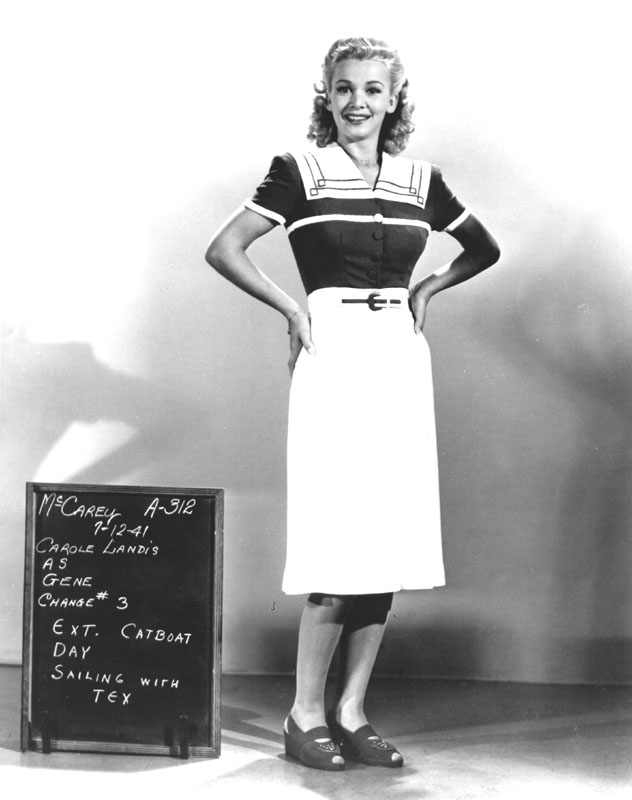
Carole Landis


It is funny what celebrity death can do... both to the public and to the deceased. The masses were so distraught after Rudy Valentino's death that at least a couple of the broken hearts tried to take their own lives as well. The tragedies of James Dean and Marilyn Monroe, instead of ending their time on earth, brought them eternal life and the love of devoted fans. Yet, sometimes, despite one's fame, to die is to die. Such is the sad case of Carole Landis, who despite her bright light, her profound beauty, and the fanatic adulation she received during her lifetime, is now remembered-- if at all-- as a sad and balled-up corpse on the bathroom floor. After she took her own life in order to ease her wounded heart, the world was left in shocked silence. Slowly, she became all but forgotten outside the halls of Hollywood's macabre trivia. The time has come to unearth her and give her the respect and embrace she always wanted but was forever denied. As the anniversary of her death approaches on July Fourth, it seems befitting to dedicate our most patriotic month to the woman who, in her life, was America's favorite patriot. Carole Landis, God shed his grace on thee...


Carole was naturally photogenic... and a brunette. 
She went blonde when she went Hollywood.


Just as mysterious and saddening as her end was her beginning. Frances Lillian Ridste was the youngest of five children born to Clara Zentek and Alfred Ridste of Wisconsin in 1919. Yet, from the beginning there was controversy, including a debate as to just who her real father was. While the family was temporarily living in Montana-- due to Alfred's job with the railroad-- Clara met farmer Charles Fenner and, it is assumed, had an affair with him. Since Alfred obtained a divorce from Clara not long after Frances's birth, credence can be given to the rumor. Clara wed Charles after her first divorce, but that union would only last 17 months. Thus, Carole inherited two absent fathers and an equally absent mother, who was forced to spend most of her days working to feed and clothe herself and her 4 children (one of whom, Jerry, had tragically already died). Carole was often left to her own devices: both to entertain herself and to fend for herself. Her childhood lacked the innocence that every youth is owed, but she never belly-ached about it. In fact, her fortitude and her selflessness were well-honed qualities that she would carry with her into adulthood, where their repercussions would eventually and vengefully take hold. A naturally friendly, light-hearted, and popular child, Carole was laid-back and easy-going. After the family moved to San Bernardino, CA, she enjoyed the pleasures of going to school and socializing, excelling at both. She could easily chat with the girls, despite their jealousy over her growing beauty-- which her sweet demeanor rendered non-threatening-- but she preferred to play sports with the boys. Athleticism was always a major part of her life, and the glamorous gowns and delicate figure that she showcased in her later film roles would eclipse a tom-boy's energetic and shapely body. In her youth, the only "dangerous curves" Carole concerned herself with had to do with softball.


In a wardrobe fitting.


Feisty and independent, Carole would survive many tragedies and mature rapidly as a result. She lost another brother, Lewis, when he was accidentally shot at the kitchen table while playing with a neighbor's gun. After her mother suffered a ruptured appendix, Carole, despite being the youngest member of the household, was the only child who neither panicked nor cried. She did what she always did and "got to gettin'." Nonetheless, the scars of these early experiences increased in her a need for escape. One option for relief was through the movies, of which she very quickly became enamored. Singing was also a talent she indulged in, possessing a beautiful voice to match her gorgeous physical features. It was this latter beauty that led to another possibility of escape: men. At 14, she passed for 21, and the fellas noticed, especially after she started winning beauty competitions (for which she had to lie about her age to enter). Luckily, Carole was completely lacking in vanity, and saw this all as a fun joke. She was more focused on creating the first powder-puff football team at her school, (though the Principal didn't go for it because it was "unwomanly"). Then, at the age of 15, she met 18-year-old Irving Wheeler and fell in love. He offered her a life away from her increasingly dependent mother, and more importantly a life of their own. Carole took the bate, and the two eloped on January 14, 1934, though the marriage was soon annulled when both sets of parents found out. Defiantly, Carole wed Wheeler again, whose intentions were more physical than emotional, only to walk out on him by September of the same year. It would not be her last tumultuous relationship.


Twentieth-Century Fox definitely cashed in on Carole's sex appeal, 
which was at times devastating to her sense of self.


The self-starter herein made her first big move: to San Francisco. Still only fifteen, she left school, her family, and all of her friends behind and travelled to the city that was known for its artistry and culture. She hoped to make a name there for herself as a singer. She did. First, she changed her name, taking "Carole" from one of her favorite actresses, Carole Lombard, and "Landis" from baseball commissioner (of course) Kennesaw Mountain Landis. Many have alleged that Carole spent her early days in San Francisco as a call-girl, but these seem to be nothing more than slanderous rumors cooked up by a jealous and unforgiving world. In truth, Carole had no time to engage in this type of vocation, because almost as soon as she stepped off the train, she marched into the famous St. Francis Hotel and asked the manager for a job. When he heard her sing, he was stunned and gratified to hire her on the spot. By working the smaller St. Francis bar, Carole was soon scooped up by the "Carl Ravazza Orchestra," and after enjoying a great deal of success and adulation, she possessed enough confidence to give Hollywood a go. In 1936, now seventeen, Carole was primed to take the industry by storm, though she would have to edit her age again to do so. With the same fearless determination and zestful work ethic that she had shown in San Francisco, Carole made the rounds to different studios and obtained numerous extra jobs until being offered a contract. 


Her athleticism served her well in the physically demanding 
One Million B.C. Eat your heart out, Raquel Welch.


Her first big break came when she was cast in the special effects, B-movie triumph One Million B.C, in which she outmaneuvered dinosaurs in scant clothing alongside costar Victor Mature. It was her athleticism that won her the role. D.W. Griffith himself was brought on board to help cast the film initially, and he hand-picked Carole because, as he put it, "She's the only [girl] who knows how to run." Soon, she was using her natural talent and knack for both comedy and drama to climb the popularity polls in films like Turnabout, in which she plays a man in the body of a woman, I Wake Up Screaming, in which she plays Betty Grable's morally questionable, murdered sister, and A Scandal in Paris, in which she plays such a sexy and devious villainess that she literally sets the screen on fire. Her beauty made her a prime candidate for some of the most popular pin-up photos of the day, though some of hers didn't make it to print due to censorship-- not because they were naughty, but because she was too well endowed. In fact, she became the first "sweater girl," before contemporary Lana Turner took the title. She was so innocently provocative that at least one particular photographer warned her before a shoot, "For God's sakes, don't inhale!" to try to diminish the appearance of her... gifts. Though Carole thought all of this objectification was a lark, she went along with it, simply because she was easy-going; not because she put stock in her sexual appeal. It wasn't until they tried to label her as the "ping" girl that she completely rebelled. She wanted to be a great actress and studied Bette Davis's performances with an eager ferocity, hoping to lend the same depth to her own roles. Sadly, because of her beauty, she was rarely afforded the privilege. Yet, she remained popular, especially among her contemporaries who constantly became smitten by her kindness and conviviality. She counted Patsy Kelly, Cesar Romero, "Mousie" Lewis, and Burgess Meredith as close friends. Even the most temperamental actors found safety in Carole's presence; she just had one of those auras that put people at ease. 


In Turnabout with John Hubbard.


All was not rosy, however. Carole's private life, if not her career, was always a failure. After finally obtaining a divorce from first husband Irving Wheeler, she then married and was divorced from Willis Hunt. She too was in a damaging relationship with Busby Berkeley and an abusive one with Pat DiCicco. Her many gentlemen friends led to rumors that Carole was just another of the many young women sleeping her way to the top. Yet, there is hardly any woman in Hollywood untainted by such a rumor, nor many who are completely innocent of it. Los Angeles doesn't breed angels. Though Carole was free-spirited and far from prudish, the assumption that she was, for lack of a better phrasing, a "studio whore," is unfounded and unfair. This is evidenced by that fact that she was able to make a legitimate career for herself, whereas so many women were simply used and discarded. It is, however, reasonable to assume that she did use the Hollywood game to her advantage, as many did, at least until she achieved enough power to extricate herself from the misogynistic system. It is generally accepted that she was one of the many ingenues Darryl F. Zanuck used for his own pleasure, but she eventually either grew tired of or outgrew this accepted station, and uttered the unfathomable word, "No." Consequently, this led to her casting in silly supporting roles beneath her talent, a tactic for Zanuck's vengeance. Ironically, the thing that saved her was WWII. Just as Carole's desire to please and bring joy to others had pulled her into a life in the entertainment business, so too did her big heart drive her to become the war effort's number one hero-- at the time above and beyond even Bob Hope or Jack Benny. Her tireless efforts in entertaining the troops at home and abroad made her America's Sweetheart and favorite patriot. Due to this, her popularity boomed, particularly after she penned a novel of her war experiences, Four Jills and a Jeep. Zanuck was begrudgingly forced to produce a film version-- albeit a Hollywoodized one-- starring herself and her three female compatriots, who were also worthy of much praise, Kay Francis, Mitzi Mayfair, and Martha Raye.


Entertaining the troops with Jack Benny.


The war changed Carole. Seeing brave men fight and die, befriending them and then losing them, and witnessing first hand the terrors of war, awakened in her a deeper knowledge of herself. No more did the glitz and glamour of stardom matter to her, not that it ever did much anyway. Now she wanted something more meaningful and fulfilling in her life. Most particularly, she yearned for a love that would lend her life gravity and comfort. She sought to attain this goal by wedding a soldier whom she met in England, Thomas Wallace. However, after their whirlwind, mid-battle courtship and wedding, the two returned to American soil and realized that they had little in common. Tommy had married her to fulfill a dream-- to wed a movie star-- only to realize that a determined woman with a career was far too belittling to his own masculinity. Carole's pipe dreams again went up in flames. After Tommy broke her heart, she moved on quickly and wed businessman Horace Schmidlapp, though that marriage too was not to last. The construction of her happy home was thus based on rocky soil. Love is found, not manufactured. The fighter in her believed a little elbow grease and work would create the life she wanted, but in reality she could never really build with anyone the love that she was looking for. 


Carole lies dead, beneath Det. Emmett Jones.


Then, she met Rex Harrison. Handsome, educated, talented, (and married), he wooed her quickly and efficiently. The only trouble was that, besides the Missus, Rex had a dark side. His feelings for Carole were superficial and sexual where hers were deep and emotional. Finding herself lost and unhappy in her career after the war, which left her feeling undernourished and useless, Rex became her all. Making movies, and bad movies at that, was a far cry from the deeply fulfilling humanitarian efforts she had offered up in Europe and Africa. She trucked along, never revealing her inner pains, remaining the devoted and beloved friend every one knew and loved, but inside she was crumbling. There is speculation that Carole tried to end her life more than once but had always been stopped before the mortal damage was done. These attempts, if true, were cries for help from a woman who was unable to articulate her own weaknesses; who knew only how to serve others and not take selfishly from them. The ability she had to push past her pain, slowly but surely crept up on her and reached a climax with hurricane Rex. Finally, tired of being used, of always being the other woman, Carole confronted Rex after a Fourth of July party that she had hosted. It is assumed that the two quarreled and the relationship was abruptly ended. That night, Carole packed all of Rex's belongings, photos, and memorabilia into a bag and left them by the mailbox at Ronald Culver's house, where Rex was staying. Then, she drove home, swallowed 30-50 Seconal tablets, and was not found until the next morning when a stunned Rex appeared before her maid and said, "I think she's dead." He, coincidentally, ran from the scene after the discovery. The eternal image of Carole now is that of a girl in a pretty summer outfit, lying on the floor in a ball, her arms frozen in an awkward, bent position. This posture suggests that she was trying to raise herself back up. She would not make it. Carole Landis: dead at 29 years of age on July 4, 1948. 

In one of her girl-next-door in one-helluva-sweater poses.


This sad, tragic tale is like so many in Hollywood, but is perhaps the most tragic because of the girl it involves. Of all the tormented souls wandering La La Land, or those who are immersed in their own demons, Carole seemed on the outside to be the least likely of its victims. Strong, vibrant, endearing, sensitive, giving, sweet... She was beloved by everyone in the community, save for those salacious studio wives who enjoyed spreading slanderous rumors about her. For her corpse and not her film work to be more remembered, for treacherous lies to be recalled and passed on and not her good deeds and selflessness, is the height of shamefulness. In every role she played, Carole brightened even the dullest of duds. She stole every show, not through effort, but from pure, unadulterated charisma and charm. She was the girl-next-door every service man in America fell in love with, and the compassionate lady every soul-sister wanted to give a big ol' hug. Yet, she forever remained apart. In her youth, she was the "other" child, and later, she became the pretty girl in Hollywood who, no matter how surrounded she was by people, was always alone. You cannot invent love, you can either give it or receive it. Too much of Carole's nature was in the giving and not the receiving, until she gave all that she had and was left with nothing. Her offerings to us, her remaining films, are cold comfort to a world who at one time idolized her and now only sits in ignorance. But, for the precious few who do recognize the true jewel that she was, her entertaining films and performances shall have to suffice. 

STAR OF THE MONTH: Carole Landis


The ultimate female objectification: Jane Russell and her assets
advertised in a 3D movie.


The battle of the sexes reached a fever pitch with the advent of cinema. Exploring gender roles on the silver screen was one thing, but it was the behind-the-scenes shenanigans that would take on much greater precedence in the history of He vs. She. The business of movie making, in a way, opened up a Pandora's Box of sexism, for as young ingenues came out to a land offering dreams-come-true and limitless possibilities, the consummation of ambition and corruption gave birth instead to what has commonly become known as "the casting couch." Sadly, it is not a myth. Hollywood itself, particularly in the early pioneering days and the apex of the studio system, was a glorified and gorified representation of a patriarchal society gone haywire. With large, wealthy businessmen and moguls holding the reigns and beautiful women running amok, it didn't take long for the well known game of quid pro quo to begin. As studio magnates got more and more powerful, their manipulation of the system, bloated egos, and inflated sensibilities of entitlement, resulted in a cat and mouse game, wherein more than one girl became the reluctant prey. In the eternal battle, many Virgins were sacrificed to the great Gods of Fame, Fortune, and Celluloid, but Rebels too came out swinging with a vengeance. Here are their stories.

LB at his throne of power.

MGM: "the dream factory." On the screen, it churned out delicious masterpieces for the eyes and imagination. Off camera, however, this iconic studio was a complete nightmare. Louis B. Mayer knew the business, he knew money, and he likewise knew how to cash in on his audiences. Yet, despite the fact that his job was to provide mass entertainment for the human soul, he seemed to lack one of his own. One of movieland's greatest hypocrites, he scolded his stars for their indecent behavior, while personally committing countless acts of debauchery and malevolence. In addition to controlling every aspect of his stars' lives-- his livestock-- spying on them, tapping their phones, intercepting their private letters and wires, he too abused his power physically. Some women, such as the strong Luise Rainer, never played into his trap and maintained enough control over their lives so that he was never able to infect their private business. Rainer (left) always made Mayer uneasy. He couldn't "figure her out." Read: she wouldn't play into his hands like an eye-batting simp. She came to work, did her job, and did not mix business with his pleasure. Actresses like Rainer, who didn't care about the fame but were invested specifically in the work, easily avoided the noose, and irritated the hell out of LB. Ava Gardner too could be lumped into this category. Fresh out of North Carolina, Ava was naive about the ways of the world when she was signed at MGM, which-- coupled with her beauty-- made her a prime target. However, Ava wasn't "that type of girl," and when she was nearly sexually attacked by a certain employee, she ran to Howard Strickling, MGM's publicity man, to protect her. Strickling ordered the man with happy hands to keep his "paws off." While Ava would later become more sexually adventurous, she was also a woman in control of her own life; she was calling the shots and not the other way around. For this reason, she was never played as a sexual pawn.


This is not to say that all women who fell prey to the man in charge were soulless fame seekers or women weak in spirit. Most girls were simply too young to understand how to fight back, nor in the days before the feminist movement did they know that they should. One such ingenue was Judy Garland (right), who in later years would recount being "felt-up" by Mayer a number of times when she was a young woman just starting to blossom. Mayer would call her into his office and have her sing for him. After she wowed him with her god-given gift, he would then say to her, "You know why you have such power in your voice, Judy? Because you sing from the heart. From here." He would then place his hand on her heart aka her breast. As an adolescent, Judy was awkward in these moments, not knowing how to react. Her instincts of course could feel that she was being abused, that something wasn't right, but Mayer was the man in charge. What could she do? (She joked in later years that she was grateful that she didn't sing from another part of her anatomy.) This type of occurrence repeated itself over the years, until finally, one day after Judy had matured, Mayer tried the tactic again. This time, Judy looked him straight in his bespectacled eyes and said, "Mr. Mayer, don't you ever do that again!" Mayer, who was known for lapsing into dramatic hysterics, burst into tears. "How could you say such a thing to me, after all I've done for you?!" Judy, shocked, suddenly found herself comforting him. At least he never laid another hand on her.


Mickey Rooney, Judy, and the "affable" Papa Mayer.


For all of the turbulence in their relationship, Mayer always had a soft spot for Judy, mostly because she proved to be such a huge moneymaker. This would come in handy later. Judy once had an encounter with one of Mayer's right-hand men, Ben Thau. When the stuffy, abrupt Thau surprisingly laid a kiss on the adolescent Judy, she was shocked. He then told her in no uncertain terms that she was to go to bed with him. Judy politely refused the flowery proposal, and Thau became angry, telling her that if she didn't obey, he would "ruin her." Judy by now had enough clout at the studio to hold her ground. She stared him down and said, "Oh, you'll be gone before I will." Indeed, he was. After the story was relayed to Mayer, Thau was out.


Another man who was known to throw his slovenly, repugnant weight around MGM was producer Arthur Freed. Judy had a hefty business relationship with Freed, whose name is present on the majority of the MGM pictures she made. Freed was another chronic womanizer who used his power for personal gain. His most infamous relationship perhaps involves Judy's co-star Lucille Bremer, who starred as Judy's older sister in Meet Me in St. Louis. She secured the job only because she was Freed's "girl." Sadly, her career didn't last much longer after the film's release. Another story involves Freed's meeting with Shirley Temple, the pint-sized actress who was one of cinema's greatest moneymakers (left). When she transferred over to MGM from Fox, the eleven-year-old was invited into Freed's office, where the pompous windbag told her that he was going to "make her a star," which, coincidentally, she already was. He then presented his... member to her. (That's right, I said 11-years-old). The young child responded with childish, uncomfortable laughter, which set off Freed's hairtrigger temper. He screamed at her "Get out! Get out!!!!" Honestly, what response did he expect? Despite the fact that this story in particular is unsettling due to Shirley's age, it is comical in that a pre-teen girl was able to emasculate the notorious lecher. (Temple's mother was also forced to fend off the wolves, who often tried to proposition her when she was trying to get her daughter ahead in the business. It is also speculated that Judy Garland's mother, Ethel, freely offered herself up on behalf of her daughter's career.).


Mayer's #2, Eddie Mannix, is a perplexing person in film history. A bruiser with mob connections, his experience and knowledge of cinema was null, making his high post at MGM... questionable. Publicly, he was Vice-President. In truth, he was a glorified spy who kept stars in line by keeping himself very knowledgeable about their private business. Needless to say, Mayer loved him, and Mannix loved his job, using MGM as his personal, sexual piggy bank. His favorite girl for a time was Mary Nolan, a former Ziegfeld Girl nicknamed "Bubbles" (right). When Mannix fell for her, she was suddenly cast in films opposite the likes of Lon Chaney and John Gilbert. However, she paid the price for fame. Attempting to prove his great machismo, Mannix was mentally and physically abusive. Sometimes he would beat Mary so savagely that she required surgery. Many would note her black and blue appearance when coming to set. It was only a matter of time before she, in addition, became addicted to morphine. (Ironically, she would play an addict in West of Zanzibar). When Mannix tired of her and tried to break it off, Nolan fought back and sued him in a court of law. Of course, being a high man on the totem pole with his hands in government pockets, Mannix never suffered the consequences for his actions. Mary was libeled as a "drug-addict" and a "tramp" in the press and quickly intimidated out of town by Mannix's henchmen. She died alone of liver disease in 1948.


One of the most horrific stories about the distorted misogyny of Hollywood can be learned from the story of extra girl Patricia Douglas. MGM held yearly sales conventions, during which Mayer entertained his multiple investors by showing off the fruits of their monetary contributions. Concocting elaborate parties that invited these men onto the back lots of the studio, wild and ribald behavior was endorsed and the wine flowed like... wine. The beautiful women and hopeful ingenues were too paraded before the slobbering lot-- dancing, singing, and serving them liquor. Eternal gentleman John Gilbert was so disgusted at the display at one particular party-- and the way Mayer was offering up "those poor little girls" like prostitutes-- that he stormed out, much to Mayer's chagrin. It seemed like harmless fun from the outside, but the truth was that once the gates of MGM closed, over a hundred girls were trapped and outnumbered by drunken, pawing men who felt they deserved a little "reward" for their lucrative contributions to the studio. On June 1, 1931, 20-year-old, Patricia was one of these victims. Growing up in Hollywood, the lovely young girl was familiar with the business and some of its players and took the job for a little extra money. It wasn't as easy a job as she originally expected, and soon things became rowdy and out of control. Actress Ginger Wyatt was also present at this affair, and would recall things getting so out of hand that actor Wallace Beery had to punch a few guys out in order to get her to safety. Patricia was not so lucky.


She was eventually asked to dance by MGM employee Dave Ross. She found him unsettling and creepy, but she found him difficult to avoid. At one point, he and an unnamed friend held her nose and poured a mixture of scotch and champagne down her throat. On the verge of vomiting, she stumbled outside onto the dirty fields of the Hal Roach lot. Ross came up behind her, pushed her down, threatened her life, warned her not to scream, and raped her. After she was discovered, bloody and bruised, she was taken to MGM's own hospital. Patricia expected something to be done, but the silence was deafening. She approached District Attorney Buron Fitts, but he of course gave service to the highest bidder, so Patricia's case went nowhere. MGM had to protect its reputation, so the story of their party had to be squelched. Despite the fact that Patricia was a young innocent and a virgin, a fact many testified to, she was labeled as a "loose woman" with unsuitable morals who was out for money. Her case was dropped, MGM was kept out of the papers, and Patricia never got her retribution. Her sad story meant nothing to Hollywood's biggest money machine-- she was just another commodity to be used as the men in charge saw fit. In court, Buron Fitts solidified MGM's defense with the mere comment, "Who would want to sleep with that?" That sentence would echo through Patricia's ears for the rest of her life. (Learn more from the film Girl 27 by brilliant author and filmmaker David Stenn).


But MGM wasn't alone in its sexual shenanigans. Darryl F. Zanuck of Twentieth-Century Fox was also a notorious lecher. In fact, it was well known on the lot that business with Zanuck was closed from 4-4:30pm each day. Why? Because that was always the time that a pretty, young actress was escorted into his office, where he would personally "audition" her. It was a free for all, and women who didn't perform off screen were told in no uncertain terms that they wouldn't perform on screen. The way these girls were paraded around led to more than one woman gaining a reputation. Carole Landis and Linda Darnell both allegedly suffered the humiliation of social judgment after various encounters. It was just the way of the business. Who were these young actresses to question it? Upon most of their initial introductions to Hollywood, they were told that this was just how things were. Not every girl was equipped with the same fierce and gamely antagonistic spirit of a Bette Davis, and some were a little too naive to simply say "No." However, Zanuck would learn that he wouldn't always get his way. When the young Betty Grable (right) entered his office at 4pm one day and was unceremoniously offered his appendage, she simply said, "That's beautiful. You can put it away now," and walked out the door.


Harry Cohn of Columbia was no prize either. The sadistic relationships he had with his actresses, especially the resistant ones like Rita Hayworth, Kim Novak, and Jean Arthur-- who opposed his power plays-- were legendary. He was labeled as "White Fang," a mental and physical rapist who left in his wake a landscape of discarded and humiliated women. He was said to have auditioned new actresses by sticking a pencil in their mouths to examine their teeth, lifting their skirts to look at their legs, and moving them over to his infamous white couch where they would "perform" before being escorted out the back door. After Marilyn Monroe appeared in Ladies of the Chorus for Columbia (left), she was invited to a meeting by casting director Max Arnow. Nervous about a possible new role, Marilyn prepped herself, crossed her fingers, and went to the appointment. However, Arnow wasn't there. A smiling secretary sent her instead into the office with Cohn, who beamingly showed off a picture of his yacht. He then invited Marilyn to come along on his next trip to sea, to which Marilyn responded, "What about your wife?" Cohn became enraged telling her to "leave [his] wife outta this," but any time he tried to redirect conversation to a rendezvous, Marilyn avoided the bait. Despite what is often said about her, Marilyn was a shrewd tactician and she knew better than to become yet another one of Cohn's walking wounded. Thus, as she made her way to the exit, Cohn blurted out "This is your last chance!" She exited nonetheless. Her Columbia contract was cancelled the following Monday.


The stories out there are endless, most of them experienced by the nameless women whose sacrifices never got them the opportunities they were promised when in a compromising position. Often, in recollection, women still protect the names of the men that so abused them on their rise to the top. One such woman is the spitfire Veronica Lake (right), who was never prone to gossip. BS maybe, but gossip no. Ronni's encounters in the extreme and sometimes rotten world of Hollywood are entertaining and eye-opening to say the least. She would recount in her memoirs mysterious auditions for various "films," which turned out to be pornographies-- one sort of movie she was not apt to make. She recalled being somewhat fearful in these situations. The casting director would try to intimidate her into accepting the job, leaving her nothing to do but run. The most hilarious of her appointments with sexism is also the most indicative of her character. She was once called in to meet a certain producer, whom she left nameless. After talking about a future role for her, this man took out his member (seemed to be a running theme) and laid it on his desk. Instead of batting her eyes at the great wonder of nature before her, or cowering nervously and searching for the exit, Veronica did what only Veronica would do. She threw a book at it. A heavy one. That had to hurt, and good riddance!


Mae West: an actress who put women firmly in a position of
power and took over Hollywood on her own terms.


One would hope that the aforementioned practices are a thing of the past and that the rise of feminism had abolished the submission of women in the Hollywood workplace, but the sad truth is that this kind of thing still goes on all the time. In a fame-hungry world, the need for power and celebrity to validate one's own existence only heightens a prospective star's susceptibility to such a cruel injustice. The hungrier one's desire for fame, the easier it is for a person in the position to give it to feed his (or her) own appetite. Luckily, there have always been those ladies who knew that their greatest service to society and themselves could not be performed on their backs. From those who suffered and those who triumphed, we can learn much: the cost of fortune should never be one's soul. Unfortunately, this truth was not blatant enough for all of these young women to see. In the game of sex, life, or business, if a girl isn't in control of her own moves, she is the one being played. Women like Lake, Rainer, and Grable had enough gumption to turn the tables and not be the pawn. Check mate, fellas.

MENTAL MONTAGE: Ladies in a Man's World