Download Games

Recent Posts

Showing posts with label Charlie Chaplin. Show all posts


The front lobby of The Hollywood Museum. 


After living in Los Angeles for six and a half years, I finally made it to one of the tourist cornerstones of Hollywood and Highland: The Hollywood Museum. You'd think it would be a no-brainer for me to visit this den of cinematic archaeology sooner, but in a way I am glad that I waited. Finding and exploring a new jewel is nice, especially after scouring the whole city and thinking that I'd left no stone unturned. Then again, perhaps the "cheesy" factor delayed my interest. Beings that the museum is located next to a Ripley's Believe It Or Not, I often opted for "not," thinking it was a mere magnet for out-of-towners and that there would be little to engage a true connoisseur's interest (ahem). Well, thank God I finally got bored on a Sunday, because to the museum I did go, and I left more than pleased.


One of the pairs of ruby slippers worn by Judy Garland 
during The Wizard of Oz.


Sandwiched between Ripley's and Mel's Diner, The Hollywood Museum is situated in the old Max Factor building at 1660 N. Highland Blvd. Due to its locale at the old make-up haven, the first floor is almost entirely dedicated to cosmetics and beauty. Different rooms, labeled by hair-color, feature different actresses, and artifacts like Joan Crawford's old make-up case are on display. The "Brownettes Only" room dedicates much of its space to Judy Garland: one of Frances Gumm's original, tiny stage outfits and Dorothy's Ruby slippers are proudly encased for drooling gawkers. The "Brunettes Only" room equally pays particular attention to Elizabeth Taylor, as the "Red Heads Only" does to Lucille Ball.


The dress Marilyn Monroe wore while entertaining the 
troops in Korea (Sorry for the glare).


The museum too, unbeknown to me, possesses one of the most extensive collections of Marilyn Monroe treasures, which are of course shown in the "Blondes Only" room. Her old makeup, famous dresses she wore, and a memorial case dedicated to her untimely death are visible, as is a strange gadget that seems to be an early attempt at the "face-lift." It bears a stronger resemblance to the iron maiden, but for your mug. Needless to say, (or should I say "needles?"), I was scared. Apart from the make-up rooms, the back corridors lead you to a garage where Marilyn's private limousine is parked. I wanted to get a closer look, but was afraid that the monkeys from the Planet of the Apes display would come after me.


The early face-lift: The Max Factor Beauty Calibration Machine, 
still raising eyebrows...


Also on the first floor is an extensive anthology of signatures collected by notorious autograph hound Joe Ackerman. This guy got everybody's John Hancock, and now the majority of them hang on the walls, encased in picture frames according to various movies. The cast of Gilda adorns one wall, Tarzan another, but most happily to me the cast of The Great Dictator was hanging for all to see, complete with the signatures of Paulette Goddard and the Charlie Chaplin. Down another walkway is a room featuring a miniature representation of the barn used as Cecil B. DeMille's first office, used when filming The Squaw Man. This is now known as the Hollywood Heritage Museum, another superb spot. Glamour shots of all of cinema's greatest stars-- Spencer Tracy, Bette Davis, Lon Chaney, etc-- also decorated the walls, along with some beautiful photos of Hollywood's growth from the early, nearly vacant silent years to the bustling times of Schwab's Diner. The temptation to slip one of these portraits under my arm was hard to fend off.


Ackerman autographs from The Great Dictator: Charlie, Paulette, 
Jack Oakie, and Billy Gilbert.


From here I went downstairs to the "Hall of Horrors," which apparently was once a speakeasy, and where now a great many props from classic horror films are on display. I spied the mask of Jason Voorhees, the dresses of Elvira and Vampira, and most impressively the facial casts of some of Horror's greatest stars: Lon Chaney, Jr, Boris Karloff, Bela Lugosi, Peter Lorre, Vincent Price, and Christopher Lee (left). There was more than scary-stuff downstairs, however, and I was pleased with a display showcasing wardrobe from both the 1917 and 1934 versions of Cleopatra. Theda Bara's headdress and Claudette Colbert's gown were both featured. The big finale was the long, dark walk down Hannibal Lane, where a complete re-creation of Lecter's cell stood waiting at the very end. I admit that I got chills when nearing it. As in the film, a folded chair awaited Clarice Starling, and Hopkins's inmate costume and infamous mask within the cell completed the illusion.


Can you smell the fava beans? (Sorry for the darkness).


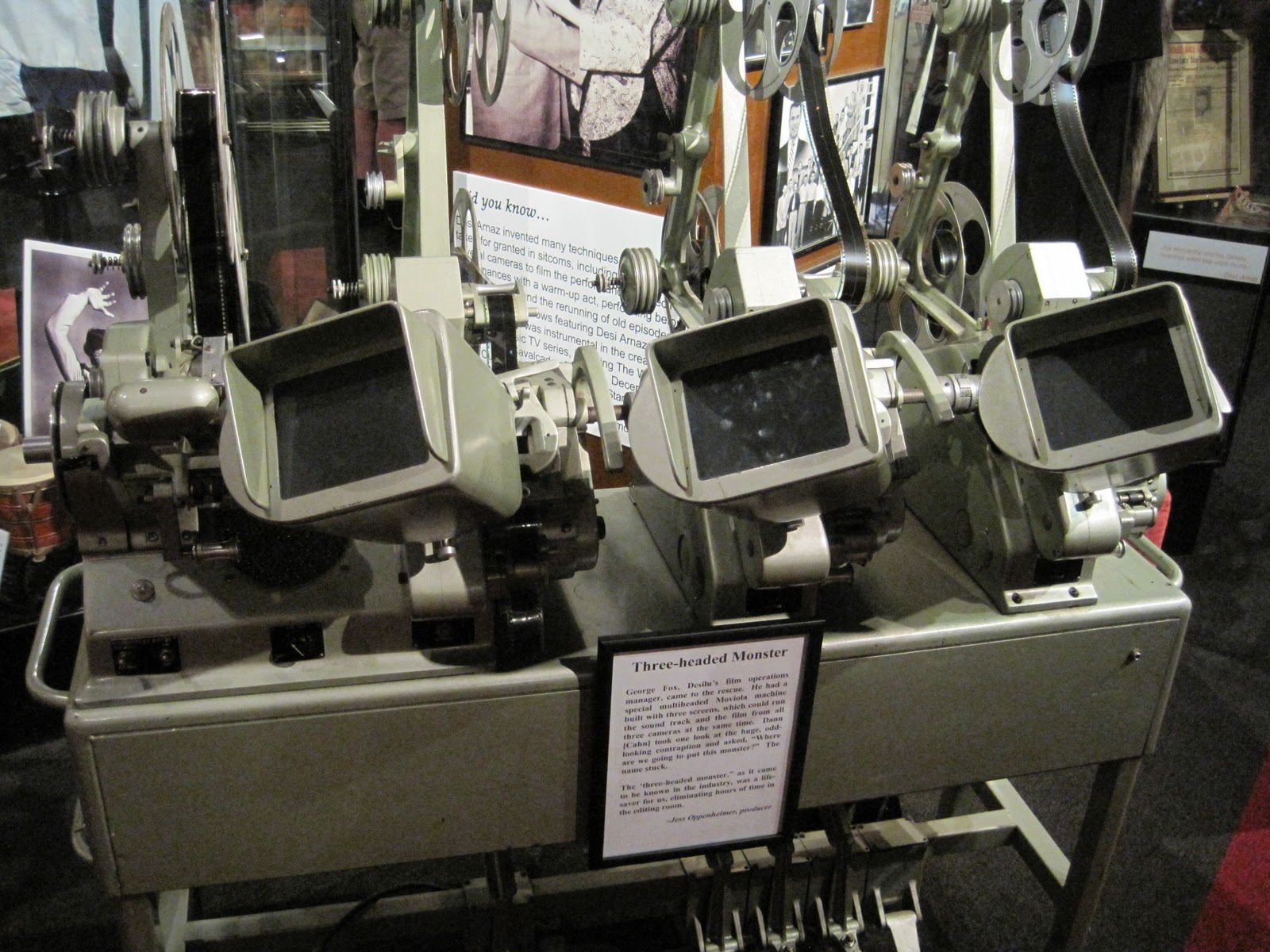
The upper floors are dedicated to rotating displays, which is what makes the museum worthy of multiple visits. When I was there early this September, I lucked out in being able to witness the "Lucille Ball at 100, I Love Lucy at 60" display. In addition to several of the awards that the lovable Lucy won over the years, various props, costumes, and personal dresses she wore to awards shows were present. One of my favorite features was the famous "three-headed monster," which was an innovative piece of equipment used to film what is now considered the first official sitcom. Much attention was equally paid to Desi Arnaz, Vivian Vance, and William Frawley. As a Gustav Klimt fan, I was also appreciative of the "Portrait of Emilie Floge" re-creation with Lucy standing in for Emilie (right).


I Love Lucy's "Three-headed Monster."


And finally, the "piece de resistance" was the top level, devoted to one of my all time favorites, Jean Harlow. Another hundred year tribute, this exhibit proved that the sweet and gorgeous Jean continues to shine so many years after her death.  Much like the Lucy display, there were several dresses to view, as well as enlarged photos of the glamour vixen (in youthful days, left), and personal letters and documents on display. Seeing first-hand the correspondence and penmanship of this silver screen goddess was quite moving, especially when perusing cute notes to friends and colleagues. As big as she became, Jean clearly always remained down to earth and loyal to her pals. Another object worth mentioning was the movie star mural that husband Paul Bern apparently commissioned for their short-lived home together on Benedict Canyon. It depicts a fictional, ancient banquet scene with Jean at center table and other actresses like Joan Crawford and Norma Shearer in attendance. It was quite decadent and unexpected. By far, the most impressive was her personal Packard on display. I don't know much about automobiles, but in this case it was love at first sight. Jean definitely had taste.


Jean's 1932 Phaeton Packard. Yum.


In the back on this same floor, more space was dedicated to other historical mementos, including a roulette table from the infamous Pickfair, gowns worn by Mae West, Greta Garbo, and Clara Bow, and Pee Wee Herman's bicycle. I wish I had had more time to really peruse everything with great scrutiny, but I literally would have had to spend hours there to do so. All in all, it was a great experience with some truly jaw-dropping exhibits and unexpected charms. The downside was that in appearance the museum was a bit cluttered, but I could hardly blame them with all of the artifacts they have to jam into one place. It's still worth a visit to those truly interested in Hollywood history and the preservation of its favorite players. I will definitely be going back when a new display comes to town. 


The much beloved Roddy MacDowell's powder room, complete 
with friends' pictures and autographs.


To visit the The Hollywood Museum: 
1660 N. Highland Avenue
Hollywood, CA 90028
323-464-7776
$15 for Adults
Open 10am-5pm Wed-Sun.

HOT SPOTS in CA: The Hollywood Museum


Ginger Rogers: the face that launched a thousand woos. 
Just ask Burgess Meredith...

During the Hollywood hey-day, Ginger Rogers was one of the silver screen gals whom the men of America considered a dream come true. One thing that set her apart from her contemporaries was her approachability. As flirty and sassy as she was, her sexiness had a cuteness to it that made her both desirable and obtainable. She was the gorgeous girl-next-door who danced her way onto the silver screen and sang her way into men's hearts. The proof of her effect on the opposite sex could be seen early in her career. In addition to garnering a great amount of fan attention, her co-stars and co-workers often found themselves mooning over her. While working on the Broadway hit musical "Girl Crazy" in 1930, her scene partner Allen Kearns revealed his smitten condition before a live audience. During a scene together, Allen was to say to Ginger's character (Molly Gray), "Molly, I love you," (as seen left). Instead, he blurted out, "Ginger, I love you!"The audience started cracking up, and after a blush, the duo had no choice but to keep the scene going as if nothing had happened. However, the slip-up was so charming that they decided to do it again on purpose for the remaining shows. As a result, when the film version was made at MGM starring Mickey Rooney and Judy Garland, Garland's character became "Ginger," both in honor of the preceding leading lady and the embarrassing romantic blunder that helped endear the show to audiences.

Burgess Meredith can be identified as another one of those pinched by Cupid's arrow in Ginger's presence. He made no secret of his affinity for the beautiful actress during the filming of their mutual project Tom, Dick and Harry (both in the film right) and flirted openly with her. He wanted to "woo" her, as would become blatantly obvious. Their attachment would never become truly romantic and was more of a friendship in which Burgess would poke fun at both Ginger's star persona and her enchanting effect on the opposite sex. As a prank, he started to send her lavish gifts every day on the set. The first was a box of chocolates, or rather a "candy woo," as he called it. The only problem was that the yummies were actually made of paper. He then sent her phony flowers as a "flower woo," fake jewelry ("pearl woo") and a ratty fur coat ("fur woo").  The rest of the cast and crew got very caught up in the hilarity, even going so far as to give Burgess suggestions and pointers on how to attack next. They came up with a "diamond woo" and a "car woo"-- the former involved an enormous fake gem and the latter a broken down Model-T Ford. Eventually, the gag got old and Burgess wore himself out. The two laughingly established an armistice and enjoyed the rest of the shoot. Ginger would always look back on this film fondly because of Burgess, whose shenanigans earned him a special place in her heart. In that respect at least, the wooing worked.

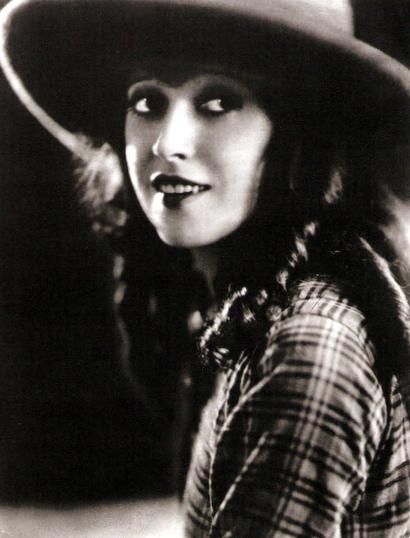
Speaking of pranks, it wasn't always the gents having fun at the ladies' expense. Sometimes, the girls got to have a little revenge as well. Hollywood's earliest Comedienne Fatale was Mabel Normand, whose carefree and boisterous humor made her a popular girl with friends and fans alike (see beauty, left). Part of her charm lied in her ability to lighten the mood when others were taking life too seriously. Sam Goldwyn would learn this when the gorgeous pip, unbeknown to him, was following him around  making faces while he lectured a film crew. Upon discovery, the perturbed Sam couldn't stay mad at her long. This was not just because he was in love with her like every other guy on the lot, but because no one could seem to stay mad at Mabel. Not even Ben Turpin, who had good reason. While filming one particular scene, Ben was to do a bit with a live bear, which terrified him. In the days before computer generated effects, actors had to duel with live animals all the time, and this kind of authenticity scared the bejeezus out of the cross-eyed clown. As such, he insisted that a stuffed bear be used instead. This was a logical request, but Mabel-- who had done her share of animal stunt work-- decided to have a little fun at Ben's expense. Ben crawled into bed beside the fake bear and, just to be sure it was phony, stuck one of Louis Fazenda's hat pins in it. It laid still, so Ben relaxed. Little did he know that Mabel too was in that bed with him, buried beneath the stuffed mammal. No sooner had the camera started rolling , then Mabel moved the bear's arms around Ben, who jumped up in fear and shot out of frame! The moment was so hilarious that it was used in the final print. Mabel thought it was a gas. After all, if a little lady like her could go mono e mono with a lion (in The Extra Girl), then a grown man like Ben could be teased a little about his lack of carnivore courage.


Ben Turpin, armed and ready for Mabel. (I wonder if she's the
 reason he went cross-eyed in the first place)?

Sid Grauman was known for two things in Hollywood: being the greatest showman in the motion-picture business and being the grandest prankster. As lush and extravagant as his movie palaces were-- like the Egyptian and the Chinese theaters in Hollywood-- so too were his gags. One of his favorite marks, and every one else's apparently, was again Sam Goldwyn. The uptight, no-nonsense businessman clearly needed to be taken down a peg or two. Since Sam was an early movie mogul, it was easy for him to find young women willing to go out and enjoy the town with him, and he certainly could have his pick of the prettiest, eagerest ingenues around. Thus, Sid decided to enlist the help of his pal and fellow funny man, Charles Chaplin (both pals right), to teach the egomaniac a bit of a lesson. Charlie offered to set Sam up on a date with a gorgeous girl: "And I mean gorgeous, Sam. You won't find another like her!" Sam, to no surprise, agreed to the blind date, and nearly went blind himself when he found himself sitting across from Sid... In drag. (Pause for spastic laughter as Chaplin grabs his side and hits the floor howling). Another kindly cruel joke was played on friend Ernst Lubitsch, whom Sid knew for a fact had a fear of flying. One day, when Sid caught wind that Ernst was about to (reluctantly) take to the air, he concocted another scheme. After the plane had taken off, he paid two actors dressed as pilots to run from the cockpit and exclaim, "I don't know about you, but I'm getting outta here!" They then jumped from the plane (with parachutes one hopes) leaving a shaking Ernst in their wake. Luckily, there were still authentic pilots flying the plane, and Ernst made it home safe, where he most certainly gave Sid a swift kick in the behind.

Gloria Swanson's hands are immortalized at Grauman's Chinese 
Theater with the help of pal Sid.

Not all of these guffaw-inducing moments were purposeful, however. Sometimes, in fact, certain people were not even aware that they were the butt of the joke. Take Gary Cooper, for example. Coop certainly had his charms and could throw out a dirty limerick or two, but he wasn't really known for his side-splitters. Nonetheless, he could be accidentally entertaining from time to time. Just ask neighbor Veronica Lake. Ronni (right in Ramrod) had taken to Coop, since he was a salt of the earth kind of guy and not one of those stuck-up, pretentious types who so annoyed her. Thus, when she would see him passing by atop his horse in the hills near her home, it would always bring a friendly smile to her face... and a bit of a chuckle. See, Coop had a habit of going for midnight rides when he couldn't fall asleep, especially on Friday evenings. So, he'd climb on his horse and ride a pace, only to  finally conk out in the saddle. The first time Ronni saw his snoring, slumped form ambling by, she probably cocked that iconic eyebrow with a "What the...?" But she got used to it. She was more worried when she didn't see Coop's horse-aided somnambulism than when she did. "No need to wave. Coop's just sleep-riding again. Saturday morning, and all's well!"


Coop on his horse and much more alert.

NOW, THAT'S FUNNY: Part VI


Hitchcock makes one of his famous cameos alongside a 
befuddled Cary Grant in To Catch a Thief.


It has been said that there are two types of movie stars: the film actor and the film personality. It could be argued which category is more vital to cinema. The "actor" star is more commonly commended for his performance skills, but monetarily speaking the "personality" star is the one drawing in the big bucks. This is not to say that the latter persona lacks talent, but he essentially-- at least according to public perception-- plays himself in every role rather than becoming various characters. Cary Grant was a personality star, so were Gable and Harlow. Marlon Brando was a film actor whose adamant refusal to become a personality star made him one anyway (at least in the tabloids). The pure film actor is more difficult to label. Lon Chaney, who notoriously underwent great metamorphoses from role to role, could be added to this category, but his publicly contrived persona as the "man of mystery" too made him famous. Modern actors are easier to peg: Daniel Day Lewis, Anthony Hopkins, and Meryl Streep-- though famous-- are more easily labeled as actors and not personalities. And what of our monthly star, Orson Welles? If ever there were a personality, this guy was it. He played incredibly varied roles over his career, but through it all, he remained Orson. His presence always dominated a film more than his actual performance. One never forgets while enraptured by Charles Foster Kane's personal disintegration that he or she is watching Orson Welles.


I bring this up to illustrate the impact of the Hollywood Cameo Role, which only truly works with a personality star. Over the years, celebrities in small cameo roles have become a linchpin in American cinema, particularly in comedies. Why? The mere presence of a well known face produces all sorts of mental and emotional connotations to viewers. A brief cameo moment on film makes things more exciting; it is a private joke between the filmmaker and the audience-- and between the star and his or her fans. Actor stars can still make a non-starring appearance in a motion picture to effect, but normally this only works when the more decorated thespian appears as one of his or her more famous characters. The aforementioned Mr. Hopkins, for example, would typically make less of an impression on fans than would his Hannibal Lecter. On the other hand, Clint Eastwood-- everyone's favorite squinting bad ass-- could deliver a line as Clint Eastwood and the audience would eat it up. The appearance of George Clooney or Ricky Gervais would equally be more effective than an appearance by Frances McDormand or Joseph Gordon Levitt. The use of star power is profound, and the use of it in a cameo role is always entertaining, simply because there is no agenda or product to sell. Whether meant to add an extra laugh or lend extra weight to a scene, a short cameo can go a long way.


Charlie Chaplin tries to collect autographs from William Haines 
and Marion Davies in Show People.


One of the earliest examples of this phenomenon that I have witnessed occurred in the silent comedy Show People, starring Marion Davies and William Haines. The very nature of the plot opened up a myriad of possibilities to use Tinsel Town to its best effect. Marion's character, Peggy Pepper, is an aspiring actress who finds herself working in Hollywood alongside the biggest stars of the day. MGM, thus, took viewers behind the scenes, making a movie about making movies. A great cameo moment occurs at a banquet when a table of stars are shown eating together: Douglas Fairbanks, John Gilbert, Renee Adoree, William S. Hart, etc. While audiences got to see these faces all the time on the silver screen, seeing them out of character and as themselves-- before the days of tabloid TV and instant internet access-- was a thrilling moment. It brought them a little closer to their idols. An even funnier moment occurs when Charlie Chaplin makes an appearance, only to go unrecognized by Marion. He asks for her autograph for his "collection," and she stands in annoyance while William Haines stands agog at the Hollywood giant before him. Charlie leaves Marion behind, who faints in Billy's arms upon her final realization. In effect, while Charlie greets these two fellow actors, he has said hello to his fans as well.


Speaking of silent films... The aforementioned situations were all very comical, but sometimes the use of different actors is applied for a more serious effect. Gloria Swanson's role in Sunset Boulevard was by no means a cameo, but the casting was a strategic move by Billy Wilder, for Gloria's natural embodiment of all the grandeur and history of old, silent Hollywood conveyed more than mere acting could. Her performance as the aging, faded movie queen thus elevated the film to another level, bringing the audience in on a continued discussion, whereas a random actress, capable as she may have been, would have had to invent all of the things that Gloria innately was. Wilder used this same casting tactic when he pulled in some other big names into cameo roles. As Norma Desmond's butler, ex-husband, and former director, he cast Erich von Stroheim (left with Gloria and Bill Holden) which perfectly indicated the continuing theme "Oh, how the mighty have fallen." Gossip columnist (and former actress) Hedda Hopper too makes an appearance as Norma makes her infamous final cascade down the staircase, amidst much camera-flashing, lending further gravity and realism to the event.


As Gloria's group of comrades playing bridge, aka the "waxworks," Wilder cast former actress Anna Q. Nilsson, silent, stone-faced comedian Buster Keaton, and the original Jesus Christ himself, H.B. Warner. (Initially, Gloria had asked William Haines to be part of this group as well, but he declined). The appearance of these individuals, especially in such a simple, dark, and strangely macabre scene, added to the pity and discomfort of film fans, who recognized the sharp contrast of the former Gods once sitting high on their Hollywood thrones and now sitting glumly around a table playing cards. To add more gravity to the game, the ever stoic and silent Keaton mutters only one word: "Pass," just as time had passed him over. Finally, Cecil B. DeMille's cameo as Norma's favorite, former director (right) too added an extra layer to their scene together, for educated audiences knew that Gloria and Cecil had worked together; that he had once called her his "little fella" and had made her a star. His empathy for her is thus more easily felt, but the audience too recognizes that the career the duo had together has long since passed, and Norma's continued delusion makes this encounter incredibly painful to watch. Cecil took these scenes very seriously, even rewriting some of his own dialogue to get it right. Wilder was so excited to have him working on the project that he completely deferred to him in the scene and let the old director take control. It was a gamble that worked brilliantly.


Most often, celebrity cameos aren't this in depth and exist purely as quick bits of humor that wink at the audience. Thus, the line between fact and fiction is gamely overstepped. Here are a few such moments worth mentioning:


One wonders what it was about The Muppet Movie that appealed to Orson Welles, but then one wonders about a great many things that went on in that Boy Wonder's head. Whatever the attraction, be it financial or comical, Orson did make a brief appearance in the film as top dog mogul Lew Lord (left). While at first, this may make one shudder at the fall of such a great idol, we too have to remember how big the Muppets were, and in addition, how many other big names made appearances in their films, from Steve Martin to Bob Hope. So, Orson wasn't really sullying his reputation by taking the project on; he was hopping on the gravy train! His bombastic, domineering personality was put to good use as the threatening producer Lord, who has Kermit shaking in his webbed feet. As an imaginative, overgrown child at heart, one can only imagine that Orson enjoyed himself.


Marlene Dietrich also added a little flavor to Paris When It Sizzles. As William Holden's character struggles to invent his latest screenplay plot, which Audrey Hepburn painstakingly tries to transcribe, he comes up with many failed vinettes. One of his imagined scenes begins with a fancy, ever-changing car pulling up to a curb. The door opens, two perfect legs emerge, and it is quickly revealed that they are attached to the glamorous Ms. Dietrich. End scene. Many women could have been used for this brief moment, but since Marlene was known to have the best pair of gams in Hollywood (see right), her casting gave it a little extra "oomph." In addition, using a big name like herself also indicated Holden's character's intention to write a big star vehicle. The film includes several other cameos, including a couple by Tony Curtis, and is, like Show People and Sunset Boulevard, a great look at Hollywood behind the scenes. Interestingly, as in Sunset, Bill is again playing a screenwriter! Clearly the cameo ploy works best in movie-themed movies!


The friendship of British thespians Peter O'Toole and Richard Burton is legendary. Two handsome men, both vastly talented, physically dissimilar, but equally caddish, they appeared in Becket together in 1964 to great acclaim (left). It appears that they remained pals when they separated and took on other various projects, for they were quickly reunited-- albeit briefly--  in What's New, Pussycat? a year later. Woody Allen's wild and outlandish script needed little help in the laugh department, but, somehow or other, another guffaw was concocted. During a scene in a bar, Peter is wandering around when he bumps into an old pal-- Burton. If you aren't paying attention, you can miss the moment completely due to the haze of smoke and the dark lighting, but the duo greet each other and quickly part, at which point Peter shouts out, "Say 'hello' to what's her name!" He is indicating, of course, Elizabeth Taylor, Dick's wife, which in essence makes it a double cameo.


In It's a Great Feeling, Doris Day's character, a waitress, goes through the gamut while Jack Carson and Dennis Morgan try to make her a star (all three right). In the end, she leaves it all behind to become a wife. The duo track her down to her wedding, where they watch the procession. Smirking and snarling through a window at how their prodigy has betrayed them, they volley back and forth about the mistake she's making, and how she'll regret being tied to some old "cornball." Then, her groom is revealed: Errol Flynn-- lecher, ladies' man, and Lothario. Errol was brought in tactically to indicate to the audience that Doris was in good hands-- at least sexually speaking. Clearly, her character is not going to be living a boring life. All this is communicated simply by showing the audience Errol's handsome face and crooked smile, which carries a plethora of connotations. (Gary Cooper also has a cameo doing his token "yup" routine).


Another type of cameo that the audience sometimes doesn't even pick up on is that of a celebrity's child in a minor role. Orson, who always had a distant and complicated relationship with his children, was at least proud enough of a Papa to cast his eldest daughter, Christopher, in his 1948 adaptation of MacBeth as Macduff's child. Liza Minnelli made her film debut in the final scene of In the Good Old Summertime opposite her mother, Judy Garland, and Van Johnson (left). And Paul Newman and Joanne Woodward cast their own daughter, Nell Potts, in a brief role in Rachel, Rachel as the heroine in her youth. The physical resemblance between mother and daughter probably made that decision a no-brainer. Cecil DeMille too cast his daughter Cecilia from time to time in various film roles when he needed to throw a kid into the mix. She appeared in both The Squaw Man and The Virginian, among others.


The King of Cameos is, of course, Alfred Hitchcock, who probably needs no mention here. Fans started to look forward to Hitch's blink-and-you'll-miss-them appearances in his films, which added a fun puzzle on top of a puzzle to his mysterious capers. It began in The Lodger-- when he is seen in the crowd, with his back to the camera as an editor, and allegedly also as a corpse-- and continued through all of his following films. Some were more obvious than others, such as the scene in To Catch a Thief when Cary Grant looks beside him on the bus and sees his director sitting stoicly. The moment is meant to be recognized, for rather than just passing it over, Cary takes an obvious look then does one of his classic bemused expressions. He, Hitch, and the audience therefore have a good "ha ha" before returning to the business at hand. Hitch had to get more creative sometimes, including the curious way he had to integrate himself into Lifeboat. Clearly, this was going to be no easy task. It would completely take his audience out of the moment if he were to randomly float by in the middle of the ocean, so instead, he placed himself in the weight-loss newspaper ad William Bendix is reading (right). He more accurately appears twice: in the before and after pictures. This provided a double laugh since Hitch was always struggling with his weight in real life. Hitch had no qualms about advertising himself, even emblazoning his name on his inter-titles in his early silents, and rumor has it that his penmanship found its way into many of his films as well. These moments became ways for Hitch to ingratiate himself to his audiences, who became just as familiar with his face as those of his stars-- no easy feat for a behind-the-scenes filmmaker.


The list of these quirky little moments could go on ad nauseum, but I will let it rest here... for now! The most fascinating thing about Hollywood, beyond the film-making of course, is the star-making. The concept of, evolution of, and implementation of celebrity into our culture, in the end, says much more about the viewers than it does the players. Those we choose to latch onto, the perceptions we place upon them, and the roles we give them in our own minds, lock them steadfastly into an identity that very often is not their own nor of their own creation. However, there are some that did contribute wholeheartedly to their screen selves, purposely encouraging their false image's mutation into societal fact. Orson Welles and Marlene Dietrich, for example, both adhered to their own mythology. It is these larger than life personae that make cameo moments that much sweeter. To see a big star, acknowledging and playing with his or her own largess, poking fun at and equally embracing the facade of this stardom, is a way of agreeing to continue to disagree with the audience: "Yes, this is all a ruse, but we both enjoy it, so let's keep playing." After all, it's all in fun. Game on!

MENTAL MONTAGE: "Wait... Was that who I think it was?"

Orson Welles, exhibiting his widely remarked upon "Oriental quality,"
 amidst objects also indicating the beauty and beast of his nature.


Orson Welles. The Boy Wonder, the Great White Hope, the Wunderkind, the Enfant Terrible, the Quadruple Threat, the etc. etc. etc. A man of multiple ambitions and perpetual, frantic, mental motion requires more than one name to account for his being. Interestingly, each moniker too infers a sort of size and magnitude. In time, his physical self would come to mirror the enormity of his intellectual capacity. History would indicate that Orson Welles was larger-than-life, a belief that he too supported by elaborating on his own mythology. You never knew where fiction ended and truth began. However, with Orson, despite the personal BS-ing, despite the flagrant disregard for societal or artistic standards, despite an almost indefatigable urge to disturb, the purpose was always about truth: uncovering truth, discovering truth, interpreting the truth, or even reforming it. But can anyone get to the truth of Orson? Doubtful. However, by dissecting his work, we can more fully come to respect him if not completely to comprehend.


Audiences waiting to get into Orson's voodoo "Macbeth," which included an all black cast. 
Orson's love of Shakespeare and dedication to reinterpreting the master was equal 
with that of contemporary Laurence Olivier. His dedication to politics and black
 rights too was a constant in his life.


Perhaps the fact most key to understanding Orson's nature is his parentage. In effect, he was forced to pay for the flagrant sins of the father and the supposed divinity of the mother. This duality, the good and evil angels whispering in his ears, continuously pulled him apart, putting him in constant turmoil with himself. His mother was the artiste, the musician, and the ambition propelling him toward success, and his father was the seductive, debaucherous, temptation pulling him to ruin. In either case, the result was excess. There was no half-way with Orson, no dabbling, no "perhaps;" there was only full throttle, full-speed-ahead, caution be damned! From an early age, after his mother's death, Orson devoted himself to becoming the brilliant youth she had always taught him to be, indeed told him he was. In fact, his mother's lover-- and in effect, his "step-father"-- Dr. Maurice Bernstein, was perhaps more fascinated with the boy than the woman. Orson would pick up quite a few father figures in his life, all of them compelled to both foster the young man's unique intelligence and artistic penchants and perhaps vicariously live through them. Orson's power and passion for life was seductive and was perhaps more interesting to men because it was always more cerebral than emotional-- though his intoxicating presence certainly affected many women in a more sexual nature. Orson's mother taught him to approach life through his head not his heart, and this effect can be seen in all of his work- cool, calculated, intriguing, but without sentiment. After his father too passed away-- a man from whom he had grown increasingly detached over the years-- Orson carried a heavy cross of guilt, and in turn began mimicking the alcoholic's self-destructive habits. Booze, women, amphetamines, food... excess. Always excess. The stress of living up to his mother's standards and the need to defy them by embracing his father's weaknesses created quite the contradictory individual-- at once intimidating, at once compelling, and always questionable.


During one of his popular "Mercury on the Air" broadcasts.


From his birth to the culmination of Citizen Kane, the story of Orson Welles's life looks like an impossibly perfect existence. Everything he touched turned to gold. In everything he tried, he excelled. Even his imperfections were exhultory, because they were devastating, different, and provocative. This was no ordinary boy. Quoting Shakespeare like he knew what he was talking about while still a tot, becoming the writer, director, and star of school productions at his beloved Todd School in his adolescent and teenage years, and making a smashing debut at Dublin's Gate Theater in "Hamlet" at the age of sixteen (playing Claudius and The Ghost, both decades older than himself), the fascinating youth's vigor was hypnotizing. Every patch of earth he tread upon, he altered. Via the Federal Theater Project and later the Mercury Theater Group in NY, he became the toast of the industry when he produced, wrote, directed, and sometimes starred in shocking vehicles such as "Macbeth," which he brazenly set in Haiti with an all black cast. Shakespeare was a constant fascination for Welles, and he would create several stunning interpretations of his classics over the years on stage and in film. His voice-- that superb, resounding, booming voice-- possessed a natural command, which was needed in such daunting roles and large scale productions. This voice too would lead him to radio, where he infected two-dimensional stories with a vivid and even violent life on the airwaves. Running back and forth from the stage to the recording studio, he would eventually write, direct, and perform in adaptations of Mutiny on the Bounty, Rebecca, Dracula, and most importantly The War of the Worlds, which memorably started a bit of a furor (which despite rumor was completely unintentional at the time). In doing so, he elevated the possibilities of entertainment. It was not just his performance, nor the performances of some of his favorite Mercury players (Agnes Moorehead, Joseph Cotten, or George Coulouris), but the creativity with which he delivered his interpretations that was so interesting. Imaginitive, bold, and inventive, he gave incredible detail to the sound of his broadcasts, even performing in the men's lavatory if he had to to create the illusion of a sewer. It was these qualities that made him a star before he had reached the age of 22, and these same qualities would bring Hollywood calling.


In Citizen Kane-- his masterwork and what some argue 
is the greatest film ever made.


Citizen Kane remains a hot topic of debate among cinephiles. It is genius, or it is absurd. It is the greatest film ever made or the most overrated. As always with Orson-- controversy. Some found fault in the film's coldness, the lack of feeling, the objectivity. Others see this as exactly the point, and they extol its artistic achievements and technological  innovations, which in effect changed filmmaking forever. The use of light, sound, camera angles, and the photography that Orson and Gregg Toland developed together kicked Hollywood in the pants and slapped America in the face. Some weren't ready for it, but ready or not, there Orson was. At the least, Citizen Kane was exciting! Not just because of the uproar it caused in the press, due to the too-close-to-home resemblance of the main character to newspaper magnate William Randolph Hearst, but because it indicated a new generation of filmmaking-- art imitating life and twisting it instead of glorifying it. Change, Growth, Possibility: these words were at the very core of Orson's agenda. The likeminded Charlie Chaplin was a fan of the film. Louella Parsons, Hearst's right-hand-gossip columnist, obviously was not. Today, the vote is still split. It was argued that, afterward, Orson's chances for true success were destroyed by Hearst and the latter's battle to demolish not only the film but Orson himself, (which is ironic since the film actually indicated more about Orson Welles than it did Hearst or his lover Marion Davies). But, Orson had his own help in dissolving his heretofore stellar career. There were bright moments ahead, but for the unstoppable boy who grew up too fast, Citizen Kane became the burdensome triumph he could neither duplicate nor live up to.


Filming in Brazil for the unfinished It's All True.


But oh, did he try. After Kane, Orson-- forever putting too much on his plate-- started filming three vehicles at once. The Magnificent Ambersons, Journey into Fear, and the government induced documentary promoting the "Good Neighbor Policy," It's All True. He filmed Ambersons and Journey simultaneously, jumping from one set to the next without changing wardrobe, then left them unfinished and in the hands of the studio-- RKO-- while he went off to Brazil to maintain the Panamerican goodwill initiative between the North and South Americas, only to be swept up in the majesty of the "Carnival" of Rio, the samba, and the saga of the local people. Editing the first 2 films long distance, he basically offered input that was overturned, and both Journey and Ambersons suffered while he nonchalantly remained abroad, dedicated to the task at hand. For this, he too was partly at fault for the massacred remains of both pictures. Draining the studio dry financially-- for Orson only cared about the art not the cost-- RKO finally released sub-par versions of the films that Orson had originally intended and then pulled the plug completely on It's All True, which remains unfinished to this day. The hunt for the original cut of Ambersons makes it one of the most sought after films of all time, though there is beauty in the final cut left behind. Journey into Fear, with its climactic rain-soaked ending, and the remaining footage of It's All True also bear the unmistakable Welles mystique.


The Lady from Shanghai-- in which Orson challenged Hollywood both
by tampering with cinematic style and the perfected image of his 
movie star wife, Rita Hayworth.


In the end, it seems that Orson became overwhelmed by his own ambitions. He held such noble aspirations, but he was never able to carry things off as flawlessly as he had in his younger days. The pressure of staying on top only succeeded in knocking him off his pedestal. But he still had bright moments to come. Between his political stints-- using radio to defend the blinded, African-American war veteran Isaac Woodard, to support FDR for re-election, or to defend himself from assertions that he was a communist-- he revisited the theater, sometimes to exultant effects-- 1947's primeval reinterpretation of "Macbeth" or the racially controversial "Native Son"-- and had moments of cinematic brilliance as well. The nightmarish quality he produced in The Stranger, urging America to wake up, recognize and remember always the attrocities of WWII, the twisted and "somnambulistic" artistic achievements of The Lady from Shanghai with that incredible, indescribable final showdown in the funhouse, or the technical wizadry showcased in the four minute tracking shot of Touch of Evil-- as spellbinding as anything ol' Hitch could produce-- show that the genius was still there. His performance in The Third Man would too maintain his reputation, if only for his contribution of that cuckoo clock monologue. What is most often concurred about Welles's work is his perfect use of sound, which is unprecedented. But more telling perhaps is the visual composition. All of his films work, even when played silently, is hypnotic. Masterpieces to the eyes, one can be riveted, moved, and mesmerized even while not completely understanding what he or she is looking at. What these intercut images relay to each individual are perhaps not always effective, but they are affecting. That was Orson's purpose. He cared little what everyone thought; he cared greatly that people were thinking.


Orson's performance as Harry Lime is what some believe to be his best. 
The seductive, mysterious, and immoral character could only have
 been made charming by a man as equally complex.


Orson's embrace of concept, of taking an idea and bending it (and perhaps breaking it) to his own unique will is what has made his work stand the test of time and continue to engage both fans and enemies. As he aged, despite different triumphs, in Chimes at Midnight for example, Orson's achievements became lost under the immensity of his polemic reputation. He became somewhat of the butt of the joke. The man who had once been the toast of the town, married to Rita Hayworth, and with all the future in the palm of his hand, was now an overweight has-been producing a slew of theatrical flops and doing vocal work on the cartoon "Transformers." To Orson's credit, he never apologized for his girth, but rather used it to full effect in his later films. Perhaps this too was indicative of his shame, a living portrait of the disgusting wreck he had become. He thus apologized and refused to apologize at once. Orson's success, however, lay not in his perfections but in his imperfections; in his daring ability to say what others wouldn't, do what others wouldn't, and try what others wouldn't dare. The result was not always popular, but it was always bold. In his case, the means justified the (at times indiscernible) ends. His eccentric, flawed, and confused body of work thus remains one of the most remarkable to ever come out of Hollywood, simply because it is the product of pure originality.


With Peter Bogdanovich and unknown. Peter was a huge fan and did several
interviews with his mentor.


Martin Scorcese said that Orson Welles was the filmmaker who influenced a whole new generation of directors to want to make movies. Orson wasn't about offering answers, he was about asking questions. He did not want to luxuriate in ignorant bliss, he wanted to instigate intellectual warfare. He took a medium based upon pretty images and fairy tales and helped to turn them into something darker and more nightmarish and equally showed that such exploration was not a crime. While he himself may be held prisoner by his own caricatured self-- mocked even in his lifetime-- his disruption of the Hollywood agenda could possibly be the best thing that ever happened to the imaginative but often uninspired town. He is best compared to his most perfect role and his most highly acclaimed performance: Harry Lime in Carol Reed's masterpiece The Third Man. Not appearing until nearly an hour into the movie, Orson exists still as a dominant presence. The audience waits, growing increasingly anxious for his appearance, and when he finally reveals himself from out of the shadows, his insolent smirk alone produces an indescribable rush worth waiting for. Suddenly, things are more interesting, more provocative, more dangerous. You can't explain why, but Orson always seems to bring "something" to the table. He had more than his finger on the pulse of American life; he was a jolt of adrenaline in its arm. If you compare films made prior to Citizen Kane to those made after Citizen Kane, you will soon be forced to agree that we are all still his junkies.

STAR OF THE MONTH: Orson Welles

Bob Hope performs for the boys in Sicily, 1943.


For a brief period, film existed solely as a pure artistic venture blended with scientific innovation. Almost immediately, this sanctity was corrupted by business, which both heightened its possibilities and tangled its intentions. Cinema as a propaganda device was always forthcoming, but despite the expected birth of celebrity product endorsements, the most influential collision of stardom and salesmanship didn't occur until the Great War. The different ages of American War have revealed themselves in various ways through our movies, but perhaps the most interesting moments occurred not in the later rallying, reactionary cries of the Vietnam or Korean Wars, but in the earlier calls to arms of WWI and WWII. This equally paranoid and frightful time produced in Hollywood a profound moment of unity, patriotism, and brotherhood. On the screen or behind the cameras, an attitude of "One for all, and all for one" reigned supreme. The movies of the day were used to relay this message, as did its stars, who for once proudly took a back seat to the Stars (and Stripes) of the American Flag. Though contention and doubts did exist, an indestructible, unified front was always presented, which was perhaps simply due to the source of the battles being waged-- particularly the genocidal WWII. In a continuing celebration of Independence Day, here is a look back the impact of war on Hollywood, and the impact of Hollywood on the war.


While the Revolutionary War called upon a young and insecure landscape to defy its tormentors (and sometimes its own inhabitants) in order to proclaim itself a union, and the Civil War pitted brother against brother when incongruous versions of scruples and ethics threatened to tear the country apart, The Great War was entered into willingly by a freshly healed and newly thriving society. Its effect would render America not only unarguably the most powerful nation in the world, but-- as it was the lone combatant to emerge without war torn soil-- it too would rise victoriously as the film capital of the world. During a period of low economic peril that would lead to the euphoria of the roaring twenties, the strength and positivity of the nation was echoed loudly through its silent film players. Most memorably, Mary Pickford, Douglas Fairbanks, and Charlie Chaplin would embark on a tour selling war bonds (left), using their popularity and charisma to maintain and enhance the country's participation in the movement. The films of the time showcased their dedication, such as Mary Pickford's The Little American, which put America's Sweetheart right in the throes of German atrocities. The picture was passionately directed by Cecil B. DeMille-- a strong supporter of both the war movement and the armed forces-- who had in fact established the Home Guard, via Famous Players-Lasky, as its Captain when the war began in April of 1917. Yet, it is Douglas Fairbanks who was perhaps most indicative of American patriotism at the time. Healthy, virile, in incredible shape, and possessing both an optimistic spirit and a zest for life-- which, if canistered, could probably have provided enough energy to power a large city for 100 years-- "Mr. Pep" was the era's masculine ideal. He proudly made several short propaganda films to get his brethren in the spirit of battle, such as Swat the Kaiser and Sick 'em Sam.


Chaplin too did a great deal to express his feelings about the war, but as a more calculating aesthete and a true humanitarian, his efforts most often revealed themselves through his own compelling work. The strongest statement he ever made about war came about prior to WWII in his defiant, tragicomic masterpiece The Great Dictator (right). While many remained blind to or even embraced the shocking new stratagems of Adolf Hitler during his rise to power, Charlie always remained aghast, dismayed, and disgusted by the Fascist's lunacy. When Hitler's administration mutated into abject madness, Chaplin was not surprised, and The Great Dictator became his impassioned wake up call to America. The artistry of the film remains pure poetry, yet at the time its honesty was under-appreciated: Hitler banned it in Germany and all other Nazi-occupied countries. It was the presence of Hitler, recalled quite accurately as one of the most crazed and demonic beings to ever live, that propelled Hollywood more emphatically into its support of the war, making WWII even moreso than WWI an interesting period to look at cinematically. While it was a Japanese attack that pulled America directly into battle, it was Naziism that more accurately identified the threat of the times. Yet, after the tragedies and losses of the Great War, there was a still a hesitant skepticism about entering into another foreign battle. Not surprisingly, most early support was coming from British actors like Laurence Olivier and Vivien Leigh, whose homeland was already suffering graphic actualities that America was only theoretically pondering. Then, the eternal day of infamy arrived at Pearl Harbor and erased all doubts. America went to war with a vigor that has yet to be matched.


A very vocal spokesperson at the beginning of America's entrance into WWII was Carole Lombard (selling bonds, left). Everyone's favorite and most beautiful kook definitely had a serious side when it came to Life, Liberty, and the Pursuit of Happiness. She gave her staunch support to the cause and went on a nationwide war bond tour for which she was able to raise over $2 million in one day. Her shocking death while on her way home from this tour had a great impact on the American people in general but most specifically on her Hollywood friends. Jack Benny couldn't even bring himself to perform his radio show when he heard the news. Respectfully, Carole was awarded the Presidential Medal of Freedom by FDR and given the notoriety of being the first woman killed in the line of duty. Carole had been prodding husband Clark Gable to enlist since before the war even began, but he-- fearing that he was not cut out for it-- had demurred. After her death and in honor of it, he did indeed enlist and, as many in his regiment would attest, started volunteering for the most dangerous missions. While fighting, he wore a locket containing the last remnants of his beloved wife: a few sparse pieces of her jewelry collected from the crash site.


Clark was not the only member of the Hollywood community to serve heroically. A large portion of the male actors fought, including Douglas Fairbanks, Jr (who enlisted before war was even declared), Henry Fonda, Glenn Ford, Robert Montgomery, Tyrone Power (right), David Niven, Alan Hale, Mickey Rooney, William Holden, etc. Jimmy Stewart, who had to sweet-talk his way into the war (due to the fact that he was underweight), would become the most decorated actor to ever serve his country. Directors like John Huston, George Stevens, and Frank Capra too contributed by going overseas and filming raw footage, which was subsequently compiled for newsreels and war documentaries. This is not to imply that these fellas were blithely fearless. The old paranoia remained, which is perhaps why Jack Warner, fearful that his studio would be misconstrued from the sky as an army base, had "LOCKHEED" painted on the roofs in large, bold letters. However, the war department demanded that he have the label removed. This was an obvious overreaction on the mogul's part, but there was reason to worry. War is a very real thing, after all. Leslie Howard became another Saint of the cause, joining Lombard, when he and sixteen others were shot down by the Germans when flying over the Bay of Biscay.


The women also did what they could in terms of entertaining the troops, participating in war bond rallies, and making public service announcements and war propaganda advertisements. Veronica Lake (right) participated in a memorable campaign that persuaded women to wear their hair up at the factories, where so many females were seeking employment during the war effort. It turns out, too many of their copied, peek-a-boo hairstyles were getting caught in the machines! War was about social fusion not fashion! (However, it could be argued that this was a mere publicity ploy to publicize Paramount's latest, sexy star). Actresses too encouraged their sisters to ration supplies, including their precious silk stockings. Rarely recalled, as well, is the fact that a young Audrey Hepburn was a courier for resistance fighters in Holland at this time. 


However, there were some men who were unable to serve due to various injuries, ailments, or simply their age. If these reasons were explained thoroughly enough by the press, the public forgave the trespasses, but there was occasional, savage hostility directed at the men whose absence from the front identified them as cowardly or emasculate. Errol Flynn irritatingly received a 4F classification from the army-- a crushing blow to such a screen hero-- due to the ravages of past and recurring illnesses. His lung was marred by an unmistakable shadow-- an effect of TB-- and he too suffered recurring bouts of malaria. There also were alleged problems with his heart, though it was only after he was refused entree into the army that it was truly broken. (He does his part for the effort in The Dawn Patrol with David Niven, left). John Wayne was too left out of the loop due to an old knee injury, and Van Johnson's recent car crash and head injury extricated him from combat. Left at home, these boys carried on the tradition of screen heroism, and their careers boomed as Hollywood churned out more and more patriotically themed films.


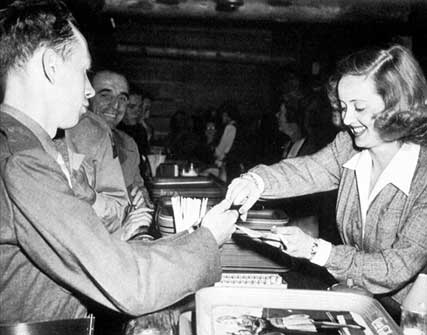
John Garfield was another macho guy, ironically left behind due to his weak heart. Frustrated by inactivity, he yearned for a way to do something special for the war effort. He decided to team up with friend Bette Davis (left, serving her autograph to a serviceman) to form the Hollywood Canteen, the dream oasis and dance hall for soldiers with a night off. Instead of cruising around to the nearest local bar, fighters lucky enough to have landed in Hollywood now had a chance to go to the infamous Canteen and talk to, be served by, and even dance with, some of the most famous stars of the silver screen. This memorable hot spot is but one of many examples of Hollywood's selflessness during the war. The way these different celebrities turned the spotlight away from themselves and onto the brave men serving their country added a great deal of gravity and character into an industry that had grown increasingly self-absorbed. The bugle sound of battle had awakened more than just a need to defend human rights; it had brought the city of angels down to earth. Movie stars making thousands upon thousands of dollars a picture were reminded of their good fortune. Thus, the immortals, the untouchables, made a conscious effort to repay a great debt to the viewers who basically allowed them their lavish privileges, and what's more, were fighting for them. Barbara Stanwyck, Ann Sheridan, Jennifer Jones, Marlene Dietrich, and Claudette Colbert were some of the many beautiful ladies who dedicated their time to the soldiers, sometimes dancing with them until their feet started to bleed! But, the men came too, and Gary Cooper, Cary Grant, and the Marx Brothers offered up jokes and laughs, chumming up to the brave men and doing their part. Before Tony Curtis became one of these elite, he came to the Canteen as a young navy officer to stare awestruck at such personalities. As such, John and Bette's landmark achievement became a Hollywood monument, (though it is rumored that Bette was a little overly patriotic in her attentions to some of the soldiers. Not that they complained).


The most dedicated and selfless offerings came from those stars who devoted their time to entertaining the troops. A majority of stars would make such a contribution, particularly to the local California army bases. Those who are truly noteworthy went overseas and into the heart of danger to bring a bit of home to the men abroad. Bob Hope's efforts are legendary as are Jack Benny's. But the army's number one girl during WWII was none other than Carole Landis (hitching a ride, right). The tom-boy knock-out was dedicated to the cause from the get-go, singing at bases, volunteering, and gamely donating both blood and money. She saw the war coming before it had reached American soil, and had even requested an acting job in England so that she could be closer to those who were already fighting. She earned her own pilot's license, hoping to enlist with the ATS, but she sadly withdrew when she learned that she would have to surrender her American citizenship, which was something the All-American-Girl was not apt to do. Her solution was to devote as much time as she could to "the boys." She remained as active as possible, and actually carried a trunk in her car filled with a variety of uniforms and wardrobe options for whichever random event should happen to claim her attention. She motored back and forth to countless benefits. By 1942, she was already made an honorary Colonel by Hollywood Post 43. She became a favorite of soldiers on leave, whom she honestly befriended. She offered up her beach house to them, and many a lucky gang found themselves taking a breather there and being served breakfast by Carole and her mother. (No funny business. She treated them as her own brothers, and they as their sister). Carole also always volunteered for the foxhole tours, which were considered the most dangerous. To her, the fellows here were the most in need.


Carole was aching to do more, and her most memorable gift to the servicemen came when she enlisted the help of actress Kay Francis, dancer Mitzi Mayfair, and comedienne Martha Raye to join her in a trip to entertain the troops stationed in Britain (all Four Jills in a Jeep, left). With her singing talents, the quadruple threat was a welcome relief to many young men whose first words to them often were, "I haven't seen an American girl in months!" Warm, fresh faces from home-sweet-home, and famous faces at that, were a dream come true in the hellish nightmare of war. Taking Cary Grant's advice to pack as many warm clothes as she possibly could, Carole and her talented retinue took on the dangerous task of spreading cheer with heart and courage. And it was dangerous. After a brief and unexpected stopover with the troops in Bermuda, the ladies traipsed on to England and later Africa. Carole documented her memories in a blue notebook that one friendly soldier gifted her early in her travels, which she would later turn into a book, and Fox would turn into a movie: Four Jills in a Jeep. However, this film, which does much to showcase the ladies' talents, does little to reveal the realities of the ordeals they went through. Carole would recall freezing nights, explosions that shook the girls to the bone and blew through their bedrooms, and life-threatening experiences-- such as a near-crash landing with the plane still ablaze! She and the ladies were once thrown into safety by some of their soldier friends, who protected their bodies from flying shrapnel. Though they donned their fancy duds on stage, where they performed a number of exhausting shows nearly every day, they wore army regulation clothing and boots on their off time, wherein they unglamorously clomped through the mud with the boys.


Carole's memories of the war and of the men she encountered would change her life and leave her with bittersweet feelings (with Mitzi at the Biskra Air Base, right). She committed herself fully, and at a cost (she would have recurring bouts of malaria and painful stomach ailments for the remainder of her short life). The height was meeting so many people, befriending them, and touching their lives; the downside was the pain of learning that they had been injured in battle or had lost their lives. Carole visited the hospitals devotedly, memorizing names, palling around with the nurses, and even refusing a private room when she herself became ill. When her tour was halted from proceeding further, Carole and Kay petitioned to Dwight Eisenhower himself for aid in allowing them to continue their mission to the frontline, come Hell or high water. He found it impossible to say no to them, and their persistence eventually got them to Africa. As tiring as the entire process was, doing eight shows a day over and over for thousands of men, traveling to strange and dangerous destinations, and getting little sleep, there was some time for fun. A few of her favorite soldiers took her and Mitzi especially around, showed them what remained of the wrecked local life, and indulged them in jitterbugging. Carole too found time for love, falling for soldier Thomas Wallace, and fulfilling what she must have believed was a patriotic duty in marrying him. The trials she had to get through merely to get this process done was arduous enough in wartime England, but with her usual persistence, a little luck, and the help of friends-- who offered up their wartime coupons, so she could buy a wedding dress-- she completed this ultimate fantasy on January 5, 1943. Another high point was being able to perform for the Queen of England. It was always Carole's singing finales that brought down the house. After four and a half months, Carole and her gal pals ended their unified journey. Carole would never forget it, nor the soldiers her.


Back at home, Carole motored on with radio work, filmmaking, writing her war memoirs, and continuing in her patriotic efforts-- even performing in the rain for an ecstatic public who came to see her. As the war ended-- and her storybook marriage to Tommy-- she found it hard to re-assimilate to the banal existence of a once again self serving Hollywood. It certainly contributed to the depression that would later claim her life. Perhaps she felt the impact of that brief moment of history a little too deeply. Perhaps her knowledge of it was simply more profound than so many others-- who had remained ignorantly comfortable on American shores-- to understand. Existing on war-torn terrain and returning to a land of glamour and phony prestige no longer seemed bearable. But then, this was not the total reason for her end. She had lived for the boys, and she would have continued to do so had it not been for other factors affecting her emotional life. Certainly, when she took her own life, she broke a million hearts. These hadn't been lads who had merely caught a glimpse of her, but those who shook her hand, knew her by her first name, had confided in her their fears, stories about their families, tragic tales about their battles, and the dreams that they had held for the future. (Carole sings in her favorite dress, in which she would also be buried, left). To say that she touched many lives would be the understatement of the century.


Ann Sheridan at the Hollywood Canteen.


Carole was one of the many who saw to it that, for once, this topsy-turvy world was inverted, and that honor was bestowed in the right place. During WWII especially, soldiers became the celebrities. They were the ones receiving admiration and unadulterated respect. That so many Hollywood personalities would step down from their ivory towers to make this known is still a mind-boggling and moving concept. This was an odd and unrepeatable moment of cohesion and certainty, which in our confused, modern world no longer makes sense. Normally our cinema reflects social turmoil, escapist fantasy, and the product of constant human questioning. Movies, thus, become the products of our disagreements. Rarely, as in these periods of war, it becomes instead of medium of complete agreement, when the living heart and the filmic heart beat in unison. When this moment ends, and our bickering continues-- our political debates and communal banter-- it only renders our artistic and actual freedom more perfect. Our ability to vocally, visually, and even vapidly express ourselves and the things that we always fight over, is the very thing we've always been fighting for. God Bless America and American Film!

HISTORY LESSON: Hollywood at War