Download Games

Recent Posts

Showing posts with label Douglas Fairbanks. Show all posts
This edition of "Didjas" includes a motley assortment of near misses. For one who is unaware, unobservant, or perhaps simply uninvested, these quick little ditties and bits of info may slip right past your nose, eyes, and ears. Perhaps now with a second look, you'll be able to catch them!


John Wayne, Monty Clift, and Walter Brennan in Red River: 
their belt buckles were about to be upgraded.


The film Red River turned out to be a triumph for everyone involved. Howard Hawks crafted one of our most perfect Westerns, John Wayne proved that he could act (and age) with great grace and conviction, and Montgomery Clift made an astounding cinematic debut. Hawks was so proud of the film and all those who took part in it that he gave the cast and crew members a piece of memorabilia: a belt buckle with the infamous cattle brand featured in the film-- which symbolized one of the plot's major sources of contention between the main characters. The design included a "D" for Thomas Dunson-- Wayne's character-- two wavy lines signifying the river, the words "Red River," the date, and the recipient's initials. But didja catch a sight of this belt onscreen? The Duke wore his belt-buckle on camera in several of his future movies, including Rio Bravo and El Dorado. Allegedly, in order to honor their professional and personal relationship, Duke wore the buckle in all of his later Hawks-directed films. It has been spied in his wardrobe in nine films total. If you squint, maybe you'll see it too.


A sample of the Red River Belt Buckle.


Duke had a habit of honoring those who had helped him in some way. Just as Hawks helped boost his career and earned him respect in the industry, idol Harry Carey had inspired and aided him in his early days as a prop boy and B-Western star. They would even appear in several films together and, in addition to Duke befriending Harry's wife Ollie Carey, he too would take his son, Harry Carey, Jr. under his wing and treat him like family. After Harry passed away in 1947, Duke was despondent and missed his friend and mentor terribly. He was too supportive of Ollie in her grief, which was still palpable when they began filming another classic, The Searchers, even ten years later. In this film, Duke would find a way to pay homage to his late, great friend. Didja catch that stance he does at the very end of the film? After Duke's Ethan Edwards returns niece Debbie (Natalie Wood) to the arms of the rest of her kin, he stands alone in the doorway, grabs his right elbow as he takes in the reunion, and slowly turns and saunters off (see left). This posture was reminiscent of Carey and wasn't even in the original script. While filming, Duke was going through the scene as rehearsed when he happened to glimpse Ollie standing behind the camera. Stopping to honor her late husband, he prolonged the already poignant moment by grabbing his arm as Carey would have done. Thus, as he completed one of the best Westerns ever made and sealed his place in time as America's favorite cowboy, he too gave tribute to one of the ghosts of its past. The moment brought tears to Ollie's eyes and to a great deal of fans' as well. (An interesting side note is that Duke, who had typically been imbibing the night before-- most probably with Ward Bond-- was incredibly hung over during the scene. Later, an equally touched Harry Carey, Jr. arranged to have a sign placed on Duke's hotel room door at Goulding's Lodge. It read: "In this room, John Wayne got drunk before he shot one of the most famous scenes in motion picture history").


 Keeping up with the frenetic pace and overlapping dialogue of Howard Hawks's His Gal Friday would give anyone a migraine-- albeit one that they would thoroughly enjoy. The film in its day was groundbreaking in portraying human speech the way it truly occurs-- with one person talking over another and interrupted thoughts cut off mid-sentence. This tactful style created a more believable atmosphere for the fast-talking reporters of the newspaper world, in which lead characters and divorcing spouses Cary Grant and Rosalind Russell battle with verbal spears (right). Russell and Grant, both British, pulled off the speedy American banter effortlessly and made Hollywood history in the process. People may not have understood everything they were hearing all the time, and some viewers certainly struggled with choosing which eclipsing voice to listen to, but box-office revenue proved that no one minded. Thrown into the mix was a reference that many may have missed. Didja catch that zinger Cary made to an ominous politician? He stated: "The last fellow who tried to threaten me was Archie Leach. He cut his own throat two weeks later." Archie Leach, of course, was Cary's born name. For those who noticed, it was yet another cherry on a rip-roaring, nearly indiscernible sundae. 

D.W. Griffith is notorious for his star-making relationships with his ingenues, but he also did a great deal for Wallace Reid. By casting the struggling artist in his controversial classic, Birth of a Nation, he ignited Wally's career, which was a bittersweet event for Wally, who would have preferred a career behind the camera. Nonetheless, audiences responded to him heartily-- mostly because the handsome actor appeared shirtless and consequently showed his brawn in an impressive fight sequence. But Wally's role as the savory Blacksmith was not his only contribution to the film. Didja catch those cameos by Jesus Christ? Well, it wasn't Jesus, it was Wally. It turns out that Wally performed in several of the tableaux Griffith had concocted featuring the Son of the King, though most them hit the cutting room floor. One such sequence featured Abraham Lincoln and Christ shipping the African slaves back to their native land. Another featured Jesus hanging from the cross-- the filming of which was very difficult on a shivering, scantily clad Wally. The crew continuously fed him brandy to keep him warm, and as a result he was so drunk when he was finally pulled down that he had to be carried off the set. Most of these images featuring Christ were considered too graphic and were cut after the Los Angeles premiere, but his superimposed image is still see at the film's end (left), which I am assuming is all Wallace Reid. (In addition: Didja catch those faces in Griffith's Intolerance? Many of Hollywood's elite, Wally included, made uncredited cameos in the Babylonian battle sequence. Some of the stars to take a piece of another controversial Griffith pie were Douglas Fairbanks, Seena Owen, Erich von Stroheim, King Vidor, Monte Blue, and Owen Moore. Most notoriously, Lillian Gish appears as the woman rocking her baby in the intermittent sequences bridging the film's four storylines together: "Out of the cradle, ceaselessly rocking").
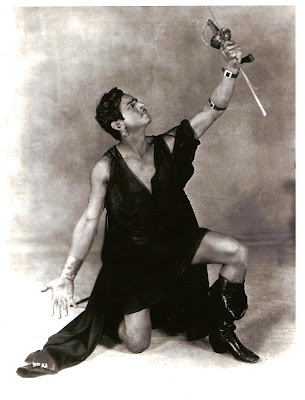
Douglas Fairbanks (right) was Hollywood's favorite hero during his reign as the ultimate swashbuckler and carefree righter-of-wrongs. The films made at his summit, from The Three Musketeers to The Iron Mask, came to define and perhaps even create the cinematic epic. A physical dynamo and equally creative chap, he had a direct hand in pushing the envelope of filmic possibilities technically and artistically. By the time he made The Black Pirate, he was one of the biggest stars in the world, and he showed this by using his clout to implement the new color process into this film as well as staging one of cinema's most famous and thereafter oft-repeated stunts: his character slices through a ship's sails and slides down. But, another interesting moment happens amidst his outrageous actions of daring do. Didja catch that kiss? When Doug finally plants a wet one on his leading lady, the camera hones in on the embrace behind the girl's back, showing only the back of her head. In fact, it was not the movie's actress Billie Dove giving Doug a smackaroo-- it was his wife, Mary Pickford. Turns out she was on the lot shooting Sparrows and decided to stop by for the scene, not out of curiosity but jealousy. She insisted on being the woman Doug kissed, so director Albert Parker staged the scenario so that it could be done. Doug probably didn't mind, since he always loathed romantic sequences. He was always more comfortable working with a saber than with his lips.

Gentlemen Prefer Blondes was a phenomenon. The comedic performances of Jane Russell and Marilyn Monroe in their roles as the feisty Dorothy Shaw and the deceptively dimwitted Lorelei Lee caused a sensation. The musical numbers, ridiculous plot, and show-stopping "Diamonds Are a Girl's Best Friend" sequence resulted in a bona fide hit, thanks again to this column's apparent savior-- director Howard Hawks. The costuming by Travilla was also something to behold, with lavish gowns that adorned two of cinema's favorite figures with great panache and sex appeal. One glorious gown barely made an appearance but remains a notorious piece of cinematic fashion history. Didja catch that gold dress? Marilyn wore it while dancing with Charles Coburn (Piggy) in a blink-and-you'll-miss-it aside. It is more memorable as being the dress that Marilyn wore in one of her most famous photos, where she lusciously entices the camera as only she could do (left). Yet, though she was the actress to make the gown famous, she was not the first to wear it. In truth, Ginger Rogers gave the glittering threads their debut when she wore the same gold lame gown previously in Dreamboat. Marilyn, with whom Ginger had become friendly while filming Monkey Business, happened to stop by the set of Dreamboat one day and saw the dress. She liked it and asked to wear it in Blondes, which is exactly what happened. Of course, Marilyn totally stole Ginger's thunder, and the latter lady is rarely given credit for debuting this piece of cinematic gold.


Ginger models a slightly more demure version of the dress in Dreamboat.

The dress where it is currently on display at Grauman's Chinese Theatre.
(The reflection of the girl to the right is me, not a ghost).

Keep your eyes peeled until next time!!!

DIDJA KNOW: Didja Catch That?

Bob Hope performs for the boys in Sicily, 1943.


For a brief period, film existed solely as a pure artistic venture blended with scientific innovation. Almost immediately, this sanctity was corrupted by business, which both heightened its possibilities and tangled its intentions. Cinema as a propaganda device was always forthcoming, but despite the expected birth of celebrity product endorsements, the most influential collision of stardom and salesmanship didn't occur until the Great War. The different ages of American War have revealed themselves in various ways through our movies, but perhaps the most interesting moments occurred not in the later rallying, reactionary cries of the Vietnam or Korean Wars, but in the earlier calls to arms of WWI and WWII. This equally paranoid and frightful time produced in Hollywood a profound moment of unity, patriotism, and brotherhood. On the screen or behind the cameras, an attitude of "One for all, and all for one" reigned supreme. The movies of the day were used to relay this message, as did its stars, who for once proudly took a back seat to the Stars (and Stripes) of the American Flag. Though contention and doubts did exist, an indestructible, unified front was always presented, which was perhaps simply due to the source of the battles being waged-- particularly the genocidal WWII. In a continuing celebration of Independence Day, here is a look back the impact of war on Hollywood, and the impact of Hollywood on the war.


While the Revolutionary War called upon a young and insecure landscape to defy its tormentors (and sometimes its own inhabitants) in order to proclaim itself a union, and the Civil War pitted brother against brother when incongruous versions of scruples and ethics threatened to tear the country apart, The Great War was entered into willingly by a freshly healed and newly thriving society. Its effect would render America not only unarguably the most powerful nation in the world, but-- as it was the lone combatant to emerge without war torn soil-- it too would rise victoriously as the film capital of the world. During a period of low economic peril that would lead to the euphoria of the roaring twenties, the strength and positivity of the nation was echoed loudly through its silent film players. Most memorably, Mary Pickford, Douglas Fairbanks, and Charlie Chaplin would embark on a tour selling war bonds (left), using their popularity and charisma to maintain and enhance the country's participation in the movement. The films of the time showcased their dedication, such as Mary Pickford's The Little American, which put America's Sweetheart right in the throes of German atrocities. The picture was passionately directed by Cecil B. DeMille-- a strong supporter of both the war movement and the armed forces-- who had in fact established the Home Guard, via Famous Players-Lasky, as its Captain when the war began in April of 1917. Yet, it is Douglas Fairbanks who was perhaps most indicative of American patriotism at the time. Healthy, virile, in incredible shape, and possessing both an optimistic spirit and a zest for life-- which, if canistered, could probably have provided enough energy to power a large city for 100 years-- "Mr. Pep" was the era's masculine ideal. He proudly made several short propaganda films to get his brethren in the spirit of battle, such as Swat the Kaiser and Sick 'em Sam.


Chaplin too did a great deal to express his feelings about the war, but as a more calculating aesthete and a true humanitarian, his efforts most often revealed themselves through his own compelling work. The strongest statement he ever made about war came about prior to WWII in his defiant, tragicomic masterpiece The Great Dictator (right). While many remained blind to or even embraced the shocking new stratagems of Adolf Hitler during his rise to power, Charlie always remained aghast, dismayed, and disgusted by the Fascist's lunacy. When Hitler's administration mutated into abject madness, Chaplin was not surprised, and The Great Dictator became his impassioned wake up call to America. The artistry of the film remains pure poetry, yet at the time its honesty was under-appreciated: Hitler banned it in Germany and all other Nazi-occupied countries. It was the presence of Hitler, recalled quite accurately as one of the most crazed and demonic beings to ever live, that propelled Hollywood more emphatically into its support of the war, making WWII even moreso than WWI an interesting period to look at cinematically. While it was a Japanese attack that pulled America directly into battle, it was Naziism that more accurately identified the threat of the times. Yet, after the tragedies and losses of the Great War, there was a still a hesitant skepticism about entering into another foreign battle. Not surprisingly, most early support was coming from British actors like Laurence Olivier and Vivien Leigh, whose homeland was already suffering graphic actualities that America was only theoretically pondering. Then, the eternal day of infamy arrived at Pearl Harbor and erased all doubts. America went to war with a vigor that has yet to be matched.


A very vocal spokesperson at the beginning of America's entrance into WWII was Carole Lombard (selling bonds, left). Everyone's favorite and most beautiful kook definitely had a serious side when it came to Life, Liberty, and the Pursuit of Happiness. She gave her staunch support to the cause and went on a nationwide war bond tour for which she was able to raise over $2 million in one day. Her shocking death while on her way home from this tour had a great impact on the American people in general but most specifically on her Hollywood friends. Jack Benny couldn't even bring himself to perform his radio show when he heard the news. Respectfully, Carole was awarded the Presidential Medal of Freedom by FDR and given the notoriety of being the first woman killed in the line of duty. Carole had been prodding husband Clark Gable to enlist since before the war even began, but he-- fearing that he was not cut out for it-- had demurred. After her death and in honor of it, he did indeed enlist and, as many in his regiment would attest, started volunteering for the most dangerous missions. While fighting, he wore a locket containing the last remnants of his beloved wife: a few sparse pieces of her jewelry collected from the crash site.


Clark was not the only member of the Hollywood community to serve heroically. A large portion of the male actors fought, including Douglas Fairbanks, Jr (who enlisted before war was even declared), Henry Fonda, Glenn Ford, Robert Montgomery, Tyrone Power (right), David Niven, Alan Hale, Mickey Rooney, William Holden, etc. Jimmy Stewart, who had to sweet-talk his way into the war (due to the fact that he was underweight), would become the most decorated actor to ever serve his country. Directors like John Huston, George Stevens, and Frank Capra too contributed by going overseas and filming raw footage, which was subsequently compiled for newsreels and war documentaries. This is not to imply that these fellas were blithely fearless. The old paranoia remained, which is perhaps why Jack Warner, fearful that his studio would be misconstrued from the sky as an army base, had "LOCKHEED" painted on the roofs in large, bold letters. However, the war department demanded that he have the label removed. This was an obvious overreaction on the mogul's part, but there was reason to worry. War is a very real thing, after all. Leslie Howard became another Saint of the cause, joining Lombard, when he and sixteen others were shot down by the Germans when flying over the Bay of Biscay.


The women also did what they could in terms of entertaining the troops, participating in war bond rallies, and making public service announcements and war propaganda advertisements. Veronica Lake (right) participated in a memorable campaign that persuaded women to wear their hair up at the factories, where so many females were seeking employment during the war effort. It turns out, too many of their copied, peek-a-boo hairstyles were getting caught in the machines! War was about social fusion not fashion! (However, it could be argued that this was a mere publicity ploy to publicize Paramount's latest, sexy star). Actresses too encouraged their sisters to ration supplies, including their precious silk stockings. Rarely recalled, as well, is the fact that a young Audrey Hepburn was a courier for resistance fighters in Holland at this time. 


However, there were some men who were unable to serve due to various injuries, ailments, or simply their age. If these reasons were explained thoroughly enough by the press, the public forgave the trespasses, but there was occasional, savage hostility directed at the men whose absence from the front identified them as cowardly or emasculate. Errol Flynn irritatingly received a 4F classification from the army-- a crushing blow to such a screen hero-- due to the ravages of past and recurring illnesses. His lung was marred by an unmistakable shadow-- an effect of TB-- and he too suffered recurring bouts of malaria. There also were alleged problems with his heart, though it was only after he was refused entree into the army that it was truly broken. (He does his part for the effort in The Dawn Patrol with David Niven, left). John Wayne was too left out of the loop due to an old knee injury, and Van Johnson's recent car crash and head injury extricated him from combat. Left at home, these boys carried on the tradition of screen heroism, and their careers boomed as Hollywood churned out more and more patriotically themed films.


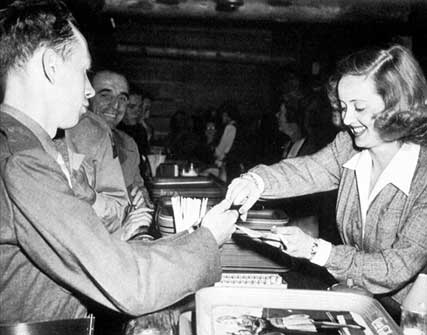
John Garfield was another macho guy, ironically left behind due to his weak heart. Frustrated by inactivity, he yearned for a way to do something special for the war effort. He decided to team up with friend Bette Davis (left, serving her autograph to a serviceman) to form the Hollywood Canteen, the dream oasis and dance hall for soldiers with a night off. Instead of cruising around to the nearest local bar, fighters lucky enough to have landed in Hollywood now had a chance to go to the infamous Canteen and talk to, be served by, and even dance with, some of the most famous stars of the silver screen. This memorable hot spot is but one of many examples of Hollywood's selflessness during the war. The way these different celebrities turned the spotlight away from themselves and onto the brave men serving their country added a great deal of gravity and character into an industry that had grown increasingly self-absorbed. The bugle sound of battle had awakened more than just a need to defend human rights; it had brought the city of angels down to earth. Movie stars making thousands upon thousands of dollars a picture were reminded of their good fortune. Thus, the immortals, the untouchables, made a conscious effort to repay a great debt to the viewers who basically allowed them their lavish privileges, and what's more, were fighting for them. Barbara Stanwyck, Ann Sheridan, Jennifer Jones, Marlene Dietrich, and Claudette Colbert were some of the many beautiful ladies who dedicated their time to the soldiers, sometimes dancing with them until their feet started to bleed! But, the men came too, and Gary Cooper, Cary Grant, and the Marx Brothers offered up jokes and laughs, chumming up to the brave men and doing their part. Before Tony Curtis became one of these elite, he came to the Canteen as a young navy officer to stare awestruck at such personalities. As such, John and Bette's landmark achievement became a Hollywood monument, (though it is rumored that Bette was a little overly patriotic in her attentions to some of the soldiers. Not that they complained).


The most dedicated and selfless offerings came from those stars who devoted their time to entertaining the troops. A majority of stars would make such a contribution, particularly to the local California army bases. Those who are truly noteworthy went overseas and into the heart of danger to bring a bit of home to the men abroad. Bob Hope's efforts are legendary as are Jack Benny's. But the army's number one girl during WWII was none other than Carole Landis (hitching a ride, right). The tom-boy knock-out was dedicated to the cause from the get-go, singing at bases, volunteering, and gamely donating both blood and money. She saw the war coming before it had reached American soil, and had even requested an acting job in England so that she could be closer to those who were already fighting. She earned her own pilot's license, hoping to enlist with the ATS, but she sadly withdrew when she learned that she would have to surrender her American citizenship, which was something the All-American-Girl was not apt to do. Her solution was to devote as much time as she could to "the boys." She remained as active as possible, and actually carried a trunk in her car filled with a variety of uniforms and wardrobe options for whichever random event should happen to claim her attention. She motored back and forth to countless benefits. By 1942, she was already made an honorary Colonel by Hollywood Post 43. She became a favorite of soldiers on leave, whom she honestly befriended. She offered up her beach house to them, and many a lucky gang found themselves taking a breather there and being served breakfast by Carole and her mother. (No funny business. She treated them as her own brothers, and they as their sister). Carole also always volunteered for the foxhole tours, which were considered the most dangerous. To her, the fellows here were the most in need.


Carole was aching to do more, and her most memorable gift to the servicemen came when she enlisted the help of actress Kay Francis, dancer Mitzi Mayfair, and comedienne Martha Raye to join her in a trip to entertain the troops stationed in Britain (all Four Jills in a Jeep, left). With her singing talents, the quadruple threat was a welcome relief to many young men whose first words to them often were, "I haven't seen an American girl in months!" Warm, fresh faces from home-sweet-home, and famous faces at that, were a dream come true in the hellish nightmare of war. Taking Cary Grant's advice to pack as many warm clothes as she possibly could, Carole and her talented retinue took on the dangerous task of spreading cheer with heart and courage. And it was dangerous. After a brief and unexpected stopover with the troops in Bermuda, the ladies traipsed on to England and later Africa. Carole documented her memories in a blue notebook that one friendly soldier gifted her early in her travels, which she would later turn into a book, and Fox would turn into a movie: Four Jills in a Jeep. However, this film, which does much to showcase the ladies' talents, does little to reveal the realities of the ordeals they went through. Carole would recall freezing nights, explosions that shook the girls to the bone and blew through their bedrooms, and life-threatening experiences-- such as a near-crash landing with the plane still ablaze! She and the ladies were once thrown into safety by some of their soldier friends, who protected their bodies from flying shrapnel. Though they donned their fancy duds on stage, where they performed a number of exhausting shows nearly every day, they wore army regulation clothing and boots on their off time, wherein they unglamorously clomped through the mud with the boys.


Carole's memories of the war and of the men she encountered would change her life and leave her with bittersweet feelings (with Mitzi at the Biskra Air Base, right). She committed herself fully, and at a cost (she would have recurring bouts of malaria and painful stomach ailments for the remainder of her short life). The height was meeting so many people, befriending them, and touching their lives; the downside was the pain of learning that they had been injured in battle or had lost their lives. Carole visited the hospitals devotedly, memorizing names, palling around with the nurses, and even refusing a private room when she herself became ill. When her tour was halted from proceeding further, Carole and Kay petitioned to Dwight Eisenhower himself for aid in allowing them to continue their mission to the frontline, come Hell or high water. He found it impossible to say no to them, and their persistence eventually got them to Africa. As tiring as the entire process was, doing eight shows a day over and over for thousands of men, traveling to strange and dangerous destinations, and getting little sleep, there was some time for fun. A few of her favorite soldiers took her and Mitzi especially around, showed them what remained of the wrecked local life, and indulged them in jitterbugging. Carole too found time for love, falling for soldier Thomas Wallace, and fulfilling what she must have believed was a patriotic duty in marrying him. The trials she had to get through merely to get this process done was arduous enough in wartime England, but with her usual persistence, a little luck, and the help of friends-- who offered up their wartime coupons, so she could buy a wedding dress-- she completed this ultimate fantasy on January 5, 1943. Another high point was being able to perform for the Queen of England. It was always Carole's singing finales that brought down the house. After four and a half months, Carole and her gal pals ended their unified journey. Carole would never forget it, nor the soldiers her.


Back at home, Carole motored on with radio work, filmmaking, writing her war memoirs, and continuing in her patriotic efforts-- even performing in the rain for an ecstatic public who came to see her. As the war ended-- and her storybook marriage to Tommy-- she found it hard to re-assimilate to the banal existence of a once again self serving Hollywood. It certainly contributed to the depression that would later claim her life. Perhaps she felt the impact of that brief moment of history a little too deeply. Perhaps her knowledge of it was simply more profound than so many others-- who had remained ignorantly comfortable on American shores-- to understand. Existing on war-torn terrain and returning to a land of glamour and phony prestige no longer seemed bearable. But then, this was not the total reason for her end. She had lived for the boys, and she would have continued to do so had it not been for other factors affecting her emotional life. Certainly, when she took her own life, she broke a million hearts. These hadn't been lads who had merely caught a glimpse of her, but those who shook her hand, knew her by her first name, had confided in her their fears, stories about their families, tragic tales about their battles, and the dreams that they had held for the future. (Carole sings in her favorite dress, in which she would also be buried, left). To say that she touched many lives would be the understatement of the century.


Ann Sheridan at the Hollywood Canteen.


Carole was one of the many who saw to it that, for once, this topsy-turvy world was inverted, and that honor was bestowed in the right place. During WWII especially, soldiers became the celebrities. They were the ones receiving admiration and unadulterated respect. That so many Hollywood personalities would step down from their ivory towers to make this known is still a mind-boggling and moving concept. This was an odd and unrepeatable moment of cohesion and certainty, which in our confused, modern world no longer makes sense. Normally our cinema reflects social turmoil, escapist fantasy, and the product of constant human questioning. Movies, thus, become the products of our disagreements. Rarely, as in these periods of war, it becomes instead of medium of complete agreement, when the living heart and the filmic heart beat in unison. When this moment ends, and our bickering continues-- our political debates and communal banter-- it only renders our artistic and actual freedom more perfect. Our ability to vocally, visually, and even vapidly express ourselves and the things that we always fight over, is the very thing we've always been fighting for. God Bless America and American Film!

HISTORY LESSON: Hollywood at War


Ginger Rogers, head to toe in gold, in Gold Diggers of 1933.


Movie Stars and Money. Moolah. Bread. Gravy. Greenback... Whatever you want to call it, it always seems like celebrities have it. And lots of it. While many of us have to count every penny before going on an edited shopping spree to the ever glorious Target (Tar-jay to the upper crust), the exorbitant expenditures of modern entertainers with their private jets, sprawling mansions, and golf-ball sized engagement rings makes one both a) fiscally insulted and b) green (as cash) with envy. But whatever new car Diddy's rolling in or whatever designer gown is draped over the elegant Ms. Kidman at the latest awards show, today's divas have nothing on silent film spenders. Even in those early days, it was all about the Benjamins. Moreso, it wasn't the size of the bank account, but how one used it to advertise his or her own fame and stature. The early flood of cha-cha-ching and the resulting birth of American royalty created the still present trend of glorious, outrageous, unapologetic, economic narcissism. Here are a few of the earliest examples:


Cecil B. directs yet another lavish scene in Cleopatra- 
(Claudette Colbert stands center stage).


It should come as no surprise that Cecil B. DeMille be counted as one of the Kings of Coin. His films themselves were so lavishly produced and luscious to the eyes that one can only imagine the coronary Adolph Zukor must have had each time he looked at a budget estimate. In fact, despite the money that CB's movies earned at the box-office, most of them were still considered failures because they couldn't recoup the production costs. But with an eye for detail and an unwavering loyalty to (exaggerated) authenticity, DeMille spared no expense when it came to his films. He wanted what he wanted, believing that his audiences deserved the best, and that is what he gave them. In The Affairs of Anatol, for example, Wallace Reid had the distinct pleasure of filming a scene wherein he got to destroy $30,000 worth of furniture, including original Louis XVI chairs and a grand piano. CB wouldn't accept cheap props; it had to be the real deal. He also added strange, costly mandates to his productions. Anne Baxter would recall that Cecil had all of her necklaces specially "heated" before they were placed on her skin during The Ten Commandments (left). This was not a stipulation she required, but one that Cecil saw to on her behalf-- he wanted her treated like a Queen since she was playing one. Between Gloria Swanson's submergence into an expensive tub in Male and Female and Claudette Colbert's illustrious milk bath in The Sign of the Cross, CB too started a craze for opulent bathrooms. However, his own house guests were often disappointed to find that his private bathroom was rather plain.


Anne Baxter in one of her temperature controlled necklaces 
in The Ten Commandments.


But CB was not always modest in his private life. Granted, he was not as extravagant off screen as he was on, preferring to spend his down time at his vacation home, Paradise, where he could hike and feed the animals. But he did have a few flashy quirks to show off just how wealthy a man he really was. For example, male guests to Paradise would be offered color-coded silk shirts-- red for a regular Joe, white for producers, and purple for directors, corporate big-wigs, or government officials. The gents also received Gold or silver chains to spice up their look. CB also enjoyed splurging on jewelry, offering women whom he was pleased with in some way a choice of his own private collection of gems. In addition, female guests were given Cecil B. DeMille's own concoction of "Paradise" perfume. For all this, Cecil still lived fairly simple compared to some of his contemporaries. Sure he had a yacht and several real estate investments around town, but his monetary swagger was tactical more than anything else. While it could be said that he enjoyed spreading the wealth and bringing a little beauty into life, he committed grand financial acts more to stake his claim as one of Hollywood's major hitters, so people would know who was boss. It worked, for "DeMille" and "Decadent" remain pretty much synonymous.


But Cecil wasn't the only power player with cash to burn-- literally. With money comes power and thus the ability to pay for pretty much whatever you want. It naturally followed that certain celebrities were able to produce custom made products or add their own special innovations on different every day merchandise. The tiniest thing would require some specific attention in order to differentiate one's belongings from every one else's. Thus, star vanity even lead to the creation of custom made cigarettes. For his part, ill-fated director William Desmond Taylor smoked only his personally designed black cigarettes with golden tips-- that's genuine gold, folks. Actor and Mr. Muscles himself, Francis X. Bushman (right), also insisted on creating his own stock of lavender colored ciggies.


Bushman let this innovation follow him over into the realm of automobiles. When driving around town in his fancy Rolls Royce, also lavender, it wasn't enough for people to merely notice his expensive wheels. He wanted them to know that it was he who was behind the wheel. Thus, he had a special light affixed into the interior, so that at night, a bright aura would shine over his face and people would know that the famous star of Ben-Hur had just sped by. Cowboy star Tom Mix (left) followed suit. For his car, he specified that the tires be produced with his own personal "crest," which was essentially the compilation of a "T" and an "M." When his car rolled down the then dirt roads of Hollywood, his insignia could be seen in the tracks. He basically left his initials all over town, an effective way of saying "Tom  Mix was here, yeehaw!!!" Gloria Swanson too had a dream car. In fact, her earliest ambition as an actress, or as anything, was to be able to afford a heretofore unseen orchid-colored automobile. People told her she was crazy and that such a thing didn't even exist. But once she became the grande dame of silent cinema, she got her fantasy car-- and then some!


The Tom Mix Bar Brand, also present on his tires.


Or course, in these days, many celebrities were chauffeured around town in their glamorous automobiles. After all, in the caste/cash system, a higher echelon personality was going to make his or her status known. Thus, wealthy vixens like Pola Negri provided extra jobs to various servants who would accentuate their prestige. Pola (right) had a chauffeur who drove her everywhere in her white, velvet upholstered Rolls, but there was an added stipulation: he was to wear white on sunny days and black on rainy days. She too had servants who were in charge of cascading rose petals into her path so that her precious feet-- adorned with toe nail polish, which was not yet popularly worn-- would never be sullied by making direct contact with the floor. Just to add a little more oomph, she too paraded around town with her pet tiger, who often accompanied her on jaunts down Sunset Boulevard. Why, who knows? She did it simply because she could, and Pola was a definitely a drama queen on and off camera.


But perhaps the most well known example of Hollywood grandeur is that of Pickfair. The fairy tale wedding of the swashbuckling hero Douglas Fairbanks to the Golden Goddess of the Screen Mary Pickford captured the attention and affection of the American people when they were united on March 28, 1920-- despite the fact that they had essentially ditched their other spouses to make such a dream come true. It didn't matter. To the general public, they had escaped unhappy lives to reach the unbelievable culmination of true love, fame, and fortune. Of course, in order to rule on high in their fantastical splendor, they needed a Kingdom, which they dubbed "Pickfair." Situated in the hills on Summit Drive above Benedict Canyon, Mary and Doug lived in what appeared to be an oversized cottage. Its ornamentation wasn't overly glamorous, but its amenities were: a seashell shaped swimming pool, big enough to fit a canoe and complete with a slide, a tennis court, and stables. Their life together at this mansion on a hill was the ultimate American Dream. Of course, one must always wake from even the best of dreams, but while Mary and Doug's marriage may have hit the skids, the memory of their plush palace remains forever entrenched in our memories.


Doug and Mary take a row in their oyster pool.


These early celebrities didn't live in a world of "what could have been," they created worlds that were. Worlds that were as outlandish, flamboyant, unrestrained, and yet impossibly possible. When America entered into the economic crisis of the Great Depression and the film world was engulfed but the crisis of the new talkie era, the fawning awe of celebrity expenditure would give way to the public's love/hate relationship with their stars. No more would we find it completely palatable for these cinematic souls to throw cash around so nonchalantly; we would let them get away with it only if they seemed like one of us-- coming up the hard way. But, for a brief moment in time, we adored our movie stars for being larger than life, or perhaps even larger than larger than life. While their splendor may make one wrinkle his nose or perhaps erupt only in a cynical guffaw today, at the time, it was all in day's work. At least, in Hollywood...

MENTAL MONTAGE: Rollin' in the Dough

Theda Bara, the original "Vamp."

Our relationships with our celebrities has changed over the past century and a quarter. Perhaps due to the fact that celebrities are so accessible today, we don't have the awe and wonder of them that we used to. There is no need to humanize them, because the jig is up: we know that they're human. The rag mags tell us alllllll about it. At best, we respect, but we don't admire. But it wasn't always so. Before, movie stars were mythic creatures that lived in the mystical world called La La Land, where they literally cavorted on Mt. Olympus. They were impenetrable beauties, trickster figures, and heroes-- real life cowboys, passionate vixens, and knights in shining armor. We looked upon them just like children, engaging in make believe, pasting their pictures to our walls, and dreaming the dreams that the movies taught us were safe. So deep was our love for them that we crafted nicknames (with studio help) after they'd worked their way into our hearts. This represented, if nothing else, how they had endeared themselves to the American public. As we celebrate our final week with Mr. Haines, I thought it would be a little fun to play the nick-name flick-game. Enjoy!

WILLIAM HAINES: THE WISECRACKER

Billy won his moniker for two reasons, the first of which should be obvious: he was a smart-ass. For every lame statement, he had a quick-as-a-whip retort, often running mental circles around those who dared to engage in conversation with him. His onscreen persona reflected this perfectly, for when his characters were faced with challenges, he merely laughed them off-- his wit used as a protective armor against responsibility. The youth of the roaring twenties responded to this rebellion with relish, especially when it seemed that Billy's personality off screen was not very different. In interviews with fan magazine reporters, Billy always deflected personal questions by making a joke of it, often turning the tables on the interviewer who suddenly found himself the interviewee. But too, his "wisecracker" status symbolized something else, for this was a code word often used to label men as homosexual. Thus, when people would say, "Billy Haines? Oh yeah... He's a real wisecracker," they were telling a double truth. As it stands in history, however, it seems that up until the emergence of the smart aleck Groucho Marx, Billy remained the king of zingers, taking the self-important divas he often found himself surrounded by down a peg or two. Or three.

BARBARA LA MARR: THE TOO-BEAUTIFUL GIRL

One of Billy's best friends (with supposed occasional benefits) in his early Hollywood days was Barbara La Marr. With dark hair and large hypnotic eyes that often appeared almost violet (a la Liz Taylor), she remains remembered most for her stunning physical presence and the looks that seemed to almost coin the phrase "knock-out." But, as many Hollywood ladies could certainly attest, beauty can be a burden, and since in the silent era Barbara held her position at the top post of "lookers," it comes as no surprise that the attention she received often worked against her. Perhaps there is such a thing as being too beautiful-- both too beautiful for words, and too beautiful for life. She earned her nickname in juvenile court, of all places, when she was spotted by writer Adela Rogers St. Johns, who gasped at the sight of her-- who is that gorgeous girl?! Barbara, then Reatha Watson, was allegedly brought in when found in the company of an older man. As a single young woman living in the city,  Reatha often fell prey to "friendly" gentlemen who wanted to help her out. Of course, the unspoken rule of quid pro quo often came into play. Standing before the judge, the youthful and tender La Marr was too lovely to punish. Indeed, Judge Monroe offered only the statement: "You are too beautiful to be allowed alone in a big city." Poor, poor pretty little thing. She made the papers the next morning, already named the "too-beautiful girl."

ROSCOE "FATTY" ARBUCKLE: THE PRINCE OF WHALES

This one needs no explanation. Not only was Roscoe's birth name quickly replaced with an insulting adjective, making him "Fatty"-- a nickname he hated-- but his size was furthermore emphasized when, as the reigning silent film comedian, he was dubbed the Prince of blubbery mammals with a wicked pun. He took it in stride, despite the fact that he had been sensitive about his size his whole life. Ironically, he ate relatively little. Even in his youth, when his family fed on a meager to invisible food supply, he was always a "big boy." Much larger than his waistline, however, was his personality. Possessing a huge heart and an energy that could light up a room, Fatty was surprisingly light on his feet and inescapable in his optimism. Audiences adored him for his at times smiling/at time befuddled mug that got into and escaped trouble to the soundtrack of uncontrollable laughter. Remembered today only for the crime of which he was innocently accused and rightly exonerated, Fatty deserves his throne back.

DOUGLAS FAIRBANKS: MR. PEP/MR. SMILE

Another man known for his enthusiasm was the seemingly irrepressible "Doug." Not only did he burst off the screen with his intoxicating positivity, exciting viewers with his heroic acrobatics and daring-do, but behind the scenes he worked with the same impassioned vim and vigor. Committed to creating and performing his own stunts, Doug was diligent about pushing the envelope and giving audiences the enthralling and inspirational stories they deserved. This demanded that he push himself to the physical limit, and today when one watches him in films like The Thief of Baghdad, his body remains something to behold. Yowzah! He was simply unstoppable, a manic maniac, who would rather run a hundred-yard dash than sit down to discuss politics or the recent findings of Freud. He was a force to be reckoned with. He even penned inspirational pieces of literature that his fans gobbled up: "Keep your chin up!" "Keep fighting the good fight!" "Reach for the stars," etc. He made anything seem possible, and when he spoke, people listened. Starring in war propaganda shorts during WWI and traveling around the country selling bonds, he united a country both in and out of the theater. We have yet to see another like him.

JOHN BARRYMORE: THE GREAT PROFILE

Oh, the illustrious Barrymore clan... So much talent, so much tragedy. The leader of the pack was always John, who ironically was the baby of the infamous acting trio, which too included Lionel and Ethel. John earned a commendable reputation as an actor with guts and gusto for his chilling and powerful performances on the stage, where he brought new depths to some of the most classic characters in literary history. His Hamlet was said to be profound, gut-wrenching, and provocative. When he entered the movies, his cinematic career followed suit. But despite his reputation for his acting gifts, it was his face that earned him his title. The startling beauty of his features, particularly as seen from the side, sent more than one woman's heart aflutter. Though his machismo was probably offended at his objectification-- which for once put a man on a woman's side of the fence-- he also embraced it. Being the sexual creature that he was, he certainly put his good looks and charismatic personality to use and wooed many an unsuspecting but willing lady into his bed. If ya' got it, flaunt it.

LANA TURNER: THE SWEATER GIRL

Lana was pegged with her nickname from almost the moment she set foot in front of the camera. She was noticed not for her gorgeous face or dripping sensuality, but for the way her sweater fit over her... parts. One of the many successful makeovers concocted by MGM, Lana went from being a brunette to a blond, from an average girl to a sex-kitten. Studios often had a way of shopping their latest ingenues around in bit parts, seeing if the public would latch onto them. When Lana strutted down the street in They Won't Forget, they didn't, and she caught more than one drooling male fan in her trap. People began writing into the studio asking for more of "the sweater girl." This was a specific ploy of the studio, who completely altered Lana's more modest costume to reveal her best assets. Thus, her original bonnet and polka-dot dress were exchanged for a sweater and that infamous walk to fame. While it was Lana's bosom that garnered her initial attention, the feisty minx's natural gifts before the camera were more than physical. Thus, she was able to stake her claim in Hollywood as a bona fide movie star and a lasting leading lady. But that damn sweater always haunted her, no matter how legitimately she strove to prove herself.

MABEL NORMAND: THE "I DON'T CARE" GIRL

Try as you may have to stop her, Mabel Normand was pretty much going to do whatever the Hell she wanted. Her rebellious and fearless nature was reflected in some of her earliest films, wherein she was known as "The Diving Girl", the bathing beauty who nonchalantly dove into the water-- backwards, forwards, you name it-- from daunting heights. Rising to fame with the aid of boyfriend Mack Sennett, Mabel attacked her comedic film roles with the same naive courage, hurtling in head first, never caring if she came off looking like a damned fool. She ignored her god-given beauty and mugged it up, enjoying a free-spirited nature completely devoid of vanity. She willingly took a pie in the face, fell on her bottom, rolled in the mud, whatever the situation called for. Unfortunately, this same lack of caution got her into trouble in her private life. She indulged in a love affair with drugs and alcohol in a foolish attempt to live in the moment. She just never considered the consequences, which would eventually destroy her. All the while, despite the rumor and folly that was to come, during her day in the sun, she reigned supreme as the first screwball queen, whose fun-loving, no-holds-barred persona won the respect of heavyweights like Charlie Chaplin, whom she could more than hold her own with. It was perhaps her joke of a husband, Lew Cody, who described her best: "She was just a little girl who neglected to look before crossing the street." But that's why they loved her.

 JEAN HARLOW: THE BLONDE BOMBSHELL


"Baby" is a name used far too often. Lovers use it to refer to each other, certain men (who seemingly hid in a cave during the feminist movement) may still use it to refer to any and all members of the opposite sex... But there is one lady whom everyone referred to as "Baby," and she didn't mind at all: Jean Harlow. For several years, Harlean Carpenter didn't even know her true name, because everyone in her family called her "baby." Warm and loving as she was, and adorable to boot, the name suited her and she carried it with her wherever she went. When she hit Hollywood, friends still referred to her as Baby, which she preferred to her stage name, Jean Harlow. Indeed, when she passed away suddenly at the age of 26, it was "Our Baby" that graced the face of her tomb. However, during her life, her fans more commonly knew her as "The Blonde Bombshell," the first of her kind, whose atomic arrival on the silver screen sent shock waves throughout the nation and changed the image of the sex symbol for all time. 

SHARED NAMES

Surprisingly, there are times that certain names have proven themselves to be recycled. Here are some examples of this equally fascinating phenomenon:


Most people are certainly familiar with the reference to Lon Chaney (right) as "The Man of a Thousand Faces." Never was there a more accurate description, for not only was this renegade actor able to flesh out countless and varied interpretations of characters in his stellar cinematic resume, but he also devised intriguing, shocking, and sometimes frightening makeups to further distinguish one creation from the other. His martyred stance for his craft communicated that his performances were not about him, but about the people he was playing, and thus people in general. But before Lon, the first movie star-- Florence Lawrence-- had already been pegged as "The Girl of a Thousand Faces." While Flo probably applied her own makeup, as many did in those early days, she never went quite as extreme as Mr. Chaney. However, her gift at relaying every shade of every emotion still won her the same title. She was given this lengthy handle due to the fact that her audiences did not know her true name, as at the time studios kept this under wraps. Afraid of resulting bloated egos and power struggles within the system, moguls tried to keep their guinea pig actors anonymous and spinning on the reels that kept the money coming in. In addition, Flo was referred to as "The Biograph Girl" and later "The IMP Girl" as she transitioned to different studios. Ironically, one of these names would also be usurped. After she left Biograph for IMP, a new ingenue stepped in and became the latest mystery face people were falling in love with. Thus, Mary Pickford became the new "Biograph Girl," though after she too became a phenomenon, she was also referred to as "The Girl with the Golden Curls."


Florence, with her happy face on.


Mary and her token curls.


There was also a steady competition going for various translations of "The Great Lover," "The Screen's Most Perfect Lover," etc. At various times in their careers, Wallace Reid, Rudolph Valentino, and John Gilbert all had titles of this sort bestowed upon them, which is interesting since they were all such different men. Wally (right) was the baby-faced, lovable cad of Carmen and The Roaring Road fame. In addition to finding him handsome, older women were often infatuated with him, taking a maternal stance. He was the all-American son they adored, who-- when he was naughty-- they couldn't help but forgive. He just had one of those faces. Valentino was distinctly different. He represented the opposite of Americana: a tantalizing and seductive foreigner, who was just as enticing as he was dangerous. Women veered from the more wholesome appeal of Wally to the powerful allure of the man who wouldn't take "no" for an answer. The desire to be dominated thus overruled the desire to be loved, though when Valentino got romantic he also sang to the emotional nature of the female heart. To see such a masculine powerhouse in a vulnerable moment again awoke feminine sympathy, and the duality of Valentino's complex nature made him irresistible. Unlike Wally, however, Rudy caught a lot of flack from members of his own sex, who despite his he-man roles in films like The Sheik and more particularly Son of the Sheik labeled him as a "sissy." Jealousy, anyone?


Rudy, alert and on the prowl.

Falling in between these two heartthrobs was John Gilbert, whose star had started soaring right when Rudy sadly passed away. John was left carrying the torch, providing a mixture of the heroic lover and the sensitive romantic. More concerned with being a true actor, John took on vastly different roles in vastly different films, sometimes playing the war hero (The Big Parade), sometimes the vengeful lover (Monte Cristo), and sometimes a downright villain (Downstairs), but always he carried off his performances with class and sophistication. And his movies with Greta (left in A Woman of Affairs)... oh my! The way he looked at her was the way every woman dreamed of being looked upon. John had a way of portraying both uncontrollable desire and undying love-- both animal and emotional-- presenting the perfect package. He could be boyish and lovable, but his dark features also relayed a warning to ladies, who were powerless to his charms. With John, the art of love was an art-- not the bashful, "ah shucks" of Wally or the domineering and savage embraces of Valentino. John offered poetry. In the end, a woman's favorite said a lot more about her than it did about the man. Choices, choices... How awful our plight.


Kim Novak: The Lavender Girl


The list could go on and on, but since you all have lives, I'll stop here, and let you ruminate about the others I've unfortunately left out-- The Great Stone Face, Old Blue Eyes, The It Girl... Though there are occasional nicknames given to our celebs today, usually referring to action heroes (The Muscles from Brussels or The Italian Stallion), for the most part, our camaraderie with our celebs is at a stalemate. And I'm sorry, but giving yourself a nickname doesn't count-- I'm looking at you "JLo"/"Jenny from the block," whatever. I think it is indicative of a disease in our culture when we remain more enamored of the stars of the past than the present. Perhaps it's just nostalgia, but I think it's a little bit more. Maybe even that lil' sum sum we all refer to as Magic.


MENTAL MONTAGE: A Star by Any Other Name...