Download Games

Recent Posts

Showing posts with label Lana Turner. Show all posts


Though an obvious casting choice for Julie in Show Boat, Lena Horne missed out 
on a role that finally matched her skin tone... because of her skin tone.


Quick challenge: name five studio-era African American stars. The first name served is Sidney Poitier, next Hattie McDaniel, then Lena Horne... Maybe one is able to recall the comic efforts of the heavily stereotyped Stepin Fetchit... Kind of gets hard to tack that last digit, doesn't it? While no one can argue the continuing spell that classic Hollywood casts over us-- the beauty, the allure, the glamour-- when one is being realistic, there are many flaws in Tinsel Town's handsome face. Hence, cinematic racism: a painful subject and a continuing saga of human failure and regeneration for every generation. The great thing about being a student of film is having this tangible ability to witness human beings in action. Since the advent of this medium, we have been able to literally watch history unfold and effect change before our very eyes, though we are rarely aware of this phenomenon as it happens. The social motivations that compel us to tell certain stories-- and audience reactions to these documentations-- in turn, become artifacts of our ever malleable culture.


Evaluating movies of the past, wherein racial slurs or sexist statements make a modern audience wince, can often result in the ostracizing of certain films-- we are unwilling to admit past blunders, so we bury our past. But this too is a failure on our part. In not permitting certain films-- which fail to live up to our current politically correct standards-- to be seen, we miss out on the talents that paved the way toward a more understanding, comprehensive society. For example, there are those that refuse to list Gone with the Wind's merits due to the perpetuation of the "happy slave" myth, as portrayed through the characters of "Mammy," "Pork," and "Prissy." True enough. But what of the stellar performances? The epic love story? The scope of filmmaking as yet never before reached? And what of the black actors McDaniel, Polk, and McQueen who you are robbing of their moment? One small step for man, one giant step for mankind. Through cinema, you embarrassingly watch man commit his prejudices and slowly unlearn them. One shouldn't be afraid to watch us making these steps, nor rob himself of the intrigue of literally watching it happen. And so we move from Cabin in the Sky, to Gone with the Wind, to Malcolm X, etc. And this is just dealing with one branch of our multiple minorities.


In the Romeo & Juliet tale of West Side Story, the interracial romance between 
a white Jet and a Puerto Rican Shark was made savory by casting the 
Caucasian Natalie Wood as Maria.


With that overly lengthy introduction being said, I can now press on to the matter at hand, which is how the racial issue has been investigated in our cinematic storylines in one particular fashion. While the burden of racial tension almost consistently fell on Mr. Poitier's shoulders, producing in his career one of the most profound and effective bodies of work in perhaps all film history, the female element of the African American race was very rarely given voice. When it was, it was normally stereotyped through the role of the sassy servant or house maid. But, there too was a strange mutation in which a black woman was given opportunity to reveal the prejudices under which she suffered through a character with true depth and feeling, but in this case, of course, she had to be half white. The final clincher, she had to be played by a Caucasian actress. (Harrumph). While this shoddy choice at casting was taken as a slap in the face to the many black actresses dying for a chance to give credit to their race and prove themselves as genuine talents, the choice was just as much about business as it was an unhealthy dose of racism. Due to the production code, there could be no interracial romance or miscegenation on camera, which meant that a black actress could not indulge in a romance with a white actor (this is the same stipulation that caused Anna May Wong's career to suffer). This, in addition to the fact that famous, white actors were considered the real stars and money earners, led to  forward thinking plots with backward thinking production. Nonetheless, these films are worth a glance, as they are yet one more step forward from our segregated past. I have three films (and multiple versions) to discuss today: Show Boat, Imitation of Life, and Pinky.

~     ~     ~

To begin with, we have Show Boat, based upon the book by Edna Ferber and the following smash musical by Jerome Kern and Oscar Hammerstein II and adapted for the screen thrice in 1929, 1936, and 1951. (Unfortunately, the following racial angle was suspiciously absent from the 1929 silent version, so I have had to drop it from the discussion altogether). The plot of the story varies little from film to film and involves the generational saga of a family of show boat performers: Cap'n Andy and Parthy Hawkes, their daughter Magnolia and her husband Gaylord, and in time their daughter. On the outskirts of these tales of love and loss, performance and reality, there is another character-- one who is not of the family. The "other." Julie, played by Helen Morgan in 1936 and Ava Gardner (left) in 1951 (and Alma Rubens in 1929), is a songstress on the boat and a good friend of the blossoming Magnolia. The interesting thing about this woman is that she is biracial, but "passes" for white. However, the Hawkes family knows the truth and does not shun her for her accidental heritage. In addition, Julie is deeply in love with her husband Steve-- a white man. As Magnolia is a bit younger and as yet untouched by love, she is fascinated by Julie, whom she looks to for guidance. Julie communicates her character's deep, unshakable love through the show-stopping "Can't Help Lovin' Dat Man." During the number, we see Julie as a woman of spirit and warmth: a big sister to Magnolia, a devoted lover to Steve, and, underneath it all, a sad little girl who can't believe that her dreams have come true. This sadness will be broadened when the authorities threaten to arrest her for her interracial marriage to Steve-- which is indeed illegal-- at their most recent, unfortunate port. Reluctantly, the Hawkeses are forced to let Julie and Steve go from the show, and the romantic duo are thrust head-first into an unforgiving world with only each other as comfort.


Fast forward to a few years later, and we find Julie alone without her man. Steve, her one true love, has left her, most probably due to the societal pressures of being married to a "negro girl," but also there are hints at infidelity and the other hard-knock financial pressures that any entertainer must endure. Julie mourns him, singing her heartbreaking "Bill" to the drunken crowds at The Trocadero, a gigantic step down from the homey and classy show boat. Julie too, it is discovered, is a drunk who has taken to the bottle to cope with her heartbreak. Surprisingly, Magnolia is brought back into her life and, just like Julie, she has fallen on hard times with her husband, Gaylord, whose gambling has cost them their home and eventually each other. He too has walked out on his wife, and so the two spurned women are reunited in song, for Julie overhears Magnolia auditioning for a spot at the club. Her audition piece is, of course, "Can't Help Lovin' Dat Man." Just as she had several years prior, Julie performs her act as guardian angel, watching out for her younger soul sister, and ensuring that she will not have to suffer the same pains as herself. She leaves her job at The Trocadero, seeing to it that Magnolia takes her place. Here we encounter the first example of the chosen sacrifice of the lower race. In all areas, Julie and Magnolia are fairly interchangeable. Though Magnolia was fortunate enough to be born to more prosperous and white parents, they are both destitute, abandoned, and lost. The one defining difference is Julie's mixed race. For this, she is irredeemable and she knows it. Julie committed the mortal sin of thinking she could climb above societies' restraints and enjoy the high life-- aka the white life-- but fate surely and swiftly reminded her of her place in the caste system. Though the Civil War has ended, her breeding still makes her a slave. She knows her place, and she accepts it. Her giving heart, which gave all to Steve, now continues to give to her friend who, of course, goes on to become a great star.


This same goodness eventually works to reunite Magnolia with the wayfaring Gaylord, whom a drunken Julie encounters some time later. Ava Gardner does some of her best work in this scene in the 1951 version when she all but shames and begs Gaylord to give up his scandalous, cowardly ways and return to Magnolia. If she can bring one man back to the woman who loves him, it will have made her martyrdom worth it. All of the suffering she has endured as an outcast will be won back if she can prove that true love does exist, and her karmic injustice will be paid in full-- as the other, she delivers the true rights of happiness to the true white race that deserves it. Forgiven for sullying the waters of purity, this last sacrificial act may give her peace. Gaylord does return to Magnolia, and the Hawkes family floats on their boat to better things on the ever-flowing river of life. Julie, we are left to assume, will be kept warm for the remainder of her days with the knowledge that she has done some good. As is her fate, she should expect nothing more, right?


Julie is not the only person of "color" in the story, with various other helping hands along the way being portrayed by Hattie McDaniel and Paul Robeson ('36), and William Warfield ('51), the latter two of whom perform with great pathos and gut-wrenching gusto the famous "Old Man River." As is usual, these authentically black characters are treated with a sort of condescending affection that is elevated only by the performances of the actors. They are kind-hearted but most importantly unambitious. They know their place and do not seek to escape it. It is Julie's ferocious beatings against history's iron cage that eventually victimize her. This is why she is not carried to heaven on 'Old Man River' with the other, allegedly smarter members of her race. While these themes today irk the conscience, the films are at least successful in painting sympathy for the African American population, though they are still forced to suffer. The fact that a white woman was chosen to play the mixed Julie is somewhat forgivable in the restraints of the time, as an onscreen romance between a black Lena Horne-- one original choice for the role in 1951-- and a white actor was a definite no-no and far too shocking for an America still in the midst of racial segregation. Lena in fact was asked to coach Ava Gardner in her singing for the role, which was an additional slap in the face to both women. In the end, Ava's singing would not be used but was dubbed by Annette Warren. The only happy ending there is that Lena and Ava were actually good friends. Ironically, Lena had performed the song "Can't Help Lovin' Dat Man" in the biopic of Jerome Kern's life, Till the Clouds Roll By, in 1946. The time had not yet come for a black woman to have a romantic leading role, even a supporting, romantic leading role. Women of color were still resigned to character roles and bit parts. Yet, the film industry was able to inch the door open ever so much wider, and through the superb performances of its actors, audiences at least subliminally could begin to empathize with a dark race-- though sadly by giving them a white face.

~     ~     ~

The story for Imitation of Life further showcased this other racial archetype when brought to the screen in both 1934 and 1959. Overall, these films are about the relationships between mother and daughter, but the most striking aspect of both was the choice to introduce a "light-skinned" black girl as a supporting character. In accordance with the whole production code stuck-uppedness (new word), the character of Peola ('34)/Sarah Jane ('59) had-- as described by her black mother Delilah/Annie-- a very light-skinned father. While this strange extended storyline is meant to occur outside the main plot-- which concerns the sudden prosperity of working girl Bea Pullman/Lora Meredith (Claudette Colbert/Lana Turner) conflicted with her mothering of Jessie/Susie (Rochelle Hudson/Sandra Dee) and her romantic life with suitor Steve Archer (Warren William/John Gavin)-- Peola/SJ and her disdain for her skin color becomes the most fascinating part of the movie. Her rejection of her true race results in harsh penalties, and by existing in a counterfeit "imitation of life"-- in which she tries to pass as a white girl-- she suffers heavy consequences.

Both films are essentially the same in plot, but where the '34 version is more poetic and sentimental the latter version is overly melodramatic but bold. In both, the white matriarch encounters the black matriarch by accident, and as they are both mothers struggling along, Bea/Lora gives Delilah/Annie a job as, basically, her housekeeper. The most obvious difference in the films occurs through the Bea/Lora character, who in '34 is a widow who essentially bogarts Delilah's pancake recipe to start a restaurant and later a thriving pancake mix enterprise. Of course, as she is a tolerant, open-minded individual, she considers Delilah an equal partner, but when she offers Delilah her financial freedom, the latter doesn't want it: "Please don't send me away..." It is the contemporary equivalent of the "happy slave"-- after being freed from imprisonment, the convict is far too unaccustomed to life on the outside, and thus opts to remain incarcerated. The two women get along well, are "friends," though from time to time it is obvious that Bea enjoys mocking Delilah's lesser intelligence. Though this is seemingly the epitome of a romanticized, segregated, separate-but-equal existence, the distinction between the two women in levels of "class" is brilliantly observed when they go off to bed: Bea climbs the spiral staircase to her glamorous bungalow, while Delilah descends the steps to her simple room in the basement. With Louise Beavers giving the character of Delilah light touches of comedy and innocence, and Claudette bringing her equal emotive skills to the table, both women remain likable despite the itchy subject matter. The one character who isn't fooled is Peola (Fredi Washington), who clearly recognizes the difference between her mother and Bea and soon enough decides that she too wants to be white. And why wouldn't she? Who wouldn't prefer wearing elegant gowns and throwing hot-to-trot soirees to massaging the boss's feet? (The "happy" family, left).

Equally, Sarah Jane in the '59 version (Susan Kohner) recognizes her limited life choices as a black girl. In this version, white heroine Lora Meredith is a much more determined albeit conscientious character. As much as she loves her daughter Susie or the wooing Steve, she wants to be an actress most of all and nothing is going to stop her. The severity and danger of Lana Turner works perfectly in the role, who is clearly crawling out of some hole that she refuses to ever re-enter (unlike Colbert, who was simply a single mother trying to survive the depression). Glamour matters, fame matters, money matters-- thus, in this film, it is clearer that Lora too is engaging in an "imitation of life," one that the magazines have taught her is the truth. Sarah Jane has apparently been reading the same articles and looking at the same pictures-- all with smiling, white faces. Her mother, Annie, is not offered an independent way up in the world, as Delilah was in '34, but instead is put to work for Lora with no argument or other ambition. In both films, it is the black matriarch who is not playing games, who embraces her true position in life and does not try to combat it. Yet, the performance of Juanita Moore as Annie in '59 makes this character much more believable and integrous. Her warmth and honesty make daughter Sarah Jane's treatment of her all the more painful to witness, especially as she is the pure, moral compass of the story. While one can fault her for not pushing for a better life, she is too smart, too savvy, and too full of character to make such an error. She accepts who she is, her color, and her heritage, and when SJ tries to reject these same things, Annie tells her plainly and sternly, "It's a sin to be ashamed of what you are." SJ, of course, won't have it. (Annie tries to reason with Sarah Jane, right).

In both films, the black daughter has no qualms about expressing her disdain for her race nor resenting her mother for it. Out in the world, she easily passes for a white girl, and she can tell the difference in the way that she is treated. She ignores her mother when she comes to see her at school, so the other children will not know that she is truly black. When the truth comes out, she becomes hostile and flees. As she ages, her antipathy only increases. In '34, she runs away from school-- "one of those nice, black, southern schools"-- to get a job as a white girl at a restaurant. Where '59 has an edge on '34 is in how far it takes Sarah Jane's own attempts to escape her racial shackles. As a child, SJ doesn't want to play with the black doll, she wants to play with the white doll. As a teen, her rebellion becomes more intense. While Lora and her mother get along, she's no fool. She knows that Lora, while supporting Annie, too looks down on her-- a point made when Lora shows surprise that Annie has other friends, and thus another life outside her employ. SJ shows her contempt for Lora's feigned liberalism by mimicking a black servant in one particular scene, leaving Lora appalled and embarrassed. Whereas Peola's outside confrontations are merely implied, we clearly witness the tension of Sarah Jane as she permeates the wall between the black and white races. This most blatant example is that SJ starts dating a white boy, whom she intends to run away with and marry. In the most powerful and shocking scene of the film, she is confronted by her young lover, who mercilessly beats her when he discovers that she is "a nigger." Sarah Jane runs away, using sex as her only weapon of defense, and takes jobs as a showgirl at various clubs (left). If she can seduce a white man and get a ring, perhaps she can at last achieve salvation; at the very least, as a sexual being, she can garner as much attention as a white girl. In both stories, the Peola/SJ character finally breaks from her mother, who in the end dies of a broken heart. The black daughter is thus left to carry the guilt of her neglect and the personal shame of abandoning her roots. The white mother-daughter pairs, on the other hand, learn from these tragic mistakes and are able to avoid them, walking off into the distance untouched by such injustice.

While Peola/Sarah Jane may at first seem atrocious to audiences, her fury at her enforced situation is incredibly telling of current societal pressures, especially through Kohner's performance in '59. Her Sarah Jane is sadistic, masochistic, and brimming with rage. Yet, her character gains sympathy in her occasional softness with her mother, under whose gaze she finds it difficult to froth. Her desperation to run away with her boyfriend too engenders affection-- she so much wants to live the white, picket fence fantasy that she is willing to commit the biggest white lie to do so. To some, she appears an ingrate-- living in the Meredith family palace with her mother, Lora, and Susie-- who is her friend. But the naive bliss of Susie paints a stark (annoying) contrast to her own life, which is always one step below. Everyone tries to pretend that the two girls are the same, but they're not. They're different, just as Julie and Magnolia were not the same in Show Boat. The protective fortress of Lora's home is nothing compared to the cold outdoors. Why would SJ not want to carry the fantasy further? The audience has to forgive her for trying. Yet, she cannot be forgiven for denying her roots and turning a cold shoulder on her mother, (Peola turns on Delilah, right). In the rat race of life, all one has is one's kin, one's people, one's blood. The Delilah/Annie character bore all the burdens of a subordinate life to give her daughter a slightly better one, only to be shunned for her sacrifice-- the ultimate degradation for a mother. The black mother figure accepted the slow progression of life; the black daughter tried to jump too many hurdles into the future. She suffers the loss of her mother as a result-- the only person who truly loved her for who and what she was.

~   ~   ~

The most groundbreaking offering to this limited genre comes from none other than Elia Kazan. Elia was was known for his envelope-pushing films, especially in the opportunities they gave to actors. Each of his offerings seemed to crank the wheel of human progress a bit further, simply because he directed films with human honesty. No social issue, no dark crevice of the human soul was out of bounds. Under his guiding force, the female sex particularly had more of a voice with better roles and more compelling stories. Thus, it was no surprise when he was placed at the helm of Pinky in 1949 to tell the story of a biracial woman whose southern homecoming forces her to definitively choose an identity-- black or white. Starring in the film is Jeanne Crain-- everyone's favorite apple blossom girl with grit-- who is about as far from black as one can get. Again, Lena Horne would be dismissed as a leading lady, as would Dorothy Dandridge. Another possibility was Linda Darnell-- herself a half-breed of sorts, as she carried within her Cherokee blood. But, due to the usual studio stipulations and societal prejudices, Jeanne snagged the role. It is at least a testament to her that she was able to handle it with such grace and conviction.


"Pinky" is a young woman who has been away at college in the north studying to be a nurse. While there, she has been passing for white and too has fallen in love with a white doctor who knows nothing about her contaminated heritage. Her grandmother, Dicey-- played by Ethel Waters (with Jeanne, right)-- fills out the role of the moral compass of an earlier generation, one who holds onto the integrity of her roots while bearing the burden of a life that was bereft of even fewer opportunities than Pinky has been afforded. Elia Kazan paints vivid pictures of the stark difference between living life as a young, beautiful white girl and a young, beautiful black girl in various scenes, such as one in which the police interfere in an altercation between Pinky and two sinister men with obvious intentions. At first, the officer is on the innocent, harassed Pinky's side, until he learns that she is actually half-black, and thus all-black, at which point he quickly switches allegiance to the lechers. Pinky, though torn between her love of her grandmother, respect for herself, and disgust of the bigoted white race, cannot wait to return to the north and resume her life as a white woman. But cutting ties with her true self is not as easy as that, especially after she befriends and takes care of the ailing, wealthy Miss Em (Ethel Barrymore). Em leaves Pinky a hefty inheritance when she passes on, and immediately the town interjects, thinking it-- I suppose-- unconstitutional that a woman of color be given such a privilege when the money should go to Em's family-- family that had no care for the dying woman when she was alive. A court case ensues in which-- much to her surprise-- Pinky triumphs and receives the inheritance. Her fiance asks her to return with him to the north where they can go on pretending that Pinky is a wholesome, Caucasian girl, but Pinky refuses. She decides to stay and turn Miss Em's home into a clinic and black nursery school. She embraces her roots-- the antithesis to Peola's decision-- and makes a life for herself as her true self.


Pinky defends the right to her inheritance (in the arms of her white lover) in 
this lobby card.


In this film, we see an atypical success on all counts of the biracial woman. Just as Julie in Show Boat, Pinky at first wants to escape the constraints of her skin color and "live the dream," as it were-- the white dream. Like Peola, she wants to ignore her roots and pass as a white woman to do so. However, she finds a success that these two women did not. The end cases for both Peola and Julie were negative in that, despite their comeuppances and martyrdoms, they always maintained the bitter pill of guilt for their choices. They rebelled only to be struck down and forced to live with regret. Why? Because they denied half of their identities. Julie did not try to deny her blackness so much as she tried to ignore it. When she was severely reminded, she went about punishing herself, and never again tried to push for a better life.  Peola completely rejects her blackness so that she may live this self same hypothetical life of privilege and too is castigated. Pinky may begin with the same intention, resenting her mixed race-- or at least half of it-- but in the end she comes to an acceptance of self that elevates her from a place of shame and remorse. She refuses to live a lie with the man she loves, and thus embraces the roots that society tells her she should shun-- the fatal error that Peola committed. Yet, she refuses to live as a victim to this, the fatal error that Julie committed. Instead, she becomes an entrepreneur, starting her own school, running her own business, and thriving in a society the way a white woman could-- Hell, the way a white man could! She will not be shackled by racism nor any of man's bigoted laws. She marries her pride in her African roots with the benefits that a full white woman of the time was expected to enjoy, and in truth she does better. She succeeds because she possesses no self-denial.


What makes this last film an even greater historical success is that this mixed race character is the main character. She is not the sad, supporting character that the leading lady is meant to learn lessons from. There is no angelic white girl to contrast with or dominate her. She is the one learning lessons, she is the one triumphing under adversity, she is the one on whom the entire pendulum of the plot swings. While it is true that she suffers under the weight of her race, while she must sacrifice true love and thus not emerge an outright winner as a white female character may have, her abandonment of love is not necessarily a loss in that her love was not real to begin with. It was based on a lie and a denial of her true self. Thus, in letting go of her white lover, she is able to live free and clean with dignity. Her strength is her gain. What is interesting is that, despite the fact that this film was made prior to the '51 versions of Show Boat and the '59 version of Imitation of Life, these latter films should still be made, taking a step backward after Kazan made such a great step forward. Though, I suppose this can be attributed merely to the fact that they were remakes. Yet, Hollywood would have to wait such a long time after this comparatively early contribution to see such another leap from cinematic prejudice-- one step forward and two steps back.


In Saratoga Trunk, Ingrid Bergman plays the biracial daughter of a white, Creole 
aristocrat and a light-skinned "woman of color" who returns to New Orleans 
to enact some vengeance... and make love to Gary Cooper.


What can be said of the white-woman-in-a-black-woman's-role scenario is complicated to say the least. While these films have solid messages and great performances, the unorthodox or rather ignorant casting remains a strike against them. However, when placed firmly within their own distinctive timelines, they make more sense. In the history of America, we may like to believe that the swift hand of justice can come slamming down and shake the world up so violently that rightness may finally have its way... but this is not the truth, is it? Monumental change is only ever effected in baby steps, and so these films, by being plopped into the human pool, enacted a ripple effect that would in turn engage further human discussion and brotherly comprehension. This is what makes the medium of cinema so great, particularly in a world heavily populated by visual learners. You can tell man "how the other half lives," for example, but until he sees it with his own eyes, he won't get it. What he sees, he shall believe. It takes a long time for human beings to wear down a path into a road; a long time for these various roads to meet each other and connect us all on our various quests. So, these films, as prejudiced as they may be in retrospect, were still solid, firm footprints in the dirt, leading a way to understanding that the writers, directors, and actors could only hope the rest of society would follow and, hopefully, improve upon.

TAKE ONE, TWO, THREE: Nothing's Black & White

Carole Landis, poised for laughs.


Carole Landis's fun-loving attitude made her an eager participant in many a good-natured joke or game. A warm person, her mere presence seemed to flip the happy switch and put people in a better mood. This came in handy most particularly when she started entertaining the troops during WWII. Her heart went out to the battling soldiers, and she would do anything to give them a little peace and joy in the midst of the chaos that they daily faced. And I mean anything... During the war, radio became a useful outlet for the boys fighting abroad, and a steady stream of broadcasts gave them comforting reminders of home. One particular show, Command Performance, was based upon this concept. It took random requests from the boys and put them into action, making the oddest desires come true. Hopefuls called in with strange petitions, asking for various sound mementos from home or-- more daringly-- celebrity performances. On one interesting occassion, a huge Carole fan asked for very small favor. All he wanted was to listen to her "sigh." Carole must have gotten a good chuckle out of such an odd inquiry, but she gamely agreed to do it. So, on June 14, 1942, Carole stood in front of the microphone and softly proclaimed to soldiers all over the world, "Ahhhhhhhh...." It was a sensation and one of the best remembered moments of the show, as well as one which earned the most requests for replay.


The next jest is too tied to Carole, but there is debate over whether it was she who indeed committed the whimsy or her contemporary Lana Turner (left). In either case, one of these two ladies was again entertaining the soldiers in wartime and dancing with one fellow in particular-- who found his gaze continually traveling downward to the damsel's low-cut neckline. The soldier then humorously asked if the plunging cut was supposed to symbolize "V for Victory?" Not to be outdone, the lady in question quipped back, "Yes, but the bundles aren't for Britain!" Carole would later attribute the punchline to Lana, but some argued that she had in fact said it herself. I guess we'll never know. Both ladies were certainly capable of that kind of brazenly, silly stunt.


Beyond the Forest is most memorable for being the line in which Bette Davis uttered the eternal quote: "What a dump." However, there is actually a rather funny story involving another quote from the film. See, Bette didn't want to do the film in the first place. She thought both the story and the character were beneath her. Having constantly battled with studio head Jack Warner in the past, her fierce, stubborn streak was old news at this point. It was clear that both Bette and Warner Brothers were growing tired of each other. She fought, begged, and pleaded to get out of the role, even offering up casting suggestions-- she thought Virginia Mayo was better suited to play Rosa Moline, which was probably a back-handed compliment at the actress, who was more notorious for playing sexy, gangsters' molls. In the end, Bette's tenacity did not get her out of the movie, but it did end her contract. She threatened to walk off the picture, which was only half finished, thus inducing an ultimatum from Warners: if she finished the picture, she would be free from her home studio. She agreed. Finally, liberated after eighteen years, Bette was ecstatic... Until she learned that she had to return to do some voice over on a badly recorded scene. Glumly, she trudged back to say her last line at WB: "If I don't get out of here, I'll die." (See iconic moment, right).


Gary Cooper (left) was a quiet sort of guy, but that was part of his charm. Where most celebrity males of the time, and in fact today, walked with a confident swagger, he more gracefully strolled. Where many were loud and boastful, throwing their masculine weight around, Gary was quiet and soft spoken. Many a person, particularly women, spent a great deal of time trying to figure out what was going on inside that pretty, silent head of his, and certain gals like Carole Lombard threw up their hands in defeat after trying to figure him out. In the end, Carole preferred the brashness of Gable, thinking Gary was, well, boring. However, this was not so. Coop too had a great sense of fun and naughtiness, as Rita Hayworth and Veronica Lake would witness first hand... when they went on a bender together. This unlikely trio of shy outsiders banded together one fateful night while in Chicago on a War Bond tour. Determined to forget their stresses and throw caution to the wind, they soon found themselves at a strip joint watching the current female attraction on stage.


Gary, despite his bashful demeanor, was one of the notorious Hollywood "ladykillers," so it came as no surprise to Ronni and Rita when a girl plopped down next to him and started a conversation. Gary listened sympathetically, despite being schnockered, as this young woman explained that it was her sister who was dancing on stage and, "Oh dear, isn't it a horrible thing?" Veronica and Rita marvelled at the way Coop was able to draw the unsuspecting girl to him like a moth to a flame; how a complete stranger found herself babbling her innermost sorrows as he at least pretended to listen. He had such a wooing, calming effect. Eventually, having unburdened her conflicted heart, the girl made a drunken exit, leaving her stripping sister and famous cohorts behind, though she was probably not even aware to whom she had just been speaking. Feeling a bit guilty after this revelatory conversation, the three friends quieted their consciences by becoming equally inebriated and ambling down to another strip joint. And just who do you think should be dancing center stage? The very same girl who had just been mourning her sister's sad profession!  As eyes bulged and mouths opened, one can almost imagine Rita and Veronica looking at a surprised Gary and cackling at the twist of fate. The joke, it seemed, was on them! The girl recognized the coterie and humorously gave Gary a great deal of attention, for which he provided a generous tip. As they departed from their night of debauchery, the man of few words had, as usual, little to say. Smirking and shaking his head, he let it go with a: "Well, I'll be damned." (Gary and Rita reunite more soberly during They Came to Cordura).


Vicente Minelli, Judy Garland, and Kate Hepburn chit chat
on the set of Undercurrent.


After the disastrous shoot on Summer Stock, Judy Garland found herself permanently severed from her home studio MGM, which was bittersweet. Happy to be free, yet anxious without a home, her depression was only intensified by her deteriorating marriage to the homosexual Vicente Minelli. At the end of her tether, Judy disappeared into the bathroom and used some broken glass to slash her own throat. This suicide attempt was no laughing matter, of course, but it was typical of Judy, whose injuries were far from fatal. Mostly, she was crying for help, attention, and sympathy-- publicly proclaiming herself the victim of MGM's ruthless brutality. The message was received, and Louis B. Mayer, in a panic about what the negative publicity could do to his studio, sent for Hollywood's immovable pillar of strength, Katharine Hepburn, for help. She agreed to go talk to Judy and hopefully coax her out of the black hole into which she'd fallen. Kate arrived at Judy's home and was barraged by photographers, whom she told in no uncertain terms that if they took her picture, they would be punched in the face. Needless to say, the shutters stopped. In her typical, New England drawl, she then burst into Judy's room with a series of reprimands and supportive anecdotes. "Oh deah, you rally are in a bad way, ahn't you?" Kate offered Judy room and board at her place, where the patient could regain her strength and recuperate. Judy, grateful for the offer, was too terrified to accept. "Relaxing" with Kate surely would include swimming, jogging, and various other tough love rejuvenation tactics. Judy preferred to mope and enjoy the pitiful windfall of sympathy. Yet, Judy loved and respected Kate and felt truly victorious that one of Hollywood's biggest angels had been sent to help her. However, she was soon offered another consoling shoulder, which she did not find as appealing. During prayer at church, Jane Russell believed that she had been sent a divine message to reach out to Judy in her plight. So, she made a telephone call. Judy answered, at which point Jane went into Psalm 23: "The Lord is my shepherd..." Judy, who-- despite evidence to the contrary-- was in no mood to face her maker, quickly and embarrassingly interrupted with a "Thank you" and abruptly hung up. Perhaps at her next prayer session Jane offered up an "Our Father, return to sender."

Talk about "V for Victory..." Jane in her Sunday best.

NOW, THAT'S FUNNY: Part V


Rita Hayworth throws herself into the bullring and takes
down Tyrone Power in Blood and Sand.


Blood and Quicksand


In the Golden Era, the battle of Stars vs. the Studios was a constantly waged and painstakingly contained one. A star could use his or her box-office power to get away with a lot of things that the top dogs would otherwise refer to as "deviant behavior," but the moguls too had ways of getting their performers to toe the line. One method was "career threat." When a celebrity got too pushy or started to go too far, another, younger actor would be presented-- one who was almost a double of the alleged offender. This was the studio's way of saying: "Go ahead. Misbehave. There are plenty of people waiting to take your place." This ominous warning would often cause whatever diva was having a tantrum to back down. It was but one of many games in the dog-eat-dog world of Hollywood, where biting the hand that feeds was the appetizer de rigueur. Victims and villains were hard to tell apart: moguls thought that they were betrayed by the childish, narcissistic stars they had helped to create, and stars thought that they were abused, overworked, and under-appreciated by the greedy men behind the metaphorical curtain. In such an environment, if you weren't a business mastermind, it was often hard to keep your head above water. Suffice it to say, there were rarely winners, and mostly losers.


Carole Landis (left) was one of the many who played the game and lost, though her complete victimization by the system is not up for debate. An actress who was very far from the accepted cinematic Drama Queen, Carole was selfless, friendly, and hard-working. This did not, however, leave her free from punishment. Just being a woman in Hollywood was burden enough on its own. When Carole was signed at Twentieth-Century Fox, she quickly became accustomed to this fact. Early in her career, her beauty, singing talent, and natural charisma in front of the camera made her a prime pawn of actress intimidation. Low on the totem pole, Carole wasn't immediately given leading roles, for her box-office power hadn't been tested. Thus, her presence was used to intimidate other actresses-- whom she resembled in some respect-- and keep them in line. Alice Faye and Betty Grable were two unenthusiastic recipients of this maneuver. Her presence reminded them of their own career vulnerability. Carole, of course, was innocent of these studio machinations, and merely used whatever opportunity she had to better her standing and hone her acting skills. Slowly, with the help of the publicity machine and the public's growing attentions, Carole found her popularity rising. She gained a little position and started using it. Thus, she in turn found herself being equally intimidated by other actresses, some of whom snagged plum roles right out from under her.


A favorite beauty that Zanuck loved to use against Carole was Rita Hayworth (right), who was signed at rival studio Columbia Pictures. Zanuck's disdain for Carole had nothing to do with her professionalism and everything to do with her refusal to go to bed with him. After an initial affair, Carole put her foot down and claimed her independence, refusing to be further manipulated or taken advantage of. Zanuck thereafter went about trying to destroy her career, finding that nursing a bruised ego was more important than cashing in on a viable, talented asset. When a remake of Blood and Sand was presented to Fox for production, Carole was a front-runner for the role of Dona Sol, and she wanted it badly. But, instead of giving Carole a rich part that she could really sink her teeth into, not to mention one that could help to further her career, Zanuck paid Harry Cohn five times Rita Hayworth's salary to borrow her on loan-out for the role. He would commit the exact same crime when My Gal Sal was filmed, though Carole was allowed to remain in this picture. However, that time around she was forced to play a minor role beneath her stature, still under the starring Rita Hayworth. Rita, like Carole, was not guilty of any malevolence. In fact, the two had a lot in common, and were simply sweet women stuck in a rotten game. Today, it is hard to imagine anyone else beside Rita playing the seductive and heartless Dona Sol opposite Tyrone Power's toreador, but with Carole's equal talent and sex appeal, it makes one yearn for what could have been had she landed the part. The reason for the final outcome had less to do with perfect casting, and more to do with the fact that-- between the two of them-- the sensitive Rita was more apt to do as she was told. Carole??? She had less of a problem speaking her mind.


Love Me or Leave Me? Given the option...


Speaking of feisty women and toreadors, Hollywood's favorite She-Wolf, Ava Gardner, didn't take too kindly to orders. She too had had her fill of harsh studio treatment, and after playing nice for many years, she was no longer in the mood to sit back and do as she was told. After an arduous shoot on The Barefoot Contessa and an enduring, tumultuous marriage to Frank Sinatra, Ava now found herself in the hospital suffering severe pangs from kidney stones. MGM ordered her back to work starting on Love Me or Leave Me, but Ava was having none of it. For starters, they were ignoring her illness, claiming that she was "faking it," which ticked her off. Then, they offered her a part in a biopic musical (about the life of Ruth Etting) in which her voice would certainly be dubbed, which ticked her off more. After the humiliation of singing her heart out in Show Boat (left) only to have her voice replaced by Annette Warren, Ava was not about to go through an embarrassing repetition. She refused, mostly because she didn't like lip-syncing and looking like "a goddamn goldfish." At her wit's end emotionally and physically, she said "hell no" and headed for Europe, leaving the way free and clear for Doris Day, for whom co-star James Cagney had been enthusiastically rallying. Doris was known up to now as a pretty, ever-smiling songstress, but this role allowed her to indulge in her underutilized talents. The depth and pain she gave to her interpretation opened a lot of eyes, though she would rarely get this serious again. She soon after hit her stride in romantic comedies opposite the likes of Rock Hudson. As for Ava, she preferred Spain... and its bullfighters.


James Cagney fought to have Doris Day star opposite him in 
Love Me or Leave Me. He chose a perfect sparring partner, and the duo
 produced some poignant and painful scenes together.


Opportunity Always Rings Twice


The hot and heavy film noir masterpiece The Postman Always Rings Twice, whose success depended very much upon the chemistry of its leading characters, could have been a very different film. Originally, Joel McCrea was offered the role of Frank Chambers. However, Joel was always very astute about his career and his star persona, and he turned the role down, not thinking himself right for it. So, the offer was given to the darker, more rugged John Garfield, who was ecstatic at the opportunity. Unfortunately, just as filming was about to begin, WWII came roaring onto the scene, and John backed out of the film to fight overseas. Then, John was refused entree into the service because of his heart condition. Deeply upset, he felt that he had missed out on two golden opportunities: the role of a lifetime and the chance of a lifetime to serve his country. Luckily, MGM offered him the role again, and this time Chambers was his. This was a fortunate result. The steamy connection between John and Lana Turner (together, right) remains one of the most romantic and dangerous cinematic couplings of all time. Becoming thick thieves and pals behind the scenes helped them to create a trusting and relaxed environment, which left them free to explode on the screen. Joel McCrea could certainly hold his own with the ladies, but his boy-next-door, "aw' shucks" persona did not have the same edge nor sexual dynamism of Garfield. John would recall this film as one of his favorites, and his partnership with Lana did not end when the filming stopped: they remained lifelong friends.


Queen Kong???


When Merian C. Cooper embarked on his now iconic adventure film, King Kong, he had a clear vision. From the outlandish story to the bold and fascinating new special effects that he intended to use, he was determined to create an incredible new world for his viewers. However, he was also aware that making a film that starred a huge, stop-motion monkey was going to be a hard one for audiences to buy. He needed to give viewers an emotional connection, one which would allow them to suspend their disbelief and get swept up into the unimaginable universe which he had invited them. The key was in casting the right girl to play Kong's captive/daughter/love interest, Ann Darrow. The actress would need to be able to relay sincere reactions and emotions, ranging from feminine sensitivity to abject fear. Merian needed an unparalleled beauty, both inside and out, to kill his beast. He found it in Fay Wray, (left) who seemed born for the role by name alone, as her horrified shrieks provided a vast amount of the film's resulting soundtrack. When Merian first offered her the part, he told her very little other than that she would be starring opposite the "tallest, darkest leading man in Hollywood." Fay's heart, which was all aflutter at the prospect of working with Cary Grant, was quickly palpitating for other reasons when she learned the truth! Her part in King Kong remains her most famous performance, which has kept her very much alive in the public consciousness. This is fortunate for her, since the role almost when to Dorothy Jordan...or Jean Harlow! Jean's version certainly would have been interesting and perhaps a bit more provocative, though it would be hard to imagine a sweet and sexy Jean screaming at an ape for an hour. With her demeanor, they probably would have hunkered down and played a hand of cards after the first 5 minutes... All the better for Merian's decision: he needed a girl who could scream, not seduce!


A match made in Movie heaven. Fay's probably missing Cary about now...

CAST AWAYS: Part VII


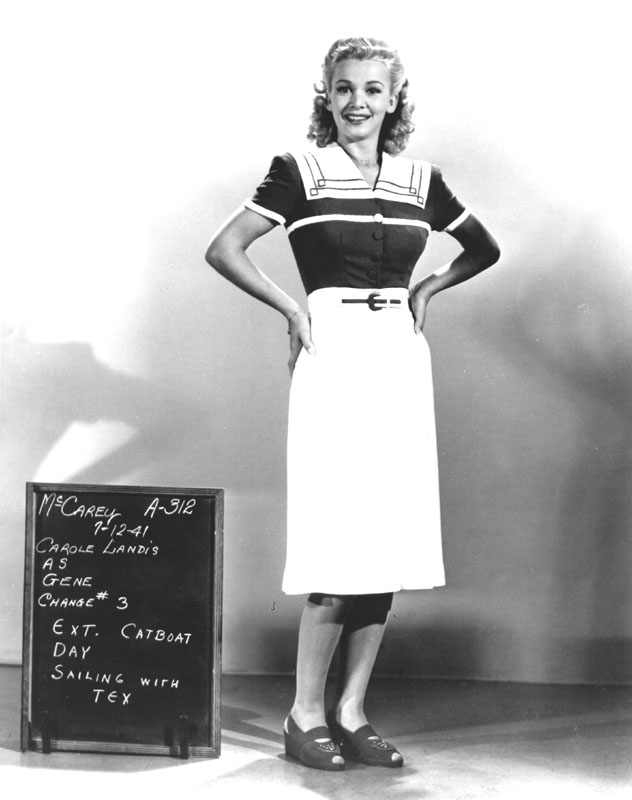
Carole Landis


It is funny what celebrity death can do... both to the public and to the deceased. The masses were so distraught after Rudy Valentino's death that at least a couple of the broken hearts tried to take their own lives as well. The tragedies of James Dean and Marilyn Monroe, instead of ending their time on earth, brought them eternal life and the love of devoted fans. Yet, sometimes, despite one's fame, to die is to die. Such is the sad case of Carole Landis, who despite her bright light, her profound beauty, and the fanatic adulation she received during her lifetime, is now remembered-- if at all-- as a sad and balled-up corpse on the bathroom floor. After she took her own life in order to ease her wounded heart, the world was left in shocked silence. Slowly, she became all but forgotten outside the halls of Hollywood's macabre trivia. The time has come to unearth her and give her the respect and embrace she always wanted but was forever denied. As the anniversary of her death approaches on July Fourth, it seems befitting to dedicate our most patriotic month to the woman who, in her life, was America's favorite patriot. Carole Landis, God shed his grace on thee...


Carole was naturally photogenic... and a brunette. 
She went blonde when she went Hollywood.


Just as mysterious and saddening as her end was her beginning. Frances Lillian Ridste was the youngest of five children born to Clara Zentek and Alfred Ridste of Wisconsin in 1919. Yet, from the beginning there was controversy, including a debate as to just who her real father was. While the family was temporarily living in Montana-- due to Alfred's job with the railroad-- Clara met farmer Charles Fenner and, it is assumed, had an affair with him. Since Alfred obtained a divorce from Clara not long after Frances's birth, credence can be given to the rumor. Clara wed Charles after her first divorce, but that union would only last 17 months. Thus, Carole inherited two absent fathers and an equally absent mother, who was forced to spend most of her days working to feed and clothe herself and her 4 children (one of whom, Jerry, had tragically already died). Carole was often left to her own devices: both to entertain herself and to fend for herself. Her childhood lacked the innocence that every youth is owed, but she never belly-ached about it. In fact, her fortitude and her selflessness were well-honed qualities that she would carry with her into adulthood, where their repercussions would eventually and vengefully take hold. A naturally friendly, light-hearted, and popular child, Carole was laid-back and easy-going. After the family moved to San Bernardino, CA, she enjoyed the pleasures of going to school and socializing, excelling at both. She could easily chat with the girls, despite their jealousy over her growing beauty-- which her sweet demeanor rendered non-threatening-- but she preferred to play sports with the boys. Athleticism was always a major part of her life, and the glamorous gowns and delicate figure that she showcased in her later film roles would eclipse a tom-boy's energetic and shapely body. In her youth, the only "dangerous curves" Carole concerned herself with had to do with softball.


In a wardrobe fitting.


Feisty and independent, Carole would survive many tragedies and mature rapidly as a result. She lost another brother, Lewis, when he was accidentally shot at the kitchen table while playing with a neighbor's gun. After her mother suffered a ruptured appendix, Carole, despite being the youngest member of the household, was the only child who neither panicked nor cried. She did what she always did and "got to gettin'." Nonetheless, the scars of these early experiences increased in her a need for escape. One option for relief was through the movies, of which she very quickly became enamored. Singing was also a talent she indulged in, possessing a beautiful voice to match her gorgeous physical features. It was this latter beauty that led to another possibility of escape: men. At 14, she passed for 21, and the fellas noticed, especially after she started winning beauty competitions (for which she had to lie about her age to enter). Luckily, Carole was completely lacking in vanity, and saw this all as a fun joke. She was more focused on creating the first powder-puff football team at her school, (though the Principal didn't go for it because it was "unwomanly"). Then, at the age of 15, she met 18-year-old Irving Wheeler and fell in love. He offered her a life away from her increasingly dependent mother, and more importantly a life of their own. Carole took the bate, and the two eloped on January 14, 1934, though the marriage was soon annulled when both sets of parents found out. Defiantly, Carole wed Wheeler again, whose intentions were more physical than emotional, only to walk out on him by September of the same year. It would not be her last tumultuous relationship.


Twentieth-Century Fox definitely cashed in on Carole's sex appeal, 
which was at times devastating to her sense of self.


The self-starter herein made her first big move: to San Francisco. Still only fifteen, she left school, her family, and all of her friends behind and travelled to the city that was known for its artistry and culture. She hoped to make a name there for herself as a singer. She did. First, she changed her name, taking "Carole" from one of her favorite actresses, Carole Lombard, and "Landis" from baseball commissioner (of course) Kennesaw Mountain Landis. Many have alleged that Carole spent her early days in San Francisco as a call-girl, but these seem to be nothing more than slanderous rumors cooked up by a jealous and unforgiving world. In truth, Carole had no time to engage in this type of vocation, because almost as soon as she stepped off the train, she marched into the famous St. Francis Hotel and asked the manager for a job. When he heard her sing, he was stunned and gratified to hire her on the spot. By working the smaller St. Francis bar, Carole was soon scooped up by the "Carl Ravazza Orchestra," and after enjoying a great deal of success and adulation, she possessed enough confidence to give Hollywood a go. In 1936, now seventeen, Carole was primed to take the industry by storm, though she would have to edit her age again to do so. With the same fearless determination and zestful work ethic that she had shown in San Francisco, Carole made the rounds to different studios and obtained numerous extra jobs until being offered a contract. 


Her athleticism served her well in the physically demanding 
One Million B.C. Eat your heart out, Raquel Welch.


Her first big break came when she was cast in the special effects, B-movie triumph One Million B.C, in which she outmaneuvered dinosaurs in scant clothing alongside costar Victor Mature. It was her athleticism that won her the role. D.W. Griffith himself was brought on board to help cast the film initially, and he hand-picked Carole because, as he put it, "She's the only [girl] who knows how to run." Soon, she was using her natural talent and knack for both comedy and drama to climb the popularity polls in films like Turnabout, in which she plays a man in the body of a woman, I Wake Up Screaming, in which she plays Betty Grable's morally questionable, murdered sister, and A Scandal in Paris, in which she plays such a sexy and devious villainess that she literally sets the screen on fire. Her beauty made her a prime candidate for some of the most popular pin-up photos of the day, though some of hers didn't make it to print due to censorship-- not because they were naughty, but because she was too well endowed. In fact, she became the first "sweater girl," before contemporary Lana Turner took the title. She was so innocently provocative that at least one particular photographer warned her before a shoot, "For God's sakes, don't inhale!" to try to diminish the appearance of her... gifts. Though Carole thought all of this objectification was a lark, she went along with it, simply because she was easy-going; not because she put stock in her sexual appeal. It wasn't until they tried to label her as the "ping" girl that she completely rebelled. She wanted to be a great actress and studied Bette Davis's performances with an eager ferocity, hoping to lend the same depth to her own roles. Sadly, because of her beauty, she was rarely afforded the privilege. Yet, she remained popular, especially among her contemporaries who constantly became smitten by her kindness and conviviality. She counted Patsy Kelly, Cesar Romero, "Mousie" Lewis, and Burgess Meredith as close friends. Even the most temperamental actors found safety in Carole's presence; she just had one of those auras that put people at ease. 


In Turnabout with John Hubbard.


All was not rosy, however. Carole's private life, if not her career, was always a failure. After finally obtaining a divorce from first husband Irving Wheeler, she then married and was divorced from Willis Hunt. She too was in a damaging relationship with Busby Berkeley and an abusive one with Pat DiCicco. Her many gentlemen friends led to rumors that Carole was just another of the many young women sleeping her way to the top. Yet, there is hardly any woman in Hollywood untainted by such a rumor, nor many who are completely innocent of it. Los Angeles doesn't breed angels. Though Carole was free-spirited and far from prudish, the assumption that she was, for lack of a better phrasing, a "studio whore," is unfounded and unfair. This is evidenced by that fact that she was able to make a legitimate career for herself, whereas so many women were simply used and discarded. It is, however, reasonable to assume that she did use the Hollywood game to her advantage, as many did, at least until she achieved enough power to extricate herself from the misogynistic system. It is generally accepted that she was one of the many ingenues Darryl F. Zanuck used for his own pleasure, but she eventually either grew tired of or outgrew this accepted station, and uttered the unfathomable word, "No." Consequently, this led to her casting in silly supporting roles beneath her talent, a tactic for Zanuck's vengeance. Ironically, the thing that saved her was WWII. Just as Carole's desire to please and bring joy to others had pulled her into a life in the entertainment business, so too did her big heart drive her to become the war effort's number one hero-- at the time above and beyond even Bob Hope or Jack Benny. Her tireless efforts in entertaining the troops at home and abroad made her America's Sweetheart and favorite patriot. Due to this, her popularity boomed, particularly after she penned a novel of her war experiences, Four Jills and a Jeep. Zanuck was begrudgingly forced to produce a film version-- albeit a Hollywoodized one-- starring herself and her three female compatriots, who were also worthy of much praise, Kay Francis, Mitzi Mayfair, and Martha Raye.


Entertaining the troops with Jack Benny.


The war changed Carole. Seeing brave men fight and die, befriending them and then losing them, and witnessing first hand the terrors of war, awakened in her a deeper knowledge of herself. No more did the glitz and glamour of stardom matter to her, not that it ever did much anyway. Now she wanted something more meaningful and fulfilling in her life. Most particularly, she yearned for a love that would lend her life gravity and comfort. She sought to attain this goal by wedding a soldier whom she met in England, Thomas Wallace. However, after their whirlwind, mid-battle courtship and wedding, the two returned to American soil and realized that they had little in common. Tommy had married her to fulfill a dream-- to wed a movie star-- only to realize that a determined woman with a career was far too belittling to his own masculinity. Carole's pipe dreams again went up in flames. After Tommy broke her heart, she moved on quickly and wed businessman Horace Schmidlapp, though that marriage too was not to last. The construction of her happy home was thus based on rocky soil. Love is found, not manufactured. The fighter in her believed a little elbow grease and work would create the life she wanted, but in reality she could never really build with anyone the love that she was looking for. 


Carole lies dead, beneath Det. Emmett Jones.


Then, she met Rex Harrison. Handsome, educated, talented, (and married), he wooed her quickly and efficiently. The only trouble was that, besides the Missus, Rex had a dark side. His feelings for Carole were superficial and sexual where hers were deep and emotional. Finding herself lost and unhappy in her career after the war, which left her feeling undernourished and useless, Rex became her all. Making movies, and bad movies at that, was a far cry from the deeply fulfilling humanitarian efforts she had offered up in Europe and Africa. She trucked along, never revealing her inner pains, remaining the devoted and beloved friend every one knew and loved, but inside she was crumbling. There is speculation that Carole tried to end her life more than once but had always been stopped before the mortal damage was done. These attempts, if true, were cries for help from a woman who was unable to articulate her own weaknesses; who knew only how to serve others and not take selfishly from them. The ability she had to push past her pain, slowly but surely crept up on her and reached a climax with hurricane Rex. Finally, tired of being used, of always being the other woman, Carole confronted Rex after a Fourth of July party that she had hosted. It is assumed that the two quarreled and the relationship was abruptly ended. That night, Carole packed all of Rex's belongings, photos, and memorabilia into a bag and left them by the mailbox at Ronald Culver's house, where Rex was staying. Then, she drove home, swallowed 30-50 Seconal tablets, and was not found until the next morning when a stunned Rex appeared before her maid and said, "I think she's dead." He, coincidentally, ran from the scene after the discovery. The eternal image of Carole now is that of a girl in a pretty summer outfit, lying on the floor in a ball, her arms frozen in an awkward, bent position. This posture suggests that she was trying to raise herself back up. She would not make it. Carole Landis: dead at 29 years of age on July 4, 1948. 

In one of her girl-next-door in one-helluva-sweater poses.


This sad, tragic tale is like so many in Hollywood, but is perhaps the most tragic because of the girl it involves. Of all the tormented souls wandering La La Land, or those who are immersed in their own demons, Carole seemed on the outside to be the least likely of its victims. Strong, vibrant, endearing, sensitive, giving, sweet... She was beloved by everyone in the community, save for those salacious studio wives who enjoyed spreading slanderous rumors about her. For her corpse and not her film work to be more remembered, for treacherous lies to be recalled and passed on and not her good deeds and selflessness, is the height of shamefulness. In every role she played, Carole brightened even the dullest of duds. She stole every show, not through effort, but from pure, unadulterated charisma and charm. She was the girl-next-door every service man in America fell in love with, and the compassionate lady every soul-sister wanted to give a big ol' hug. Yet, she forever remained apart. In her youth, she was the "other" child, and later, she became the pretty girl in Hollywood who, no matter how surrounded she was by people, was always alone. You cannot invent love, you can either give it or receive it. Too much of Carole's nature was in the giving and not the receiving, until she gave all that she had and was left with nothing. Her offerings to us, her remaining films, are cold comfort to a world who at one time idolized her and now only sits in ignorance. But, for the precious few who do recognize the true jewel that she was, her entertaining films and performances shall have to suffice. 

STAR OF THE MONTH: Carole Landis