Download Games

Recent Posts

Showing posts with label Marion Davies. Show all posts
Linda Darnell's too good to be true life story was the inspiration 
for one of her biggest films.

I have referenced multiple times in the past the fascinating mirror effect of reality and fiction. One such article, The Blurring of Violence, dealt with the way life has appeared at times to imitate art-- or at least claim to. Today's turn will examine the way art has imitated life in the movies, or more particularly how it has directly imitated the lives of its stars. Of course, there are a string of biopics about our celebrity favorites, from the Good, to the Grand, to the Ugly, (aka Man of a Thousand Faces, Chaplin, and Harlow), but while these direct tributes of celebrity life are fascinating-- a movie about a movie star making movies-- there too are examples wherein filmdom more indirectly borrows stories from stars' lives to spice up their scripts. Here are some occurrences when art has imitated the lives of its artists:


Linda Darnell's rise to fame and celebrity stature was just the sort of Cinderella story that made Hollywood the dream town of youths all over the nation. While "overnight success" is not really achieved overnight, the hard work and persistence that Linda put into her dream would pay off suddenly and shockingly to the 15-year-old when she signed with Twentieth-Century Fox in 1939. Suddenly, a switch was flipped-- Monetta Darnell was off, and Linda Darnell was on. After her breakthrough roles in Hotel for Women and Daytime Wife, Darryl F. Zanuck and company decided to capitalize off Linda's sudden appeal and "road to super-stardom" story. Thus, by the age of sixteen, a script was already being penned for the new starlet by Jessie and Ivan Kahn about her up-to-now life story... sort of. While the film did tell the tale of a small town girl turned movie gem, the old Hollywood spit and polish made things much more palatable to a glamour loving public, thus Linda's eccentric mother Pearl, for example, was not included in the plot. However, Twinkle, Twinkle, Little Star-- as it was originally titled-- did include some facts in its fictions. When Linda first came to Fox, she rode on the train with two fellow discoveries: Dorris Bowden and Mary Healy. In the film, later titled Star Dust, these two supporting characters were rolled into one, and Mary herself took on the role of "Mary Andrews." In the film, Mary's character was made to be a flop in pictures who finds happiness in the real world. This made Linda's light shine a little brighter as character Carolyn-- one of the few lucky, "chosen" ones. (This plot point was somewhat premonitory in that Mary's career never did take off like Linda's, and she made few feature films). Director Walter Lang also replicated Linda's original Fox screen test of "Two Nuts on a Sidewalk," even using her same wardrobe, though Linda admitted that the fake test was better than her original one. John Payne was added into the mix as another movie hopeful and love interest-- with a constantly broken nose-- to give the film a little romance, though Linda had no such beau upon her Hollywood arrival. Strangely enough, she was falling for cinematographer Pev Marley behind the scenes on this project. When the film premiered, Linda's name was above the title, with Fox declaring that Linda was a star before she'd had any real time to prove her mettle. In a little twist of life imitating art, Linda would immortalize her hand prints outside Grauman's Chinese Theatre after the film's premiere on March 18, 1940, just as her character had at the end of Star Dust. For one so young, it was totally unprecedented and a living dream come true. (Ironically, the movie that declared Linda a star was the same one she watched the night she suffered the fire that claimed her life. Linda is with Mary Healy and John Payne, left).


Katharine Hepburn (right) was superbly represented by another Kate, Cate Blanchett, in Martin Scorsese's The Aviator in 2004, but Kate actually brought a little of her true life to the screen over 60 years prior in the film Stage Door. When still a struggling thespian, Kate had performed in the play "The Lake" in the early '30s. It was a critical disaster that resulted in one of her most scathing reviews a la illustrious drama critic Dorothy Parker: "Hepburn ran the gamut of emotions from A to B." The negative reviews were certainly devastating to the young actress, who took her work very seriously. Having had previous raves for "The Warrior's Husband," the sudden change in mood was hard to swallow, especially since "The Lake" was basically her Broadway debut. Director/Producer Jed Harris was little help, having pushed her in his direction against her natural instincts, thus instigating a flawed performance. He too blamed her for the play's failure. As per usual, Kate took the lumps and pressed on chin up. Fast forward 4 years to Kate accepting the role of the socially oblivious but goodhearted actress Terry Randall in Stage Door. Kate would poke a little fun at herself, and perhaps at Dorothy as well, during an important plot point. Having snagged a role in "Enchanted April" from another actress, Terry finds herself underwhelming in her performance and unable to deliver the following lines with conviction: "The calla lillies are in bloom again. Such a strange flower. I carried them on my wedding day. And now I place them there, in memory of someone who is dead." These were actually the self same lines that she delivered on stage in "The Lake!" However, in Stage Door, as in her life, she was able to prove herself. After learning that the actress she had inadvertently wronged had killed herself, her performance in "Enchanted April" became jaw-droppingly honest and poignant. Terry could act after all! So could Hepburn. In later years, Dorothy Parker would recant her earlier assessment, saying that she believed Hepburn to be one of the finest actresses in the biz and that her original, infamous quotation had been a "joke." Good recovery, Dot. (Use of the play "Enchanted April" was another inside joke, as a film of that name had been an RKO failure a couple of years prior.)


Kate's co-star in Stage Door, Ginger Rogers, also indulged in a little game of live and tell. After Ginger won the "Texas State Charleston Competition" at the tender age of fourteen, she and her mother, Lela, rode across the enormous state in a continuing performance circuit. Immediately after this, she began an engagement working with bandleader Henry Santrey, which meant that she and Lela would continue traveling all over the United States. Needless to say, there were a lot of train rides. Because the dough needed to maintain one's career-- affording hotels, wardrobe, and food-- often made the cost of living higher than the rate of pay, the dynamic duo had to find ways to cut corners and save cash. One way was train fare. Mother and daughter came up with a scheme pretty early to have Ginger pretend to be two years younger, making herself twelve and thus eligible for child rates. To complete the illusion, along with her acting skills, Ginger carried a large Egyptian doll named "Freakus" around to both cover her face and make herself appear physically smaller. The plot worked like a charm until, fortunately, Ginger got far enough in her career to afford lawfulness and avoid a life of little white cons. However, she got a pleasant surprise when Billy Wilder sent her the script for The Major and the Minor, since Ginger's character pulls the exact same stunt as in her youth: she pretends to be a child in order to afford cheaper train fare only to find herself trapped in the illusion after meeting the handsome Ray Milland. Freakus, however, was substituted with a balloon (see left). Though feigning an eighteen year age difference was more difficult than a mere two year one, Ginger still pulled off the feat flawlessly. If it ain't broke... don't grow up.


Hollywood storytelling is not always a laugh, as our continuing subscriptions to rag-mags and website tell-alls can attest. The poster boy for movie star breakdowns in 1923 was America's favorite playboy, Wallace Reid (right). Having just lost his battle with morphine addiction, Wallace was cremated and put to rest at Glendale Forest Lawn cemetery, but his memory and untimely passing remained quite palpable in the public. His sad end would inspire a film, spearheaded by his grieving widow Dorothy (Davenport), about the devastating effects of drug abuse on family. Left alone with two young children, Wally Jr. and Betty, Dorothy became totally devoted to educating the nation about drug use. She equally wanted to finance a hospital in her husband's name that would care for addicts seeking mental and physical redemption. Wally's mother, Bertha, was opposed to the idea, not wanting her son to be remembered for the way he died, but Dorothy was adamant. She joined up with Harold Lloyd in forming the "Anti-Narcotics League of Los Angeles," which she too hoped to finance with profits from the movie, which was originally titled The Living Dead. 


Compiling a screenplay with C. Gardner Sullivan and signing on friend Elinor Ince as a producer (wife of Thomas), the movie got underway with the acting talents of luminaries such as James Kirkwood, Bessie Love (shooting up, left), and Dorothy herself. Jesse Lasky and the boys at Paramount had no hand in the film, which is perhaps emblematic of their guilt-- they were at least partially responsible for Wallace's dependence on morphine. Despite all of the intention, the plot was a bit over-dramatic and convoluted, involving the corruption of a taxi driver who becomes a substance abuser and, thereafter, a thief to support his habit. He then inexplicably pulls his lawyer down into the bowels of addiction with him, and the families of both men suffer as a result. However, while the lawyer finds absolution, the taxi driver does not and is killed in the end. The film was imperfect, but few critics would throw stones knowing that it was a legacy of love for Dorothy and a commemoration of one of their favorite, fallen soldiers. Some did argue that Dorothy was simply trying to profit off Wally's name-- in the film's opening she had credited herself as "Mrs.Wallace Reid"-- but with two kids to feed, who could blame her? Ironically, while the film was meant to save lives, it nearly ended two. Actors Harry Northrup and George Hackathrone were nearly killed in a collision when they had to jump from a car before being hit by a speeding train, (Oh, the days before special effects). While the end product of Human Wreckage had little to do with Wallace's life, it was a testament to what he had suffered and was notorious for its honest depiction of drug use, down to the painful realizations of withdrawal. If the story was able to save even one life, Wally certainly would have been proud.


Norman Maine (Fredric March) tries to balance his love of his wife, Vicki Lester (Janet Gaynor), 
with his jealousy over her career, as Adolphe Menjou looks on in 1937's A Star is Born.


There has been a great amount of controversy surrounding the back story of A Star is Born, a film that has been made thrice ('37, '54, and '76). The plot varies little between the different versions and involves-- similarly to Star Dust-- the meteoric rise of a young ingenue in the film business, as her lover/protege/husband's career crashes and burns. The character of "Vicki Lester" is coached into her career by fading idol "Norman Maine," whose decent into alcoholism in response to his jealousy over his new wife's career leads him to suicide. Even today, rumors abound in Hollywood, but just who the true source of this tragic tale is remains a hot debate. Many pinpoint MGM's silent leading man, John Gilbert (right), as the inspiration for Norman Maine's tragic hero. This is somewhat understandable when one compares the downward slide of Gilbert's career with that of Maine's--  in addition to his unfortunate taste for alcohol. However, many differences suggest otherwise. Gilbert was much more a victim in reality, whereas on screen the Norman Maine character is pretty much assumed the culprit of his own downward spiral-- a mixture of changing audience tastes, his addiction, and self-loathing. Some too may draw comparisons between the relationship of Norman and Vicki and Gilbert and Garbo, but Gilbert's kind guidance of Greta during her early studio days is vastly different from Maine's complete metamorphosis of and public campaign for Vicki in the film. Too, Gilbert did not commit suicide but suffered a heart attack, so the two characters there also have a divide. Yet, the method of Maine's self-annihilation-- drowning himself in the ocean-- does bring to mind a story as told by Marion Davies. Apparently, John-- who would occasionally fall into bouts of despair-- once fell under the spell of his own melancholia while at one of Marion's beach parties. Dramatically and drunkenly, he declared to all within ear shot that he was determined to kill himself. Some onlookers called his bluff and dared him to drown himself in the ocean. In defiance, Jack dove headfirst into the waves. A worried Marion called after him to stop, but the less sensitive wisecrackers assured her that Jack would not complete the task. When he was indeed washed back ashore not much later, he began weeping at his own cowardice to the jeers of onlookers. Marion's heart went out to her deeply disturbed friend, and she balled the jesters out. Since John's life is still causing inspiration, as seen in the latest The Artist, it is possible that A Star is Born also absorbed some of his tragic tale. 


But these likenesses between John and Norman are not the only bases for the film. Another popular lovers' feud often referred to with Star is that between Barbara Stanwyck and her first husband Frank Fay (together left). Babs was a struggling young actress of twenty-one when she married 36-year-old vaudeville comedian Fay in 1928. Under the more popular entertainer's protection and guidance, Babs was able to kick-start her own career and soon had movie offers. This story alone has spawned rumors, including those that allege the marriage was one of appearance only. There is argument that both Barbara and Frank were homosexuals who wed to cover their sexual preferences and protect their careers. However, if this was the case, it makes the situation that followed somewhat nonsensical. Almost immediately after the nuptials, the young bride went to Hollywood where she began working at United Artists, while funny man Fay continued on the road. Eventually, he made the move to Hollywood and was signed at Warners, but he failed to catch on with movie audiences like his wife had. This led to envious arguments that often turned physical. Friend and neighbor Joan Crawford was witness to more than one brawl. Allegedly, Frank wanted Barbara to give up her career and join him on the road when his contract was canceled in 1931, but she refused. After the duo adopted son Dion, Fay's drinking only increased.  The battling couple was a well-guarded secret in the press, but the bruises that Babs often sported were common knowledge around town. When an inebriated Fay threw son Dion into the family pool, Babs decided enough was enough and pulled to plug. They finally were divorced in 1935. Barbara would go on to become one of the most beloved and acclaimed actresses of her generation, and Fay's name would slowly disappear from the limelight. The sadistic nature of the relationship-- with the male as the dominating force-- could well have been one more bone in the spine of the Star story, especially as the inverted careers of the man and wife were the same as in the film.


Yet, there is even another story that could have served as source material: that of everyone's favorite flapper, Colleen Moore and producer husband John McCormick (together right). Colleen was an old-fashioned but ambitious young woman when she decided that acting was "the thing" for her. However, even as a youth, she was business savvy, and she understood that her atypical looks and somewhat boyish figure did not make her the symbol of female eroticism the guys usually went for. Still, there was something about her--including the fact that her eyes were two different colors--that caught the attention of John, who met her one night when the duo went dancing with Mickey Neilan and Blanche Sweet at the Sunset Inn. Not used to flattery and a wise little thing herself, the cynical Colleen merely raised an eyebrow when John asked her to marry him after three measly dances. But, before she knew it, she was head over heels as well, and the two were wed a mere day before her birthday. At first, life seemed grand. With John's support and her own ambitious spirit, Colleen's career started gaining steam, but as in the case of Babs and Frank, John's jealousy of her rising star and taste for alcohol impaired what had at first seemed a match made in heaven. Colleen kept the facts of her personal misery a secret for many years, never being one for gossip, but she did finally unleash the truth. John had been physically abusive, once nearly throwing her out a window, and finally-- when she told him she was going to leave him-- nearly choking her to death. His angry words, "You can't leave me. You're nothing without me! I made you a star!" would echo in her ears for years to come... and quite possibly in the script of Star. 


Mrs. Norman Maine ( Judy Garland) takes a hit from her alcoholic husband 
(James Mason) in 1954's A Star is Born.


One particular factor that ties the factual and fictitious versions together is a phone call that Colleen made while still married to John. At the time, Colleen's career was thriving, but she received word that her husband was about to be fired from their home studio. Though the marriage was troubled, Colleen was loyal. She called up top dog Richard Rowland and stated loud and clear, "This is Mrs. John McCormick. I just called to say 'hello." The message apparently was heard, and John's job was temporarily saved. The marriage was not, and Colleen finally left John and never looked back. History did, for in A Star is Born, the famous ending line uttered by the grieving widow/superstar, which she delivers to fans, is: "Hello, everybody. This is Mrs. Norman Maine." (Strangely, this is not dissimilar from Dorothy Reid's credit as Mrs. Wallace Reid in Human Wreckage...). Whether the tragic romance of Vicki Lester and Norman Maine was based in part on one or all of these tales is still uncertain. It is quite possible that the age old battle of the sexes and the conflicts that arise when gender roles are eclipsed (in her case) or failed (in his) are enough of a starting point for any good screenwriter. In any case, the elastic nature of the silver screen continues to give and take with its stories and its stars, giving audiences a little truth mixed with the fiction. As long as the material is good, the pond from which writers reel in ideas doesn't matter. Keep 'em comin'.

(A friend just tipped me off to the story of John Bowers as well, who may very well have been a significant source in the A Star is Born story).

HISTORY LESSON: Art Imitating LIfe

Paulette Goddard in a very elaborate get-up when she was
part of the Follies.


Hollywood and Beauty are nearly synonymous terms; Hollywood and sex are perhaps even more interchangeable. Aside from invigorating storylines and their emotional relevance, the movies have always offered us perhaps even more profoundly another source of satiation for our very ravenous eyes. Hitchcock wasn't barking up the wrong tree when he made Rear Window, starting a discussion on the obsessive and at times creepy voyeuristic tendencies of mankind. Watching gorgeous bodies in motion, observing creative and aesthetically appealing mise en scene compositions and camera angles, has made us all rabid devotees of theaters, televisions, and now iPads. But we didn't always have the movies. Before that, there was theater, vaudeville, travelling acting troupes... But nothing would produce the glorious collaboration of beauty and sex appeal, nor unleash it upon a grateful public on such a grand scale, as the brainchild of Florenz Ziegfeld: The Ziegfeld Follies. Using the knowledge that men enjoy few things more than looking at beautiful things, and enlisting the aid of a myriad of women who enjoyed the power of being the objects of male desire and adoration, Ziegfeld started the Paris-inspired Follies in New York in 1907, renaming it the Ziegfeld Follies in 1911. By 1913, The New Amsterdam Theater had become its home, with 1800 seats and shows going all the way up to the rooftop, where The Danse de Follies took place. While some regarded these extravaganzas as rude, offensive, and exploitative, you couldn't argue with box-office revenue. The public had spoken; they liked what they saw.


Chorus girls light up the stage.


The shows weren't as simple as strip-teases: there was elegance, detailed costuming, fantastical imagery, and romanticized story-telling. Sure, every once in awhile girls showed up buck naked, but in these cases, they were always forced to remain stationary so that the show did not become graphic or "lewd." It was only the glamorously bedecked females that were able to move and shake. And these women weren't frowned upon; they were adored. Wealthy businessmen, most of them older, near to retirement and enjoying their years of hard work, spent the late night hours paying it off on the numerous lovelies who danced and sang for them on stage. Of course, performances by comedians like Eddie Cantor were also intermittently featured, but that's not what the public came for. Tickets to get in were expensive, so only the elite could afford them, which also added to the acceptance of the shows as "classy." Because of the glamour and fashion, women came too, and the shows became hailed as legitimate and invigorating entertainment... with a side of naughty. The same reception would not have resulted in poorer districts that lacked the cash for flash. Working girls fought their way into the Follies, both to have a job that often paid more than their fathers were making, but also to hopefully land a "sugar-daddy." For some, a little gold-digging went a long way. For others, their brief moments on the stage only served as a stepping stone to higher aspirations. Many Hollywood leading ladies got their start spanking the planks at the scandalous Follies. It proved to be a wealthy source of education in terms of how to use sex appeal and feminine charm to demand attention. While some may have been embarrassed at their humble, fleshy beginnings, they often had to admit that the experience helped them establish their later film careers. In this respect, the days with Zeigfeld were not merely moments of youthful folly.


Olive Thomas:
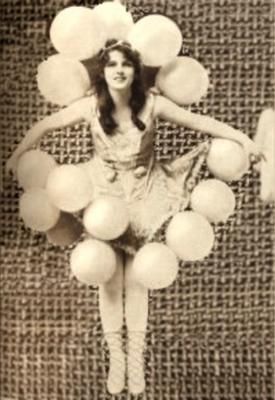
Olive arrived at the Follies in 1915. A great beauty, it wasn't long before she became a main attraction, of course her ongoing affair with Florenz also helped her rise in the ranks. She was assigned to more and more scenes, got to wear the most elaborate and elegant costumes, sang solos, and accrued scores of admirers-- including a German ambassador who once gave her a $10,000 string of pearls, (that's $100 grand today). The era when Ollie was a part of the Follies is often remembered as the best, due to the epic stage designs by Joseph Urban, but the shows would continue into the early thirties. In the 1910s, girls would sometimes stroll through the crowds of appreciative spectators wearing negligees covered by several helium balloons (see Olive left). The men in the crowd would use their cigars to pop the balloons, slowly revealing more girl and less latex. The girls also played games to entertain themselves while onstage, such as competing to see who could hit the most bald heads with their tossed garters. While performing in the Midnight Frolic, which was slightly more risque, Olive was also one of the many girls who danced on the infamous glass walkway, which Florenz had built so the men could sit beneath the high-kicking ladies with a... better view. Like most of the girls working at the Follies during these early, rebellious years, Olive didn't take the whole thing too seriously. She felt no guilt or embarrassment with regard to her employment; she was laughing all the way to the bank, and in an era when women still had little authority-- indeed, not even the right to vote-- a position in the Follies was one of the most powerful positions a girl could hold. Olive tarried at the Follies for 2 years, and then left the stage for the screen. But, during her time with Ziegfled, she was numero uno. As the "Most Beautiful Girl in the World," she was featured in a routine that showcased various women of different nationalities walking down into a large cauldron of sorts. Then, emerging from the melting pot came the sum whole of their parts: God's perfect creation, Olive Thomas. She was the ultimate, male dream.


Barbara Stanwyck:
Back when Barbara was still known as Ruby Stevens, she was a feisty and ambitious youth determined to overcome her impoverished lifestyle. Toughened up after her mother's death and her father's abandonment, Ruby spent most of her tender years escaping from foster families until she completely dropped out of school and started looking for work on her own. By the age of 14, she was already pounding the pavement, and having been inspired by her elder showgirl sister Mildred and the acting of silent film star Pearl White, she decided to become a performer on her own. Driven by an unrockable focus, there was little that was going to get in her way, which, despite her unconventional looks, allowed her to force her way into the mainstream. Allegedly, an audition landed her a gig in the chorus of the Follies for both 1922 and 1923, when she about 15 or 16-years-old. She also participated in various other chorus girl acts after leaving the Follies, but the hardened youngster wasn't satisfied with merely smiling and looking pretty, and her great strength and passion for honest and deeply felt work would soon take her from the stage to the screen, where even after her death she maintains a reputation as one of cinema's greatest, most professional actresses.


Louise Brooks:
Louise started out her performance career as a dancer with absolutely no ambitions to go into acting. As such, she was much more comfortable performing on stage under the tutelage of the illustrious dance instructors Ted Shawn and Ruth St. Denis than she would ever be before the camera. After learning from the masters, she performed with Ted and Martha Graham in the Denishawn company, but was later fired by Ruth for her inability to "co-operate." Louise then found herself a part of George White's Scandals, a contemporary of the Follies, but quit to follow her friend Barbara Bennett to Europe. When she returned, Florenz Ziegfeld scooped her up, and she began dancing at the Follies of 1925. Florenz was impressed with Louise, and soon she was climbing the ranks (literally) and was placed at the top of those notorious Follies girl-pyramids. During her time there, she also befriended fellow performer W.C. Fields, though his routines in the show were far different from her own. Will Rogers was also a member of the company at that time, as was Paulette Goddard. Louise was finally wooed by Walter Wanger to Astoria's Paramount Studios, where she begrudgingly started taking on film work. She considered it a mere experiment when she made her debut in Streets of Forgotten Men, however, she would soon become one of Hollywood's brightest stars. The city girl was about to move West.


Marion Davies:
Marion Douras too came to the Follies in her youth, but she may have had a little help securing a spot in the chorus. She was already working as a chorus girl in various shows, along with her sisters, by the time she met William Randolph Hearst in 1915. She was appearing in the Irving Berlin musical Stop! Look! Listen! at the time, in which she appeared in the number "The Girl on the Magazine Cover." Hearst definitely noticed her, despite the fact that she was an awkward beauty with a stammer. Her light personality and large eyes won him over, and he started flattering her with flowers and gifts. She wasn't the only lovely he was courting, indeed he had a reputation with show girls (he had even married one, Millicent Wilson), but soon Marion would become the only real woman of interest in his life. He arranged to have some special photos done of Marion at Campbell's Studio to test her star power and promote her. Marion was fairly clueless as to what was going on, and was uncomfortable when she spotted Hearst sitting by the camera watching her. Noticing her discomfort, he in turn got embarrassed and left. He would begin courting her in earnest and started heavily publicizing her career in his many papers, which eventually helped to land her a spot in the Follies in 1916. Marion, who had by now changed her name to Davies, didn't shy away from the attention; it was a way to support herself and her family. She later admitted that she had started out a gold-digger only to surprisingly find herself in love. She didn't tarry long in the Follies, for Hearst was determined to make her a star in the movies. As was Marion's character, she just kinda went with it, and it paid off in full.


Many other girls paid their way to fame in the Follies, including Joan Blondell, Mae Murray, Josephine Baker, Gyspy Rose Lee, Dolores Costello, Eve Arden, Irene Dunne, Mary Nolan, and Billie Dove (left). However, there too were a few who were turned down as being "not pretty enough," including Norma Shearer and Alice Faye-- of course, those ladies certainly proved their worth when the world fell in love with them on the silver screen. While the Follies shows at first appear to be nothing more than early strip-joints-- and perhaps when it all comes down to it, that's what they were-- somehow they remain something better. Before the great depression, they were an example of the grandeur, the wealth, and the glory of the almighty American dollar. Florenz Ziegfeld spared no expense when it came to his sexual extravaganzas, a flaw that would later send him into bankruptcy, but his big dreams echoed those of his thriving country. As America continued to play with the very thin line between artistry and deviance, between innocent sexuality and flat-out sin, the Follies reflected the most we could get away with. While some of the participating women may be mocked or criticized for their bartering of flesh for cash, the times they lived in did not promote the same sense of "wrongness" that today's feminists cringe at in retrospect. The female had not yet escaped her place in life as an object/wife/mother. The Follies were thus surprisingly a step in the right direction; a step toward female independence. For the first time, and on a grand scale on that large, vibrant stage, women were finally able to feel powerful. With men wrapped around their fingers and drooling at their feet, the Follies stage must have been one of the only places on earth that these ladies felt completely safe, completely in control, completely in command... even while scantily clad. After all, they couldn't very well have sold seats to a crude show if there weren't people willing to buy tickets.


An example of the mixture of sex and sophistication that
Ziegfeld brought to his shows.

HISTORY LESSON: Follies Girls to Leading Ladies

Everett Sloane, Joe Cotten, and Orson Welles cook up a plot in Citizen Kane.
Didja notice Orson's fake schoz? He wore them often, because he thought his
own nose was too small and demure.


Chapter Two of Random Factoids: enjoy!


The Real Rosebud


The great mystery of Orson Welles's Citizen Kane was the elusive "Rosebud." After all the ensuing drama, the character recollections, and the unwrapping of a complicated past, the last word of Charles Foster Kane is revealed as the name of his boyhood sled (left). When the bulk of Kane is whittled down, the audience is left to see that this small seed from a lost childhood is responsible for the maladjusted growth of the mammoth CFK. However, behind the scenes, there too was much controversy surrounding Rosebud. For years-- as the plot of the film was based at least in template on the life of William Randolph Hearst-- it has been gossiped that "Rosebud" was actually the nickname that Hearst prescribed to his mistress Marion Davies's nether regions. While this could quite possibly have been a fortunate (or rather unfortunate) coincidence, the truth is much simpler. Citizen Kane was the brainchild of Welles brought to life by the writing talents of friend Herman Mankiewicz. As such, pieces from both of these men's private lives found their way into the film, such as Orson naming one of the characters "Bernstein" after his mother's lover, Dr. Maurice Bernstein. The true Rosebud was similarly contrived: Orson received a sled from his beloved Todd School upon his graduation, marking the true end of his childhood-- not that he ever indulged in its innocence or naivete-- and Mank', as Orson called him, had a bicycle when he was a boy that he named... "Rosebud." By uniting these two youthful memories, one of cinema's most referenced plot devices was born. If Ms. Davies too shared the moniker, which cannot be confirmed or denied, it was thus by complete happenstance.


Obie, Camera, Action!


Every great actress knows that  the real man to make friends with on the set is the cinematographer. Carole Lombard and Marlene Dietrich were both staunch students when it came to lighting and angles, and they always knew how to hit their mark to look their best. Merle Oberon would too get a little education in this arena. She, like Lombard, was in a near fatal car crash in 1937, which left her face scarred. After painful surgery and recuperation, she returned to the screen, but covering up the new blemishes on her face was a daunting task. Luckily, while filming the 1944 remake of The Lodger, (right) she fell in with cinematographer Lucien Ballard. Ballard worked diligently to create a camera light which, when placed directly beside the camera, shined light directly onto her face and eliminated the appearance of her scars. Appropriately, he named his invention after her: The Obie. In gratitude, Oberon promptly married Ballard and enjoyed a fruitful career. (Coincidentally her first husband was Alexander Korda, the ambitious English producer who tried and failed to make many projects with Star of the Month Orson Welles over the years, including War and Peace).


Great Faces, Greater Minds


On the subject of inventions... It comes as no surprise that many screen performers are multi-talented. Especially in the early days, one had to be particularly well-rounded to make it, so that he or she could be thrown into any role-- drama, musical, or comedy-- and come out swinging... or singing. However, we also have a crew of film stars that should be acknowledged not just for their physical gifts but for their mental proclivities. It turns out that some stars aren't only lookers, they're thinkers, innovators, and even... inventors??? Did you know that: the first film star, Florence Lawrence, invented an early form of the automobile turn signal? It was comprised of two arms, which, when signalled, would drop to indicate which way the driver was turning. She sadly did not obtain a patent and thus missed out on the cash reward of such a novel idea. Zeppo Marx too was a very interesting man. Always tinkering with gadgets, the ex-actor/sometimes agent became an engineer. He started the Marman Products Company, Inc. in 1941 and helped the war effort by producing clamping devices and straps. He also developed the first heart-rate pulse monitor! Perhaps the most shocking-- to those who don't think that beauty and brains can come in the same package-- Hedy Lamarr (left), who had been previously married to an arms merchant, used what she had gleaned from him to make an invention of her own. She created a "frequency hopping" device to be used with WWII torpedoes in order to avoid signal "jamming" by the enemy. Sadly, although she did obtain a patent, the US Military never put her invention to work. Still, she must have been proud to do her part.


Don't Let the Heels Fool Ya'


Ann Miller was one tough cookie in her youth. In addition to her great dancing talent, she too possessed a fierce determination. This created quite the ambitious young lady, and her great work ethic would serve her well in the industry. It definitely helped her grab gigs opposite both Fred Astaire and Ginger Rogers. In 1937, Ann was already chomping at the bit to get to work, and when she had the opportunity to work opposite Ginger Rogers in the film Stage Door she was willing to do whatever it took to do so... Including lie. Only 14-years-old, Ann fudged four extra years and made herself eighteen! Whether or not the big-wigs believed her is unknown, but then they were probably too distracted by her lengthy stems to notice any discrepancies. Thus, the lanky youngster got her way and was cast as "Annie." She proved her mettle again when she was given the chance to dance opposite Fred Astaire. She was ecstatic about working on the project Easter Parade with him, and was devastated when she suffered a severe back injury-- aka her husband at the time pushed her down the stairs. (Real gentleman, that one). This should have taken her out of the running, but Ann wasn't about to give up the chance to waltz with her hero (see right). So, she worked overtime to get in shape and had the doctors strap up her back for the dancing sequences. The process hurt like hell and often left her in tears, but when the camera is on you never see it. What a pro.


Call of the Wild


Sound engineers rarely get their due. Ever since the talkies came screaming in with their sounds, squeaks, and squeals, a whole new arm of the filmmaking body had to be born to carry the weight. It's not always as easy as "Roll sound, record dialogue." Creating the proper atmosphere within a film requires a mind sophisticated or creative enough to combine a variety of noises into an underlying track. It's like writing a often barely audible symphony. Some of this sonic tinkering is more obvious, such as in explosions, sirens, gun shots... or jungle howls??? Believe it or not, coming up with the now iconic yowl of Johnny Weismuller's Tarzan for 1932's Tarzan the Ape Man was no easy feat. Audience imagination previously had to interpret his animalistic battle cry for the 1918 silent film version, but the addition of the mic made things more complicated. The point was to make his cry distinctive without making it laughable; make it palatable to the ears without making it either too passive or too threatening. There have been many theories over the years as to how the mammalian screech was made, including combining Weismuller's voice with the growl of a dog, a soprano trill, a violin, and a hyena. But the simplest version may perhaps be the most true: Johnny screamed, Douglas Shearer recorded his voice, the yell was enhanced, and then played backward. So, when you hear Tarzan howling for his Jane (with Maureen O'Sullivan left), he's actually screaming in reverse! Who knew Tarzan was fluent in palindrome?


(Another interesting note on this infamous yell was Johnny Weismuller's ability to use it as a "get out of jail free" card. He claimed that during the time Castro was preparing to take over Cuba in 1959, he was traveling with friends through Havana on his way to a celebrity golf tournament. His car was ambushed by rebel soldiers, and the only way he could prove that he was neither Cuban nor a threat was to tell them he was an American movie star. To prove it, he let out his Tarzan howl. They recognized it and gave him safe passage).

Didja Know: Part II


Hitchcock makes one of his famous cameos alongside a 
befuddled Cary Grant in To Catch a Thief.


It has been said that there are two types of movie stars: the film actor and the film personality. It could be argued which category is more vital to cinema. The "actor" star is more commonly commended for his performance skills, but monetarily speaking the "personality" star is the one drawing in the big bucks. This is not to say that the latter persona lacks talent, but he essentially-- at least according to public perception-- plays himself in every role rather than becoming various characters. Cary Grant was a personality star, so were Gable and Harlow. Marlon Brando was a film actor whose adamant refusal to become a personality star made him one anyway (at least in the tabloids). The pure film actor is more difficult to label. Lon Chaney, who notoriously underwent great metamorphoses from role to role, could be added to this category, but his publicly contrived persona as the "man of mystery" too made him famous. Modern actors are easier to peg: Daniel Day Lewis, Anthony Hopkins, and Meryl Streep-- though famous-- are more easily labeled as actors and not personalities. And what of our monthly star, Orson Welles? If ever there were a personality, this guy was it. He played incredibly varied roles over his career, but through it all, he remained Orson. His presence always dominated a film more than his actual performance. One never forgets while enraptured by Charles Foster Kane's personal disintegration that he or she is watching Orson Welles.


I bring this up to illustrate the impact of the Hollywood Cameo Role, which only truly works with a personality star. Over the years, celebrities in small cameo roles have become a linchpin in American cinema, particularly in comedies. Why? The mere presence of a well known face produces all sorts of mental and emotional connotations to viewers. A brief cameo moment on film makes things more exciting; it is a private joke between the filmmaker and the audience-- and between the star and his or her fans. Actor stars can still make a non-starring appearance in a motion picture to effect, but normally this only works when the more decorated thespian appears as one of his or her more famous characters. The aforementioned Mr. Hopkins, for example, would typically make less of an impression on fans than would his Hannibal Lecter. On the other hand, Clint Eastwood-- everyone's favorite squinting bad ass-- could deliver a line as Clint Eastwood and the audience would eat it up. The appearance of George Clooney or Ricky Gervais would equally be more effective than an appearance by Frances McDormand or Joseph Gordon Levitt. The use of star power is profound, and the use of it in a cameo role is always entertaining, simply because there is no agenda or product to sell. Whether meant to add an extra laugh or lend extra weight to a scene, a short cameo can go a long way.


Charlie Chaplin tries to collect autographs from William Haines 
and Marion Davies in Show People.


One of the earliest examples of this phenomenon that I have witnessed occurred in the silent comedy Show People, starring Marion Davies and William Haines. The very nature of the plot opened up a myriad of possibilities to use Tinsel Town to its best effect. Marion's character, Peggy Pepper, is an aspiring actress who finds herself working in Hollywood alongside the biggest stars of the day. MGM, thus, took viewers behind the scenes, making a movie about making movies. A great cameo moment occurs at a banquet when a table of stars are shown eating together: Douglas Fairbanks, John Gilbert, Renee Adoree, William S. Hart, etc. While audiences got to see these faces all the time on the silver screen, seeing them out of character and as themselves-- before the days of tabloid TV and instant internet access-- was a thrilling moment. It brought them a little closer to their idols. An even funnier moment occurs when Charlie Chaplin makes an appearance, only to go unrecognized by Marion. He asks for her autograph for his "collection," and she stands in annoyance while William Haines stands agog at the Hollywood giant before him. Charlie leaves Marion behind, who faints in Billy's arms upon her final realization. In effect, while Charlie greets these two fellow actors, he has said hello to his fans as well.


Speaking of silent films... The aforementioned situations were all very comical, but sometimes the use of different actors is applied for a more serious effect. Gloria Swanson's role in Sunset Boulevard was by no means a cameo, but the casting was a strategic move by Billy Wilder, for Gloria's natural embodiment of all the grandeur and history of old, silent Hollywood conveyed more than mere acting could. Her performance as the aging, faded movie queen thus elevated the film to another level, bringing the audience in on a continued discussion, whereas a random actress, capable as she may have been, would have had to invent all of the things that Gloria innately was. Wilder used this same casting tactic when he pulled in some other big names into cameo roles. As Norma Desmond's butler, ex-husband, and former director, he cast Erich von Stroheim (left with Gloria and Bill Holden) which perfectly indicated the continuing theme "Oh, how the mighty have fallen." Gossip columnist (and former actress) Hedda Hopper too makes an appearance as Norma makes her infamous final cascade down the staircase, amidst much camera-flashing, lending further gravity and realism to the event.


As Gloria's group of comrades playing bridge, aka the "waxworks," Wilder cast former actress Anna Q. Nilsson, silent, stone-faced comedian Buster Keaton, and the original Jesus Christ himself, H.B. Warner. (Initially, Gloria had asked William Haines to be part of this group as well, but he declined). The appearance of these individuals, especially in such a simple, dark, and strangely macabre scene, added to the pity and discomfort of film fans, who recognized the sharp contrast of the former Gods once sitting high on their Hollywood thrones and now sitting glumly around a table playing cards. To add more gravity to the game, the ever stoic and silent Keaton mutters only one word: "Pass," just as time had passed him over. Finally, Cecil B. DeMille's cameo as Norma's favorite, former director (right) too added an extra layer to their scene together, for educated audiences knew that Gloria and Cecil had worked together; that he had once called her his "little fella" and had made her a star. His empathy for her is thus more easily felt, but the audience too recognizes that the career the duo had together has long since passed, and Norma's continued delusion makes this encounter incredibly painful to watch. Cecil took these scenes very seriously, even rewriting some of his own dialogue to get it right. Wilder was so excited to have him working on the project that he completely deferred to him in the scene and let the old director take control. It was a gamble that worked brilliantly.


Most often, celebrity cameos aren't this in depth and exist purely as quick bits of humor that wink at the audience. Thus, the line between fact and fiction is gamely overstepped. Here are a few such moments worth mentioning:


One wonders what it was about The Muppet Movie that appealed to Orson Welles, but then one wonders about a great many things that went on in that Boy Wonder's head. Whatever the attraction, be it financial or comical, Orson did make a brief appearance in the film as top dog mogul Lew Lord (left). While at first, this may make one shudder at the fall of such a great idol, we too have to remember how big the Muppets were, and in addition, how many other big names made appearances in their films, from Steve Martin to Bob Hope. So, Orson wasn't really sullying his reputation by taking the project on; he was hopping on the gravy train! His bombastic, domineering personality was put to good use as the threatening producer Lord, who has Kermit shaking in his webbed feet. As an imaginative, overgrown child at heart, one can only imagine that Orson enjoyed himself.


Marlene Dietrich also added a little flavor to Paris When It Sizzles. As William Holden's character struggles to invent his latest screenplay plot, which Audrey Hepburn painstakingly tries to transcribe, he comes up with many failed vinettes. One of his imagined scenes begins with a fancy, ever-changing car pulling up to a curb. The door opens, two perfect legs emerge, and it is quickly revealed that they are attached to the glamorous Ms. Dietrich. End scene. Many women could have been used for this brief moment, but since Marlene was known to have the best pair of gams in Hollywood (see right), her casting gave it a little extra "oomph." In addition, using a big name like herself also indicated Holden's character's intention to write a big star vehicle. The film includes several other cameos, including a couple by Tony Curtis, and is, like Show People and Sunset Boulevard, a great look at Hollywood behind the scenes. Interestingly, as in Sunset, Bill is again playing a screenwriter! Clearly the cameo ploy works best in movie-themed movies!


The friendship of British thespians Peter O'Toole and Richard Burton is legendary. Two handsome men, both vastly talented, physically dissimilar, but equally caddish, they appeared in Becket together in 1964 to great acclaim (left). It appears that they remained pals when they separated and took on other various projects, for they were quickly reunited-- albeit briefly--  in What's New, Pussycat? a year later. Woody Allen's wild and outlandish script needed little help in the laugh department, but, somehow or other, another guffaw was concocted. During a scene in a bar, Peter is wandering around when he bumps into an old pal-- Burton. If you aren't paying attention, you can miss the moment completely due to the haze of smoke and the dark lighting, but the duo greet each other and quickly part, at which point Peter shouts out, "Say 'hello' to what's her name!" He is indicating, of course, Elizabeth Taylor, Dick's wife, which in essence makes it a double cameo.


In It's a Great Feeling, Doris Day's character, a waitress, goes through the gamut while Jack Carson and Dennis Morgan try to make her a star (all three right). In the end, she leaves it all behind to become a wife. The duo track her down to her wedding, where they watch the procession. Smirking and snarling through a window at how their prodigy has betrayed them, they volley back and forth about the mistake she's making, and how she'll regret being tied to some old "cornball." Then, her groom is revealed: Errol Flynn-- lecher, ladies' man, and Lothario. Errol was brought in tactically to indicate to the audience that Doris was in good hands-- at least sexually speaking. Clearly, her character is not going to be living a boring life. All this is communicated simply by showing the audience Errol's handsome face and crooked smile, which carries a plethora of connotations. (Gary Cooper also has a cameo doing his token "yup" routine).


Another type of cameo that the audience sometimes doesn't even pick up on is that of a celebrity's child in a minor role. Orson, who always had a distant and complicated relationship with his children, was at least proud enough of a Papa to cast his eldest daughter, Christopher, in his 1948 adaptation of MacBeth as Macduff's child. Liza Minnelli made her film debut in the final scene of In the Good Old Summertime opposite her mother, Judy Garland, and Van Johnson (left). And Paul Newman and Joanne Woodward cast their own daughter, Nell Potts, in a brief role in Rachel, Rachel as the heroine in her youth. The physical resemblance between mother and daughter probably made that decision a no-brainer. Cecil DeMille too cast his daughter Cecilia from time to time in various film roles when he needed to throw a kid into the mix. She appeared in both The Squaw Man and The Virginian, among others.


The King of Cameos is, of course, Alfred Hitchcock, who probably needs no mention here. Fans started to look forward to Hitch's blink-and-you'll-miss-them appearances in his films, which added a fun puzzle on top of a puzzle to his mysterious capers. It began in The Lodger-- when he is seen in the crowd, with his back to the camera as an editor, and allegedly also as a corpse-- and continued through all of his following films. Some were more obvious than others, such as the scene in To Catch a Thief when Cary Grant looks beside him on the bus and sees his director sitting stoicly. The moment is meant to be recognized, for rather than just passing it over, Cary takes an obvious look then does one of his classic bemused expressions. He, Hitch, and the audience therefore have a good "ha ha" before returning to the business at hand. Hitch had to get more creative sometimes, including the curious way he had to integrate himself into Lifeboat. Clearly, this was going to be no easy task. It would completely take his audience out of the moment if he were to randomly float by in the middle of the ocean, so instead, he placed himself in the weight-loss newspaper ad William Bendix is reading (right). He more accurately appears twice: in the before and after pictures. This provided a double laugh since Hitch was always struggling with his weight in real life. Hitch had no qualms about advertising himself, even emblazoning his name on his inter-titles in his early silents, and rumor has it that his penmanship found its way into many of his films as well. These moments became ways for Hitch to ingratiate himself to his audiences, who became just as familiar with his face as those of his stars-- no easy feat for a behind-the-scenes filmmaker.


The list of these quirky little moments could go on ad nauseum, but I will let it rest here... for now! The most fascinating thing about Hollywood, beyond the film-making of course, is the star-making. The concept of, evolution of, and implementation of celebrity into our culture, in the end, says much more about the viewers than it does the players. Those we choose to latch onto, the perceptions we place upon them, and the roles we give them in our own minds, lock them steadfastly into an identity that very often is not their own nor of their own creation. However, there are some that did contribute wholeheartedly to their screen selves, purposely encouraging their false image's mutation into societal fact. Orson Welles and Marlene Dietrich, for example, both adhered to their own mythology. It is these larger than life personae that make cameo moments that much sweeter. To see a big star, acknowledging and playing with his or her own largess, poking fun at and equally embracing the facade of this stardom, is a way of agreeing to continue to disagree with the audience: "Yes, this is all a ruse, but we both enjoy it, so let's keep playing." After all, it's all in fun. Game on!

MENTAL MONTAGE: "Wait... Was that who I think it was?"