Download Games

Recent Posts

Showing posts with label Norma Shearer. Show all posts
Linda Darnell felt like a star-struck fawn when she began working
with her acting heroes. Little did she know that she would
 in due time become one of the inspirational elite.


Just as the integration of sound in film created an uncomfortable tension between the silent generation and the studio era, so too would the invention of Television topple Golden Era Hollywood's ivory tower. Changing fads, younger audiences, and this new feat of technological competition would-- along with age-- humble many of cinema's greats. The more business savvy Gods and Goddesses immediately hopped on the gravy train, such as Loretta Young who starred in her own TV show. Other, older curmudgeons found it difficult to acclimate, like Clark Gable, who let his MGM contract run out and then sought semi-retirement. Linda Darnell became one of the many who was left to walk a crooked line between sudden, grateful independence from studio control and complete and utter bafflement at what to do next. Like many of her generation, too young to retire and too old to appeal to the new method-acting trend, Linda did a little of everything: the occasional, poorly made film, some television, and most importantly the stage. It was on the stage that Linda believed she truly learned to act and to carve out characterizations that went beyond simply hitting marks and giving good face to the camera. The various plays she did-- A Roomful of Roses, The Children's Hour, Critic's Choice, etc-- were sometimes successful and sometimes flops, but the experience was still an enriching one for her. With mostly positive reviews, her confidence was bolstered, and with younger cast members looking up to her, she gained a self-respect that had been absent from her film work. Many upcoming thespians and later film actors would get a chance to perform opposite the fading but still radiant icon, whom they came to respect and admire for her kindness, generosity, and under-appreciated talent. And so, it was on the stage performing Tea and Sympathy in 1956 that one of the gentle guiding hands of Old Hollywood would help usher in New Hollywood when Linda performed opposite a future leading man... Burt Reynolds.


After years doing stage and television work, Burt Reynolds takes his place
 in film history in Deliverance.


Another, earlier transition in the entertainment world came with cinema's first appearance. Suddenly, the world of the stage was broadened and audiences were introduced to another form of passion plays in flickering lights. Of course, as with all new "fads," many stuck their noses up at film and film actors, thinking it a cheap imitation of true performance. While half the population held tightly to the boards of the stage, another half embraced the possibilities of stories in pictures, resulting in an exciting and contentious era in our nation's past. While film actors endured the shame of ostracization and prejudice from a society that deemed them not only artistically by morally inferior, the actors of the stage dealt with an impending paranoia that the burgeoning new medium of movies was going to shake them out of the business. In time, movies did come to override the theatre as the mass favorite, but the prestige of the stage remained. Yet, with film's new success, attributed in part to the actors and actresses who helped elevate it above the mundane and superficial, respect between the two groups followed. One such example of this can be seen in the tribute one of the stage's greatest actors paid to one of cinema's. Turns out John Barrymore (left) had a bit of a crush on Lillian Gish. Not only did the notorious lecher certainly find her beautiful, but he was apparently in awe of her emotive talents, which he deemed "superlatively exquisite." He was moved to such a degree that he was uncharacteristically too embarrassed to approach her with his compliments. Instead, he used notorious director D.W. Griffith as a go-between. He wrote Griffith a letter full of plaudits, and asked him to pass on his ardent respect to Lillian after seeing her performance in Way Down East: "I wonder if you will thank Miss Gish from all of us who are trying to do our best in the theater." Of course, Jack would later arrive in Hollywood himself and start making his own impression on the cinematic world, but had it not been for his respect for actors like Lillian and their work in the medium, he may well have simply continued treading the boards on Broadway.


D.W. Griffith's "soul," Lillian Gish, apparently reached
John Barrymore's as well.


Another olive branch was extended by none other than Olive Thomas (right). She was at the height of her career when she started filming The Flapper. Life was good, work was steady, and she was quickly solidifying her place as a qualified leading lady. This certainly only served to heighten Olive's perpetually high spirits. Always a generous, free-spirited person, her charm was infectious and endeared many of her colleagues and collaborators to her. One such person was Norma Shearer, an up and coming ingenue who was breaking her way into the tough world of Hollywood through bit parts and extra roles. A fiercely determined girl herself,  Norma-- who landed her first, uncredited role in The Flapper alongside sister Athole-- most assuredly watched every move Olive made with great acuity. Here was a woman she wanted to emulate: charismatic, sensual, talented, and powerful. Never the haughty type, Olive and Norma must have struck up some sort of casual, working relationship while filming, for when Olive learned that the struggling actress had fallen ill, she was deeply concerned. As was her nature, she offered assistance without giving it a thought and wound up forking the dough for Norma's medical bills. It was a debt for which Norma remained eternally grateful and sadly never got to repay, due to Olive's untimely death. But, having indeed learned from a pro, she put this bit of kindness in her pocket and "paid it forward" in her later career, where-- after she became one of MGM's top attractions-- she often lent a hand to other up-in-comers in need, (such as Janet Leigh and Tyrone Power).


Norma Shearer grew to wield her hard-won fame
 energetically and gratefully.


Another type of world that consistently seemed to collide with Hollywood was that of the gangster. The stories of underworld debauchery made their way into cinematic stories as soon as prohibition put a bitter thorn in America's side. While we did not enjoy the truth behind the myth of the booze-pushing mobster-- the man-handling, threatening, and murdering-- we could not help but idolize him in some respect, because at least he was giving us something good to drink! Gangsters too were drawn to the glamorous allure of Hollywood for business and pleasure, and thus our nastiest ne're-do-wells started rubbing elbows with our creme-de la-creme, (see more in a past article here). Linda Darnell's mother, Pearl, would in time come into close, friendly contact with none other than Mickey Cohen (left). After Linda had moved her entire family to Los Angeles and bought them a home, Cohen happened to move in right around the corner. Due to his menacing reputation, many of the neighbors were understandably unhappy. Pearl, a tough cookie, hardly paid his presence any mind. After all, she had been causing a ruckus of her own. More than one neighbor raised an eyebrow at the unconventional Darnell home, where chickens ran amok, snakes were treated like fuzzy bunny rabbits, and Pearl fed her horse through the kitchen window. For classy Los Angelenos, this was the epitome of redneck malfeasance. For a time, Mickey distracted the neighborhood's attention from Pearl-- particularly after a bomb was thrown into his home! Now reasonably frightened, the block started a petition to have the hood ousted, but Pearl refused to sign. She believed him to be the "perfect" resident: he was quiet, had no parties, and kept up his home. When Mickey learned that Pearl had stood up for him, he called personally to thank her. I guess the only person more terrifying than Mickey Cohen was Pearl Darnell. 

Desi Arnaz (right) had his own relationship with the mob, and not just through his television production "The Untouchables." Desi's family escaped the violence and upheaval of Cuba during the revolution of 1933 and settled in Florida. His father, an ex-politician who had been incarcerated for his loyalties, wanted to start fresh in American and went about establishing himself as a businessman. Living in Miami as a teen, the charming and mentally ambidextrous Desi was also interested in business and thus had no penchant for education. Yet, at his parents' insistence, he attended St. Patrick's Catholic High School part time. The one spot of good luck was meeting the boy who was to become his closest friend at the time: Sonny Capone. Desi was aware of who Sonny's father was, but out of courtesy never brought up the fact that ol' Al was doing time in Alcatraz. He would never meet the notorious thug in the flesh, but he did have a bit of a shock one day. As per usual, Desi called the Capone household to chat with Sonny and make plans to meet up and get into the usual boyish hijinks. However, a strange, male voice answered the phone. Desi was thrown at first... and then became even more thrown as he put two and two together: Al was out on parole at the time, and must have traveled to meet with his family. Holy Moly! He was talking to Al Capone! Desi would play it cool at the time, but years later he would have a good chuckle over it. However, after he had found success in Hollywood with wife Lucille Ball, he was surprised to hear from his old friend Sonny, who was deeply insulted by "The Untouchables" due to its subject matter-- an insult to his father. "How could you do it?" Sonny asked. "Why not?" Desi retorted. "Somebody else would have anyway." Sonny's ego was not soothed-- he served Desi with a million dollar law suit. Sometimes, old friendships die hard.

Al Capone: one character not even Hollywood could make up.

BITS OF COINCIDENCE: Part IX

Paulette Goddard in a very elaborate get-up when she was
part of the Follies.


Hollywood and Beauty are nearly synonymous terms; Hollywood and sex are perhaps even more interchangeable. Aside from invigorating storylines and their emotional relevance, the movies have always offered us perhaps even more profoundly another source of satiation for our very ravenous eyes. Hitchcock wasn't barking up the wrong tree when he made Rear Window, starting a discussion on the obsessive and at times creepy voyeuristic tendencies of mankind. Watching gorgeous bodies in motion, observing creative and aesthetically appealing mise en scene compositions and camera angles, has made us all rabid devotees of theaters, televisions, and now iPads. But we didn't always have the movies. Before that, there was theater, vaudeville, travelling acting troupes... But nothing would produce the glorious collaboration of beauty and sex appeal, nor unleash it upon a grateful public on such a grand scale, as the brainchild of Florenz Ziegfeld: The Ziegfeld Follies. Using the knowledge that men enjoy few things more than looking at beautiful things, and enlisting the aid of a myriad of women who enjoyed the power of being the objects of male desire and adoration, Ziegfeld started the Paris-inspired Follies in New York in 1907, renaming it the Ziegfeld Follies in 1911. By 1913, The New Amsterdam Theater had become its home, with 1800 seats and shows going all the way up to the rooftop, where The Danse de Follies took place. While some regarded these extravaganzas as rude, offensive, and exploitative, you couldn't argue with box-office revenue. The public had spoken; they liked what they saw.


Chorus girls light up the stage.


The shows weren't as simple as strip-teases: there was elegance, detailed costuming, fantastical imagery, and romanticized story-telling. Sure, every once in awhile girls showed up buck naked, but in these cases, they were always forced to remain stationary so that the show did not become graphic or "lewd." It was only the glamorously bedecked females that were able to move and shake. And these women weren't frowned upon; they were adored. Wealthy businessmen, most of them older, near to retirement and enjoying their years of hard work, spent the late night hours paying it off on the numerous lovelies who danced and sang for them on stage. Of course, performances by comedians like Eddie Cantor were also intermittently featured, but that's not what the public came for. Tickets to get in were expensive, so only the elite could afford them, which also added to the acceptance of the shows as "classy." Because of the glamour and fashion, women came too, and the shows became hailed as legitimate and invigorating entertainment... with a side of naughty. The same reception would not have resulted in poorer districts that lacked the cash for flash. Working girls fought their way into the Follies, both to have a job that often paid more than their fathers were making, but also to hopefully land a "sugar-daddy." For some, a little gold-digging went a long way. For others, their brief moments on the stage only served as a stepping stone to higher aspirations. Many Hollywood leading ladies got their start spanking the planks at the scandalous Follies. It proved to be a wealthy source of education in terms of how to use sex appeal and feminine charm to demand attention. While some may have been embarrassed at their humble, fleshy beginnings, they often had to admit that the experience helped them establish their later film careers. In this respect, the days with Zeigfeld were not merely moments of youthful folly.


Olive Thomas:
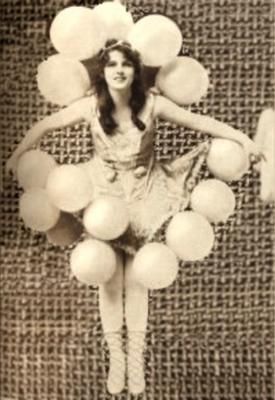
Olive arrived at the Follies in 1915. A great beauty, it wasn't long before she became a main attraction, of course her ongoing affair with Florenz also helped her rise in the ranks. She was assigned to more and more scenes, got to wear the most elaborate and elegant costumes, sang solos, and accrued scores of admirers-- including a German ambassador who once gave her a $10,000 string of pearls, (that's $100 grand today). The era when Ollie was a part of the Follies is often remembered as the best, due to the epic stage designs by Joseph Urban, but the shows would continue into the early thirties. In the 1910s, girls would sometimes stroll through the crowds of appreciative spectators wearing negligees covered by several helium balloons (see Olive left). The men in the crowd would use their cigars to pop the balloons, slowly revealing more girl and less latex. The girls also played games to entertain themselves while onstage, such as competing to see who could hit the most bald heads with their tossed garters. While performing in the Midnight Frolic, which was slightly more risque, Olive was also one of the many girls who danced on the infamous glass walkway, which Florenz had built so the men could sit beneath the high-kicking ladies with a... better view. Like most of the girls working at the Follies during these early, rebellious years, Olive didn't take the whole thing too seriously. She felt no guilt or embarrassment with regard to her employment; she was laughing all the way to the bank, and in an era when women still had little authority-- indeed, not even the right to vote-- a position in the Follies was one of the most powerful positions a girl could hold. Olive tarried at the Follies for 2 years, and then left the stage for the screen. But, during her time with Ziegfled, she was numero uno. As the "Most Beautiful Girl in the World," she was featured in a routine that showcased various women of different nationalities walking down into a large cauldron of sorts. Then, emerging from the melting pot came the sum whole of their parts: God's perfect creation, Olive Thomas. She was the ultimate, male dream.


Barbara Stanwyck:
Back when Barbara was still known as Ruby Stevens, she was a feisty and ambitious youth determined to overcome her impoverished lifestyle. Toughened up after her mother's death and her father's abandonment, Ruby spent most of her tender years escaping from foster families until she completely dropped out of school and started looking for work on her own. By the age of 14, she was already pounding the pavement, and having been inspired by her elder showgirl sister Mildred and the acting of silent film star Pearl White, she decided to become a performer on her own. Driven by an unrockable focus, there was little that was going to get in her way, which, despite her unconventional looks, allowed her to force her way into the mainstream. Allegedly, an audition landed her a gig in the chorus of the Follies for both 1922 and 1923, when she about 15 or 16-years-old. She also participated in various other chorus girl acts after leaving the Follies, but the hardened youngster wasn't satisfied with merely smiling and looking pretty, and her great strength and passion for honest and deeply felt work would soon take her from the stage to the screen, where even after her death she maintains a reputation as one of cinema's greatest, most professional actresses.


Louise Brooks:
Louise started out her performance career as a dancer with absolutely no ambitions to go into acting. As such, she was much more comfortable performing on stage under the tutelage of the illustrious dance instructors Ted Shawn and Ruth St. Denis than she would ever be before the camera. After learning from the masters, she performed with Ted and Martha Graham in the Denishawn company, but was later fired by Ruth for her inability to "co-operate." Louise then found herself a part of George White's Scandals, a contemporary of the Follies, but quit to follow her friend Barbara Bennett to Europe. When she returned, Florenz Ziegfeld scooped her up, and she began dancing at the Follies of 1925. Florenz was impressed with Louise, and soon she was climbing the ranks (literally) and was placed at the top of those notorious Follies girl-pyramids. During her time there, she also befriended fellow performer W.C. Fields, though his routines in the show were far different from her own. Will Rogers was also a member of the company at that time, as was Paulette Goddard. Louise was finally wooed by Walter Wanger to Astoria's Paramount Studios, where she begrudgingly started taking on film work. She considered it a mere experiment when she made her debut in Streets of Forgotten Men, however, she would soon become one of Hollywood's brightest stars. The city girl was about to move West.


Marion Davies:
Marion Douras too came to the Follies in her youth, but she may have had a little help securing a spot in the chorus. She was already working as a chorus girl in various shows, along with her sisters, by the time she met William Randolph Hearst in 1915. She was appearing in the Irving Berlin musical Stop! Look! Listen! at the time, in which she appeared in the number "The Girl on the Magazine Cover." Hearst definitely noticed her, despite the fact that she was an awkward beauty with a stammer. Her light personality and large eyes won him over, and he started flattering her with flowers and gifts. She wasn't the only lovely he was courting, indeed he had a reputation with show girls (he had even married one, Millicent Wilson), but soon Marion would become the only real woman of interest in his life. He arranged to have some special photos done of Marion at Campbell's Studio to test her star power and promote her. Marion was fairly clueless as to what was going on, and was uncomfortable when she spotted Hearst sitting by the camera watching her. Noticing her discomfort, he in turn got embarrassed and left. He would begin courting her in earnest and started heavily publicizing her career in his many papers, which eventually helped to land her a spot in the Follies in 1916. Marion, who had by now changed her name to Davies, didn't shy away from the attention; it was a way to support herself and her family. She later admitted that she had started out a gold-digger only to surprisingly find herself in love. She didn't tarry long in the Follies, for Hearst was determined to make her a star in the movies. As was Marion's character, she just kinda went with it, and it paid off in full.


Many other girls paid their way to fame in the Follies, including Joan Blondell, Mae Murray, Josephine Baker, Gyspy Rose Lee, Dolores Costello, Eve Arden, Irene Dunne, Mary Nolan, and Billie Dove (left). However, there too were a few who were turned down as being "not pretty enough," including Norma Shearer and Alice Faye-- of course, those ladies certainly proved their worth when the world fell in love with them on the silver screen. While the Follies shows at first appear to be nothing more than early strip-joints-- and perhaps when it all comes down to it, that's what they were-- somehow they remain something better. Before the great depression, they were an example of the grandeur, the wealth, and the glory of the almighty American dollar. Florenz Ziegfeld spared no expense when it came to his sexual extravaganzas, a flaw that would later send him into bankruptcy, but his big dreams echoed those of his thriving country. As America continued to play with the very thin line between artistry and deviance, between innocent sexuality and flat-out sin, the Follies reflected the most we could get away with. While some of the participating women may be mocked or criticized for their bartering of flesh for cash, the times they lived in did not promote the same sense of "wrongness" that today's feminists cringe at in retrospect. The female had not yet escaped her place in life as an object/wife/mother. The Follies were thus surprisingly a step in the right direction; a step toward female independence. For the first time, and on a grand scale on that large, vibrant stage, women were finally able to feel powerful. With men wrapped around their fingers and drooling at their feet, the Follies stage must have been one of the only places on earth that these ladies felt completely safe, completely in control, completely in command... even while scantily clad. After all, they couldn't very well have sold seats to a crude show if there weren't people willing to buy tickets.


An example of the mixture of sex and sophistication that
Ziegfeld brought to his shows.

HISTORY LESSON: Follies Girls to Leading Ladies

The Beautiful Hearst Castle: 
Home Sweet Mansion to visionary William Randolph Hearst.


Ironically, one of the gathering places most representative of the Golden Age of Hollywood is not in Los Angeles but almost 250 miles north. Newspaper magnate William Randolph Hearst built his illustrious castle, "San Simeon," as a labor of love, not only for lover Marion Davies, but to art and culture in general. Though it is now best remembered as being the influence for "Xanadu" in the Orson Welles masterpiece Citizen Kane, this house holds none of the movie's dark nature. Basing the construction on the breathtaking architecture he fell in love with on his constant trips abroad, Hearst built quite the collection of structures: the main house, guest houses, swimming pools, tennis courts, not to mention the far reaching exteriors of the outdoor property that included lush gardens and a playground for assorted wildlife. He invited his beloved Marion to finally come and see his new creation in 1924, having refused her admission until it was ready. Of course, it would never really be "ready," as Hearst was always adding to it, improving upon it, and tinkering with it. Bebe Daniels, Ben Lyon, and Constance "Dutch" Talmadge were also invited to this initial visit. As these movie stars' jaws hit the floor at the grandeur before them, it was certain that this place-- this glamorous and expansive "ranch"-- would become a welcoming abode for the Hollywood elite.

San Simeon was a representation of Hearst himself (right), with design and decor of impeccable taste and worldy knowledge but also an assortment of eccentricities. The interior and exterior of the buildings were filled with historical relics and priceless antiques. Genuine pieces of ancient European structures were dismantled, shipped across the Atlantic, and implemented into every corner and crevice of San Simeon. Authentic tapestries, famous paintings and sculptures, and only the grandest of furniture filled the lush rooms. Though the architecture would at first appear intimidating, with the main building resembling a chapel more than a home, the warmth and color applied to the rooms provided a very welcoming vibe. Because of this, Star of the Month William Haines was tongue tied and fascinated when he was invited up for the first time. In fact, Billy would become a frequent visitor to San Simeon, as he was close friends with Marion. Since he had a keen eye for interior design and a great love of antiques, he took to Hearst's artistic knowledge like a moth to a flame. Hearst loved sharing what he knew with Billy, indulging him like a son, answering his questions, and in turn taking his suggestions too. Certainly, the possibilities of design became apparent to Billy during his frequent trips, wherein he soaked in every nuance, every shade, every corner of Hearst's famous home.

The Neptune Pool

The Assembly Hall is exemplary of the rest of the main building. It includes Flemish tapestries, a genuine 16th-century French fireplace, and an extravagant ceiling comprised of transported pieces of the Palazzo Martinengo in Brescia, Italy. One of the most delightful aspects of "Hearst Castle" is its heated Neptune Pool, which contains 345,000 gallons of water. Surrounded by the impeccably tailored gardens of the grounds and decorated with marble replicas of some of Hearst's favorite sculptures, the pool itself was mesmerizing to visitors. Should they prefer to swim out of the sun, the indoor pool was available was well, complete with a diving platform and floor tiles bearing genuine gold flakes. Cary Grant was known to "get his swim on" quite often at either pool, and certainly enjoyed sunning himself by Neptune and keeping up his token tan.


Indoor pool, complete with gold tile.


However, for every luxury, there was also an absurdity. Hearst was a powerful, knowledgable, but eccentric man in many ways. Thus, despite the fact that San Simeon was Party Palace as far as Hollywood was concerned, he allowed no liquor on the premises. While many honored this rule, let's be honest, the majority found ways to break it, including Marion (left), who had many crafty hiding places for her booze. Her niece, Pepi Lederer, was also a frequent guest, and got into many scrapes with Hearst when her behavior indicated that she and her friends, including Louise Brooks, had been imbibing. Marion always got them off the hook, though.

However, Marion couldn't always have everyone's back, and people would quickly learn how close they were to being kicked out by how far they were seated from Hearst at his huge dinner table. If you were seated next to or across from Hearst, you knew you were in good. If you found yourself nearing the end, it was either because you had done something to tick Hearst off, or else he was getting sick of you and trying to tell you to move along. One person that even Hearst couldn't stay mad at was the lovely Jean Harlow, though she did make him blush on one occassion. She came to dinner in one of her typical, slinky dresses-- also typically lacking her undergarments. Hearst asked Marion to suggest that Jean put on something more "appropriate." Jean complied, went upstairs, and returned to dinner with a coat on over her dress, which she jokingly refused to remove. Dinner was an interesting experience for all invited, because it also indicated Hearst's attitude toward germs. He found linen napkins unsanitary, so there was no tablecloth at the lengthy table and paper napkins were used with the rest of the dinnerware. A ketchup bottle was also always handy.

The Table of Judgment

Another interesting story involving Hearst's penchant for oddities involves one of the many trees on the property. Billy Haines (right) would remember walking with Marion Davies down a pathway when the petite woman was forced to duck under an intruding tree branch. The next day, Hearst had uprooted the tree and moved it several feet out of the way. However, there is another story, which claims that Hearst moved the tree when the obstructive branch knocked his own hat off. Whether this indicated Hearst's eccentricities (moving a tree rather than walking around it), his love of the screwball queen Marion (whom he would never allow to suffer any kind of discomfort), or his simple use of power, (using resources to move a tree simply because he could), remains a topic of much speculation and bemusement.

Though Hearst could at times come off as imposing, most close to him looked on him as a little boy. Though his eyes could become piercing when his anger was (rarely) evoked, in general he was shy and fun-loving. He too had a great love of animals. One day, Marion came upon him in a distraught state: he had discovered that a mouse he was nursing back to health had died. The grounds of San Simeon also supplied a home for various wildlife, and Hearst had essentially created his own zoo. However, the majority of the animals were running free, so he wouldn't let his guests wander off onto the property alone. On his land, one could find lions, tigers, elephants, deer, zebras, etc. He eventually had to put up a sign telling visitors "Don't Tease the Monkeys," for after Marie Dressler (left) did so, a monkey threw a little... something in her face.

Most notorious, however, are those expensive, extravagant San Simeon parties. Quite often, WRH and Marion would decide to randomly throw a costume-themed party, and they would thus invite all of their favorites up to the ranch to partake. Cowboys and Indians, Favorite Historical Figures, Circus Clowns... there was no telling what characters a random night would introduce. Actors, directors, politicos, royalty, anyone who was anyone would hop on a train to San Simeon for the chance to rub elbows and cut a rug. At these fetes it was common to see Clark Gable and Carole Lombard, Jean Harlow and William Powell, Norma Shearer and Irving Thalberg, Gary and Rocky Cooper, Charlie Chaplin, John Gilbert, Leslie Howard, etc, etc, etc. While on one corner of the room Hedda Hopper and Norma Shearer would be getting into a fight over Norma's obtrusive Marie Antoinette costume-- which was so wide that she had to be accomodated with extra seats-- Hearst would be tap dancing up a storm on the other. While Billy Haines and Clara Bow made out under the piano, Gloria Swanson would be playing her infamous pranks on the assorted male guests, which usually ended with them being hit in the face with a bag of ice. Anything and everything went, for as long as people could stand... But they had better know that if they weren't up and ready for breakfast the next morning at Hearst's specified time, they weren't eating! Most just stayed up all night so as not to miss the grub, then passed out by the pool until the next round of parties started again. Others, like Harpo Marx, hitchhiked home.


Walter Winchell gives Clark Gable lessons on "How to Woo" 
his own wife, Carole Lombard, during a country/western party.


Hearst's expenditures didn't end here. He also built Marion a beach house-- beach mansion, more like-- in Santa Monica where more of the same continued. It contained 10 guest rooms complete with 10 living rooms, 15 bathrooms, 12 staff rooms, and a pool with a bridge. Erected in 1926, it lasted until 1960, when it sadly became a parking lot. Her dressing room at MGM was equally impressive, being more of a bungalow: it possessed 14 rooms and cost $70,000 all told to build. When her contract at MGM was up, her bungalow was simply moved to her new studio, Warner Bros. San Simeon, however, remains right were it was.


The usual suspects, including Greta Garbo, center, John Gilbert, lying center, 
Buster Keaton, squatting, and Norma Shearer and Irving 
Thalberg holding up the right side.


Now property of California State Parks, this sophisticated pleasure dome is open for viewing to the general public. I had the great pleasure of visiting in the summer of 2009, and it must be said that none of this structure's grandeur has diminished. I took tons of pictures (as seen above) as I ambled about in a near daze. I must say, that even the great Biltmore Mansion in Asheville, NC was not as impressive to me as San Simeon, (but perhaps that is because of its Hollywood ties, which I clearly prefer). Different tours are available, so one trip won't do it. Upon your first visit, I recommend that you do the standard tour, which takes you through the first floor of the house and gardens, but definitely go back for a more thorough glimpse of the upstairs rooms. They don't make 'em like this anymore, which I guess is good considering that it would be considered a viscious waste of money. Yet the beauty is definitely worth your appreciation, and the nostalgia you feel for a time left behind remains as poignant as the still startling architecture. As you wander the hallways, it is easy to see why so many of the celebrity elite were drawn here-- to this distant house upon a hill, far away from the glaring Hollywood lights, where they could roll up their sleeves, relax, and laugh easily with their friends. San Simeon provided devilish fun that was still somehow innocent and offered a getaway for those in the spotlight who normally could never seem to find escape. I recommend you try to escape here too.


One of the fancy guest bedrooms.


When Hearst fell on hard times, he was forced to give up San Simeon. It was one of the hardest things he ever did. The home held such memories, but even moreso it held so much of Hearst himself-- his greatest dreams and his greatest loves. He put his heart and soul into it, and never quite finished what he set out to do. Indeed, certain areas are still not completed, and windows lacking glass have been filled in with cement. Upon his final day at San Simeon, he packed up his last belongings and made the trek down the long hill and back to reality. Pausing halfway down, he stopped to gaze up at his silent creation, once so alive and brimming with excitement. San Simeon now stands up in the distance, looking down on the Pacific, and winking at passers by. A mystery swirls around it, beckoning drivers to make the voyage up and recapture some of the high times and misdemeanors the golden age of Hollywood has left behind.

View My Slideshow!!!


Visit San Simeon today HERE.

HOT SPOTS IN CA: San Simeon


Ava Gardner (above) has long been labeled as one of the loveliest women to grace the silver screen. In a town full of beautiful girls, it is no surprise that she occasionally came gorgeous face-to-gorgeous face with one of her fellow competitors for the title of "Most Beautiful." One instance goes way back. When she was making her initial train ride to Hollywood in 1941, she was unaware that another MGM starlet was on board: Hedy Lamarr  (below).  However, while LB Mayer let Ava keep her melodic sounding name upon her arrival, Hedy had not been so lucky. When she was first signed at MGM, LB changed her name from Hedwig Eva Maria Kiesler, having decided to name her after Barbara La Marr-- one of Movieville's greatest forgotten beauties. Ava and Eva, who knew? Both girls had been plucked from their native homelands by MGM-- Ava from North Carolina and Hedy from Hungary-- to be made into stars, though Ava was a complete unknown, and Hedy had already appeared in several foreign films (including the notorious Ecstasy). In fact, when Ava first made the rounds in Los Angeles, Jimmy Fidler said she "looked like Hedy Lamarr, only better." Interestingly, the two women would cross paths again after they became famous, this time in Mexico when Ava was on her honeymoon with Frank Sinatra, and Hedy just happened to be vacationing in the same place! It's a small world for Goddesses.


~ ~ ~

A similar parallelism happened to Norma Shearer (left) and another struggling actress. Back when Norma was a model in NY, playing the piano at local movie theaters to get by, she constantly bumped into another ingenue at casting calls. However, while years later people would recall the ambitious and passionate beauty that Norma was even then, they struggled to remember the other girl in their midst: Jean Arthur. Jean (below) was too shy and awkward to draw much attention behind the cameras, but Norma? As photographer Alfred Cheney Johnston put it: "Now... there was an outstanding personality!" The two ladies were very soon off to Hollywood, but they would not share a train. Norma made it out west in early 1923, and Jean followed a few months later. Strangely, people are more familiar with bashful Jean's movies than Norma's these days (thanks to the former's work with Capra and Stevens). Yet, while Norma's acting style seems a bit outmoded in these modern times, the eternal diva lives on in her celluloid kingdom as the dangerous, free-wheeling Prima Donna of her generation.


~ ~ ~

Once upon a time in New York, a young dancer was being instructed on new  choreography for the "Embraceable You" number in her upcoming stage production, Girl Crazy. The man teaching her the new moves was a skinny, scrawny sort of fellow, but he also had a strange sort of charm and an amazing talent to boot. An initial curiosity was sparked, and they went out on a date-- dancing of course. Though they liked and respected each other a great deal, romance was not on the menu. Instead, they went their separate ways, working on their own individual entertainment careers. Years later, they would be re-teamed in a major motion picture in which their dance routines stole the show: Flying Down to Rio. Though the magic never happened between them in real life, in reel life they were electric, and audiences would savor them together on the screen nine more times. They would enjoy one of the most enduring romances of cinematic history despite their lack of attraction those years ago.  Back when Fred Astaire was polishing Ginger Rogers's technique on that NY stage, he had no idea that he had just met his professional soul mate!

Destined to Dance- Ginger and Fred

~ ~ ~

When gifted thespian Judith Evelyn (right) was performing in the play "Craig's Wife" in 1947, she had the privilege of working with a young ingenue whom she found to be quite mature for her years. The young blond was educated, ambitious, patient, and generous with her co-stars-- a real pro. Judith was impressed and was certain that the lovely young lady would carve out quite a career for herself. Of course, she had no way of knowing that the junior actress's notoriety would eventually surpass her own. Years later, the two were reunited on the set of Rear Window, in which Judith played the important role of Ms. Lonelyhearts. When Grace Kelly (below) discovered that her former co-star and hero would be working with her, she invited Judith to her dressing room to share a bottle of champagne and celebrate their reunion. They often met during the shoot to catch up and reflect on old times. Judith found Grace to be as humble and sweet-natured as ever. At least some things never change.


~ ~ ~

Now, for a bit of pre-Halloween spookiness...

Franchot Tone (left)was one of the handsomest leading men of his day. Though he is less remembered than some of his contemporaries, he was certainly man enough to win the affections of Joan Crawford, to whom he was briefly married. He was quite the Lothario-- a charming ladies' man. His position as a famous Hollywood actor only made it easier to impress women. One night in 1944, he was out at the infamous Formosa Cafe when he spotted a beautiful young woman with dark hair and piercing blue eyes. Naturally, he singled her out as his lady of choice for the evening. They got to talking, and he discovered that she was an aspiring actress. She was quite fascinated with him. She asked him questions and was eager to learn how she too could get her own career going. In his head he thought, "This one's in the bag!" Franchot assured her that he could give her some advice, introduce her to the right people, etc. She was eating out of the palm of his hand by the time he got her into his car to meet an "associate." 

They drove to his swanky bachelor pad, and the young lady's attitude changed when she realized Tone had no associate waiting for her and instead had other things in mind. When Franchot tried to put the moves on her, she resisted completely, trying instead to change the subject back to her career. He realized that he had made a mistake. Despite her beauty and gorgeous curves, she was really a naive little girl at heart. She hadn't come to his room for a rendezvous;  she had really hoped to learn something from him. Feeling a bit embarrassed, Franchot dialed things down, and they talked for awhile before he put her in a cab. Less than 3 years later, he would receive quite a shock when he learned that her body was found beaten, mutilated, and cut in half, lying on a patch of grass at 39th and Norton in downtown LA. The papers were calling her "The Black Dahlia." He had known her only as Bettie Short (pictured below). Disturbed by the experience, he probably looked at every woman he tried to pick up a bit differently after that...


Hope your costume hunting is going well! Just two weeks to go!!!

BITS OF COINCIDENCE: Part IV

The empire of Hollywood was built to meet public specifications. We've been spoon-fed love stories, crime capers, and whatever plot seems to suit our current appetite.  Keeping us happy can be quite a racket, and the best of the best like Louis B. Mayer and Adolph Zukor have made millions off predicting our next craving. However,  changing attitudes make the American mind difficult to read, and more than one box-office flop has been made when the big-wigs guessed incorrectly. Just as certain films become surprise hits, different stars also unpredictably climb to fame. Certain actors that were never supposed to make it still manage to capture our attention. When Meryl Streep auditioned for 1976's King Kong, she overheard Italian producer Dino de Laurentis say to a colleague: "She's ugly. Why did you bring me this thing?" Little did he know that this brainy lady could speak his language fluently and understood the jab. While Dino predicted that Meryl didn't have the looks to charm the infamous ape, she still managed to become the most beloved and respected American actress of her generation. Here are a few more cases of the Man in Charge being Wrong as Hell.


When Douglas Fairbanks (left in The Three Musketeers)came out to Hollywood in 1915, the established thespian was placed in very prestigious company. Now working with The Triangle Film Corporation, he was in the prime position of being directed by D.W. Griffith, Mack Sennett, and Thomas Ince. However, the first filmmaker, who was working out of his Fine Arts Studio at 4500 Sunset Blvd, was less than thrilled to be dealing with the overly energetic actor. Griffith would say of Doug: "He's got a head like a cantaloupe and can't act." Now, Doug was never referred to as classically handsome, but his manic charisma endeared fans to him nonetheless, and he went on to star in some of the most epic and technically accomplished films of the silent era. Griffith must have changed his mind about Mr. Pep, whom he later teamed up with to form the independent studio United Artists (along with Chaplin and Mary Pickford).


Fred Astaire received a similar response from a studio executive. When trying to pave his way in the film industry, Astaire struggled. Despite his extreme talent, he was slight of frame and did not possess those typical, leading man looks. No one saw his potential. After an early screen test, the jury was in: "Can't act. Slightly bald. Also dances." The money men were looking so hard for stars that they failed to see one in their midst! No matter, Freddy would do all right. What he lacked in stature, he made up for with indescribable, incalculable presence... And moves!


Some of the handsomest men of their day were also originally flooded with negative feedback. Clark Gable (barely recognizable in the left photo) is still referred to as the "King of Hollywood." Even today, women find themselves falling in love with him. During his hey-day, he could and did have nearly any woman that he wanted, but no one would have predicted that when he first started out. An awkward, Ohio boy, he was a bit of a physical anomaly. "Attractive" wasn't the first word used to describe him, especially with his two gold-plated front teeth, which he constantly had to paint white! When making a screen test for Little Caesar, Darryl F. Zanuck was underwhelmed: "His ears are too big. He looks like an ape." With a little help from the miracle workers at MGM, who fixed Clark's teeth, gave him polish, and cut his hair to hide his protruding ears, Clark would have the last laugh.


Even Rudolph Valentino was shunned when he first arrived on the scene, and today he is revered as one of the most powerful sex symbols of all time. Rudy's problem was a little more complex. Due to the bias against different immigrant groups, including the Irish, Chinese, and Italian, Rudy of Castellaneta was not the prototypical American dreamboat. Italians for the most part, with their darker skin and features, were seen as untrustworthy, even insidious. This made it hard for Rudy to break into the pictures, and he was originally cast in villainous, unsavory roles-- thieves, con artists, and charlatans. No one expected much from him, including (once agan) D.W. Griffith, who said: "He's too foreign looking. The girls will never like him." Seems like D.W. should have stuck to making stars of his women; his taste in men couldn't have been more off! It was exactly Rudy's "foreign-ness" that would make him a huge, dangerously sexual superstar.


The women had a lot to put up with in regard to their appearances, of course-- probably much more than men. In addition to being sized up by studio moguls, who were more concerned about going to bed with an ingenue than casting her in a movie, young women in Hollywood were pinched, powdered, bleached, stuffed, and pushed in front of the cameras with scanty wardrobe. Many were completely made over once the star system was in full effect, becoming unrecognizable transformations of their former selves. There were some sassy ladies that resisted it though, including the following:


Jean Arthur was never comfortable with her appearance. When sizing herself up with other leading ladies of the day like Rita Hayworth and Marlene Dietrich, she felt she didn't quite measure up. Perhaps this was one of the reasons she began dyeing her naturally brunette hair blonde. Studio magnate Harry Cohn was inclined to agree with her reservations, declaring: "D'ja see her face? Half of its angel, and the other half horse." Thankfully, the horse-side must have been invisible to the camera, because audiences never saw it, nor did David O. Selznick, who was madly in love with Jean for quite some time. Despite her insecurity, Jean dug in her heels and decided to prove that she was just as much of a woman as the next hot body. Not only did she refuse to go to bed with the notoriously lustful Cohn, but she made him eat his words. Jean's earthy, soft, and natural beauty became part of her eternal appeal.


Another feisty lady that refused to be bullied was the Irish spitfire, Maureen O'Hara. When first landing in Hollywood after having some success in London, there were a lot of grumblings from the higher-ups. It may come as a shock, since Maureen seems like such a classic beauty, but at the time a lot of argument circled around her nose, which was considered too big. It was delicately suggested that she get a nose-job to make her face more palatable to the movie camera, and thus the movie-going public. This time, it was Maureen who would have the last say: "My nose comes with me. I've got a big square face, and I need my big nose. If you don't like it, I'll go back where I came from." With that kind of passion and strength, it is no wonder that her hot-tempered Mary Kate Danaher of The Quiet Man was so believable. The nose stayed with Maureen, and Maureen stayed in Hollywood, thank Heaven!


The prey of the Hollywood racket seems to come in three categories: the Pawns, the Players, and the Rebels. The metamorphosis of Norma Jean Baker to Marilyn Monroe, both body and soul, still raises the question, "What Price Fame?" Marilyn was sadly a pawn. When Norma Shearer was refused the lead in The Divorcee by her own husband, because she wasn't "sexy" enough, she proved her sensuality by having sultry photos taken. Irving Thalberg readily recanted his refusal, and Norma got the role and the Academy Award as a result! Norma was a player, and she loved the game. As for the rebel category: one actress arrived in Hollywood with a gap between her two front teeth, which she refused to fix. It was part of her and who she was. Instead, she wore a cap in her mouth for all of her films and publicity photos. This was her way of showing that while the cameras rolled, she was Ann Sheridan of Hollywood, but on her own time, she was plain ol' Clara Lou from Texas. 


Ann Sheridan... Ain't nothin' wrong with that.


At the end of the day, it didn't matter how gorgeous a person was or how many categories they hit on the list of Movie Star Must-Haves. The "X-factor" wasn't found in a face, it was found buried within-- that uncanny quality that radiated from certain blessed individuals and reached out to their audiences. This is why, while people may have wanted to shun Valentino, Fairbanks, or O'Hara at first, they were forced to bow down in humility when the public showed them their error with box-office receipts. Jean Harlow was more than her luscious curves; Gary Cooper was more than a pretty face. Clara Bow may have risen to fame by winning a magazine beauty contest, but she wouldn't have maintained her status if not for having "It." It is only in believing in the long-shots and the unique individuals that true gold is found. People want to be shown something they've never seen before. I mean, you've seen one Barbie Doll, you've seen them all. But Clark Gables? They don't come around every day...


There's the Clark we know and love!!! Haha.


MENTAL MONTAGE: With a mug like that?!