Download Games

Recent Posts

Showing posts with label Pola Negri. Show all posts


Ginger Rogers, head to toe in gold, in Gold Diggers of 1933.


Movie Stars and Money. Moolah. Bread. Gravy. Greenback... Whatever you want to call it, it always seems like celebrities have it. And lots of it. While many of us have to count every penny before going on an edited shopping spree to the ever glorious Target (Tar-jay to the upper crust), the exorbitant expenditures of modern entertainers with their private jets, sprawling mansions, and golf-ball sized engagement rings makes one both a) fiscally insulted and b) green (as cash) with envy. But whatever new car Diddy's rolling in or whatever designer gown is draped over the elegant Ms. Kidman at the latest awards show, today's divas have nothing on silent film spenders. Even in those early days, it was all about the Benjamins. Moreso, it wasn't the size of the bank account, but how one used it to advertise his or her own fame and stature. The early flood of cha-cha-ching and the resulting birth of American royalty created the still present trend of glorious, outrageous, unapologetic, economic narcissism. Here are a few of the earliest examples:


Cecil B. directs yet another lavish scene in Cleopatra
(Claudette Colbert stands center stage).


It should come as no surprise that Cecil B. DeMille be counted as one of the Kings of Coin. His films themselves were so lavishly produced and luscious to the eyes that one can only imagine the coronary Adolph Zukor must have had each time he looked at a budget estimate. In fact, despite the money that CB's movies earned at the box-office, most of them were still considered failures because they couldn't recoup the production costs. But with an eye for detail and an unwavering loyalty to (exaggerated) authenticity, DeMille spared no expense when it came to his films. He wanted what he wanted, believing that his audiences deserved the best, and that is what he gave them. In The Affairs of Anatol, for example, Wallace Reid had the distinct pleasure of filming a scene wherein he got to destroy $30,000 worth of furniture, including original Louis XVI chairs and a grand piano. CB wouldn't accept cheap props; it had to be the real deal. He also added strange, costly mandates to his productions. Anne Baxter would recall that Cecil had all of her necklaces specially "heated" before they were placed on her skin during The Ten Commandments (left). This was not a stipulation she required, but one that Cecil saw to on her behalf-- he wanted her treated like a Queen since she was playing one. Between Gloria Swanson's submergence into an expensive tub in Male and Female and Claudette Colbert's illustrious milk bath in The Sign of the Cross, CB too started a craze for opulent bathrooms. However, his own house guests were often disappointed to find that his private bathroom was rather plain.


Anne Baxter in one of her temperature controlled necklaces 
in The Ten Commandments.


But CB was not always modest in his private life. Granted, he was not as extravagant off screen as he was on, preferring to spend his down time at his vacation home, Paradise, where he could hike and feed the animals. But he did have a few flashy quirks to show off just how wealthy a man he really was. For example, male guests to Paradise would be offered color-coded silk shirts-- red for a regular Joe, white for producers, and purple for directors, corporate big-wigs, or government officials. The gents also received Gold or silver chains to spice up their look. CB also enjoyed splurging on jewelry, offering women whom he was pleased with in some way a choice of his own private collection of gems. In addition, female guests were given Cecil B. DeMille's own concoction of "Paradise" perfume. For all this, Cecil still lived fairly simple compared to some of his contemporaries. Sure he had a yacht and several real estate investments around town, but his monetary swagger was tactical more than anything else. While it could be said that he enjoyed spreading the wealth and bringing a little beauty into life, he committed grand financial acts more to stake his claim as one of Hollywood's major hitters, so people would know who was boss. It worked, for "DeMille" and "Decadent" remain pretty much synonymous.


But Cecil wasn't the only power player with cash to burn-- literally. With money comes power and thus the ability to pay for pretty much whatever you want. It naturally followed that certain celebrities were able to produce custom made products or add their own special innovations on different every day merchandise. The tiniest thing would require some specific attention in order to differentiate one's belongings from every one else's. Thus, star vanity even lead to the creation of custom made cigarettes. For his part, ill-fated director William Desmond Taylor smoked only his personally designed black cigarettes with golden tips-- that's genuine gold, folks. Actor and Mr. Muscles himself, Francis X. Bushman (right), also insisted on creating his own stock of lavender colored ciggies.


Bushman let this innovation follow him over into the realm of automobiles. When driving around town in his fancy Rolls Royce, also lavender, it wasn't enough for people to merely notice his expensive wheels. He wanted them to know that it was he who was behind the wheel. Thus, he had a special light affixed into the interior, so that at night, a bright aura would shine over his face and people would know that the famous star of Ben-Hur had just sped by. Cowboy star Tom Mix (left) followed suit. For his car, he specified that the tires be produced with his own personal "crest," which was essentially the compilation of a "T" and an "M." When his car rolled down the then dirt roads of Hollywood, his insignia could be seen in the tracks. He basically left his initials all over town, an effective way of saying "Tom  Mix was here, yeehaw!!!" Gloria Swanson too had a dream car. In fact, her earliest ambition as an actress, or as anything, was to be able to afford a heretofore unseen orchid-colored automobile. People told her she was crazy and that such a thing didn't even exist. But once she became the grande dame of silent cinema, she got her fantasy car-- and then some!


The Tom Mix Bar Brand, also present on his tires.


Or course, in these days, many celebrities were chauffeured around town in their glamorous automobiles. After all, in the caste/cash system, a higher echelon personality was going to make his or her status known. Thus, wealthy vixens like Pola Negri provided extra jobs to various servants who would accentuate their prestige. Pola (right) had a chauffeur who drove her everywhere in her white, velvet upholstered Rolls, but there was an added stipulation: he was to wear white on sunny days and black on rainy days. She too had servants who were in charge of cascading rose petals into her path so that her precious feet-- adorned with toe nail polish, which was not yet popularly worn-- would never be sullied by making direct contact with the floor. Just to add a little more oomph, she too paraded around town with her pet tiger, who often accompanied her on jaunts down Sunset Boulevard. Why, who knows? She did it simply because she could, and Pola was a definitely a drama queen on and off camera.


But perhaps the most well known example of Hollywood grandeur is that of Pickfair. The fairy tale wedding of the swashbuckling hero Douglas Fairbanks to the Golden Goddess of the Screen Mary Pickford captured the attention and affection of the American people when they were united on March 28, 1920-- despite the fact that they had essentially ditched their other spouses to make such a dream come true. It didn't matter. To the general public, they had escaped unhappy lives to reach the unbelievable culmination of true love, fame, and fortune. Of course, in order to rule on high in their fantastical splendor, they needed a Kingdom, which they dubbed "Pickfair." Situated in the hills on Summit Drive above Benedict Canyon, Mary and Doug lived in what appeared to be an oversized cottage. Its ornamentation wasn't overly glamorous, but its amenities were: a seashell shaped swimming pool, big enough to fit a canoe and complete with a slide, a tennis court, and stables. Their life together at this mansion on a hill was the ultimate American Dream. Of course, one must always wake from even the best of dreams, but while Mary and Doug's marriage may have hit the skids, the memory of their plush palace remains forever entrenched in our memories.


Doug and Mary take a row in their oyster pool.


These early celebrities didn't live in a world of "what could have been," they created worlds that were. Worlds that were as outlandish, flamboyant, unrestrained, and yet impossibly possible. When America entered into the economic crisis of the Great Depression and the film world was engulfed but the crisis of the new talkie era, the fawning awe of celebrity expenditure would give way to the public's love/hate relationship with their stars. No more would we find it completely palatable for these cinematic souls to throw cash around so nonchalantly; we would let them get away with it only if they seemed like one of us-- coming up the hard way. But, for a brief moment in time, we adored our movie stars for being larger than life, or perhaps even larger than larger than life. While their splendor may make one wrinkle his nose or perhaps erupt only in a cynical guffaw today, at the time, it was all in day's work. At least, in Hollywood...

MENTAL MONTAGE: Rollin' in the Dough


William Haines in Are You Listening?

William Haines was no phony. While he may have enjoyed the privileges that a life of luxury could afford, he also never took any of it seriously. It was all a joke really, and while he liked nice clothes and a fancy home, he could just as easily have walked away from it all at any given moment... which he essentially proved when he left the movies. Perhaps this stems from his good, old-fashioned southern roots. Integrity was everything to Billy, and those who lacked it or shirked it for superficial reasons annoyed him. He found the dramatic mannerisms of Pola Negri hilarious. Some found Greta Garbo "mysterious;" he found her stuck up. Others fell for Louis B. Mayer's tearful rages, Billy just laughed. He wanted people to be real: if you had class, you didn't have to invent it, nor cram it down anyone's throat. Thus, it comes as no surprise that one of his greatest foes was the ever exaggerated Elinor Glyn, who sent his BS detector flying off the charts.

Billy wasn't the only one who found the authoress to be an over-the-top, full-of-baloney diva. Clara Bow would jokingly refer to her as "that sh*t head." Chaplin too openly laughed at her feigned, worldly knowledge. But, for the most part, people tolerated her condescending invasion into the Hollywood lifestyle as her erotic books were adapted into screenplays. Billy didn't give a hoot who a person was as long as he or she was honest about it, but he saw Elinor as a walking nightmare of garish concoctions, both physical and mental (see right). The two never got along. Indeed, he called her "Baby Peggy." When Elinor passed out her great stamp of "It" on various actors like Clara, Gary Cooper, and Wallace Beery, Billy did not make the list. In fact, she blatantly told the world that he did NOT have "it," which theater-goers obviously disagreed with in ticket sales. (Others not making the "it" list were: Ronald Colman and Ramon Novarro). This was a jab that Elinor took at Billy specifically because he was immune to her charms, refusing to fall for her ruse of grandeur and grace. Too, he refused to flirt with her, as many men did in the hopes that her public approval would enhance their careers. When Elinor came sniffing around Billy, he just raised an eyebrow, threw off a quip, and ignored her. The insecure Elinor was enraged.

Their battle was quite public, and Billy showed his open irritation, if not contempt, refusing to support the image of Elinor's supreme intellectual and sexual perfection. He made fun of it-- and her snubbing of him-- by saying: "Elinor... said I was a big ham. I replied that the best hams in the world came from Virginia." However, the most memorable confrontation Billy and Elinor had was at the illustrious San Simeon, home of William Randolph Hearst and Billy's good friend, Marion Davies. A frequent guest, Billy was not too jazzed to see Elinor in attendance at one particular party. He happened to overhear her rattling on and on about "It." Who had "it," who didn't, and finally he got fed up. After hearing her list off all the reasons that he himself did not have "it," Billy marched right up to her and said, "Madame Glyn, you, of course, certainly do have 'it,' but you left the 'sh' of it." Elinor's face turned bright red. Billy, undoubtedly, turned on his heels and sauntered off with a smirk and a whistle. Final score: Billy- 1, Elinor- 0.

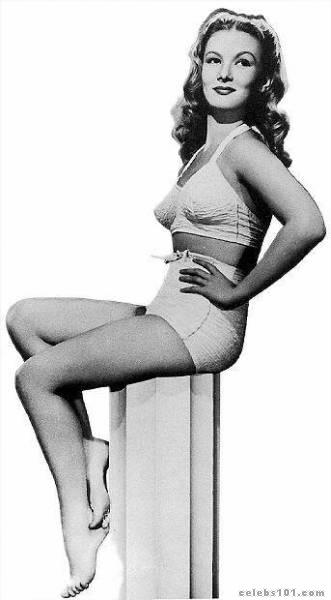
Another minor rivalry existed between Louella Parsons and Veronica Lake. Ronni (right) could really care less what Louella Parsons thought about her, and she didn't ever get involved in any of the petty gossip that seemed to keep Hollywood spinning, but for some reason Louella took a particular interest in her. Perhaps out of jealousy, Louella often made Ronni the subject of her articles, spreading the slanderous rumors that Ronni was both hard to work with and a temperamental diva. These allegations are strange, as in looking back I find it difficult to find any accounts of unprofessional behavior or rage-fueled tantrums displayed by Ronni on the set. Most of the rumors harken back to her first big movie, I Wanted Wings, when Constance Moore started spreading it around set that Ronni kept late hours and was always up partying. Ronni was actually always home in bed while Connie was engaging in this behavior. However, director Mitchell Leisen believed the tales and gave Ronni quite a roasting. Stories were spread, and soon every one believed that Veronica was causing trouble on this and every set she ever stepped on. Louella caught wind and chose to believe that Ronni truly was the troublemaking brat Hollywood had labeled her as. In her columns, she often reference Ronni was "overrated," either in acting ability or in the looks department. Ronni tried to ignore the negative press, but it did at times get her down. One day, she got a little bit of revenge. She happened to bump into Louella at a beauty parlor. Louella didn't recognize her, which was common since in her off time Ronni dressed down and without makeup. Looking simple and soft, like the girl next door, she overheard Louella comment to her attendant, "What a pretty girl." Not letting the opportunity pass her by, Ronni piped in: "Why don't you write that in your column!" Whoops, Lolly.

 Louella takes aim...

Of course, some of the slanderous portrayals of celebrity naughtiness are true, or at least based on some kernal of the truth. For example, William Haines was rightly referenced as a bit of a party-boy, enjoying nights on the town, get-togethers with friends, and good-natured shenanigans. One of his partners in crime was BFF Joan Crawford, his number one fan and lifelong ally. Joan had a rep of her own, mixing together her own ferocious ambition and unstoppable diligence with her raw and uninhibited sexuality. Joan always got what she wanted, whether it be a role or a man, but her career always came first. For this reason, she rarely got into trouble. She did get others into trouble, however. Case in point: West Point, in which she starred with Billy (left). The story takes place at the legendary military academy, and indeed this is where the cast and crew shot many of their scenes. Joan was already causing a stir on the set by NOT wearing stockings and baring her legs to the world, but she would take her rebelliousness further when flirting with the entire student body. In fact, the erotically charged Joan had no qualms about enjoying her time on campus, so she accepted (or perhaps even made) a date with one of its students. When it was discovered that the cadet skipped his classes to go out with Joan Crawford, he was immediately expelled. However, I doubt he regreted it, and Joan certainly had a good laugh.


Another naughty boy was Montgomery Clift, whose chosen salve for his personal demons was the age old trick of inebriation. Marring his classic good looks in his notorious car wreck of 1956 only propelled him deeper into his personal misery and an addiction to pain pills. Meanwhile, Monty had an ongoing rivalry with Marlon Brando, though they both truly respected each other. They would never be close friends, as competing egos rarely are, but they spent their lives privately inspired by each other, openly criticizing each other, and always trying to out-do each other. In truth, they were very different talents, with Marlon bursting forth on the screen like a lightning bolt and Monty insinuating himself more like an ominous storm cloud. In life, they came off the same way, with Monty being more elegant and Marlon more brash. Not surprisingly, Marlon found Monty stuck up and serious; Monty found Marlon just plain sloppy. Both were fairly quirky characters, though Monty often appeared much more "normal" than the exaggerated Marlon. This made it all the more shocking to learn that Monty was the one in greater personal danger, as Marlon himself would witness. 


Marlon showed his respect for Monty shortly after the latter completed Raintree County, the film which notoriously shows the "before" and "after" of Monty's car crash face. Monty went into a deep depression after the film bombed and he was snickered by audiences aghast at his lost beauty. Marlon surprised him when he drove to his house and begged him to get off the drugs and alcohol. Monty was touched (and surprised) by the concern, but insisted that he was fine... as he downed another vodka. The two buried the hatchet, admitting how impressed they were by their respective performances in A Place in the Sun and A Streetcar Named Desire. It was quite a moment. Marlon explained that he didn't want Monty to kill himself-- it was a waste of talent. Sacrilege! He also couldn't lose his top competitor, his "challenger," who kept pushing him to better his own performances. "You have to stop this nonsense, if not for your sake, then for mine!" he pleaded. Still, Monty was unmoved. But he was inspired enough to get to work on his next picture, ironically with Marlon. The two made The Young Lions, their only mutual movie, though they didn't even have any scenes together. Occasionally Monty would see Marlon lurking around the set, watching him work. Even in this, his darkest moment, he saw that he hadn't lost his touch. If he could impress Brando... Well, 'nuff said.


 A true actor, Monty insisted on creating truthful 
characters from the inside out, such as for 
his role as Noah in The Young Lions,
for which he distended his ears
and put putty on his nose.


NOW, THAT'S FUNNY: Part III


As any movie lover knows, in this modern age of consumerism it is never enough to see a movie just once. When you fall in love with a film, just like any other romance, you are filled with an unquenchable need to possess the object of your desire. Unfortunately, we true movie-buffs find this difficult, because sometimes the most sought-after and adored films of all time are unavailable to the general public. Sure, there's the occasional re-release of a beloved classic and great venues like The Egyptian or The Silent Movie Theater that will unlock the vault of cinematic past for our present pleasure, and there is nothing like seeing a feature on the big screen. However, if you are as compulsive as I am, when you see something you like, you want it! Even though you know your bank account is low; even though you know buying new shoes would be a wiser choice of expenditure.

I have sought in vain for many a film, particularly when I am deep in researching a certain individual. The number of titles that are either completely lost or being held hostage astound and frustrate me every time. So many great storylines and brilliant performances have either deteriorated, been burned for silver, or are sitting in a lonely vault somewhere. But, through my diligence i.e. obsession, I have been able to find quite a few sites that can offer the needle-in-a-haystack pieces that even the almighty Amazon.com cannot provide, (though praise be to Allah that such a site exists too)! Since I consider us comrades in arms, I want to aid you in your common quest. Here is a list of sites for the most loyal of you movie-hunting lovelies. I would say don't spend your money all in one place, but if you live in a glass house, you shouldn't throw stones! Haha ;)

See it through the Grapevine:

When I randomly stumbled onto Grapevine Video's website, I thought I had died and gone to heaven! So many films from the silent era, starring its biggest as well as its lesser remembered stars, are here for the plucking! Salivating at the mouth, I managed to put 4 movies in my cart before I remembered that I had rent to pay and should probably restrain myself. The great thing about this site, aside from the number of titles and the great quality of the films, is that the majority of the discs are double-features or include some sort of short film or comedy, so it's more bang for your buck. The site is also easy to navigate, because it allows you to search by title, director, genre, or performer, so if you have a favorite actor, he and his work will be easy to find. If Rudy's your man, look no further. If you're partial to Blanche Sweet (above, left), it doesn't get any sweeter! They accept credit or Paypal, so the money exchange is a cinch. 

Vintage is always in fashion:

Vintage Film Buff has quite the plethora of forgotten 1930s and 1940s productions. If you like B-movies, horror films, westerns, or noirs, you will find great flicks and hidden jewels at this website. Overlooked stars like George Raft, Miriam Hopkins and Anna May Wong (right) are finally given a chance to shine here, and there are fabulous and scandalous pre-code films sure to aid you in indulging your naughty side. Many of these films are boundary pushing oddities, which makes them interesting to watch and easy to enjoy.

Unknown, But Not Forgotten:

I was able to find this company after buying a couple of their dvds through Amazon. Unknown Video houses a great deal of silent classics, particularly comedies and westerns. Mabel Normand and William S. Hart (left) are highly favored here, as well as racing gent, Wally Reid. The website doesn't seem to list all of their available movies, but each time I order from them, a small catalog is provided, which includes more of their releases. A cute bonus about these films is that they each come with a collectible magnet. I now have Fatty Arbuckle and Mabel hanging on my fridge.


Clara Bow Bound:

If you love Clara-- and let's face it, who doesn't-- this website is fantastic for finding nearly all of her films!!! Yeah, I know; I too found it almost too good to be true. Yet, there it is. The Clara Bow Page contains Bow's greatest silent and talkie films, so you can sink your teeth into Mantrap and Hoopla with no trouble at all! (Who needs the Library of Congress)?! These films are burned onto a dvd at your specification, and you get two for the price of one! The quality is great and the transaction is easy, with the option of checks, money order, or Paypal. There are also several other titles available with various stars, such as Ann Harding and Pola Negri. Definitely worth the gander.

Lon Ain't Gone!

Since Chaney remains my favorite actor, and it seems that his throne is secure from future usurpation, I was more than miffed when in the beginning of my adolescent studies, I was unable to find the majority of his titles on video (this was back in the age of VHS). Still, with the coming of Digital Video Discs, he was nowhere to be found. I sadly cherished my copy of The Phantom of the Opera and The Hunchback of Notre Dame and considered all other films exiled into oblivion. Not so! Unique Dvd has an ENTIRE collection of Chaney's greatest films in one fantastic pack! The downer is that you can't purchase one film alone, and you have to get the whole shebang; but for $50 you get 20 films, plus a copy of a Lon Chaney documentary. Where East Is East, Tell It To the Marines, and While the City Sleeps... They're all there! Chaney's diverse film work is available at long last, and the "Man of a Thousand Faces" can finally be appreciated for some of his less monstrous ones! Each film is the best known surviving copy of its kind, and a few incomplete films are included and edited together for the best possible version. For a true fan, it's like a dream come true. (Also available at the site are a collection of fascinating, banned cartoons and other various series). (Unfortunately, it looks like this site has been shut down. I hope it is only temporary, as avid Lon fans need access to his work. Stop holdin' it hostage, people!).

I hope that this information helps you all in your quest for the preservation of our cinema's history. If you purchase from these sites, be sure to thank them for the great contribution and honor they are doing for our artistic heritage. It is a truly noble effort, too little recognized. So, spoil yourself, get a little movie treat, and enjoy!


HOT SPOTS... On the Internet!!!

The lexicon of movie stars gets longer and longer every day (though some may argue that, these days, the title is applied too liberally). As our collective history gets more and more jam-packed, we dispense with the ever-increasing data to make room in our brains for future information. So, while we may maintain Lillian Gish, we lose Mae Marsh; we hold tightly to Garbo, but kick Pola Negri to the curb. But these ladies of cinema trivia are not trivial, and should be remembered. Which is why, just as we revere glamour girl Jean Harlow, so too should we pay homage to her platinum predecessor: Ice Cream Blonde Thelma Todd.


Today, Thelma Todd is remembered for two reasons: she was a supporting lady in the Marx Brothers' comedies, and she died a mysterious death. But Thelma was much more than some "bit player" and was a comedic phenomenon in her own right. Discovered after winning the Miss Massachusetts Beauty Contest-- which she did NOT want to enter-- she found herself in Hollywood starring opposite legends like Laurel and Hardy and Charley Chase. Her natural talent and immediate likability made her an instant star. Too beautiful and funny to be stuck in the background, she effortlessly drew the audience's attention. Before long, she was partnered up with Zasu Pitts and later Patsy Kelly in female buddy films. This was really saying something in a genre where men were always given the lead and women were an afterthought, generally only there to move the plot along.


Sadly, her luminosity is clouded by her macabre death. On Dec. 16, 1935, Thelma was found dead in the garage above her Pacific Palisades restaurant: Thelma Todd's Sidewalk Cafe. Hastily ruled a suicide, the police at first didn't even pretend to investigate-- she had died of carbon monoxide poisoning, case closed. However, the bruises on her face raised questions, and her disbelieving mother and friends got the media in a tizzy, so DA Buron Fitts was forced to order an investigation. It was commonly known that Thelma was linked to the downright evil Lucky Luciano, and there was a lot of evidence implicating his involvement, yet the finger of blame was never placed upon him. Witnesses were bullied into keeping their mouths shut, and while Roland West, Thelma's ex-paramour and business partner, was temporarily used as a scapegoat, no real evidence could be found against him. Her death was finally ruled "accidental." In one fell swoop, Thelma and her place in the public consciousness was killed.

The thing that makes Thelma's overshadowed career the most tragic is that she was just plain fun! Watching her movies, you wish you had known her personally and could kick back and laugh it up with her. To her friends, she was the kindest and warmest pal they could ask for. Humble, utterly lacking in vanity, witty as they come, and girlishly vulnerable, hers is an endearing soul that continues to draw viewers in long after her untimely demise. Goofy and not afraid to make an ass of herself, Thelma still maintained her beauty and sex appeal. She was the whole package and a true gift to all of us. Since laughter is the best medicine, I think we could all do with a dose of Hot Toddy! Cheers!!!

 With Grouch Marx in Monkey Business

For a more thorough bio on Thelma, visit my myspace page, and read her Three Part Bio:  

STAR OF THE MONTH: THELMA TODD

Gary Cooper on the set of Farewell to Arms


I spend a great deal of my time reading. A very, VERY great deal. Most weeks when I come to the computer, the topics I discuss are a result of deductions I have made from different source materials. The more I read, and the more films I watch, the more I am able to pull together a thorough analysis of a given individual or situation. When I see a person surrounded by the layers of context they survived within, it makes him or her much easier to understand and flesh out. 

I have been impressed by many biographies or novels of historical analysis, and nonplussed by a handful as well, but there are a few that stand out in my mind as particular favorites. This week, instead of drawing personal conclusions based on what I've read, I shall introduce the materials themselves! Here are the books that currently fill my "Top Three Faves" slots:

1) A Cast of Killers by Sidney D. Kirkpatrick: This book is amazing!!! I stumbled upon it at the Los Angeles Library when looking into the William Desmond Taylor murder. Curious about the unsolved case, I decided to investigate and was thrilled to find that a book existed told from the perspective of acclaimed Director, King Vidor. This book reads like a crime novel, with Vidor standing in as Sherlock Holmes. It passes like fiction, but is non-fiction, based totally upon the diaries and findings of the director himself as he plunged headfirst into the life and death of his dearly departed friend. Kirkpatrick weaves together the facts of the Desmond case along with Vidor's personal investigation of it. Along the way, you get to know Vidor himself, including the romantic and enduring friendship he shared with business partner and former flapper, Colleen Moore. Light is shed on the effect the case had on Mabel Normand, Mary Miles Minter, and all of Hollywood, and recorded interviews with the people who were there give you a first-hand look at the death that knocked the film world off its Olympian pedestal. I won't give away the ending to those who wish to experience it for themselves, but for a spoiler and a recounting of the case as exposed by Kirkpatrick, go to my past blog on Taylor. I can't say enough about the pacing, the suspense, nor the fascinating approach to history that Kirkpatrick presents. I think I set a record for how quickly I read this one! For murder, mystery, scandal, and heart, this one is a must.

2) Hollywood's Hellfire Club: The Misadventures of John Barrymore, W.C. Fields, Errol Flynn, and the Bundy Drive Boys by Gregory William Mank: I bought this book on a whim when killing time in a Joseph-Beth Booksellers. I already had a stack of books at home and had no reason to make a purchase, but this one was pulling me to it like a moth to a flame! The jubilant, horrendous, mischievous, and down-right dirty lives and shenanigans of the group of friends who used to meet and mingle at the former residence of John Decker is brilliantly recounted in this novel. The 'Boys' include: Barrymore, Fields, Flynn, Decker, John Carradine, Sadakichi Hartmann, Thomas Mitchell, Anthony Quinn, William Fowler, and a few more. Since misery loves company, it only makes sense that these fun-loving, drunken fools find each other, and the trouble they get into is legendary. There are stories of Decker and Flynn hi-jacking a mannequin, Barrymore flashing a matronly woman in the ladies room, and the eccentric Hartmann wetting his pants because he's too lazy to get up from his seat. But with the laughs comes the tragedy, and while you chuckle at the general merriment of these troublesome fellas, you also find yourself weeping at their tales of self-destruction. Most die too young, mere fragments of the men they once were. Though their flaws are displayed openly and without apology, you cannot help but wish you had been a fly on the wall to witness even one night of their debaucheries! For all the mud slung at these men over the years, something has to be said for each of them-- if you want to know a measure of a man, count his friends. The love they denied themselves, they gave to each other... with a shot of brandy, of course.

3) Silent Stars and The Star Machine by Jeanine Basinger: I grouped these two phenomenal books together, because they are written by the same author, whom I adore, and I couldn't decide between the two!!! I have my mama to thank for these, who is always on the lookout for me when it comes to literature. Silent Stars is a great jumping off point for anyone looking for an introduction to silent cinema and its celebrities. The enormous impact that the artists Basinger features is so profound, that even witnessing it years later in the pages of the book is enthralling. The decadence of the silent stars is unparalleled. Back then, passers-by could see Pola Negri walking her white tigers down the street, or see tracks on the dirt road from Tom Mix's initialed tires. In The Star Machine, she equally investigates the impact of movie stars in the golden age, but more interestingly deconstructs their calculating and laborious creation. How stars were built, physically as well as career-wise, is fascinating. The complete and utter metamorphosis many went through created a great divide between their true and their manufactured identities, and more than one celebrity fell prey to a fractured and unnerved psyche as a result. Some played along, others fought against the system. Some are remembered today, some are forgotten. Some found a place at the crest of super-stardom, and some never quite made it because the public never responded. With features on Jean Arthur, Tyrone Power, and Eleanor Powell, you get more than a taste of true Hollywood, where all the glitz and glamour is shamelessly chipped away.


I recommend all of the aforementioned books very highly, as I refer to them frequently in my studies. For those not so interested in film and its historical and social implications, they may not seem worthwhile or could be quite laborious. But for those true Hollywoodland connoisseurs out there, there will be no tastier meat upon which to feed your starving minds! If you do take a gander, tell me what you think, and if you have any recommendations for me as well, I would love to hear them. And remember, "Beware of the man of one book!"

IF I DO SAY SO MYSELF: Book Review