Download Games

Recent Posts

Showing posts with label Thelma Todd. Show all posts
A "boo-tiful" Clara Bow gets in the mood for the Holidays.

This year's tasty greeting of chilly tidings from L.A. La Land comes in the form of the Hollywood Ghost. Just as silver screen souls continue to flicker on long after their deaths, so too do movie stars continue to haunt us in our own waking lives. Apparently, even though fate long ago called "cut," the following immortals choose to keep on living, mugging their way through the after-life, and maintaining their scene-stealing ways. Supernatural celebrity sightings have become almost as sought after as the living kind, and with accumulating stories of ghostly encounters piling up, avid fans often make it a point to visit the places their favorite, famous ghouls continue to haunt. Of course, it could all be tommyrot-- myths and legends built up over time in order to keep our idols close to us-- but then the similarities in various accounts are often a bit too startling to ignore. The locales that various celeb spirits continue to haunt is very curious and definitely indicative of who they were in life. Having never come face to face with a spirit, I can only imagine the exciting, frightening adrenaline rush a lucky (or unlucky) witness gets when encountering the eerie remnants of one they have grown to admire. Whether the fear outweighs the awe all depends on the person.


The Homes:


Errol Flynn (right) was referred to as the "Baron of Mulholland" because of his lush pleasure palace (situated at 7740 Mulholland Dr). The stories of his debaucherous parties and shenanigans are legendary. Though many stories of this Tasmanian's deviltry have been grossly over-exaggerated, the architecture of the building definitely suggested his notorious naughty side: from two way mirrors, to a front door that was really the back door, to wall murals with hidden sexual connotations, Errol always had a way of blending his keen aesthetic eye with his boyish sense of humor. But this home was more than a focal point for Hollywood parties-- it was a symbol of Errol's success, the struggles he had overcome, and the familial comforts he always sought but had trouble either finding or accepting as truth. He adored his home, which he filled with his carefully chosen, masculine decor and his beloved Paul Gauguin painting, "Famille Tahitienne." He surrounded himself with things that made him feel safe and secure; things that made him feel at home. Rumor has it that he did too good a job, for future tenants and guests would occasionally catch a glimpse of the mansion's former master.


The most interesting stories of Errol's continued residence ironically include another Hollywood heartthrob, Ricky Nelson, who moved to the address in 1977. Apparently, Ricky was a fan of the notorious lecher, and got a kick out of it when he had encounters with him. He and his family, including daughter Tracy, were constantly experiencing disturbances, such as loud banging sounds and lights turning on by themselves. One night, Tracy arrived home late. Looking toward the house, she happened to see a male figure staring out the dining room window. She thought it was her father, but when she went inside, she discovered that he was not home. When Ricky called not much later, Tracy asked him about the visitor, to which Ricky replied: "Oh, that's just Errol." After Ricky died in a plane crash in 1985, his surviving family drew the conclusion that Errol had been causing these disturbances to warn his roommate of the upcoming danger. Ricky didn't get the message. After Ricky's demise, the presence allegedly got more menacing. Thus far, there has been no word from Justin Timberlake-- who currently owns the property-- if any other odd occurrences have transpired. Since the original structure was demolished after Nelson's ownership and a new structure built, chances are slim that Errol has stuck around.


Ricky Nelson: soul brother of Errol Flynn.


Rudolph Valentino was equally proud of his Benedict Canyon home at 1436 Bella Drive, which he dubbed Falcon Lair (right) in honor of the unfulfilled film project The Hooded Falcon. The house was a grandiose expression of Rudy and wife Natacha Rambova's notorious passions and exotic tastes. The decor ranged from the oriental to the medieval, and the property housed plenty of room for Rudy's horses and dogs. Rudy became a homebody as he matured and preferred sitting at home by the fire to going out on the town. His home gave him the peace and quiet he needed. Of course, after Natacha left him, the house was also inhabited by bitter memories. Rudy's death in 1926 was a sudden, shocking event to fans and perhaps even moreso to himself. Merely thirty-one years-old at his expiration, Rudy still hasn't accepted the fact that he's dead, and there have been multiple accounts of his presence at his once beloved den. He appears most often in his bedroom and in the former stables. He too has given visitors a creep when they see him peering down from a second story window. Doors are also known to open and shut of their own accord. (George Reeves has also been known to saunter through the halls of his "suicide" house at 1579 Benedict Canyon Drive, ironically wearing his Superman costume, which he continues to bear as his own cross).


The Cemetery:

Some too have reported seeing the ghost of Rudolph Valentino at his gravesite at Hollywood Forever Memorial Park's Cathedral Mausoleum. Strangely, he is often reported as wearing his most famous costume: that of the Sheik. And he's not the only one roaming the stones at this cemetery. Some too claim to see the spirit of the infamous "Lady in Black" still visiting his grave site, as she did for several years until her own death. Also, on the edge of the lake, situated under a large tree, is the grave of Virginia Rappe (left)-- the woman notorious for crying "rape" against Fatty Arbuckle at the St. Francis Hotel in 1921, simultaneously ending his career and Hollywood's pristine image. Virginia actually died from what most scholars now agree was the effects of a botched abortion, which Fatty had nothing to do with. Nonetheless, her death was a tragic one, and the sound of her sobbing can often be heard near her gravestone, where she certainly cries for the film career she never had, the loss of her young life, and the baby she killed. Clifton Webb also has been spotted by his grave in the Abbey of the Psalms Mausoleum. Tucked down a claustrophobic corridor, the eternal man of etiquette, best remembered as Mr. Belvedere, lies in a simple plot indiscernible from his neighbors, identified only by his name. Having suffered through a complicated relationship with his mother as well as a lifetime of meticulously hiding his sexuality from the public, his restless spirit continues to hover about his final resting place. More than one visitor to the this section of the mausoleum has spotted a man in a finely tailored suit and a well-cultivated mustache walking toward them from the far wall, only to disappear as he comes too close for comfort. (Marilyn Monroe has also been reported to visit her own grave across town at Westwood Memorial).


Clifton Webb: still making a statement.


The Corner:


The famous intersection of Hollywood and Vine has also strangely been momentarily possessed by Ghosts of Hollywood's past. A bench that used to sit at the Northeast corner of the intersection was often occupied by a presence many identified as Lon Chaney. Chaney often sat at this very spot during his younger days, awaiting the bus to take him to the studios where he fought against the other hungry extras for work. As famous or as wealthy as he became, it was these lean years that always remained with him: painful years one can never fully shake off. In the future, after he had achieved success, he would pass this bench on his way to work and offer other struggling actors a ride. For years after his death, people would claim to spot him sitting at the stop, and in time the bench was even dedicated to him (see right, with son Lon Chaney Jr in top left). However, it was eventually (and unfortunately for fans) removed, and with nowhere to rest his weary bones, Lon has been seen no more. (At least not there... There are also accounts of him showing up in his Phantom garb at Stage 28 at Universal Studios where he filmed his most famous role in The Phantom of the Opera). Bela Lugosi also had an interesting moment at Hollywood and Vine... while on the way to his own funeral. Toward the end of his life, the actor was constantly taking long walks down Hollywood Boulevard, often stopping to chat with local merchants whom he'd come to know on the trek to purchase his beloved cigars. During his funeral procession,when the hearse passed through this intersection on its way to The Holy Cross Cemetery in Culver City, the driver temporarily lost control of the vehicle, and it swerved toward Hollywood-- though this route was not on the agenda. Many believe Bela was hoping to stop for one last stogie. 

Bela while appearing on Broadway as Dracula: both his
greatest friend and foe. He would be buried
in his cape.


The Restaurant:


Thelma Todd is known to prowl around her former Sidewalk Cafe (left), now home to Paulist Productions, at 17575 Pacific Coast Hwy. A cheerful, easy-going gal in life, the "Ice Cream Blonde's" appearances are never menacing, and her apparition is simply observed moving from room to room or perhaps descending the staircase. The garage where she was found dead, slumped behind the wheel of her car above the cafe at 17531 Posetano Road, also continues to experience disquieting quirks. When Thelma's body was discovered, the car's motor was still running, and the death was initially ruled a suicide by carbon monoxide poisoning-- despite the fact that her face had been clearly beaten in. The structure now appears much as it did when Thelma was alive. It was here that she always parked her car before coming down the long steps to her apartment, which was above the cafe. Today, the Posetano address belongs to another owner who-- as last reported-- uses the garage space for storage. Still, some nights, strange sounds emit from the belly of the house, including the faint sound of a motor running. Some have also recounted the scent of exhaust fumes.


The lovely Thelma in a tragic final photo.


The Hotel:


Clark Gable and Carole Lombard are still remembered as one of Hollywood's favorite golden couples (right). Carole's humor served to lighten the serious Gable's mood, and Gable's stubborn, little-boy-lost mentality induced Carole to mature (at least partly) into a loving housewife. They seemed to be made for each other, and enjoyed their blessed but simple life on their Encino ranch. After Carole's life was cut short on January 16, 1942 in a tragic plane crash, Gable was devastated. Many said that he was never the same; the light in his eyes had gone out. He would survive the love of his life by 18 years, which included two other marriages, until he was finally laid to rest beside her at Glendale Forest Lawn in 1960. However, it is not here that the two reside. Many people claim to see the duo continuing to enjoy dinner and cocktails in the lounge of one of their favorite "haunts": The Lady Windemere, now (The Georgian Hotel at 1415 Ocean Ave, Santa Monica). Various employs have entered the lower level restaurant, formerly a speakeasy-- and thus named "The Speakeasy"--after closing, to find it very much still occupied by a beautiful blond and her handsome partner. However, when they announce that serving hours are over, the figures simply disappear into thin air. (At least they know when to make an exit). In addition, the sounds of disembodied gasps, laughs, or voices saying "Good Morning," are often reported. Clark and Carole may not be completely responsible. This hotel was patronized by many, including Bugsy Siegel and Rose Kennedy, and was popular for its beauty parlor and barber shop as well. (The Roosevelt Hotel is also famous for its plethora of ghostly guests, including Monty Clift and his incessant trumpet playing, Marilyn Monroe's primping in her former mirror, and a mysterious presence and cold spot in the Blossom Room-- home to the first Academy Awards celebration).

"The Speakeasy Room" at The Georgian Hotel-- just imagine the happy
couple in the corner booth.


The Inexplicable:


Carole did a little more haunting on her own. While alive, she became close chums with upcoming comedic ingenue Lucille Ball (right). The two had much in common, including incredible beauty mixed with bawdy humor. Lucy, like many, was crushed by the news of Carole's death, and she missed her friend greatly. There were times she wished that she had Carole's ear to confide in. She particularly craved Carole's sage advice to guide her when things got rough and she felt her career slipping away. When the opportunity to do "I Love Lucy" came up, Lucy was skeptical. Television? Should she do it? What if it tanked? What would happen to her career!?!?! Anxious and full of nerves, she went to sleep, wherein she had a dream that Carole paid her a visit and said: "Honey, go for it!" Lucy listened, awoke, and went on to become the most famous television personality in history. Perhaps, in her sleep, her subconscious simply took the form of her beloved friend; but, perhaps Carole sensed a friend in need from the other side and decided to make a special trip and send a helpful message. Lucy too would go on to a future performance as a ghost. She would allegedly haunt her 1000 North Roxbury Drive home on its last day in existence. While the house was being destroyed, a passer-by happened to catch a glimpse of a flaming red-head wandering around the property. She shook her head, pacing, seeming deeply upset at what was being done to her former abode. She then disappeared around the South corner, never to be seen again... except on the boob tube. 


The Theatre:


To cap off her month as L.A. La Land's star, is Olive Thomas's preternatural tale. Olive (left) called The New Amsterdam Theatre in New York home during her years as a Ziegfeld Follies girl. These were very exciting, important years in her life, which is perhaps why-- after her death-- she chooses to return here rather than Hollywood for her occasional visits. Olive has been seen wandering the building, apparently soaking in memories of past times. Sometimes, she is in her typical, jolly mood; other times, she seems overcome with sadness. On rare occasions, she seems peeved and starts a ruckus. One employee recalled making his rounds on the stage when he surprisingly shined his light on a woman dressed in old-fashioned clothing. He thought she had merely gotten locked in, but when he called to her, she simply smiled, blew him a kiss, and disappeared. When he later compared his vision to a photo of Olive Thomas, he grew pale: it was the same girl! Mostly, Olive appears to men, continuing her worldly flirtations with impish grins and friendly greetings, often calling, "Hey, fella!" She once scared a worker away permanently when she appeared and said, "How are you doing, handsome?" His vanity was not flattered. Olive grew anxious when renovations began on the theater, allegedly becoming more vocal and wandering aimlessly in plain sight. She too has a jealous streak. When reunions involving the surviving Ziegfeld girls occur at the theater, Olive causes some serious shaking of the sets and even makes various light bulbs burn out-- simultaneously. She always appears gloriously bedecked, sometimes even wearing a sash that says "Olive," and at other mournful times, she can be spied carrying a champagne glass-- even the spirits indulge in spirits. She too walks in mid air at an area upstairs where the removed glass walkway used to be. To her, it is still there. It appears that the employees who have the courage to stay have grown accustomed to Ollie and her continued performances, often calling out "Good Morning, Olive" when they arrive in the morning and bidding her goodnight when they leave her alone in the dark with nothing but the stage's "ghost light" to keep her company.


The notoriously spooky Vincent Price lightens the mood with a bit of
dancing while filming The House on Haunted Hill.


In life, nothing is black and white. Does it not, therefore, make sense that there is not simply life and death? That there is a strange shade of gray that serves as a home for those who cannot choose a side? Our Gods and Goddesses of black and white movies seem to think so. Just as on the silver screen, they flicker on, continuing their intangible but effective presence in the world of us normal, living souls. Perhaps, to them, we are putting on the show as they exist behind the scenes, watching and observing, enjoying entertaining passion plays performed by those so unaware. Or maybe they simply continue on as if they never left, soaking in their happiest or most profound personal moments, unable to let go and unaware that they already have. Then, there are those who seem compelled to ham it up, to penetrate that thin screen between actor and passive audience, and jump out and say "Boo! I'm still here." Attention-hungry fame hounds are never satiated. Are our film players still playing with us? Putting on a show for their own amusement? Or are they simply lost and unable to make their final exit? Maybe it would be easier for them to bid farewell if we let go of them. As it is, we continue to be enamoured, hypnotized, and equally haunted by the stars who touch our lives, even after their own have ended. As we invoke their spirits every time we pop in a DVD, it should come as no surprise that they remain close to us. Until we ask them to go, they really have no reason to depart.

Halloween Spooktacular II

The easiest go-to for young lovers on date night has for some time now been the tried and true "dinner and a movie." However, if one happened to live in Hollywood in the glory days, occasionally this age-old ritual transferred to "dinner and a movie star." La La Land was, during the prime studio era, jam-packed with restaurants and eateries frequented by the glitziest faces in the biz. Chasen's, Googie's, Miceli's, The Cafe Trocadero... The list goes on and on. However, the most infamous of all these places, and the one that seems to come up as a reference in almost any Hollywood bio you read, is the The Brown Derby.


The original Derby at 3427 Wilshire.


Shaped like a hat and situated at 3427 Wilshire Blvd, the first branch of this illustrious food chain would open up in 1926 across the street from The Ambassador Hotel. It is said that the hat motif was the brain-child of co-owner Richard J. Cobb, who was once told by partner Harry Samborn (ex-hubby of Gloria Swanson) that if a restaurant was run well, the food could be "served out of a hat and you'd still make money." Cobb took this literally, and now that the duo had a hook for their diner, they set up shop-- or hat rather. Soon enough, business was bumping. While celebs like Mary Pickford and Bebe Daniels had more than a few meals at this branch, The Brown Derby didn't become synonymous with Hollywood until another restaurant was opened at Hollywood & Vine at 1628 N Vine Street in 1929. This eatery was not shaped like the famous hat, but it bore the same moniker, and since it was located in the midst of movie central, it became the go-to place for celebs and fans alike to grab a bite . Sometimes, actors would appear at the restaurant in wardrobe, because there was too little time on their lunch break to change. This restaurant is also credited with establishing the phenomenon of telephones at every booth, so that business could be conducted more efficiently by dining execs-- a tactic picked up by future eateries and clubs such as 21.


Hollywood Brown Derby at Hollywood & Vine


It was also at the Hollywood branch that the infamous "Wall of Fame" would be begun by a Polish artist, whose name was allegedly so hard to pronounce that he was referred to only as "Vitch," (first name Edward).  He started what was to become a restaurant trademark by offering to draw people's caricatures for a bowl of soup. His keen eye for accentuated facial features and his ability to capture the essence of a famous face in but a few broad strokes made him a celebrity of his own, and soon cartoonish, exaggerated pictures of Clark Gable, Marlene Dietrich, and Humphrey Bogart adorned and covered the surrounding walls (William Powell is seen left). (Other artists, most particularly Jack Lane, would continue the caricature tradition up into the eighties). Jimmy Durante would be the only star whose picture took up two pieces of paper, due to his notorious schnoz. Jimmy had a favorite corner booth, and if the table was taken when he came in for a bite, he would simply turn around and leave. Wallace Beery could also be counted on to sit in his favorite booth and order the specialty corned beef hash.


The menu at The Brown Derby was fancier than one may imagine. Offering much more than burgers and fries, the restaurant served a various assortment of ethnic masterpieces, salads, soups, and desserts. This is because various guests started adding their own favorites to the menu. Dorothy Lamour contributed her recipe for Shrimp Creole-- taste tested by her own mother-- and the different varieties of international foods can be attributed to the other universal clientele. The most famous meal perhaps is the Cobb salad, which Cobb himself is said to have haphazardly concocted on a whim. The story of its creation varies, and is the stuff of legend, but the accepted tale is thus: when he and Sid Grauman-- theater owner and showman-- were hanging around late one night, they both got hungry. Cobb took various leftover scraps of chicken, lettuce, avocado, etc, and added the famous House French Dressing. History was made, and the salad became a hit when Sid came in requesting it again the next day. The Cobb was even featured in an episode of "I Love Lucy" (right) when the gang finally goes to Hollywood and has a meal at the Derby. Seated between Eve Arden and William Holden, Lucy is, of course, star struck as she overhears the tasty Holden order the delectable Cobb. Needless to say, all Hell breaks loose and food winds up in Holden's lap and not his plate. (Watch hilarious clip here). Jack Warner was allegedly a huge fan of the salad and used to order it by the quart.


But the Derby represented more than a place to grab a bite. It was a kitchen away from home for many celebrities, many of whom have significant memories that occurred there. Here are a few worth mentioning:


The First Date
Prior to her big career breakthrough in I Wanted Wings, Veronica Lake was being wooed by esteemed art director John Detlie (both left).  After receiving bouquets of flowers from the anonymous admirer, John finally called Veronica up and asked her out on an official date. Wanting to impress the seemingly un-impressible Ronni, where did he take her? The Brown Derby- the meal locale of the who's-who of Hollywood. While Ronni was not easily flattered by superficial tomfoolery, she did enjoy her meal and was smitten enough to begin a romantic relationship with the man who was to become her first husband. Her mother, Constance, was also impressed, as she had tagged along to monitor her daughter's courtship. Love with a side of "Good-grief, Ma!"

The Proposal
Clark Gable and Carole Lombard (right at the Derby) had been romantically involved since 1936 when they bumped into each other at the Mayfair Ball. The two had appeared in No Man of Her Own together in 1932, but it wasn't until John Hay Whitney threw this little shindig that the two would click romantically. Carole was recently divorced from William Powell, with whom she remained friendly, but Clark was still very married to "Ria" Langham. Nonetheless, a love affair proceeded, during which legendary shenanigans involving doves, broken down cars, and Carole's usual pranks ensued. Soon, Carole was in over her head and head-over-heels in love. She pursued the man of her dreams with a vengeance, despite his shuffling and procrastination in obtaining a divorce: it was solely a monetary issue, for his marriage to the 17-year senior Ria had been in name only for some time. Even the studios tried to keep them apart, fearing that scandal would destroy both of their careers. Needless to say, many MGM faces turned bright red when the infamous "Hollywood's Unmarried Husbands and Wives" Photoplay article was published, insinuating Clark and Carole as two of the culprits, in the company of such others as Barbara Stanwyck and Robert Taylor. Perhaps with so many obstacles between them, the relationship would have gone up in smoke,but Clark realized that he indeed loved his dizzy, blonde Tom-boy too. After three years of waiting, on March 7, 1939 Clark obtained his divorce. Now a free man, he placed a call to Carole direct from his current location-- The Brown Derby-- and asked her to marry him. After thinking about it for a millisecond, she said "Hell, yes!" They were married a couple of weeks later on March 29.

The Wedding
No actual wedding took place at the Derby, that I know of... But Judy Garland's first act of matrimony came pretty close. David Rose was a songwriter who had won Judy's heart through his sincerity and kindness (both left). Since Dave was over ten years her senior, Judy also thought that he was a man who could protect her from her overbearing mother, Ethel. The two had first met when Judy was to do a radio show for Bob Hope, for which Rose was also scheduled. However, love seemed like a long shot for the two. Judy was still smarting over the recent marriage of Lana Turner to Artie Shaw, a good friend of Judy's with whom she was very much in love. Crying hysterically and banging her head against the wall, it appeared that Judy would be unable to perform. Rose helped to calm her down, even bringing her a piece of his mother's chocolate cake, once she had stopped with the waterworks. Since Judy had been on a very regimented diet nearly her entire life-- again, thanks to Mama Monster-- she broke out in a big smile and said, "How did you know that this was exactly what I needed?!" Soon enough, the two were dating and became engaged, though the studios were trying to stall the nuptials for as long as possible. Judy was still playing teeny-boppers in movies like Babes in Arms, and having her publicly proclaim herself as a grown-up could severely affect box office. One night, while dining out at the Derby (June 27, 1941 to be exact), Judy and David decided that they could stall no longer. Perhaps it was the romantic lighting, perhaps it was the fact that, as David discovered, the way to Judy's heart was through her stomach, but after dinner, they grabbed the check, hopped a plane to Vegas, and said "I do!" MGM was not happy, and sadly Judy was to have no Honeymoon. Furious, the studio demanded that she return the next afternoon to finish shooting on Babes on Broadway. Luckily, Judy's box-office appeal went unharmed.


The Brawl
It wasn't always hearts and clovers, however. John Gilbert (right) had a very embarrassing incident happen to him at the Derby. In the late Twenties, as the glory days of the silent film were hanging on by a thread, so too was one of its leading men. John's destruction lay not in the nature of his voice, which history has incorrectly remembered as being too squeaky for Talkies. His true enemy was Louis B. Mayer, who-- little did John know-- was already laying the trap for his downfall. Many theorize that the publicity surrounding John's inability to transfer to sound films was initiated by Mayer, with whom he had a long-running animosity. Mayer planted the seed of doubt, and soon enough it was accepted as truth that John was a hack and a far cry from his macho, leading man persona. One piece of evidence to support this is the article that Mayer (supposedly) had Jim Tully write for Vanity Fair, in which he labeled John as a lecherous mama's boy. This poison pen article was specifically used to tarnish John's ladies' man image and serve as the first nudge to propel his career on its downward spiral. John, a self-made man who had a very tumultuous relationship with his mother, was disgusted when he read the article. So sickened was he, that he actually threw-up. Thus, when he came face to face with Tully years later at The Brown Derby, he started a fight with the author. However, because Tully had a background in boxing, it was John who was left lying on the floor, his ego bruised more than his eye. It was a humiliating experience, and the drunk and disorderly John had to be removed from the premises, while Tully returned to his meal. Years later, Tully would admit that he had nothing against John, and had in fact never met him when he wrote the article, therefore having to basis upon which to make his lewd statements. It was simply a job and a job too well done. John and his career would soon disappear under the heap of lies, but not until after the insult of all insults: he was forced to act opposite Tully in Way for a Sailor of 1930.


The Beginning and The End
The Brown Derby would finally serve as a macabre bookend for the remaining days of Thelma Todd (left).  Her introduction to and her last public meeting with the man who is most often labeled as the mastermind of her bizarre, untimely death would occur at none other than The Brown Derby. Thelma's marriage to Pat DiCicco, a Hollywood agent with mob connections, was well on its way to divorce court from almost the moment they said "I do." Pat was secretive and abusive, and it was becoming abundantly clear that his charms had been covering up a selfish and sadistic personality. Thelma was fed up with the lies and his emotional distance from her: Where did he disappear to all the time? Who was he with? And why? She got her answer one night when dining with friend and ex-lover Roland West at the Derby. Ironically, the two were discussing the creation of a restaurant of their own: Thelma Todd's Sidewalk Cafe, which would soon take root on the Pacific Coast Highway. In the midst of conversation, Thelma caught sight of her hubby across the way, talking to a man she couldn't see. She boldly walked over to give him a piece of her mind, or at the very least elbow her way into his life. She was shocked by what she saw: Lucky Luciano. Though far from handsome, Lucky and his power were intoxicating, hypnotizing, and Thelma found herself stuttering under his piercing gaze. He held out his hand, introduced himself, complimented her beauty, and then offered her a drink. Since Thelma was overcoming issues with alcoholism and a drug addiction, she refrained, but when Lucky insisted, one didn't refuse. This meeting would being the rapid countdown to her final days.


Thelma's own Sidewalk Cafe.

Apparently, all of Pat's secrecy had been for Thelma's protection. He knew Lucky (right) had an eye for his movie star wife, that he loved blondes, and that he was also a dangerous and far more abusive man than Pat himself would ever be. Yet, before he knew it, Pat and Thelma were divorced, and it was Luciano who had crawled into her bed like a serpent. The affair was not a joyous one. More physical abuse began, as did more sneaking, lying, and cheating. Thelma finally had her fill when Luciano tried to get his hands on her Cafe in order to use the upstairs room as a headquarters for his gambling racket. Thelma wasn't having it, and she tried to break off the affair. Again, Lucky never took "no" for an answer. He had already succeeded in sending Thelma back into her debilitating addiction to prescription pills, uppers, and booze, now he was trying to tamper with her business. One night, the duo met publicly, as Thelma had stipulated, at The Brown Derby. Again, Lucky tried to force his way into her business, but this time Thelma let it be known once and for all that she was through with him for good, even threatening to use the knowledge she had about Lucky's illegal business deals as blackmail. Legend has it that Thelma stood up to leave, shouting out, "You'll take over my restaurant over my dead body!" She made her exit, briskly and proudly. Under his breath, Lucky allegedly muttered, "That can be arranged." Soon after, on Dec. 16, 1935, Thelma Todd was found dead, bloody and bruised, in the front seat of her car in the garage above The Sidewalk Cafe. Cause of death: Accidental Suicide. Yeah, right...

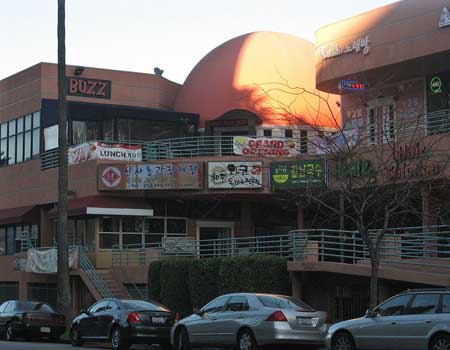
Needless to say, the Derby was a busy place. And, for the most part, despite a couple of the aforementioned tales, it produced an attractive and positive atmosphere. Thus, two more branches would open, one in Beverly Hills farther West on Wilshire and a Drive-in version in Los Feliz (left). But, nothing good lasts forever. As times changed, the very first Derby was moved from 3427 to 3377 Wilshire, but a change of venue couldn't save it. All of these eateries were vacant by the eighties and half of them were demolished. The Hollywood branch, the most kickin' of them all, is completely vanished from Vine Street, perhaps the greatest loss. The space originally known as The Brown Derby in Los Feliz still stands as a Louise's Trattoria. Originally scheduled for demolition, this locale was saved by history buffs who made it a cultural landmark. The original was too destroyed, but the curious dome that was once the top of the giant hat still sits at the top of The Brown Derby shopping center at 3377 Wilshire. It is currently a Korean restaurant, so one can technically still eat in the Derbies of Los Feliz and Los Angeles, even if one is not technically at the Derby.


3377 Wilshire and the remnants of the giant ol' Derby hat.


As silly as it might be to want to hold onto something that represents but cannot bring forth the past, there is still a nostalgia felt for the most famous of Hollywood hats. The thrill of sitting at a table once enjoyed by Jean Harlow and William Powell would certainly be something any film buff would enjoy. As it is, we have to take refuge in the faded memories alone. For those hungry for more, you can still wander to that corner of Hollywood and Vine and imagine life as it was. You can even order your own Brown Derby cookbook, (I just made the "Cobb" and it was to die for) or a replicated caricature of your favorite star. Sadly, that's the most one can hope for, but perhaps it's enough. Even in Hollywood, you can't go home again. Too bad. I could really use a dish of Grable with a side of Grant...

HOT SPOTS in CA: The Brown Derby


Ultimate Blonde Comedienne Carol Lombard takes 
a mischievous peek in Mr. and Mrs. Smith.

Grace Kelly (left) is most often remembered as being refined, classy, and chic. But so too did this lady have a naughty sense of humor. When Alfred Hitchcock initially tried to get her goat with his dirty jokes, Grace quipped back something to the effect of: "I heard worse things than that when I was in convent school." When she got close to people, she really let her guard down and showed her sweet and fun-loving side. Truth be told, she loved a good prank, and she played with the best of them!


The most infamous joker she went mono e mono with was surprisingly Alec Guinness, an English actor who was also known for his regal aura. The two chummed up on the set of The Swan (right) and became good friends. When Grace learned that Alec was receiving very "forward" fan letters from a girl named Alice, she saw to it that he was continuously paged by an "Alice" at his hotel. Alec's face probably filled with fear until he saw the look on Grace's. The two also engaged in a a decades long battle of "Where's the Tomahawk?" The duel started thus: Alec was given a little tomahawk by a friend, and as a gag, he tipped the hotel concierge to slip it into Grace's bed. Grace's initial surprise led to a continuous game. The two soon began swapping the weapon back and forth. Grace would hear that Alec was in town, and she would pay the bellboy at his hotel to place the tomahawk in his bed; Alec would learn that Grace was passing through his neck of the woods, and he would have a mutual friend hide it somewhere in hers. Sometimes, years would pass before the tomahawk would strike again, but it always did. Every once in awhile one of them was greeted with the surprisingly humorous prop, and had a good laugh over it. Where it ended up, or who was the last to receive it is unknown, but it was a good way for two friends to to send a little token of remembrance, despite the years that passed between them.


Grace also tried to help out ol' friend Jackie-O back when she was Jacqueline Kennedy, (see two classy ladies left). It seems that John was a big fan of Grace's, which is no surprise knowing his penchant for blondes. When he underwent a dangerous lumbar fusion surgery in 1954, Grace wrote Jackie and asked if she might pay a visit at the hospital. Jackie thought it was just the thing to brighten the recuperating politician's spirits, but she added a twist. The scheme was to have Grace enter John's hospital room dressed as a nurse! Grace arrived completely in character and performed to a T. Perhaps a little too well, actually. In addition to the fact that John was heavily sedated, Grace was a bit too convincing in her costume. He didn't know that the kind nurse helping him was a famed movie star! Grace left. When John became a little more clearheaded, Jackie told him of the shenanigan, and he kicked himself for missing the experience of a lifetime!


Speaking of John and his blondes... Marilyn Monroe also had a funny bone, and she too wanted to pull a fast one on her husband, Joe DiMaggio  (newlywedded, right). Unfortunately, like the above gag, it didn't pan out. This time, she asked for Maureen O'Hara's help. It turns out that Joe had a school-boy crush on the flame haired vixen, so to tease him, Marilyn asked Maureen if she would take part in his birthday party. The idea was that Maureen would hide in a large box, which Marilyn would then give to Joe as a present with the following stipulation: "Now Joe, after I give this, I don't ever want to hear about Maureen O'Hara again." Maureen would then pop out of the gift, leaving Joe quite stunned. Maureen resisted the idea, but eventually the persuasive Marilyn coaxed her into it. For some reason-- scheduling perhaps-- they never went through with it. Too bad for Joe.

Maureen O'Hara: proving red-heads 
could also get a laugh.

Another blonde who liked to have a little fun was Hot Toddy, Thelma Todd (left). When she was first signed at Paramount at the young age of 19, she was put in the studio acting class with other young hopefuls, such as Buddy Rogers. Now, between lessons on speech and performance, these youngsters got a little stir crazy. Here they were, hoping to become famous movie stars, and instead it was like being in boarding school. In the midst of the talkie revolution, studio execs really wanted to make sure that their new gents and ingenues could move cinema into the next generation, and classes on diction and pronunciation were becoming tiring. Thus, to break out of the old, starched routines, the kids decided to have some laughs. Rumor has it that Toddy was always the leader when it came to their pranks.

One example involved the illustrious legend of the silent screen, Gloria Swanson, then one of the biggest movie stars in the world, and the reigning Queen of Paramount's Astoria studios. One night, Thel' and the gang decided to toy with the famed vixen. They went to the set of her latest film, Stage Struck, (in which she was playing a waitress), and tampered with the props, which they moved around and glued down-- plates, trays, chairs, doors, everything! The next day, when Gloria arrived to the set, she started going through the scene only to realize that she couldn't move anything. Doors refused to open, silverware was stuck on the counter... From the rafters, she thought she could hear the faint sound of chuckling. Instead of getting riled, the Grande Dame calmly pulled director Allan Dwan aside into a private convo, then left the set. No more work could be done until the situation was corrected anyway.


Gloria S: Don't mess with this!

Thelma was right proud of this silly victory... until Gloria got her revenge. The next day, Thelma and her class of jokesters were called to the very same set and asked to perform scenes from the script... while Gloria critiqued! Suddenly, the laughs turned to gulps. Thelma herself was given Gloria's role. Gloria simply sat smirking-- pen and paper at the ready to give her review. Revenge was sweet. In the end, no one held any grudges. It was all in fun. In fact, Gloria probably saw in Thelma a younger version of herself. Earlier, when the gushing young actress first met her idol and told her she hoped to work with her one day, Gloria cautiously advised, "Just don't let them get to you dear. Keep them at a distance and let them think you've got steal claws and sharp fangs." If only Thel' had taken the advice...


But back to the funny business. Errol Flynn (right) was a legendary prankster. (Granted his hair was light brown, but for the sake of this article we'll say that it was dirty blonde). The number of gags he pulled on his pals is endless. One unwitting recipient of his boyish hi-jinks was Anthony Quinn. The two were scheduled to do a radio show for the Red Cross. Before Tony arrived, Errol spoke to the fellas in charge of the broadcast and asked them to play along with his scheme: pretending to be on the air when in fact the show hadn't begun. When the fake show commenced, the boys began reading through the script when Errol suddenly let out a string of obscenities that would make a sailor duck and cover. Anthony's mouth dropped open in shock! He was used to Errol's foul mouth, but he was surprised that he cut loose on "live" radio. He was even more surprised when Errol accused him of the foul language, saying, "Why Tony! Why did you say that?" Anthony of course protested, "No, no! It wasn't me!" Errol then repeated the game, each time becoming more filthily verbose and condemning Anthony for his language. "Shame on you, Anthony" he'd say, at which poor Tony would simply shake his head vigorously in protest and look around at the tech boys for help. He prayed that they'd cut the power, but he was stuck! When the show was over, Antony returned home, sure that his reputation was ruined. The phone started ringing off the hook: Hedda Hopper, Louella Parsons, and his father-in-law Cecil B. DeMille condemned him for his behavior, (all coaxed into the gag by Errol). Finally, Anthony got a final call from his mischievous friend, who simply said, "Gotca, Tony!" He could do nothing but laugh.

Anthony Quinn, laughing it up.


Olivia De Havilland constantly fell prey to Errol's pranks, (they sit together, left).  One day, while on the set of The Charge of the Light Brigade, she went into her dressing room to change. She opened a drawer in her bureau and pulled out a piece of clothing, but was startled when a long, dead snake rolled out. She let out a terrified shriek, dropped the clothes, and ran from the room! Off in the distance, watching with glee, Errol nearly fell over laughing. Olivia never did find out if the snake he'd planted was real. Errol would again pull a fast one on her when she, on a separate occasion, went to her dressing room to change. This time, when she put her feet into her shoes, she found that she was unable to walk away. Errol had nailed them to the floor. Olivia, impassioned and fiery as she was, would become livid at these unprofessional actions, but Errol's boyish good humor and charms would always win her back over. She just couldn't stay mad at the boy.


Carole Lombard: Beauty that's Bananas!

The mother of all blonde pranksters is, of course, the Queen of Screwball comedies, Carole Lombard. It seems that there was no one in Tinsel-Town untouched by her ploys. Her gags were always light-hearted and full of fun, bearing no malicious bent at all. She just loved to make people laugh, and she was enough of a ham to pull off many elaborate tricks with great pomp. Carole is responsible for getting Hitchcock to make his only official, full-fledged comedy, Mr. and Mrs. Smith. He enjoyed her bawdy, racy humor and she his, so having the chance to work together seemed perfect. However, Carole had heard the infamous quote Hitch had uttered that "All actors should be treated like cattle." Thus, when filming began, she had three cows brought to the set, one labeled for each actor: herself, Robert Montgomery, and Gene Raymond


Carole and Bob Montgomery on Mr. and Mrs. Smith.

There were no lengths Carole wouldn't go to. When she was invited to a ball that requested all invitees to show up in white, she came in an ambulance; when she hosted a dinner party, she gave it a medical theme and had the meal served in bed pans. When eating breakfast out with married co-star Bing Crosby during We're Not Dressing, she got up to leave and said, "Oh by the way, Bing, I left my nightie in your room last night. Could you please get it back to me. Thanks." She winked and walked away, leaving Bing completely stunned and embarrassed in front of the other diners, who now thought that he and Carole had had a roll in the hay! They had not, but Carole loved to set tongues wagging.


Clark and Carole: Two hams have some fruit.

She loved most to toy with husband, Clark Gable. When they first started dating, Carole learned that Clark loved collecting cars, so she sent him a present: a broken-down and deteriorating model-T covered with hearts. But this time she had met her match. Gable showed up at her front door with the car and tempted her into a joy ride in the comic vehicle. After they were married, Carole toned the jokes down a bit, but her cooky side always remained. The duo hosted occassional, absurd parties, including one in which everyone invited had to pick up an instrument and play while Carole conducted. Because few had any musical ability, the noise was atrocious, but the hilarity ensued. When Carole tragically died in her 1942 plane crash, it was her incredible joy, generosity, and sense of fun that was left behind. Thanks to her films and the tremendous and uproarious stories about her, the comedy continues.

MENTAL MONTAGE: Blondes Have More Fun