Download Games

Recent Posts

Showing posts with label Vivien Leigh. Show all posts
The players of cinema's past occasionally indulge in a little game of repetition. I'm not referring to the phenomenon of an actor reprising a role in a series of films, as Johnny Depp has done most recently with his Captain Jack Sparrow character from the Pirates of the Caribbean anthology. Instead, I more particularly draw attention to a complete duplication of a role or film throughout a performer's career. Just as Michael Sheen has been called upon to reprise his role as Tony Blair in numerous, unrelated films (The Queen, The Special Relationship), so too have past stars sunk their teeth into a part or a story that they find themselves unable to let go of-- or perhaps conversely the role will not let go of them. Here are a few examples of Flicker-Show Double-Takes. Sometimes, Deja Vu is more than a feeling; it is a fact.


Rooster Cogburn shows Mattie Ross how to fire a pistol. John Wayne's
 interpretation of the weathered but fiery Rooster Cogburn in True Grit 
would ignite more than audience appreciation-- it would
demand a sequel.


The most obvious example is John Wayne's reprisal of the role of Rooster Cogburn from the Academy Award winning True Grit in the following feature Rooster Cogburn 6 years later. After the huge success of the first film, the Duke was asked to get back in the saddle, literally, to cash in on a plum character to whom his audiences had so energetically responded. The plot of the first film involved Marshal Cogburn aiding a young girl, Mattie Ross (Kim Darby), in her quest to avenge the death of her father by the hand of Tom Chaney. Chaos ensues amidst comic relief, justice is won, and unexpected affection is born. Duke's convincing and multi-layered performance was reason enough for the studio to come up with a belated sequel of sorts. This time, Rooster would go toe-to-toe not with a precocious girl but with an equally iron-willed woman, Eula Goodnight (Katharine Hepburn). Instead of generational miscomprehension, flirtation and unfulfilled romance permeate the story, with Rooster again tracking down a band of outlaws who have this time killed Eula's father. Both films possess a certain charm and daring, and both remain classics, though True Grit is the most honored. Interestingly, Rooster Cogburn in a way was a duplication for Kate Hepburn as well, since she had portrayed a very similar character to Eula when she starred opposite Humphrey Bogart in The African Queen. In both, she plays a strong, older, religious female who is unceremoniously usurped of her home and family-- in Queen,the loss is her brother-- and joins an older curmudgeon on an unexpected journey. In both, victory is, of course, won, and her obstinacy and devotion inevitably whittle down her male counterparts' hearts to nothing. The African Queen remains more noteworthy for Kate, but it is in Rooster Cogburn that you get to witness the 68-year-old actress operate a machine gun. Not too shabby.


Don't mess with the classics: John and Kate continue to kick
tail even in their sixties.


Clark Gable too came back for another round, but this time he appeared in his own remake. In 1932, Clark had starred opposite Jean Harlow (together, left) and Mary Astor in Red Dust. In 1953, proving that at age 52 he was still indeed The King, he again ventured into the wild, but this time with Ava Gardner and Grace Kelly. The plots remain almost identical, with the love triangle of the un-tameable Dennis Carson/Victor Marswell (Gable) caught between the virgin and the whore, and the complex nature of both women making it difficult to decide who deserves which title. In the end, he lets the dutiful-- albeit tempted-- married woman go and embraces his true soul mate-- the tainted but lovable shipwrecked floozy with a heart of gold. The main difference in story is Clark's profession, which in Red Dust involves running a rubber plantation and in Mogambo is the trapping of animals. Yet, in both films, his happy isolation is invaded: first by a sensuous woman of the world and later by a prudish couple who are either surveying or studying anthropology as the story dictates. Artistically, both versions are triumphs, with Gable not failing to establish believable chemistry with all four women. There is a definite charm in watching him volley off true life pal Jean Harlow in the former version, but Ava Gardner brings such comedy and heart to her own interpretation of "Honey Bear" that Mogambo cannot be ignored. Mary Astor, already a seasoned performer by the time of filming, seems much more at home than Grace Kelly, for whom Mogambo was only her third film, but the smoldering lust beneath both women's placid demeanors is evident and thoroughly intriguing. Pitting director Victor Fleming against John Ford is too a hard debate to wage, with perhaps Ford coming a little closer to victory. In all honesty, the competition results in a draw. The Red Dust vs. Mogambo phenomenon is most profound for the fact that it is a direct remake that re-stars its male lead, cementing the fact that no one, but no one, can replace Clark Gable.


Choices, choices... Poor Clark must choose between the
luscious Ava and the tempting Grace in Mogambo.


Peter O'Toole is too no stranger to double-takes, and his performance as Henry II in Becket made certain that no other actor could possibly usurp his throne. He put the crown on again 4 years later when he starred in The Lion in Winter. Nominated for his portrayal both times, he would miss out on Academy Award night first to Rex Harrison for My Fair Lady and later to Cliff Robertson for Charly. The first film witnesses a young Henry-- about 15 years after inheriting the throne-- and his constant battles with friend, moral compass, and foe Thomas Beckett. In the end, Henry's immaturity and selfishness, along with his inherent need to protect his throne and his England, forces him to take arms against Becket (played with equal magnificence by Richard Burton) and have him killed (he eyes his work, right). Fast forward to 13 or so years later in the story of Lion. Henry has wizened and is facing his mortality. Recasting Peter in the role was more than a logical move; it was a brilliant one. The audience literally sees how he has aged; how the years of battle and politics have taken their toll, and too how he has successfully grown into his role as his country's leader. His errors of the past with Becket remain buried in his bones, a penance he still pays, and this past conflict is referred to whenever Henry's wife, Eleanor of Aquitaine (Kate Hepburn), wants to stick a needle in. The plot this time revolves around Henry's need to secure a heir to his throne. Sons Richard (Anthony Hopkins), Geoffrey (John Castle), and John (Nigel Terry) all plot, back stab, and battle for the place of honor. Eleanor stirs the pot, not just as a mother, but as a long since spurned lover whose husband has literally kept her locked up in jail to keep her out of his hair and give him free reign to indulge in numerous dalliances, including one with Alais (Jane Merrow), whom he means to marry after divorcing Eleanor. The bitter but unbreakable love between Henry and Eleanor comes to vengeful heights in this Christmas film that engenders anything but familial affection, and the performances of the entire cast are perfection. The dual Henry II films are both superb-- with the writing of Lion pushing it ever so slightly into the realm of cinematic genius-- but watching the progression of Peter O'Toole's Henry is the real reward.


The King and Queen prepare to feast... on each other.


Keeping things regal: before Cate Blanchett became the go-to girl for Queen Elizabeth, Flora Robson enjoyed the same privilege. Getting her start on the stage, Flora turned heads when she appeared as another Liz, Empress Elisabeth in Alexander Korda's The Rise of Catherine the Great. This in turn led to her casting as the notorious English ruler, Elizabeth I, in the 1937 production of Fire Over England. The film, while historically interesting, is more noteworthy today due to its casting of lovers Laurence Olivier and Vivien Leigh, who were hot and heavy and both married to other spouses at the time of the filming. To see them before they had reached mutual and independent glory in Wuthering Heights (for him) and Gone with the Wind (for her) is quite interesting. But, while the acclaimed thespians fumble their way through the new medium, albeit eloquently, Flora holds her own and portrays her Queen with a combination of ferocity and humanity (all three, left). Her superb characterization was lauded as the best representation of the enigmatic Queen yet, which led to her casting a few years later in The Sea Hawk. This time, the plot, while equally full of intrigue and corruption, was lighter fare. Enjoying the company of Errol Flynn in his role as yet another charming swashbuckler, Flora's Queen this time around is more light-hearted and emotionally vulnerable, yet her power still comes into play when necessary. Her subtle and denied attractions to her leading men in both roles are pivotal in giving her character sympathy, yet her stoicism and sense of duty ring true in her portrayals of a matriarch. The Sea Hawk is a much more enjoyable film, involving piracy and romance, and Flora truly shines. Rumor has it that even the eternal cad Errol was smitten with her and loved every minute of working with a woman whom he considered to be a true pro.


Flora dominates Flynn in The Sea Hawk, a film into which both actors
injected a lightness and humor that reflected their
off-screen friendship.

Cecil B. DeMille was one man who loved to outdo himself. Proud of his cinematic accomplishments but never satisfied, growing technological advancements only made him more frustrated that his classic efforts became dated and outmoded over time. While he would too duplicate his work when he made the sequel to his cinematic debut, The Squaw Man- The Squaw Man's Son, starring Wallace Reid-- it wasn't until 1956 that he decided to give a piece of his work a complete and utter face lift. The Ten Commandments of 1923 was astounding in its day, and yet another reason that Cecil was being hailed as the filmmaker of his generation. The controversial religious themes, the risque subject matter, and the over the top special-effects splendor, left audiences enthralled and overwhelmed. Yet, as the years passed, and as Cecil always kept the conflicting urges of Godliness and Naughtiness close to his heart, he saw more and more opportunities to improve upon his past majesty-- if only to prove that just because his work was aging, it didn't mean that he couldn't keep up with the times. So, after 3 decades, he gave Moses another go, this time with Charlton Heston replacing Theodore Roberts as the chosen vessel to lead his people out of Egypt. Now in color, the scenes became even more vivid than in their silent predecessor. Special Effects too made the great parting of the Red Sea something to behold, the likes of which had never been seen before. Hailed by many as his best work, the film oddly would not be the one for which he won the ever desired Academy Award-- that honor was bestowed upon his The Greatest Show on Earth-- yet, as his last film, and an epic one at that, it remains his own personal testament-- not of the messages of right and wrong, but of what the great medium of Movies was capable.

            
Chuck Heston lays down the law in The Ten Commandments and
changes the rules of sin and cinema forever.

As we movie viewers are the recipients of contagious filmmaking-- which infects and spreads the same stories over and over with remakes upon remakes upon regurgitated remakes-- it is no surprise when we find ourselves getting that old, familiar feeling while watching the latest take on, say, the age old boy-meets-girl storyline. But, to witness one of our pioneers blatantly plagiarizing himself is a rare and somewhat baffling occurrence. Somehow, the above exceptions prove that sometimes it is indeed okay to be two-timed. While one artist ripping off or trying to out-do another can be somewhat abrasive to our sensibilities, witnessing the results of an auteur going mono e mono with himself can be quite revelatory, curious, and provocative. It is more common to see an actor take on similar roles to those he has in the past, or for a director to bring to life similar story lines that suit his tastes, but while Michael Haneke re-making his own 10-year-old Funny Games shot for shot may at first appear absurd, it is too entertaining for the audience to level the artist against himself and see what different ingredients against a different time can induce. This anomaly is actually the perfect measuring stick for change. Comparing one draft to another, we more fully witness how history "happens" by watching the way one particular performer has aged with time.

MENTAL MONTAGE: Play It Again, Sam


Carole Landis and soldier hubby Thomas Wallace, 
wed January 5, 1943 in London. 

To pay homage to Carole Landis's wartime marriage to soldier Thomas Wallace, I thought it only appropriate to explore a similar cinematic theme: Love and War. This plot has revealed itself through multiple storylines in movieland, but there is one very specific tale that has metamorphosed over three different films. The plot mutated with each interpretation, but in essence the story is thus: a young woman and a soldier fall in love in the midst of war-torn London only to be ripped apart by fate... and the fact that the girl is a prostitute. All is fair...

~  ~  ~


Hollywood has decided, thus far, to take a stroll down Waterloo Bridge thrice. It first adapted Robert E. Sherwood's play in 1931, then remade it in more glamorous terms in 1940, and took a final stab in the plush studio bonanza of 1956's Gaby. As always, different directors, actors, and circumstances produced vastly different outcomes. The instigation of the censorship code in 1934 caused a stark contrast between the 1931 and 1940 version, but while little is changed plot-wise in the story between 1940 and 1956, the final film too bears the highly recognizable stamp of its time and conditions. 


In 1931, James Whale, the visionary and off-kilter director most renowned for his work on the horror classic Frankenstein, was assigned the task of directing the first Waterloo Bridge. At this time, America had long been at peace after WWI, the roaring twenties had been enjoyed and lost with the crash of 1929, and movies were daringly and provocatively reflective of the current human condition. As the cushy melodrama and slap-stick comedy of silent films matured into sinister and sometimes violent celluloid opuses and edgy testaments of darker humor, the time was ripe for filmic exploration. Directors were taking chances, writers were ruffling feathers, and for a brief time, studio heads were letting it all fly. Audiences needed to relate more than they needed to be elevated, which made a script whose main character was a "lady of the night" a welcome dish for salivating viewers.


In the lead role of Myra Deauville is Mae Clarke, who for whatever reason was never able to reach superstardom, but whose solid performances with relentless conviction allowed her to make a mark on many top films of the day, including The Public Enemy and Frankenstein (again with Whale).  Yet, her appearance in this picture may be her most striking. As Myra, Clarke is jaded, streetsmart, and emotionally damaged. Working as a chorus girl in London, her late night activities include picking up men on Waterloo Bridge with her friend Kitty (Doris Lloyd and Clarke, right).  A tough-cookie and survivor, Myra's mettle is threatened by the appearance of Roy Cronin (Douglass Montgomery), a young, American soldier on leave who is her very antithesis: innocent, naive, and romantic. Not realizing Myra's scandalous profession, Roy becomes quickly smitten with her, and the prospect of turning him into her next "John" disappears as Myra's cool heart starts melting. 


United by their American nationality, they are both lonely and isolated. Their connection is instant and intense, but Myra is goaded by her conscience. In a touching scene, she becomes threatened by her young suitor, whose kindness and genuine human interest she has not experienced in some time, if ever. Angered  by and envious of his sweetness and equally afraid of the damage she could do to him, she throws a tantrum to chase him away. As he picks up his things to leave her apartment, she slouches in the background, looking very small and meek, aware that she is letting the only pure thing in her life get away. An apology quickly follows, and soon Myra finds herself in love, though the cynic in her refuses to believe it at first. A woman mired in reality, she compartmentalizes these two conflicting parts of her life. After Roy finally leaves her apartment, she goes to the mirror and gives herself a hard look, applies her trashy lipstick, puts on her hat and sad little fur, symbolically dims the light, and returns to the bridge to find a paying prospect. The silent scene is pure, Whales-ian poetry.


The story thus becomes an internal struggle: a battle of right and wrong amidst the larger battle of war, which is essentially all the same. Myra cannot admit who she really is to her beloved, whose pure heart she cannot bear to break and whose honest love she cannot bear to lose. But, after Roy asks her to marry him, things become even more complicated. Her two lives, the light and the dark, threaten to collide. With his family involved-- including Bette Davis in an early role as Roy's sister, Janet-- Myra's paranoia at being discovered and her personal shame at her deceit of a good man haunts her (see repercussions, right). Any small hope of being revitalized by love and made clean again is quickly revoked by her would-be monster-in-law, (Enid Bennett) who delivers perhaps the most polite smack down in cinematic history. Sensing who Myra really is, Mrs. Cronin refuses her blessing on the upcoming union, and the martyred Myra agrees that this is the best decision. Thus, Myra flees, returning to her beloved bridge-- the only home for a streetwalker is the street. But, despite all logic, even after Roy has discovered who she is, he still loves her. When he comes looking for her on the bridge, he begs her to promise to marry him. As he is literally being pulled away to battle, she concurs, more to ease his mind than because she intends to keep her promise. The lovers are parted amidst the explosions of war, and Myra runs for safety, though it is not certain whether she runs from fear of death or fear of a future she doesn't believe in. It makes no difference, for it is the former that claims her. Struck by an explosion, Myra is killed-- her fur wrap lying like roadkill on the cluttered sidewalk.


What can be gleaned from this harsh and sudden conclusion is debatable. Are we to take that there is no love in war? Is that the height of its brutality? Is Myra a symbolic bad girl who cannot be redeemed? Or is her sacrifice more reflective of reality and how no one can be made new again? You cannot undo your experiences, good or bad, and your innocence is the price you pay for your life. Her death could be a tragedy, but it could be her salvation, her release. The hugeness of war and the immediacy it demands of its victims made the differences between Myra and Roy seem small in the midst of their romance, but could such a love truly exist in the daylight? Perhaps not. Perhaps Myra knew this all along.


The gritty, oppressive nature of this 1931 version stands in sharp contrast to what would occur in 1940. Mervyn LeRoy was this time at the helm, directing Vivien Leigh and Robert Taylor (left). In every aspect, this Waterloo Bridge would be emblematic of the heights of studio splendor... and control. After the establishment of the censorship code, women of ill-repute were no longer considered favorable heroines. Indeed, any suggestive or controversial subject matter was unduly given the kibosh while whitewashed, glamorous, euphoric presentations of human life were created. When the decision to revisit the earlier film was thus made, it was equally decided to alter the script a bit. It begins in flashback, with Taylor asking to be taken to Waterloo Bridge, where the aged soldier stands, fondling a strange token that his true love gave to him-- a good luck charm-- and thinking back to the day they met. Thrown together on the bridge in the midst of attack, Taylor saves the beautiful young woman from being struck by a car after she bends heedlessly to pick her dropped charm off the street-- a premonitory event. After spending some time together, Myra gives Taylor the charm for good luck in his battles. They part, but-- struck by her beauty-- he later comes to see her perform. This time, Myra is not a chorus girl but a genuine ballerina. Portrayed as innocent and pure, her role is essentially switched with that of the youthful soldier of the former film, while the man who captures her heart is just that, a man and not a boy: charming, assured, masculine, and knowledgeable. The qualities that remain in both characters are the somewhat melancholy demeanor of Leigh's Myra, whom is jokingly referred to as defeatist before her fate has even been tested, and the boyish thirst for life extolled by Roy, whom Taylor injects with vigor and idealistic passion. 

The combination of these two qualities and the able performances of Leigh and Taylor create a perfect chemistry, which is very important in establishing an impossible romance. The difference, certainly instilled by studio stipulation, between this vehicle and the first is the belief that they are in love. Whereas the fates of Clarke and Montgomery seemed doomed from the beginning-- a forbidden love only able to thrive in the even darker casualties of war-- the audience is led to believe that Leigh and Taylor are truly meant for each other. This is vital, as their courtship, as opposed to the '31 film, is extremely fast. Having just met, they opt to marry after one date, although this attempt is interrupted after much effort when Taylor is called to service. He promises to return; she promises to wait. Unfortunately, Leigh's recklessness and negligence of her dancing over this three-day courtship has cost her her place with the ballet company, where the unforgiving Madame Olga Kirowa, played by the always superb Maria Ouspenskaya, makes it known in no uncertain terms that a true ballerina must put her craft above everything else. Of course, in the studio era, when a woman is given the choice of husband or career, she must choose a husband, which is what Leigh does. However, her penalty is shared by her martyr-like friend, Kitty (Virginia Field), who more closely resembles Mae Clarke's character in the first film. A true friend, Kitty vows to leave the company with the fragile Myra, whom-- as the stronger female-- she feels she must protect. Kitty's presence will become very important to the plot as it escalates (both women, right).

Despite her current unemployment and poverty, all seems well, until Myra reads in the paper that Roy is dead, which is doubly unfortunate, since she discovers this news while waiting to meet her soon-to-be mother-in-law for the first time. Emotionally destroyed and unable to communicate the information she has just learned, Myra is evasive and rude to Lady Margaret Cronin (Lucile Watson), purposely forcing a wedge between herself and the woman she now knows that she will never call her mother. Distraught and hungry, Myra learns that Kitty has resorted to prostitution to support them both. With a broken heart and nothing left to lose, Myra now finds herself doing the same. Leigh's actions, unlike her predecessor Clarke, are therefore fully explained and forgivable. Her virtue becomes the sacrifice of war, whereas love was Clarke's sacrifice. However, a wrench is thrown into things when Myra is casing the train station for Johns only to find her beloved-- who is very much alive and very much still in love with her-- stepping off a train (left). Myra is beside herself with shock. Again, she is forced to hide the self that she has devolved into from the man she no longer feels that she deserves. Clarke's heroin had to protect Montgomery from the woman she was, Leigh must protect Taylor from the woman she has become. Roy brings her home to meet the family-- the fairy tale is aided by the fact that Roy appears to be loaded-- and she and Lady Cronin reconcile, though Myra's guilt forces her to confess all of her sins to the matriarch. When a shocked but compassionate Lady Cronin questions Myra's chastity, Leigh pathetically utters: "Oh, Lady Margaret, you are naive." With that, Myra flees to Waterloo Bridge, and again Roy chases after her, enlisting the aid of Kitty who tells him the whole truth.

The ending proposes several distinct differences from '31, one of which is Taylor's dismissal of his fallen angel. When he cannot find her, he seems to accept the fate he knows is coming. Of course, he still loves Myra, but he knows the woman she has become is one he can no longer be with. He thus lets her go before she's gone. Myra finds herself alone on Waterloo Bridge (right), utterly broken and destroyed. Doomed. The same war that brought her and Roy together has in another way split them apart. Her shame in herself overpowers her love, and as military trucks pass by, one after the other, in rapid succession, she hurls her body in front of them. (This fallen, martyred woman is a role Leigh was familiar with and repeated in Anna Karenina and That Hamilton Woman). The lesson, again, may make a feminist cringe-- soiled women apparently don't deserve love. This theme of carnal crime and punishment runs rampant in the immediate post-code era. However, the tragedy can still be felt, as we return to Taylor, who stands on the bridge reminiscing about the woman he knew and the love that could have been had fate not been so unkind. He stands sadly-- older, wiser, world-weary-- showing that Myra was not the only victim of the war's harsh toll. Someone else died that day on the bridge. When Myra jumped, she took too the last of Roy's innocence with her. This is the film's true commentary on war, which mirrors 1931: it stifles and kills all that is good, and those who witness it cannot get that same goodness back. Only time and the cushion of future generations can create enough distance to rejuvenate these qualities.

Thus we come to the final installment, Gaby, produced in 1956 and directed by Curtis Bernhardt. If the '31 film exposed the sense of immediacy caused by war, and 1940's version was a psalm to the immediacy of true love, the obstacle and instigator in Gaby is the immediacy of youth. The film's stars are, unlike their predecessors, (save for Montgomery) young. And they look young. Everything about the movie is fresh and alive, completely absent of any of the grittiness of the aforementioned films, and very indicative of 1950s studio cinema. But, while it is stylish, coming on the heels of Rebel Without A Cause and the loosening censorship code, it is also more indicative of an increasingly rash and daring society. The ravishing Leslie Caron and boy-next-door John Kerr  take on the roles of the now named Gaby and Gregory, and while the location remains London, Caron of course maintains her true nationality to explain her luscious French accent. This makes her all the more enticing to Gregory, who finds her in all her porcelain beauty to be an exciting and exotic dream come true. The naivete and raging hormones of the lead characters are the driving force of the plot, which perhaps makes this version more believable in at least these terms. The plot remains almost identical to the 1940 version, putting Caron's dancing ability to use by again making her a ballerina, and again her loyalty to her passion to her craft is tested by her sexual and romantic passion for Gregory.

An interesting scene also identifies another quality in Gaby, heretofore undiscovered in previous versions: her sympathy. At a club, she finds a soldier crying fearfully, and based on her interaction with him, we not only see her sweetness but are given a glimpse into the intensity and stress of war, which masculates and emasculates its men at once. The desperation for human contact and the need to feel safe thus immediately comes into play and will be reflected in the romance of Gaby and Gregory, as will her compassion. It is clear from the beginning that Gaby in fact only entertains Gregory because she feels sorry for him, however as she becomes attached to him, she soon finds herself caring more than she ought. Because Caron lends her performance much more spirit and independence than her predecessors, the effect is more striking. When Leigh forsook her career for love, she didn't consider it a great loss, but Caron's more ambitious heroine is taken for a loop when she finds herself in love and forced to choose between the two. Again, it is her good heart that leads her to sacrifice all for a near stranger, and Gregory's thirsty soldier never lets up on her for a minute until she says "I do."

However, the same complications keep the duo from being married before Gregory is again forced to leave, but-- thanks to Gaby's best friend and roommate Elsa, who gives them her absence on what she thought would be their wedding night-- Gregory and Gaby find themselves alone in her apartment on what would have been their honeymoon. The audience feels the intensity of their mutual desire, particularly Gregory's, who-- polite as he may be-- clearly wants to be joined to Gaby in flesh if in nothing else before he goes to battle. The audience wants it too. However, the more practical and in some ways mature Gaby demurs, forcing her embittered fiance to leave for battle without the knowledge of her body. Disappointed, but not deterred, Gregory again swears to return and finally marry her. When he leaves, the same tragedy befalls. This time, after losing her place in the ballet and thinking that she has lost her beloved to death, Gaby's path to prostitution becomes, similarly to Leigh's voyage, one of self-flagellation (though it is never clearly ascertained whether Gaby is being paid for her transgressions or is merely committing them to assuage her guilt). The interesting difference, is that when confronted by her friend Elsa about her scandalous new life, Gaby admits that she is perfectly conscious of what she is doing and is doing it on purpose. Every soldier she makes love to, in her mind, is Gregory. She thus, punishes herself with sex because she refused sex to the only man she ever loved. So fully and passionately does she throw herself into her unreasonable atonement, that it has a devastating effect upon her when Gregory indeed returns unscathed, expecting to find the perfect and virtuous woman he left behind. Again he takes her home, again she admits her sins, only this time she does it directly to Gregory, who is crushed and angered by the destruction of the dream which has kept him alive.

Yet, what is indestructible is their love (see left), naive and hormone-driven though it may be. Even the knowledge of Gaby's betrayal cannot prevent Gregory from coming after her. This time, he finds her. As bombs explode around them, intensifying the surging, chaotic passion between them, he hurls his body against hers to save her life. They both emerge from the rubble unharmed. It seems that this time they shall have a happy ending. At first, such a tacked-on studio-mandated conclusion makes one balk, especially after enduring the more tragically palpable, and thus wartime befitting, endings to the other films. Yet, perhaps this time it makes sense. After all, why should Gaby be punished further? Why should she be shamed for the forfeiture of her purity when it was Gregory who demanded it of her in the first place? He is just as guilty, and his acceptance of his own guilt finally matures him into the man who is worthy of her love. Their life, their innocence, gives them the ability to survive the obstacles that the other couples of Waterloo Bridge could not.


Yet another interpretation of Waterloo Bridge by Monet.

Each film is fascinating and unique in its own way. Each too possesses its own precious offerings. The most interesting is the more controversial 1931 Waterloo Bridge, whose intense texture alone makes it a worthwhile picture. Waterloo Bridge of 1940 is for the true romantic, presenting the gossamer haze of studio splendor that all movie buffs drool over. Gaby of 1956 gives us a superb performance by Leslie Caron and a surprising deconstruction of the sexual (ir)responsibilities of youth. In all films, War is too a dominant force, a character in itself, whose macabre presence can bring all life to a halt, threatening to snuff out even the most prized of human abilities-- to love. In each version, it could be argued that it succeeds, but in truth it fails miserably. The fact that any romance could find a way to blossom and thrive at all is proof enough that man's horrid mistakes are no match for his most divine aspirations. 

TAKE ONE, TWO, THREE...: Love [in/and/is] War

In the larger-than-life land of La La, one would expect every interaction between celebrities to be as dramatic and cataclysmic as on the big screen. Sometimes, they are, but mostly they are just downright comical. Here are a few of the most infamous and entertaining tales of movie star meetings:


Young ingenue, Marilyn Monroe.


When Marilyn Monroe was a young, hopeful starlet just starting out in Hollywood, she used to make the rounds at various cocktail parties and shindigs. Sometimes, this was merely part of the job description-- being paid to smile at executives while handing out cigarettes-- and other times it was part of her ploy to meet as many important people as possible and get her name and face out there. Well, her gorgeous face did catch the eye of many men, one of whom was so taken with her that he asked her to sit down beside him on the staircase, where he was getting sloppy drunk. After introducing himself in the distinguished and sardonic voice that she recognized, Marilyn told him her name as well. He then surprisingly asked her to marry him, to which she politely answered "No." He took the rebuff admirably, responding that he understood her hesitancy to marry an actor for "An actor is not quite a human being-- but then, who is?" Then, he passed out right next to her in an abrupt snore. Ironically, Marilyn would meet George Sanders again when they performed in All About Eve together, one of her big career-boosting films. In it, they would share another scene on a staircase.


Marilyn and George Sanders relive the old days
in a scene from All About Eve.


Marilyn's meeting with Bette Davis was not as hilarious as her interlude with the humorously snide Sanders. A huge fan of Bette's, Marilyn was nervous to meet her for the first time on Eve, but she tried to impart her deep appreciation for her work. Bette, being Bette, saw only a beautiful tart who, to her, was just one of a zillion pretty faces trying to make it in Hollywood. To a great actress like herself, Marilyn was a hack-- a little girl who just wanted to be famous and had no respect for the art of performance. For this reason, Bette shunned her, although that may too have had a lot to do with her own insecurity and the fact that she was being eclipsed by a younger, more beautiful woman. Throughout the shoot, Marilyn would overhear Bette taking out her wrath, most particularly during the theater lobby scene. Between takes, Bette could be heard saying (purposely loud enough for Marilyn to hear ),"That little blonde slut can't act her way out of a paper bag!" Such altercations depleted Marilyn's confidence and increased her terror of the infamous Bette. In the end, Marilyn had the last laugh, for although Bette churned out another flawless performance, Marilyn stole every scene she was in (as seen left). The camera loved Diva Davis, but it was in love with Monroe.


Ava Gardner (right) had a meeting with Bette that was not completely dissimilar. Ava was also agog at the movie queen's power. When she met her at a particular soiree, she told Bette that she was truly honored to meet her. Again, Bette raised the classic eyebrow, but perhaps sensing that Ava had a great deal more bite than the timid Marilyn, she offered only the crack:  "Of course you are," and walked off. (Bette is perhaps the only woman in history who can be perfectly bitchy and still perfect).


Bad, bad Bette.


Bette's meetings with men were different. A bit of a sexual tigress, Bette enjoyed the company of attractive leading men like Paul Henreid or George Brent. However, during her early film days, she often complained that she was cast opposite lackluster actors-- rising stars who had not yet reached their summit. She felt snubbed and craved an actor with whom she could go mono e mono. For this reason, she was ecstatic when she learned that she would be starring opposite the great Charles Boyer in All This and Heaven Too. Finally! A handsome talent that she could sink her teeth into. However, on the first day she was to perform opposite Charles, Bette was confused. She scanned the set, but didn't see him anywhere. When she saw a pudgy, balding Frenchman intruding on the sound stage, she tried to have him removed, only to discover that he was, in fact, Charles Boyer! Turns out that good ol' Chuck had to wear a toupee and a girdle for his film roles to appear more dashing, making his offscreen appearance almost unrecognizable. Shocked, Bette didn't think she could feign attraction to, well, a schlub! But, in a magical way that only the classy Boyer could do, he was able to transform into a heroic, charming, and handsome romantic as soon as the director called "action." Bette had no further complaints.


Ironically, Bette was to play the more matronly character
in All This and Heaven Too opposite an elegant Boyer.


Another case of mistaken identity occurred for Grace Kelly. She and Cary Grant became great chums on the set of To Catch a Thief (left). For this reason, Cary decided to invite her to a party being thrown by Aristotle Onassis on his yacht. The two arrived together, with Cary looking his usual, elegant self, but Grace looked more like a school teacher in her casual wear and thick eyeglasses. As glamorous as she was onscreen, away from the cameras she was down-to-earth and shy, becoming somewhat of a wallflower. An unaffected person, her beauty was something she merely turned on when necessary, not something she luxuriated in. For this reason, Onassis didn't even recognize the great movie goddess! When she and Cary made their exit, Onassis pulled Cary aside and thanked him for coming. He also told him to feel free to bring his charming "secretary" along again next time. That he did, for Cary and Grace remained close pals until her untimely death.


Groucho Marx (right) also had a bit of trouble recognizing a certain actress the first time they met, but for very different reasons. While in the Thalberg building, Groucho once entered the elevator to find it inhabited by a woman with a very large hat. From what he could make out of her profile, she looked familiar. Was it? Could it be? Not one to be shy, the funny man reached over, lifted the woman's hat, and took a peek. Sure enough, it was Greta Garbo. You couldn't mistake a mug like that! Of course, being the aloof and socially awkward woman that she was, Greta offered little in the way of conversation. Thus, to neutralize the situation, Groucho simply said: "I'm terribly sorry, but I thought you were a fellow I knew from Kansas City."


Greta ponders Groucho's quip.


Some of the most interesting cases of star meetings occur on the set. When paired up for the first-- and sometimes only-- time, the nature of an introduction says a lot about the relationship two actors are to have with each other. When Clark Gable finally and begrudgingly took on the role of Rhett Butler in Gone with the Wind, the punctual pro was irritated that his leading lady was late to their first publicity photo shoot. Pacing back and forth, he muttered to the photographer something to the effect of, "Where the Hell is this lady? If this is the way she works, I'll walk off right now!" Suddenly, ringing out behind him as clear as bell, came a sweet, English voice saying, "I quite agree, Mr. Gable...  I'd tell that Vivien Leigh to go straight back to England and f*ck herself!" Clark turned around to see his stunningly beautiful co-star, Vivien, and offered her a big grin. All anger was forgotten, and after taking her hand, he led her to their place in front of the camera and started the romance to crush all movie romances (left). Their relationship remained contentious: one minute they were locking horns about a scene and the next they were playing Battleship together.


Katharine Hepburn had wanted to act with Spencer Tracy for some time by the time they were both cast in Woman of the Year (right). Kate had great respect for Spencer's straight-shooter acting style, and-- though a confident lady herself-- she was surprisingly nervous the first time the two were to meet. Prior to shooting the film, Kate happened to be on the backlot when she bumped into Spencer and Joseph L. Mankiewicz on the stairs. After an initial "Hello, nice to meet you," Kate, who was in heels, found herself surprisingly tougue tied, and after referencing their upcoming film together, she spit out: "I'm sorry, with these shoes I'm afraid I'll be a bit tall for you." Spencer just mulled her over, not saying a word, trying to make out the strange but intriguing woman in front of him. Finally, Joe piped in with, "Don't worry, he'll cut you down to size." Indeed he did. The confusion and butterflies initially felt turned to love once the cameras rolled.


William Powell and Myrna Loy are remembered as one of the greatest film teams of all time, portraying most infamously the madcap couple Nick and Nora Charles of the Thin Man series (left). Their initial meeting was just as chaotic and hilarious as any of their crime solving buffoonary. Things were moving rapidly their first day of shooting on Manhattan Melodrama. In fact, the two didn't even have time to be properly introduced by W.S. Van Dyke before they were rushed into "take one." In the scene, Myrna's character was to rush into Powell's cab, so William sat waiting in the car for her to enter. Van Dyke called "action," but instead of saying the written lines when Myrna entered, William quipped: "Miss Loy, I presume?" Myrna burst out laughing. The two became fast friends, and the wisecracks and hijinks ensued throughout their numerous films together.


A less gentlemanly handshake occurred when legendary screen siren Joan Crawford met hot new leading man John Garfield. The two were assigned to do Humoresque (right), a film about a wealthy patroness and her kept man/musician. The lusty Joan was excited to work with John, who had become the talk of the town with his bold and earthy characterizations. When introduced their first day on the film, Joan held out her hand saying, "It's very nice to meet you." John responded by reaching out and pinching her breast. A moment of silence passed. Joan then calmly looked up, met John's gaze, and responded: "You know, I think we're going to get on just fine." That they did, performing superbly and sensuously on film and off, enjoying a brief and amicable affair. Only in Hollywood...

MENTAL MONTAGE: When First We Met

Hollywood is often referenced as the birthplace and home to the walking wounded. This city is overwrought with such a tragic history that it is difficult at times to see the beauty behind the beast. However, it should be noted that for every horror story, every drug-addicted end, every suicidal leap, there are an equal amount of career successes, envelope pushers, and obstacle anihilators. Those who fall into these latter categories normally possess either an innate or well-honed thick skin or an almost blissfully ignorant optimism. Oh, and of course an unstoppable ambition that oversteps the bounds of stubborness. Though it is unfortuante that the cream doesn't always seem to rise to the top-- despite what the old adage tells us-- it does appear that hungry, voracious, and spirited individuals are often able to stake their claim and maintain healthy, lengthy careers in the movie business.


One such person is Katharine Hepburn (above). Almost unreasonably optimistic, Kate was a solid actress and a dependable friend for all her years in Hollywood. Sturdy, intelligent, and determined, this class act and unconventional beauty was able to make it on her own terms. While she could be glamorous, she never lost her Kate-ness, opting to showcase her own unique personality and integrity over the glossy and spoon-fed images of the day. Let's face it: Kate was odd. Freckled, skinny, and ambiguous, her guts and talent carried her far. She won over the respect of the industry, the love of her fans, and along the way made quite the assortment of friends. Despite her flinty demeanor, Kate proved herself to be a loyal and warm-hearted individual who lent her kindness to many over the years. Her go-get-it spirit and can-do attitude became a crutch for many to lean on in a time of need, even if they were complete strangers. A pre-feminist in many ways, Kate most importantly was there for her fellow "sisters" in the industry, becoming the ever-present Ms. Fix-it during times of trouble or chaos. Here are a few examples:

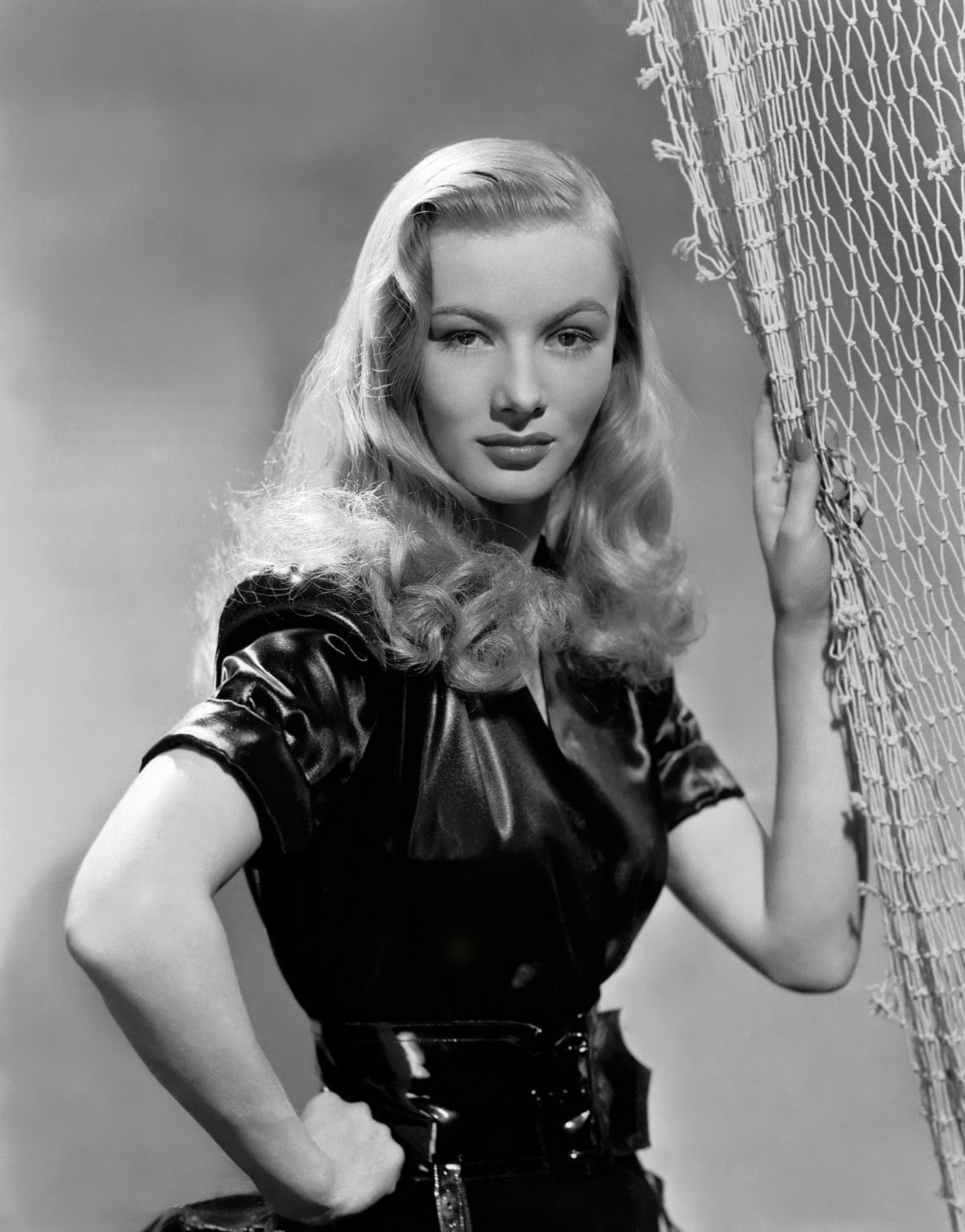
Our December Lady, Veronica Lake (left), was not well acquainted with Katharine Hepburn in 1943. Certainly, they had at some point or other crossed paths at parties or Hollywood events, but they weren't good friends. One couldn't even refer to them as acquaintances. For this reason, Kate was the last person that Ronni would expect to show up during a time of emergency. Yet, when Veronica was in the hospital after losing her second child (William Anthony Detlie, born prematurely and thereafter succumbing to uremic poisoning), she would wake up to discover Kate sitting next to her bed, complete in a mink coat. Surprised, Veronica's eyes bulged! Kate had just stopped by because she was in the hospital visiting her secretary and heard about Ronni's sad news. She offered her condolensces and offered to help in any way she could. Deeply touched, the proud Ronni said that she was fine but appreciated the sentiment. The two sat chatting briefly before Kate got up and left, but Veronica was markedly cheered after this random visit. For a stranger to go out of her way to wish her well meant a great deal to her during a sad and lonely moment in her life, especially since she was often ostracized and gossiped about by many in the industry. Kate's final words to her were, "Remember Veronica, the calla lilies will bloom again." Ronni never forgot it.

Ava Gardner (right) too had a run in with Kate, who would reveal herself as a Jack-of-all-trades. Kate was a good friend of George Cukor. Indeed, the pair would make numerous movies together due to their chemistry as actress and director as well as their connection and understanding as people. Kate was a constant visitor at George's home, attending his many soirees, where the gay director always enjoyed inviting his favorite leading ladies. Cukor later became equally enamored of Ava, the devastatingly beautiful and underrated actress, though he was sadly unable to make more than one movie with her-- Bhowani Junction. Nonetheless, their friendship was lifelong. After they made this film together, George invited Ava and her constant, tag-along sister "Bappie" to one of his get-togethers (in 1978). But on the way, the sisters got a flat tire. When George found out, passing them at the right time in his own car with Mia Farrow, he knew just what to do. He sent for Kate! Without fluttering an eyelid, Kate came down from the party, crouched to the ground-- all 69 years of her-- spun a wrench, switched in a spare, and sent her two grateful new friends on their way. Ava was surprised and delighted. Of all the people to show up... Imagine getting a flat and having Kate Hepburn pull up in a tow truck!!!

Several years prior, in 1940, Viven Leigh and Laurence Olivier had obtained divorces from their mutual spouses and were ready to finally make their scandalous love affair legitimate. Calling up friend Garson Kanin, Viv and Larry (pictured left in Fire over England) asked him to be the best man at their secret wedding. Garson, who was dead asleep when the duo called, quickly agreed, but then he remembered that he was to have a script conference with Kate later that day. Thus, he suggested that he bring her along as a bridesmaid. The two lovebirds heartily agreed, and since Kate was always game for anything, she too jumped out of bed after her call to duty, threw on some clothes, joined the wedding party, and served as the maid-of-honor to a bride she didn't even know! Everyone had a blast, and soon Viv and Larry were off on their honeymoon aboard Ronald Colman's yacht.

Kate would again come to Vivien's aid after the latter woman's bipolar disorder had severely impaired her life. Already divorced from Larry-boy, Viv was in the constant company of her lover Jack Merivale by 1965. During shooting on Ship of Fools (see right), she had an extreme mental attack brought on by the dark  nature of her role. After displaying very erratic behavior at a party thrown by Rosalind Russell,  Jack felt that Viv needed to be taken to the hospital for emergency ECT treatments immediately. But it wasn't that easy: in her current state of mind, dragging Viv to the doctor was no easy task, and it was also a challenge to get her there without the scathing paparazzi taking advantage of the situation. Jack wanted to get her there quietly, before anyone found out and could make a stink about it-- he didn't want his beloved humiliated. He therefore called George Cukor, who in turn called on Kate. 


Kate dropped what she was doing to rush to Viv's side, despite the fact that since the wedding the two had had little interaction. After finding a discrete doctor, she hopped in the back seat of Jack's car, and he drove the three of them to the hospital. All the while, Kate ducked down in back so as not to be recognized and used her light-hearted humor to calm the situation. She talked casually with Viv about normal things, distracting her from the current stress. By the time they reached the hospital, Viv was no longer unmanageable and seemed like her normal self again. She was quietly escorted inside and received the proper care. Viv's ECT treatments were always a stressful and painful thing to endure, for both Jack and Viv (together, left), but again Kate lent her support and was also there for future treatments required after this initial visit. Jack emphatically thanked his red-headed hero for her generosity, but to Kate, it was all in a day's work.

But of course, the most notable charity work Kate ever did was for her soul-mate Spencer Tracy. Her deep love for the complex and tormented actor caused her to sacrifice her life in martyrdom to his constant upkeep and welfare. The fact that such opposing forces of nature and unlikely lovers should ever come together is a mystery in itself. Somehow, the two did fall in love, and their off and onscreen affair lasted from their official meeting prior to Woman of the Year to Spencers's death in 1967. An affair it was, as Spencer had been married to the long-suffering Louise Treadwell since 1923. Katharine was not his first extra-marital dalliance, nor would she be his last, and the same demons that sent him continuosly seeking refuge in the bottle equally found him bounding from bed to bed. His relationship with Kate was somehow different, and his main attraction was probably compelled by his sense of her strength.


Spencer and Kate in their first collaboration,
Woman of the Year, the film on which they would 
fall in love.

Though Kate certainly found Spencer's marital status a bit unsavory, as certainly many others did, she was perhaps quelled a bit by the fact that he had been estranged from Louise for many years and that their marriage was one that existed in name only. Since she herself had already been wed and divorced from Ludlow Ogden Smith and had no further penchant for matrimony, and because she understood the importance for Louise to continue being Mrs. Spencer Tracy due to her charity work on behalf of her deaf son, John, Kate never pushed the issue, never asked Spencer to get a divorce, never asked for anything more than the simple partnership they had. Mostly, Kate sensed in Spencer a challenge, and God knows she loved a challenge. Despite herself, she fell in love and became entirely devoted to the Irish fireball, who with all his power, willfullness, and intensity was the first to ever really shake the imperturbable New Englander up.

For their entire relationship, Kate was a crutch and pillar of strength for the temperamental and unsteady Spence to lean upon. A source of comfort during his tormented, guilt-ridden moments and a force to be reckoned with when he needed sobering up, Kate served as a care-taker, mother, nursemaid, friend, and lover. When Spence would disappear for weeks or even months at at time, Kate would be there to nurse him back to health when he returned. The fact that she stuck by him through thick and thin, despite his overly selfish tendencies, amazed and awed him. For once, he had found a place to be safe; a place where he was accepted warts and all, and could be at peace. Kate's allegiance can most obviously be seen in the last picture that the two made together, Guess Who's Coming to Dinner. At this point, Spencer's unpredictable behavior and drinking habits endangered his casting in what would too be his last movie. Believing in his talent and his courage as a human being, Kate showed her faith in him by putting her own salary up as collateral to pay for his insurance. The studio accepted, and the duo delivered their most palpable and heartbreaking work together, and without incident.


Their last film together, 
Guess Who's Coming to Dinner.

Spencer would pass away on June 10, 1967 after 25 years as Kate's unlawful husband. He remained, to her own dying day on June 29, 2003, the love of her life. Kate's relationship with Spencer falls into place with the other events of her life, wherein she played the game her own way, unapologetically, and with great spunk and spirit. The motivations that pushed her along, despite occassional appearances, where never selfish. This was a woman who could do only what she saw in her eyes as right and just, even if it went against the grain of what others thought or believed. When a person is secure in oneself, she can extend her good fortune and warmth to others, and there are many who were blanketed by the safety of Kate's generosity. So, while it is her onscreen talent that has solidified her place in pop culture history, it is the great humanity and depth in her personal character that makes her truly admirable. These selfsame things fueled her unparalleled filmic characterizations-- full of passion, gravity, and chutzpah. She earned her nickname for a reason: Kate truly was "Great."


Kate always adhered faithfully to her family's motto:
 "Listen to the song of life."

HISTORY LESSON: "Kate the Great"